
AI assistants decide which B2B vendors get visibility long before web SERPs catch up. If you want default-citation status when your category breaks out, you need AEO for B2B SAAS mapped to entities. Treat pricing, security, integrations, and proof as citable data, not just pages. Early teams that ship this now get named by assistants while competitors wait for traffic curves to appear. See how AEO for startups operationalizes this at speed.
Lean growth teams publishing steadily whose posts stall beyond page one. You have Ahrefs or SEMrush open and need a Monday-ready workflow. This is for founders, PMMs, and SEO operators building B2B SAAS categories before peak demand.
You are likely a small team with a limited content budget. You already publish release notes, pricing FAQs, and security pages, but assistants do not cite them because they are not wired as entities with typed evidence.
If you sell integrations or operate in a trust-heavy category, your path is shorter. Assistants over-index on documentation, security attestations, and pricing math. That is your wedge into AEO for B2B SAAS.
Your runway funds content that AI skips. Getting cited early compounds awareness and shortens sales cycles. The next section shows how to wire your pages for citation.
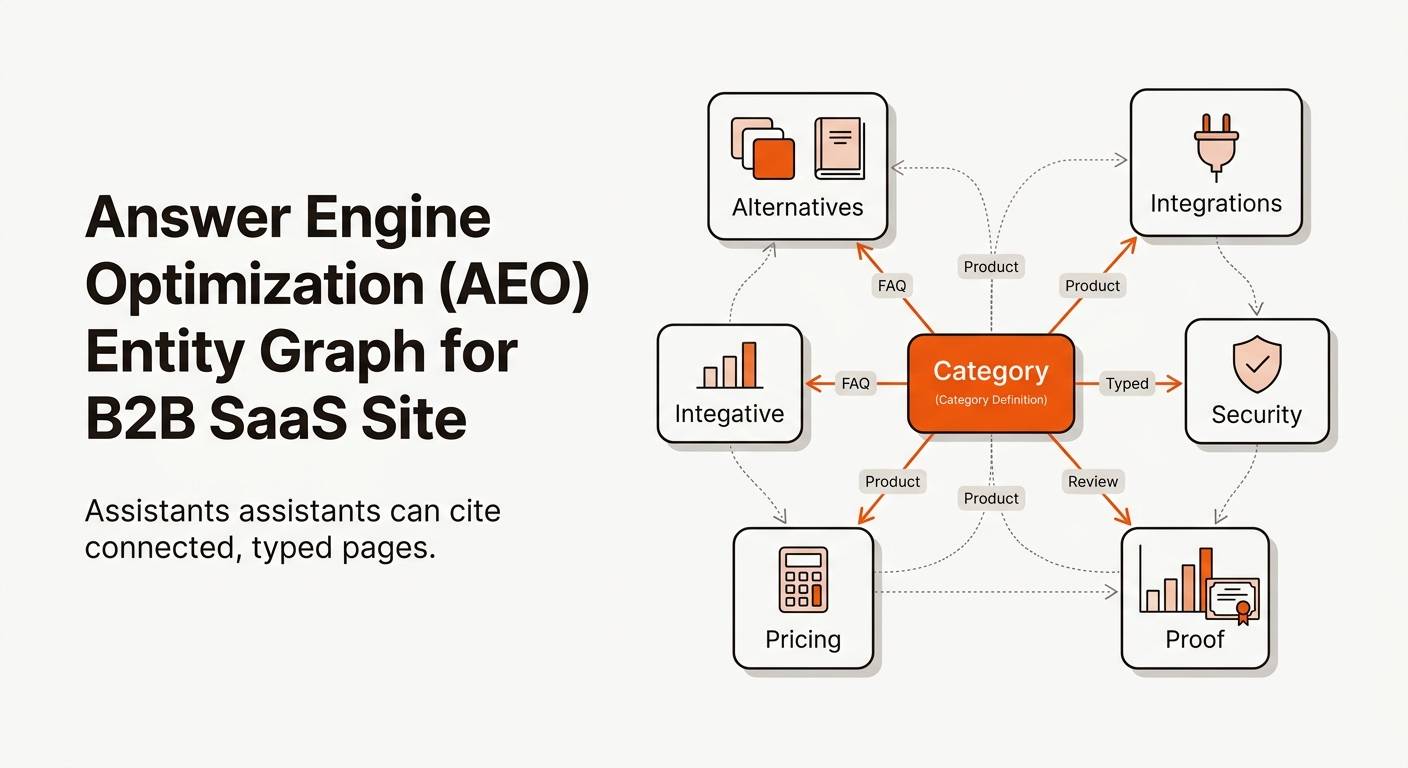
Map PMM pages to entities assistants can cite, then ship in one sprint. Build a connected graph: Category definition, Alternatives, Integrations (per partner), Security (SOC 2, ISO, DPIA), Pricing (plan math, unit costs), and Proof (case studies, benchmarks).
• Structure assets for consumption:
• Titles and H2s answer specific prompts (Who, What, Cost, Risk, Compare, Integrate).
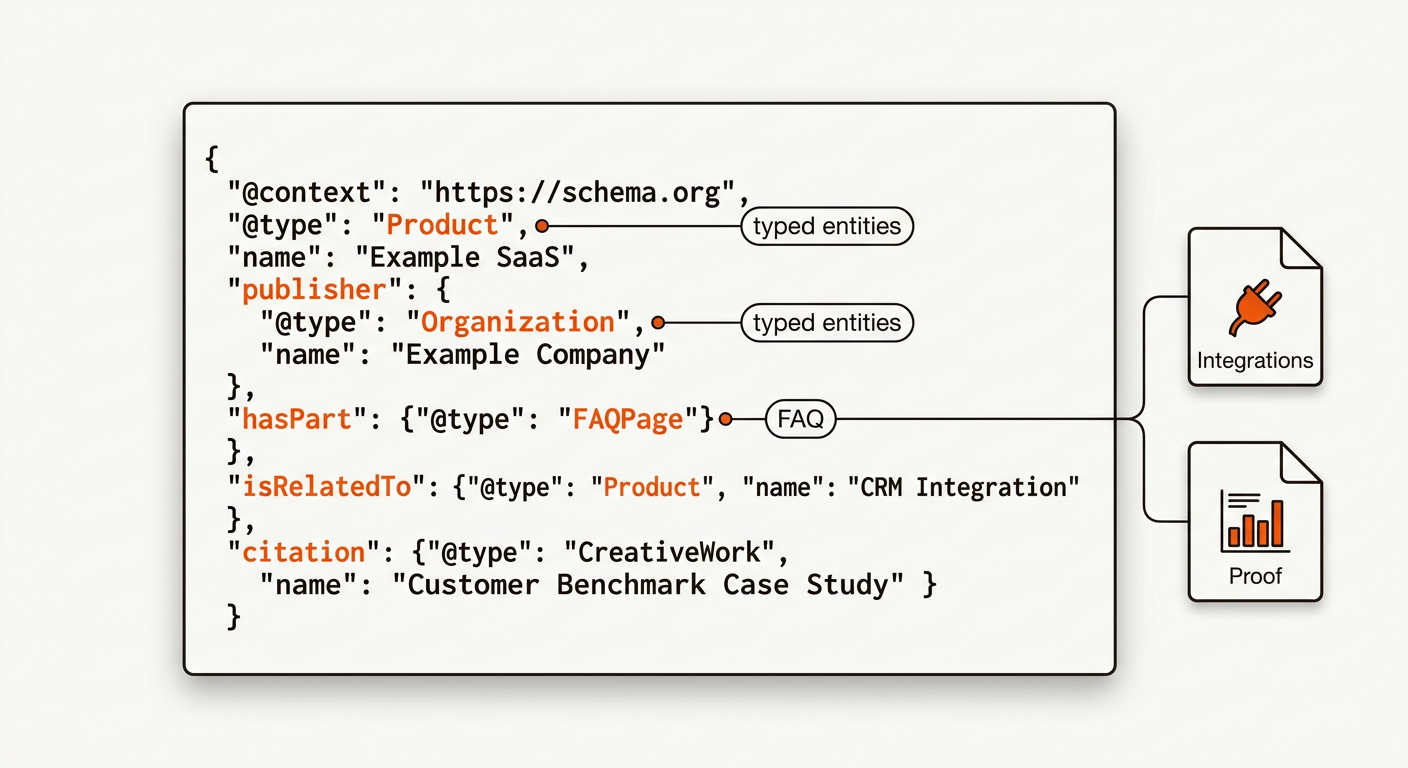
• Add JSON-LD (Organization, Product, FAQ, HowTo, Review) and link entities across pages.
• Publish integration stubs for every major partner, even if feature depth is v1.
• Harvest prompts from sales calls, RFPs, support, and competitor reviews.
• Convert answers into short, source-backed paragraphs with inline citations.
Use our answer engine optimization platform to manage entities, prompts, and schema from one place. If you are also tackling AI Overviews, see how we think about AI search visibility as part of the same pipeline.
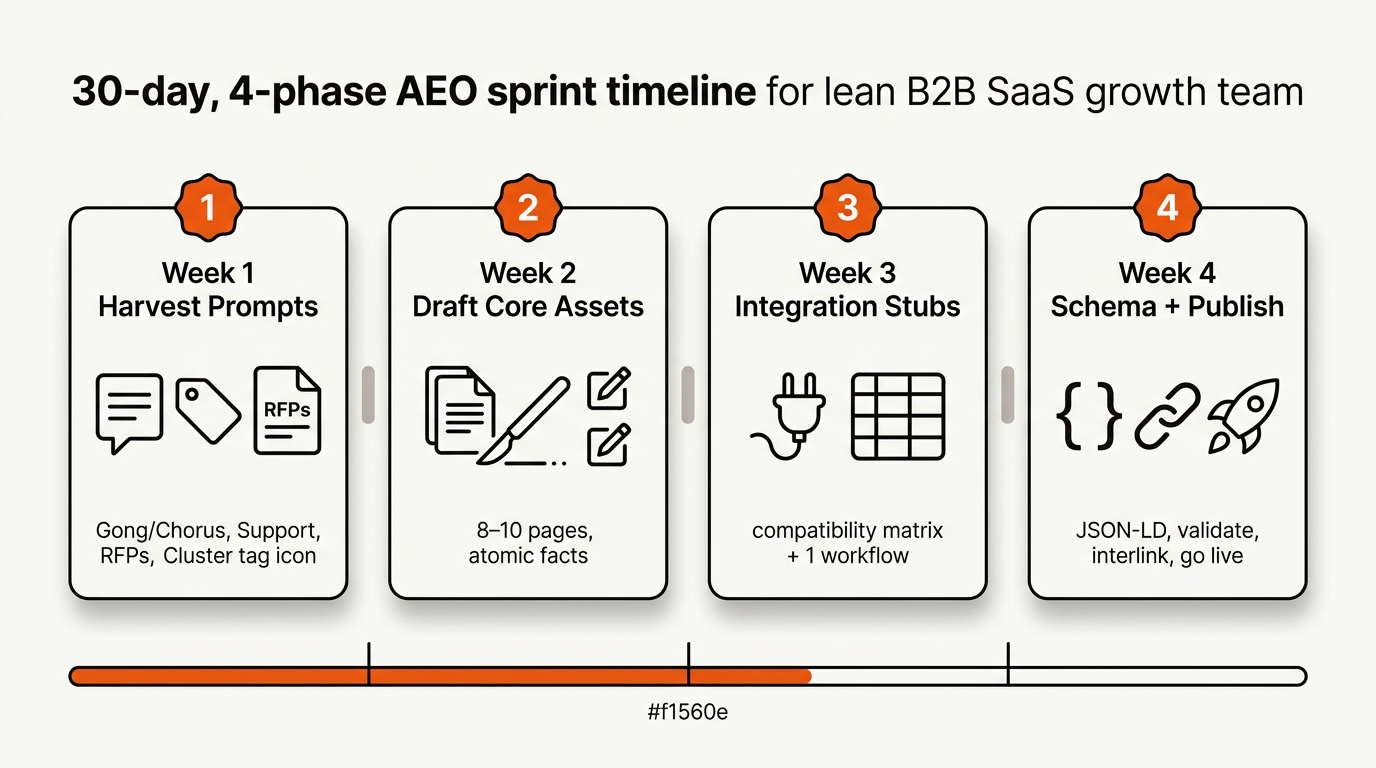
A practical sprint plan looks like this. Week 1: extract the questions buyers ask from Gong or Chorus calls, support tickets, and RFPs; cluster by intent with ChatGPT tags; map each prompt to a target page. Week 2: draft or refactor your core assets; cut fluff and add atomic facts, numbers, and process steps. Week 3: ship integration stubs with compatibility matrices and one worked workflow each. Week 4: layer JSON-LD, run schema validation, interlink entities, and push live.
Each asset holds one entity and one job. Do not bury pricing math inside a generic pricing page. Give the unit economics its own FAQ with timestamped examples. Do not bury sub-processors three clicks deep in a PDF. Put them on a web page with Organization and WebPage schema, linked from Security.
Most AEO explainers stop at definitions and ignore PMM system design. Articles like Search Engine Journal’s overview (https://www.searchenginejournal.com/answer-engine-optimization) and Ahrefs’ AI Overviews guide (https://ahrefs.com/blog/ai-overview/) focus on web SERPs or general tips. BrightEdge’s GEO materials emphasize enterprise content ops but not startup-speed entity graphs. Our angle: wire category, alternatives, integrations, security, pricing, and proof into a machine-readable graph designed to be cited by assistants.
Competitors stay at the summary layer. You win by turning PMM pages into data that assistants can parse, rank, and cite. That change happens in schema and evidence.
PEAK-CITE is a workflow to earn early citations before demand peaks. PEAK sets what to publish: Problem framing, Economics (pricing math), Alternatives, Knowledge (docs and security). CITE sets how machines consume it: Canonical entities, Interlinks, Typed schema, Evidence with sources. You apply PEAK to plan the assets and CITE to structure them for retrieval. Tradeoffs include fewer broad blogs and more ops on schema and documentation. Failure modes include thin integration stubs, missing security attestations, or unlinked entities that LLMs cannot resolve.
Here is how to run PEAK-CITE inside a small team. The PMM owns PEAK: problem definition, pricing logic, alternatives framing, and documentation scope. The SEO operator owns CITE: consistent entity naming, interlink patterns, schema typing, and evidence sourcing. Engineering or security reviews support with attestations and data flow diagrams. One owner per letter, one DRI across the sprint.
Two rules keep it fast. First, every asset must answer a discrete assistant prompt near the top of the page. Second, every claim must hold a source with a date, a number, or a named integration. That is the difference between being quotable and being ignored.
Here is how to scope an AEO pack.
• Scope: a category explainer, an alternatives page, integration stubs, security docs, pricing FAQs and case studies.
• Effort: estimate hours per page type from the last few pages you shipped, then add the schema work.
• Prompts: choose the high-intent buyer prompts you will track.
• Measure: after publishing, count how many tracked prompts cite you, and how many of those link to your pricing or security pages.
Measurement setup:
• Log source counts per prompt weekly across Perplexity, Claude, and Google AI Overviews.
• Track entity coverage completeness and schema validation errors with Schema.org validators.
• Compare pre and post assistant referrals in analytics and GSC. It is indirect, but directional uplift across pricing and security URLs is a strong signal.
A small startup scenario puts this into focus. Picture a small B2B SAAS team with one part-time writer planning the pack over a month. The SEO operator handles schema once and templatizes it. The PMM drafts short pricing and security FAQs with exact numbers, caps, and timestamped policies. Integration stubs reuse a compatibility matrix and one API step list per partner.
The operational tradeoff is speed versus depth. In our view, integration stubs with real compatibility matrices matter more early on than polishing two case studies, because each one adds checkable facts an assistant can cite. You can deepen the stubs over time, but you cannot be cited if the page does not exist.
Your PMM assets become machine-citable when you convert them into typed, linked units. Map each asset to the assistant job, then give it a schema and an evidence pattern that answers prompts cleanly.
Two clarifications matter for rankings and citations. First, state prices with clear units, such as a price per seat and a price per event, so a reader or a model can compute totals.
Assistants cite typed facts connected to canonical entities and supported by evidence. Treat each PMM asset as a node with a stable ID, a schema type, and links to sibling nodes.
Name entities consistently. If your product is a sub-module of a suite, pick a canonical string and repeat it across Product, FAQ, and HowTo schema. Link your Organization to Product and back. Link integrations in both directions: your Product to Partner Product, and Partner to your Integration page.
For schema, keep it practical. Add FAQ to alternatives pages with one Q for each competitor brand you compare. Add HowTo to integration pages with three to five concrete steps. Add Review or Article to case studies with measurable before and after metrics. Validate with Schema.org and Google’s Rich Results Test, then monitor for errors as templates evolve.
Prompts drive structure. Pull questions from sales calls, RFPs and support tickets. Tag them by Who, What, Cost, Risk, Compare, Integrate. The tag becomes the H2. The H2 becomes the question in FAQ schema. Each answer carries one cited source: your doc, a partner doc, or a standard like ISO 27001. This is how AEO for B2B SAAS moves from content theory to repeatable structure.
Integration stubs win early when they deliver one workflow, one matrix, and one link to proof. You do not need a long integration page. You need three things the model can extract and trust.
AEO for B2B SAAS covers the structural work of the article above: the page inventory, the workflow that keeps it shipping, and the measurement loop that confirms it's working. The sections preceding this FAQ describe each part in detail.
There is no fixed timeline. Google does not promise when, or whether, a page will rank. Watch Search Console impressions for the questions the page targets each week, because impressions move before clicks. A page with no impressions after a few months usually needs a sharper angle or more internal links.
Cost depends on who does the work: your own team's time, a freelancer, an agency or a software tool. Mergeflo has a free plan, and paid plans are listed on the pricing page.
Mergeflo researches topics, writes briefs and drafts in your brand voice, adds FAQ schema and suggests internal links. You choose the topics and approve each article, and it publishes to Webflow only when you press Publish. For pages losing reach, Mergeflo flags them, and when you press Refresh it writes a refresh brief for you to review.
