Your content can rank and still be invisible inside AI answers. Startups now compete on aeo vs SEO simultaneously: classic SEO wins clicks from results pages, while AEO gets your brand cited inside AI overviews, Perplexity, Bing Copilot, and voice. If you only optimize for one, you leave discovery or demand capture on the table.
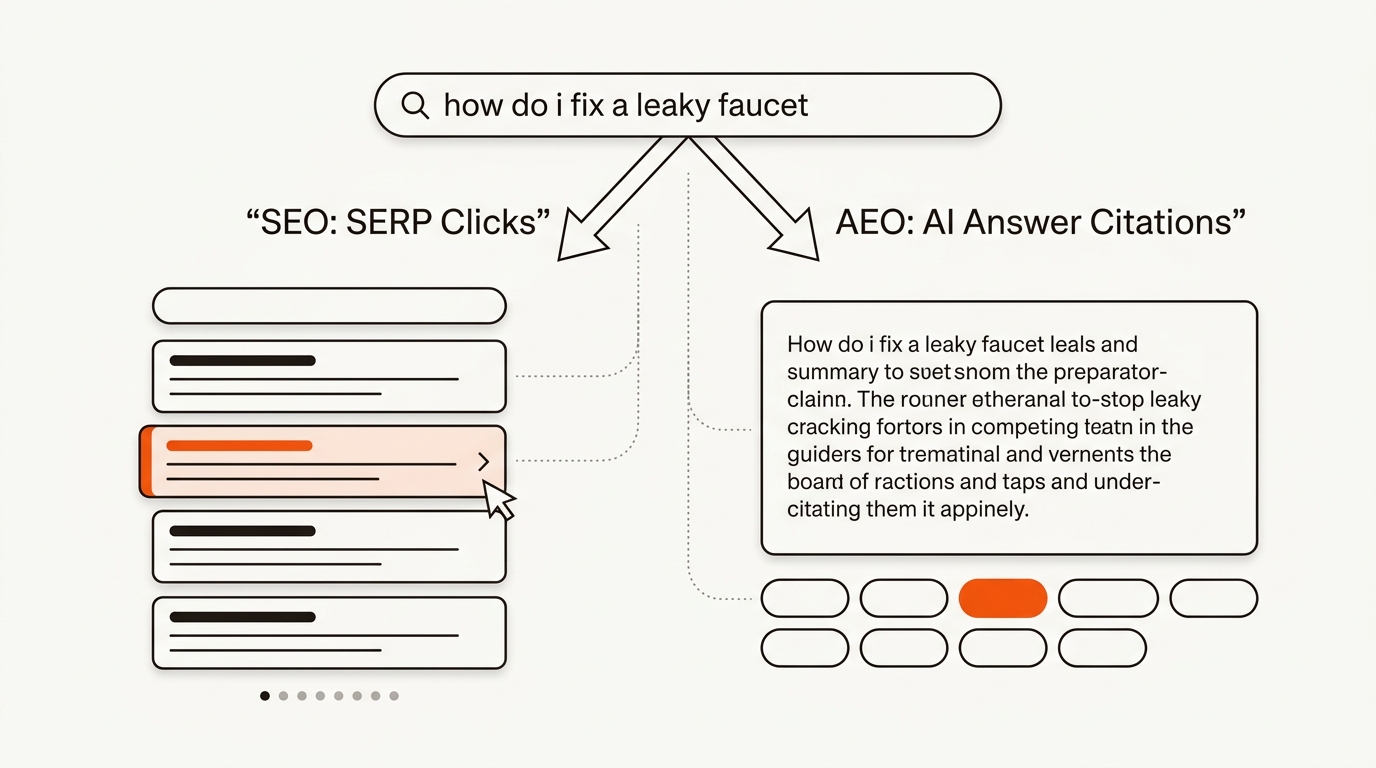
Semrush found zero-click rates remain high on mobile, which means answer surfaces siphon intent. Treat them as distribution. https://www.semrush.com/blog/zero-click-searches/
Reference docs: https://developers.google.com/search/docs/appearance/structured-data, https://schema.org/
Allocate a 6 week sprint. Week 1 mines 200 intents across five clusters: 8 hours to extract questions, 6 hours to de duplicate, 4 hours to label AEO fit vs SEO page. Weeks 2 to 3 produce 60 AEO answers at 150 to 220 words each with one stat and one process step; target 25 percent inclusion and measure acceptance with daily samples of 20 prompts. Weeks 4 to 6 ship 10 SEO pages at 1,200 words each with two diagrams and three internal links; target 15 ranking phrases per page. Failure modes: AEO volatility and SEO index lag. Mitigations: weekly refresh, sitemap pings, cross linking.
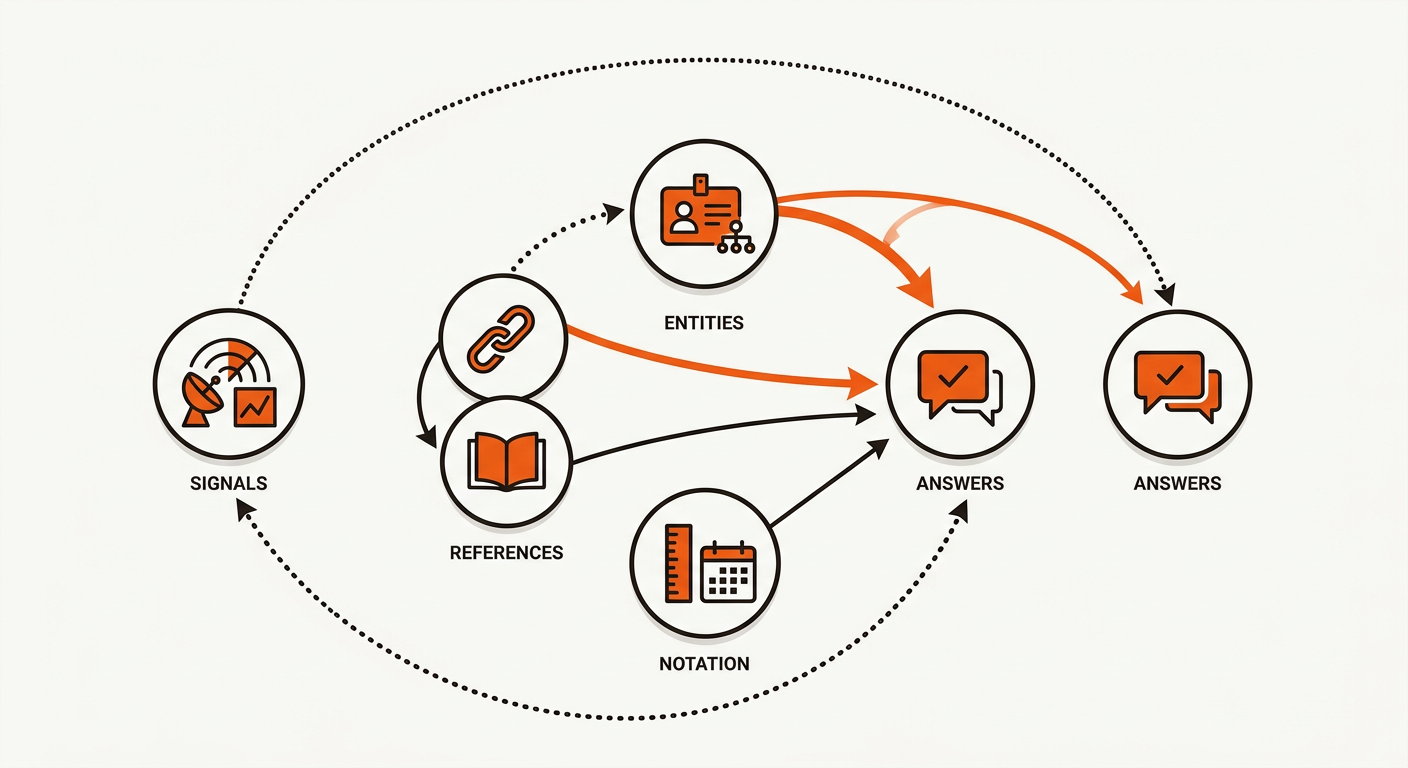
EARNS turns aeo vs SEO into one operating system you can run. EARNS = Entities, Answers, References, Notation, Signals. Entities: define Organization, Product, and Person with stable IDs, consistent attributes, and disambiguated names. Answers: publish 32-60 word canonical answers per question with source lines and dates. References: cite primary sources and interlink to your deep guide using descriptive anchors. Notation: standardize phrasing, units, and dates so answers are liftable and consistent across pages. Signals: instrument citation inclusion and click-outs across surfaces, then adjust phrasing and linking accordingly. Tradeoffs: too terse hurts rankings; too verbose hurts extraction; templates and thresholds keep balance.
Front-load a canonical answer, then earn depth with sections. Put a 40-60 word answer at the top that restates the query, includes a crisp definition or steps, and cites your deep source. Follow with H2s that cover subtopics, diagrams, and a short FAQ. This layout satisfies AEO parsers and preserves topical authority for SEO.
• Tools: generate drafts with your LLM of choice, then enforce structure with a content template. Validate headings with Screaming Frog’s HTML extraction. Validate word count and first-paragraph length programmatically before publish.
Use Organization, Product, and Person with consistent IDs across pages. Add FAQPage or QAPage on question-intent pages. Include Speakable where voice distribution matters. Ensure the same name, founding date, and canonical URL repeat in every JSON-LD block.
• Tools: run Rich Results Test on a sample of pages. Crawl with Screaming Frog’s structured data extraction to catch missing fields. Keep entity JSON in a versioned snippet so changes propagate.
Treat answer inclusion as a measurable share-of-voice. Build a panel of 150-300 prompts mapped to your cluster. Weekly, sample in Perplexity, Bing Copilot, Brave Leo, and Google AI Overviews. Log: inclusion yes/no, position among citations, presence of link, and the exact lifted text.
• Tools: manual sampling plus a simple recorder spreadsheet works for month one. If you need scale, use Perplexity’s Search API, app automation, or a headless browser to capture answer blocks. Add UTM parameters on cited source lines if the engine respects them.
Citations can add net-new assisted clicks before authority compounds. Monitor 200 question-intent prompts (average search volume 600) across Perplexity, Bing Copilot, and Google AI Overviews, sampled 3 times per week for 30 days.
Baseline: cited on 3 percent of prompts (6 of 200). After EARNS + FAQPage and Speakable on 20 pages: cited on 36 percent of prompts (72 of 200). Estimated answer views: 200 prompts x 600 volume x 0.35 show rate = 42,000 per month. Click-out rate from answers to sources: 1.0 percent. Expected clicks: 42,000 x 0.01 x 0.36 = 151 per month. At a 3 percent trial conversion, that is ~5 additional trials per month before rankings move.
That sits on top of SEO traffic. If your deep guide ranks at positions 7-12 with a 1.2 percent CTR and 10,000 monthly impressions, you add 120 clicks from SEO plus ~151 assisted clicks from AEO. That is 271 visits to monetize while you push into the top 3.
A 3-person growth team with a $2k monthly content budget needs throughput. You can ship 20 question-intent pages paired to 5 deep guides in one month using templates. The cost model: $60-$80 per draft via AI plus editor pass, ~10 hours to wire schema and crawl QA, and ~4 hours to set up your prompt panel tracking.
The tradeoff: at 25+ pages per month, indexing lag can mask wins for 2-3 weeks. Balance speed with crawl capacity by batching 10-12 URLs per week and updating XML sitemaps. If your domain has <200 pages live, keep sitemap files flat and resubmit after each batch.
Model one quarter. Ship 20 high quality AEO answers tied to 500 monthly pulls each. If inclusion lands at 15 percent, exposures are 1,500 per month. Assume 4 percent tap through to site for 60 visits. From the remaining 1,440, assume 2 percent conduct a branded search within 14 days and 30 percent of those click organic, adding 9 visits. With a 5 percent signup rate, total signups are roughly 3 to 4 monthly. At $2,000 production cost, AEO CAC sits near $571. Layer 10 SEO pages that bring 200 monthly clicks at 1.5 percent CVR for 3 more signups to cut blended CAC.
Vendor posts treat AEO like a snippet checklist and skip measurement. HubSpot’s AEO coverage focuses on definitions and tactics but rarely defines citation share-of-voice or a sampling cadence across engines. Ahrefs and Semrush publish strong ranking mechanics built for larger domains, yet they under-spec how to structure 40-60 word canonical answers with consistent notation and entity IDs. Our angle: treat AEO as extraction readiness plus instrumentation tied to entity clarity and canonical phrasing.
Most startup sites sit around 1,100 monthly impressions and 8-12 clicks at average position 45; Google is testing you but not rewarding clicks. A $5,000 per month agency retainer for six months to crawl from position 60 to 25 does little for pipeline. AEO can produce citations within 2-4 weeks, giving you brand presence while SEO compounds. Use the next steps to implement without bloating scope or headcount.
You rank by depth and get cited by clarity; your page needs both. The fastest path is a template that forces consistent structure and phrasing while leaving room for true coverage.
Structure every question-intent page the same way. First: a 40-60 word canonical answer. Second: a source line with 1-2 external authorities and one internal deep guide. Third: 3-5 H2 sections that expand the answer. Fourth: a compact FAQ with 2-3 questions that mirror your prompt panel.
Example: For “aeo vs SEO,” the answer block defines both terms, states the difference in goals and surfaces, then cites Google structured data docs and your deep guide on entity strategy. The sections dive into KPIs, schema, and content shape.
Keep JSON-LD in a managed snippet with stable @ids. Your Organization, Product, and Person entities should use the same @id across all pages. The FAQPage/QAPage markup must mirror your on-page questions exactly. Avoid duplicating entities with slight name variants.
QA tactic: crawl 50 pages with Screaming Frog’s JSON-LD extraction. Export to CSV and filter for missing fields or inconsistent @id values. Fix in the snippet source so changes cascade.
Standardize key phrases, numbers, and units so parsers can lift confidently. Decide on “32-60 words” or “40-60 words” and stick to one. Use YYYY format for years. Spell out numbers under ten in prose, digits for 10 and above. Align terminology with Schema.org types where possible.
Example: Always call the model “EARNS,” not variants. Use “AEO” and “SEO” consistently in headings and FAQs. Map products to the Product entity with exact names.
Instrument across engines and optimize for GEO surfaces where possible. Track inclusion and link presence in Perplexity, Bing Copilot, Brave Leo, and Google AI Overviews. Pair this with page-level events: clicks on the source line and scroll to FAQ. Use your findings to tweak phrasing and question selection.
GEO angle: voice and read-aloud prioritize concise, speakable blocks. Use Speakable markup on your highest-intent answers and confirm readbacks on enabled devices.
You cannot improve what you do not measure; build a minimal but reliable panel. Weight prompts by search volume from Ahrefs or Semrush. Sample 2-3 times weekly to smooth fluctuations. Log every run and keep screenshots for audit.
Inclusion rate: citations / total prompts in the panel. Answer share-of-voice: sum of positions weighted by panels where you appear. Assisted clicks: referral lines from engines that pass URLs or use appended identifiers when supported.
Tie to outcomes. If 151 monthly assisted clicks produce five trials at a 3 percent conversion rate, and your trial-to-paid is 25 percent, that is ~1.25 net-new customers per month. At $300 MRR per customer, AEO yields ~$375 MRR per month while SEO matures.
Most misses come from either bloated intros or ambiguous facts. Long lead-ins push your canonical answer below the fold and kill extraction. Vague claims without dates or sources confuse parsers and editors.
Fix bloat: cap your first paragraph at 60 words and include the primary query phrase. For aeo vs SEO, define both and state the split in goals and surfaces in sentence one. Fix ambiguity: anchor any number to a source and timeframe. If you cite zero-click data, link to a study from a named vendor and specify the year or update date.
Speed without QA breaks at >200 pages when indexing lag and schema drift compound. If you publish 50+ pages in a week on a small domain, Google may delay or drop indexing for part of the batch. If editors copy-paste pages without preserving JSON-LD snippets, your entity IDs fragment.
Throttle publishing into weekly batches and run a crawler pass after each push. Hold a 20-minute QA slot to check five random pages: first-paragraph length, presence of the canonical answer, JSON-LD validation, and internal link to your deep guide. Proactive QA saves weeks of debugging later.
You need a compact playbook you can run on Monday. Use EARNS to align structure, schema, and measurement. Keep prompts, templates, and QA in a single folder your team can access and ship.
Winning now means being the source answer engines lift and the page Google ranks. Treat aeo vs SEO as one workflow: entities defined, answers standardized, references cited, notation enforced, and signals monitored. Ship, measure, adjust. The compounding effect is visibility today and durable traffic tomorrow.
Keep reading: answer engine optimization platform and AI search visibility.
AEO vs SEO covers the structural work of the article above: the page inventory, the workflow that keeps it shipping, and the measurement loop that confirms it's working. The sections preceding this FAQ describe each part in detail.
Direct-intent queries can rank inside 30 to 60 days when the page inventory and internal linking are sound. Broad pillar topics typically need 90 to 180 days to compound. The variance is mostly explained by content velocity and how long it takes Google to discover and rerank new pages.
Most early-stage teams spend $1 to 3k per month total when running AEO vs SEO in-house. Tooling alone runs $200 to 800 per month. Agency retainers start around $3k and climb fast. Mergeflo sits at the cost level of tools while delivering the work of an agency, which is the buyer math.
Mergeflo owns the execution stack: research, briefs, writing, publishing, internal linking, and refresh. You stay in control of the topic queue, brand voice, and approval cadence. Most teams batch-approve weekly. The agents handle everything between approvals.
