
Short answer: startups need both because AI Overview tracking shows whether Google cites you inside its AI summary, while rank tracking shows your classic blue-link position. AI Overviews can push organic results down the page even when your rank holds, so watching only one metric hides where your visibility is actually moving.
Two visibility systems now decide your traffic: classic ranks and AI answer citations.
If you only track positions, you miss when AI Overviews siphon clicks to cited sources. This is the core of AI overview tracking vs rank tracking: positions show where you stand; AI Overview tracking shows whether you exist in the answer and how users exit to you. Standups should include both streams and the delta between them. Start by tightening your AI Overview optimization workflow to surface as a cited source.
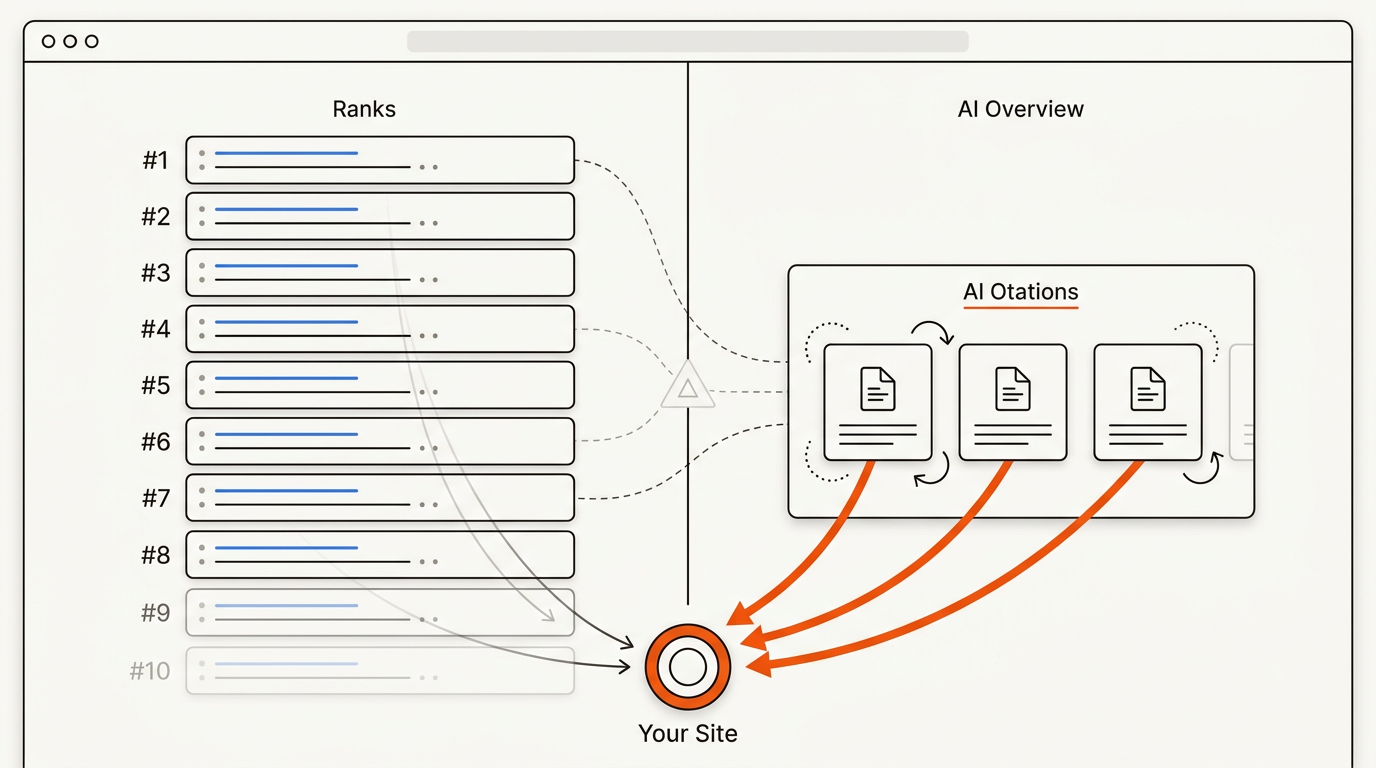
The tools in this table are not the only way to check. See Search Console's Generative AI performance report and other ways to check AI Overview citations.
AIO-specific tracking also exposes GEO opportunities that rank tools ignore. Snippet structure, claim backing, and freshness often gate inclusion. If your content lacks structured evidence (citations, lists, stats) or shows stale timestamps vs. cited sources, you’ll rank but never appear in the answer box that absorbs intent.
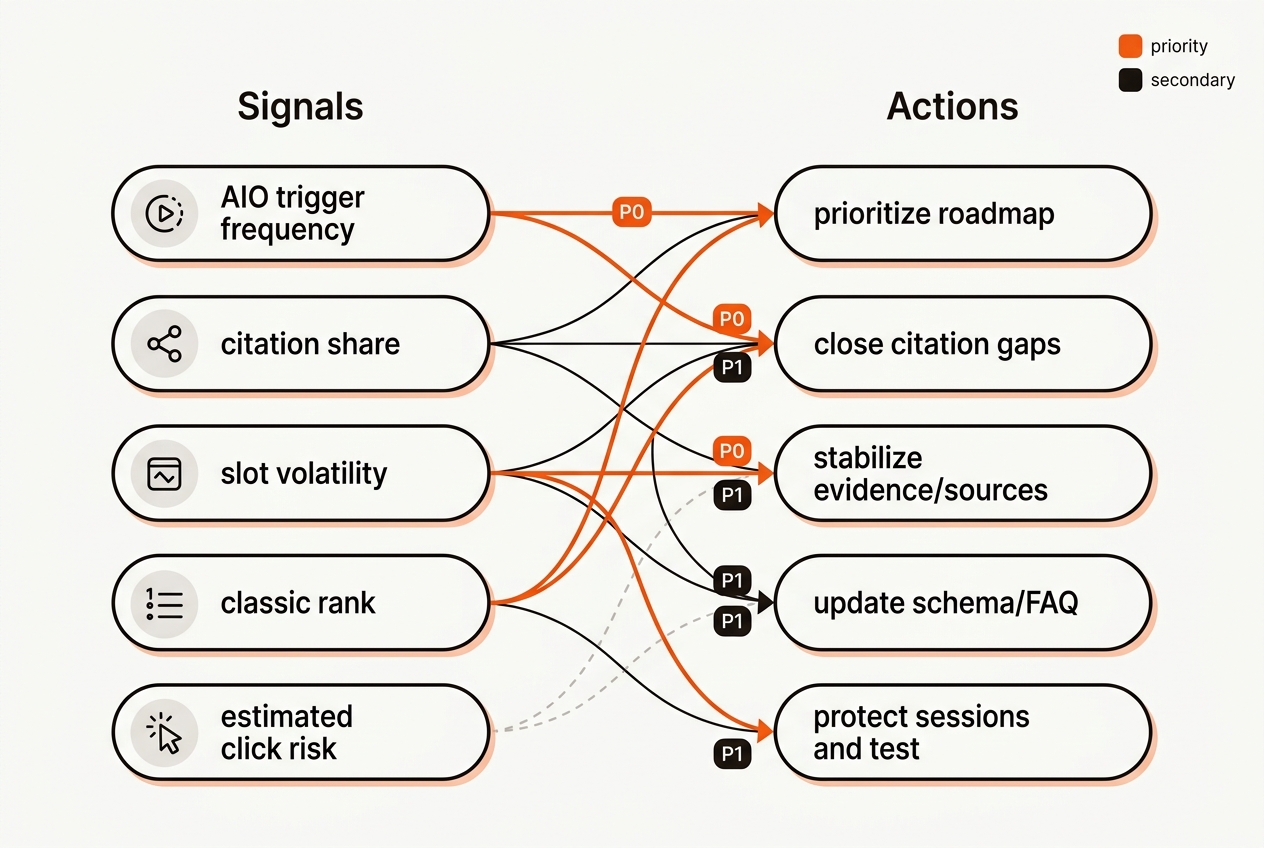
200 pages if you rely on manual checks. Indexing lag plus slot volatility creates false negatives. Either automate snapshots and slot diffs or shrink the active set. Speed vs. depth also matters: publishing 25 thin posts that never earn citations loses to shipping 10 that secure one dependable slot and path each.
Route backlog items via AI Overview and visibility tracking so tasks align to measured gaps and not gut feel.
A blended visibility roll-up shows where sessions leak.
Suppose you track 600 queries for 30 days and AIO renders on 252 queries (42%). Average monthly search volume per query is 500. Your site is cited on 58 of those queries (23% inclusion) at an average slot of 2.3. Average rank across the 252 queries is position 11.7.
• Baseline without AIO: assume positions 8-12 average 3.1% CTR. Expected clicks = 252 × 500 × 0.031 = 3,906.
• With AIO present, assume blue-link CTR drops to 2.2%. Blue-link clicks = 252 × 500 × 0.022 = 2,772 (loss of 1,134 vs baseline).
• With AIO citations: assume AIO renders on 70% of searches for the 58 cited queries, and slot 2.3 yields 1.6% “Visit site” referrals. AIO clicks = 58 × 500 × 0.70 × 0.016 = 325.
Net with AIO tracking and current inclusion: 2,772 + 325 = 3,097 vs 3,906 baseline. You’re still down 809 clicks because citation share is low and the slot is mid-pack. If you raise inclusion to 120 queries (20% of the full set) and improve to slot 1.7 with a 2.8% referral rate, AIO clicks = 120 × 500 × 0.70 × 0.028 = 1,176. Net = 2,772 + 1,176 = 3,948, clearing the baseline. The math forces focus: increase inclusion and climb average slot, or expect a structural CTR drag.
AI overview tracking vs rank tracking covers the structural work of the article above: the page inventory, the workflow that keeps it shipping, and the measurement loop that confirms it's working. The sections preceding this FAQ describe each part in detail.
There is no fixed timeline. Google does not promise when, or whether, a page will rank. Watch Search Console impressions for the questions the page targets each week, because impressions move before clicks. A page with no impressions after a few months usually needs a sharper angle or more internal links.
Cost depends on who does the work: your own team's time, a freelancer, an agency or a software tool. Mergeflo has a free plan, and paid plans are listed on the pricing page.
Mergeflo researches topics, writes briefs and drafts in your brand voice, adds FAQ schema and suggests internal links. You choose the topics and approve each article, and it publishes to Webflow only when you press Publish. For pages losing reach, Mergeflo flags them, and when you press Refresh it writes a refresh brief for you to review.
