
Short answer: You can ask ChatGPT to cite its sources, but the base model does not track provenance and will often invent references. Enable browsing or provide URLs/files so it can quote and link to real pages. Treat every citation as a lead and verify through Google or the original publisher before you publish.
LLMs predict tokens; they do not store or expose source provenance. That is why asking can you ask ChatGPT to cite its sources often returns confident links that do not exist or do not support the claim. You need retrieval or supplied context to get reliable attributions.
"DO NOT ask ChatGPT for a list of sources on a particular topic!", Duke University Libraries
Base ChatGPT is fine for outlines. For facts, move to workflows that include verifiable materials. Use browsing, attach URLs, or upload files. Then validate with Google, library databases, or the publisher page before content ships.
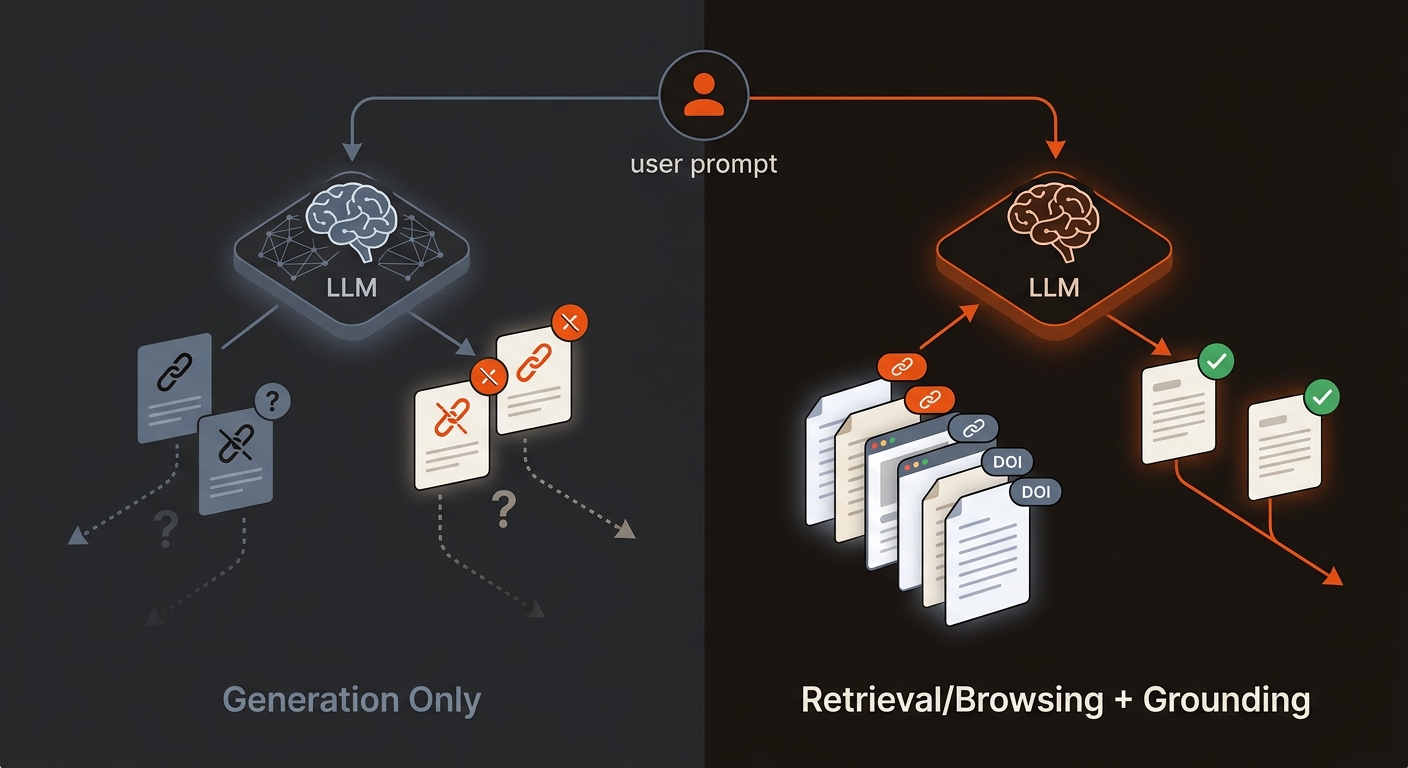
Ground the model in real documents or live pages; otherwise, you are fact-checking hallucinations. Retrieval and browsing give you links you can click. Everything else requires manual verification.
An illustrative example, not a real customer: a small growth team on a tight budget needs citable claims for a batch of posts by a deadline. Enabling browsing adds time per query and sometimes selects weak sources. Uploading PDFs or supplying URLs yields stronger quotes but takes setup time. Pick based on stakes and deadline.
Comparison of Source-Reliable Options for Citations
Strict prompting helps. Require a direct quote, a URL or DOI per claim, recency constraints, and permission to decline. See this practical prompt guidance from ZDNet. Then click every link. For compliance pages and pricing data, confirm on the primary source.
Operational tradeoff: browsing and RAG increase token use and time-to-draft, which reduces throughput. The gain is lower correction cost after publication and more trust from readers.

Use a constrained workflow that makes the model cite from pages you pick. Start with a quick scoped search, e.g., site:who.int OR site:ecdc.europa.eu, collect 3 to 7 candidate URLs, then prompt the model to answer only from those links or say not found. Ask for verbatim quotes of 40 to 120 words with section headers or timestamps, plus a one sentence synthesis per quote. Cap sources at five to reduce drift. After generation, click each link, confirm the quoted text matches, and cut any citation that is not a literal match.
AI answers cite pages that package answer, proof, and metadata cleanly. If you want AI Overviews, ChatGPT, and Perplexity to cite you, publish answer-first pages with quotes, outbound citations, and schema across your cluster.
Autonomous SEO + AEO content engine: it finds gaps, drafts articles with FAQ schema and suggested internal links, and publishes the ones you approve to Webflow. If you need a pattern, start with our take on AEO content structure for answer, proof, FAQ, citation and operationalize it across your cluster. That is how you turn can you ask ChatGPT to cite its sources into can ChatGPT cite your pages.
Turn raw citations into a page that others can trust by mapping claims to evidence. Create a simple claim table with columns for claim text, source URL, quote, and anchor. Target one to three sources per claim and a five source maximum per page. Store metadata fields author, publication date, access date, and an archive link. Replace paraphrases with short quotes and add footnotes inline. Snapshot each URL in the Wayback Machine and note the snapshot ID. Set a 30 to 90 day review cadence, prioritizing pages with time sensitive facts.
Prompts only work when the model can see real sources; anchor it or verify it.
Ask for a claim-by-claim quote with a URL per claim, recent date constraints, and permission to say "no source found." Example: "For each claim, include a direct quote and URL. Use sources from the last 24 months. If none, state 'no source.' Do not fabricate." Always open and read the linked pages.
Browsing reduces fabrications but does not eliminate them. The model can still misattribute or select weak sources. Treat links as leads. Validate with Google, library databases, or the original publisher. For high-stakes posts, run human search first, then have ChatGPT summarize your curated set.
Documenting tool use is fine, but do not treat ChatGPT as a factual source. Cite the underlying documents you verified. Many academic and newsroom guidelines advise against citing the model for facts because it lacks provenance and can hallucinate.
Clear answers, quotes, outbound citations, and schema can make a page easier for AI systems to reuse, but no one can guarantee a citation. Build answer-first pages across a topical cluster, then interlink them.
