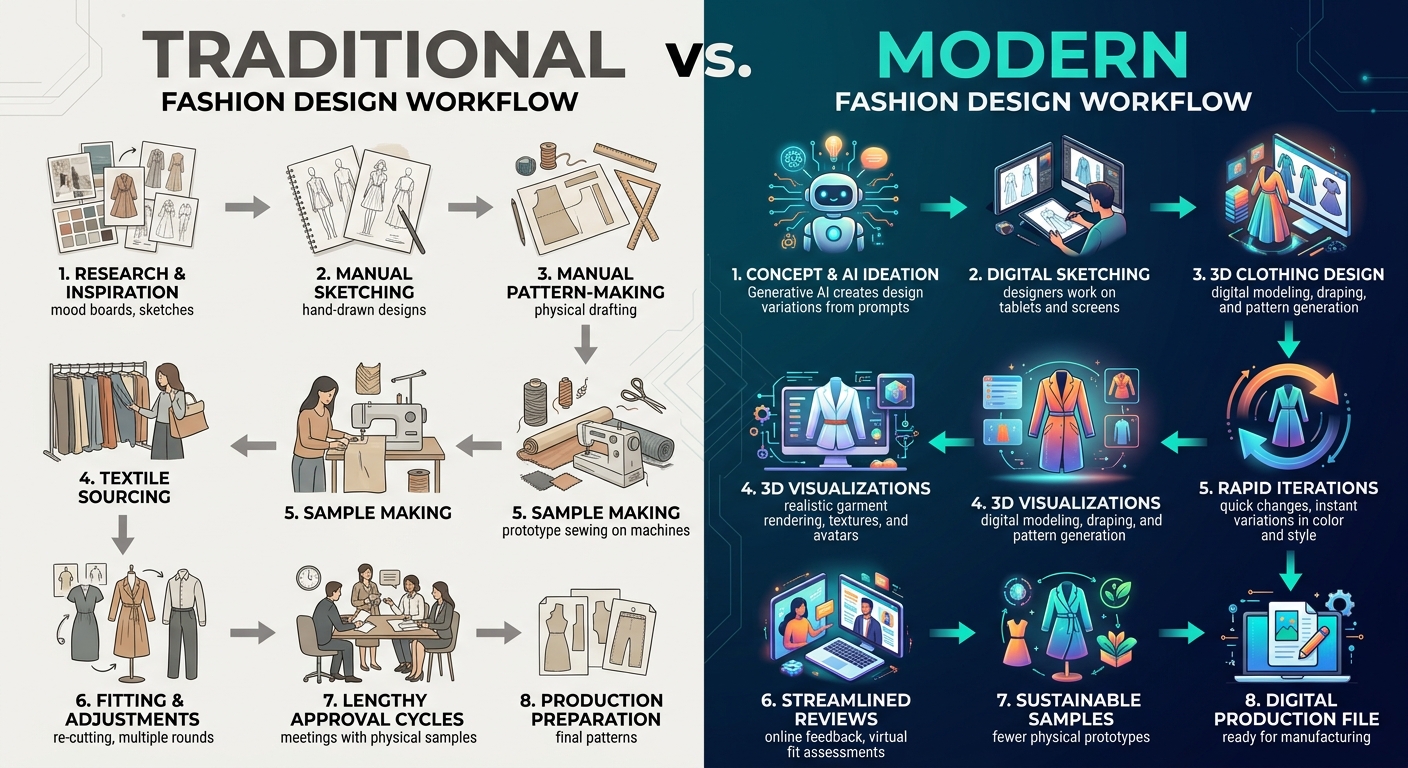
Fashion is experiencing a fundamental transformation. The industry that once relied exclusively on physical samples, manual pattern-making, and weeks-long approval cycles is now embracing digital-first workflows that compress timelines, reduce waste, and unlock unprecedented creative possibilities. This isn't simply about adding new software to existing processes—it's a complete reimagining of how fashion gets designed, validated, and brought to market.
Digital fashion design has evolved from experimental technology to production-critical infrastructure. Leading brands now use generative AI to explore hundreds of design variations in hours instead of weeks. They create photorealistic 3D visualizations that eliminate the need for multiple physical samples. They collaborate across continents in real-time, making decisions faster and with greater confidence. The result? Creative teams spend more time designing and less time managing logistics, while simultaneously reducing their environmental impact.
Three core technologies are driving this revolution: generative AI that can propose design directions based on trend data and brand DNA, 3D visualization tools that let designers see how garments fit and move before a single yard of fabric is cut, and digital sampling workflows that validate concepts without the waste and delay of physical prototypes. Together, these technologies offer fashion leaders what they've always wanted: the ability to explore more creative directions without expanding headcount, faster validation of concepts, and predictable launch timelines.
The benefits extend beyond operational efficiency. Digital fashion design enables sustainability at scale—fewer samples mean less fabric waste, reduced shipping emissions, and lower carbon footprints. It democratizes creativity by making sophisticated design tools accessible to smaller brands and independent designers. Most importantly, it returns time and mental energy to the creative process itself, allowing design leaders to focus on what they do best: creating beautiful, innovative fashion.
In this article, you'll discover how digital fashion design technologies work in practice, see real-world applications and results, understand the business case for adoption, and learn how to integrate these tools into your existing workflows. Whether you're leading design at an established brand or building something new, understanding these technologies is no longer optional—it's essential for remaining competitive in modern fashion.
Digital fashion design encompasses the creation, visualization, iteration, and validation of garments using digital tools rather than exclusively physical methods. At its core, it's about representing fashion concepts as data and pixels before—or sometimes instead of—fabric and thread. This includes everything from initial sketches created on tablets to fully-rendered 3D garments that show accurate drape, fit, and movement.
It's important to distinguish between two parallel developments in digital fashion. First, there's digital-only fashion: garments created exclusively for virtual environments, including metaverse fashion, NFT collections, and digital clothing for social media. Second, and more relevant for most brands, are digital tools used to design and validate physical garments that will ultimately be manufactured and sold in the real world. While these worlds sometimes overlap, this article focuses primarily on how digital tools transform the process of creating physical fashion.
The convergence of virtual and physical fashion represents the industry's future. Brands increasingly start with digital prototypes, validate designs virtually, generate marketing materials from 3D renders, and only then move to physical production. Some even release digital versions of collections before or alongside physical versions, testing market response and generating pre-orders before committing to full production runs. This hybrid approach combines the efficiency and flexibility of digital with the tactile reality of physical garments.
The financial argument for digital fashion design is compelling and measurable. Physical sampling traditionally accounts for a significant portion of pre-production costs—brands often create 5-10 samples per design, shipping them between design studios, manufacturers, and decision-makers. Each iteration adds weeks to the timeline and hundreds or thousands of dollars in material and logistics costs. Digital sampling can reduce these costs by 70-80%, while simultaneously compressing timelines from weeks to days.
Time-to-market acceleration delivers competitive advantages that extend far beyond cost savings. In fashion, timing is everything. A collection that reaches buyers two weeks earlier can secure better placement and terms. A trend-responsive design that goes from concept to production in four weeks instead of eight can capture market momentum that slower competitors miss. Digital workflows enable this speed by eliminating the physical bottlenecks that traditionally slowed decision-making. When design directors can review photorealistic 3D garments in real-time during video calls, approvals that once took days happen in minutes.
Enhanced collaboration represents another critical benefit, especially for brands with global operations. Traditional workflows required physical samples to travel between continents—design in New York, manufacturing in Vietnam, fit approval back in New York. Digital workflows enable simultaneous access to the same design files across all locations. Technical designers in one country can annotate 3D models that manufacturers in another country immediately see. This eliminates version control issues, reduces miscommunication, and ensures everyone works from the same source of truth.
Sustainability benefits have moved from "nice to have" to business imperative. Consumers increasingly demand environmental responsibility, and regulations are beginning to require it. Digital fashion design directly addresses fashion's waste problem. Fewer physical samples mean less fabric waste—and since sampling often uses virgin materials rather than recycled content, this waste is particularly impactful. Reduced shipping of samples lowers carbon emissions. Digital pattern optimization minimizes fabric waste during production. Brands that adopt digital workflows can quantify and communicate these environmental benefits, turning sustainability from a cost center into a competitive differentiator.
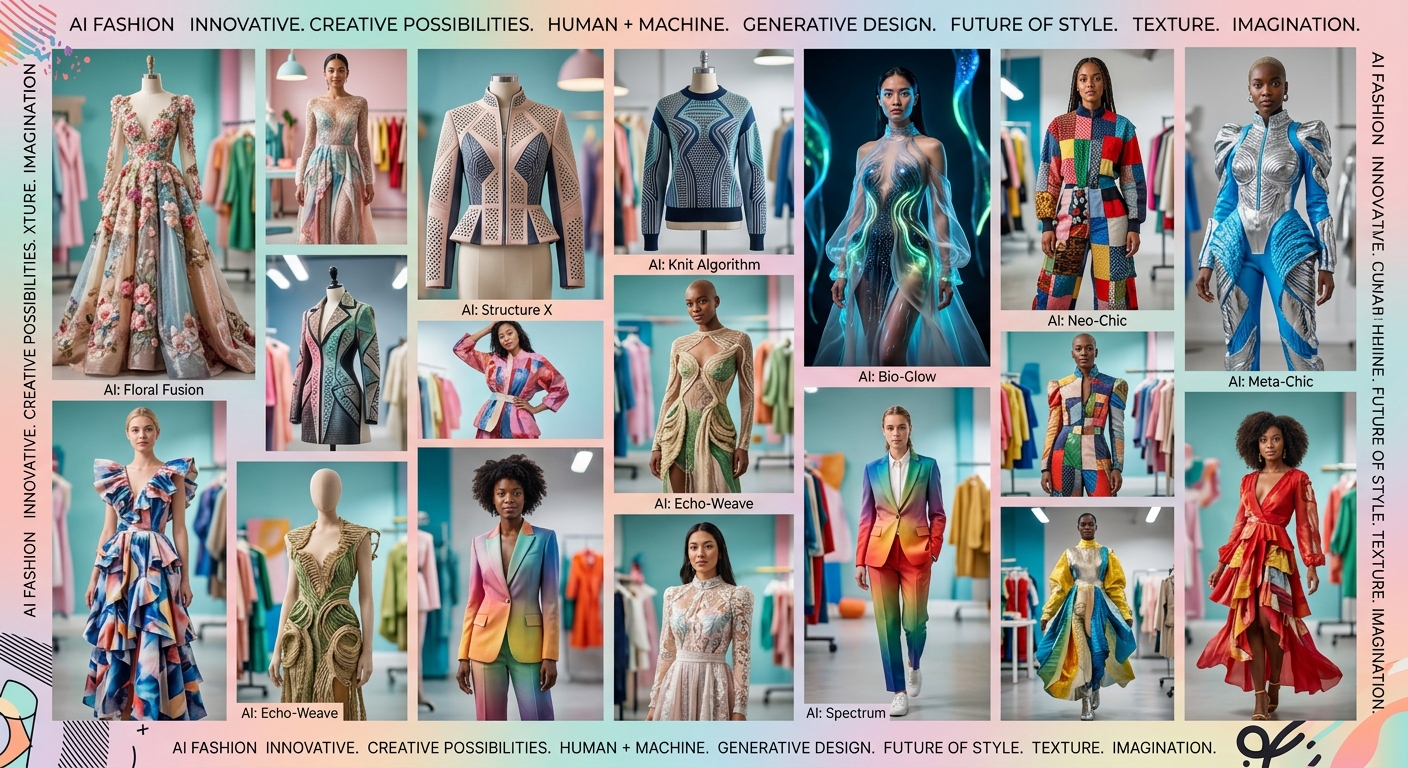
Generative AI has emerged as perhaps the most transformative technology in digital fashion design. Unlike traditional software that executes commands, generative AI creates novel outputs based on training data and prompts. In fashion, this means AI can generate original design concepts, propose variations on existing designs, optimize patterns for efficiency, and even predict which designs will resonate with specific consumer segments.
The impact on creative workflows is profound. According to Forbes, AI technologies like Genera are helping brands cut waste and accelerate design cycles by generating multiple design iterations instantly. Where a designer might traditionally sketch 10-15 variations of a concept over several days, AI can generate hundreds of variations in minutes. This doesn't replace human creativity—it amplifies it. Designers use AI-generated options as inspiration, selecting promising directions to refine, combining elements from different AI outputs, and applying their expertise to create final designs that AI alone couldn't conceive.
The key insight is that AI augments rather than replaces human creativity. AI excels at pattern recognition, variation generation, and optimization—tasks that are time-consuming but somewhat mechanical. Humans excel at cultural understanding, emotional resonance, brand consistency, and the ineffable quality that makes a design feel right. The most successful implementations combine these strengths. Designers use AI to explore a broader design space than would otherwise be possible, then apply their judgment and taste to select and refine the best directions.
Trend forecasting represents one of AI's most valuable applications. AI systems can analyze millions of social media images, runway shows, street style photos, and e-commerce data to identify emerging trends before they reach mainstream awareness. This gives brands a crucial head start in developing trend-responsive collections. AI can also segment trend data by demographic, geographic, and psychographic factors, helping brands understand which trends will resonate with their specific customer base.
Automated pattern generation and grading streamline technical design processes that traditionally required specialized expertise and significant time. AI can take a 2D sketch or 3D model and generate accurate patterns, then automatically grade those patterns across size ranges while maintaining proper proportions and fit. This doesn't eliminate the need for technical designers—their expertise remains essential for validation and refinement—but it dramatically reduces the time spent on mechanical aspects of pattern-making.
Color palette suggestions based on market data help brands make strategic color decisions. AI analyzes which colors are trending, which colors perform well in specific product categories, and which colors align with a brand's historical performance. It can generate harmonious color palettes that balance trend relevance with brand identity. For brands launching seasonal collections, this data-driven approach to color reduces the risk of selecting colors that won't resonate with consumers.
Fabric simulation and drape prediction use AI to model how different fabrics will behave in specific designs. By analyzing the physical properties of fabrics—weight, stretch, stiffness, texture—AI can predict how a garment will drape, move, and fit. This enables designers to make fabric selection decisions earlier in the design process, reducing the need for physical sampling to test fabric options. The technology continues to improve as AI systems train on more data about real-world fabric behavior.
Personalization at scale has become feasible through AI. Brands can use AI to generate design variations tailored to individual customers or customer segments, enabling mass customization without the traditional cost penalties. AI can adjust proportions, modify details, suggest color options, and even generate entirely custom designs based on customer preferences and purchase history. This creates opportunities for premium pricing and deeper customer relationships.
Leading fashion brands are already seeing measurable results from AI adoption. Major retailers report reducing design cycle times by 30-40% by using AI to generate initial design concepts and variations. One European luxury brand eliminated 60% of physical samples by using AI-powered 3D visualization to validate designs digitally. A fast-fashion retailer uses AI trend forecasting to identify emerging trends three to four weeks earlier than competitors, giving them a crucial time-to-market advantage.
The quantifiable benefits extend across the design workflow. Brands report saving 15-20 hours per design on pattern generation and grading. AI-optimized fabric layouts reduce material waste by 15-25% compared to manual marker-making. Design teams explore 3-5 times more design directions in the same timeframe, leading to more innovative collections and better market fit. Perhaps most importantly, designers report higher job satisfaction—they spend more time on creative work and less time on repetitive technical tasks.
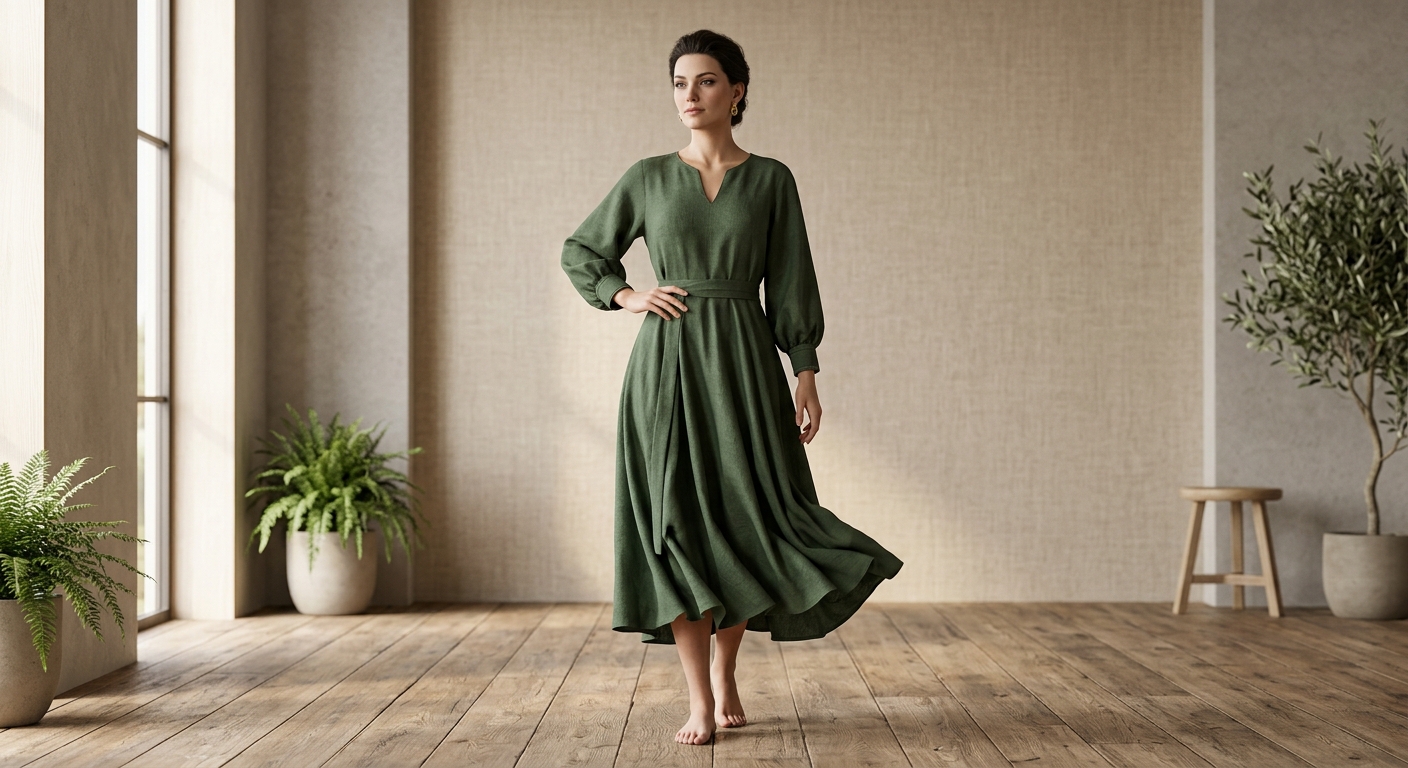
3D garment visualization technology has matured from experimental to production-critical. Modern 3D design software creates photorealistic digital garments that accurately represent fit, drape, fabric texture, and movement. According to Style3D data, major brands are adopting 3D software to speed sample development, with some reporting 50-70% reductions in physical sampling requirements. The technology has reached a point where 3D visualizations are often indistinguishable from photographs of physical garments.
The capabilities of current 3D tools are impressive. Designers can create garments from patterns or drape fabric directly on digital avatars. They can simulate different fabrics with accurate physical properties—how silk drapes differently than denim, how stretch fabrics behave under tension, how structured materials hold shape. They can see garments from every angle, in different lighting conditions, on avatars of different sizes and proportions. They can animate garments to show how they move during walking, sitting, or other activities.
Integration with industry-standard tools like CLO3D, Browzwear, and Style3D ensures that 3D visualization fits into existing workflows. These platforms import patterns from CAD systems, export tech packs for manufacturing, and generate assets for marketing and e-commerce. The ecosystem of compatible tools continues to expand, making 3D visualization a hub that connects different stages of the fashion workflow. This interoperability is crucial for brands that have invested in specific tools and need new technologies to integrate rather than replace existing systems.
The modern 3D fashion workflow starts with either 2D patterns or direct 3D draping. If starting from patterns, designers import them into 3D software where they're automatically assembled into garments on digital avatars. If starting from scratch, designers drape digital fabric directly on avatars, and the software generates patterns from the 3D shape. Both approaches enable rapid iteration—adjusting proportions, modifying seam placement, changing silhouettes—with instant visual feedback.
Photorealistic rendering transforms these 3D models into images that rival professional photography. Advanced rendering engines simulate realistic lighting, fabric texture, and even subtle details like thread texture and fabric imperfections. The results are suitable for e-commerce, marketing materials, lookbooks, and buyer presentations. Some brands now shoot entire campaigns using 3D-rendered garments, eliminating the need for physical samples, photography studios, models, and shipping.
The benefits for e-commerce are particularly significant. Product photos can be created before physical garments exist, enabling earlier listing of products and faster response to demand signals. Multiple colorways can be visualized without producing samples in every color. Garments can be shown on diverse body types without extensive photoshoots. The technology also enables innovative features like virtual try-on, where customers see products on avatars that match their body type, improving fit confidence and reducing returns.
3D models fundamentally change how teams collaborate. Instead of describing design changes in emails or marking up photos of physical samples, team members can annotate 3D models directly. A fit specialist can mark exactly where a garment needs adjustment. A merchandiser can suggest color changes and see results instantly. A manufacturer can identify potential production challenges before committing to physical sampling. This shared visual language reduces miscommunication and speeds decision-making.
Real-time feedback and iteration eliminate the traditional back-and-forth of physical sampling. In legacy workflows, a designer creates a sketch, a pattern-maker creates patterns, a sample is sewn, the sample is shipped to the designer for review, feedback is documented, revised patterns are created, a new sample is made—a process taking weeks and multiple iterations. With 3D tools, designers make changes directly in the digital model, see results immediately, and share updated files instantly. What once took weeks now takes hours.
Virtual fit sessions and design reviews across continents become seamless. A design director in New York, a technical designer in Hong Kong, and a manufacturer in Bangladesh can simultaneously review the same 3D garment during a video call. They can rotate the garment, zoom into details, simulate different fabrics, and make real-time adjustments. This global collaboration happens without shipping a single physical sample, dramatically reducing both time and environmental impact.
Digital sampling replaces physical prototypes with virtual ones, fundamentally changing the design validation process. Traditional sampling creates physical garments at multiple stages—initial prototypes, fit samples, sales samples, production samples. Each iteration requires fabric, labor, and shipping, with samples often traveling between multiple continents. Digital sampling creates virtual prototypes that stakeholders review and approve without physical production.
The traditional sampling problem is both expensive and wasteful. Industry data suggests brands create an average of 5-8 physical samples per design, with complex garments requiring even more. Each sample costs $100-500 in materials and labor, plus shipping costs that can exceed the sample cost for international shipments. The timeline impact is equally significant—each sampling iteration adds 1-2 weeks to the design cycle. Multiply this across a collection of 50-100 styles, and the cost and time implications become staggering.
Digital sampling works by creating photorealistic 3D representations that accurately show fit, drape, proportion, and aesthetic. Modern digital samples are so accurate that many brands now use them for final approvals, only creating physical samples for production validation. The technology has reached a maturity level where stakeholders trust digital samples to make critical decisions—a threshold that took years to achieve but is now widely accepted in the industry.
Waste reduction through digital sampling is substantial and measurable. Each eliminated physical sample saves 1-3 yards of fabric, plus trims, notions, and packaging. Across a typical collection, this amounts to hundreds of yards of fabric that never becomes waste. Since sampling often uses virgin materials rather than recycled content, this waste avoidance is particularly impactful. Brands report reducing sampling-related fabric waste by 60-80% after implementing digital sampling workflows.
Cost savings extend beyond material costs. Eliminated shipping saves both money and carbon emissions—international sample shipments can cost $50-200 per package and generate significant carbon footprints. Storage costs decrease when physical sample libraries are replaced with digital archives. Labor costs shift from repetitive sample production to higher-value design and development work. Brands typically see ROI on digital sampling investments within 6-12 months, with ongoing savings in subsequent seasons.
Time efficiency transforms design cycles. Instant iterations replace weeks of waiting for physical samples. A design change that once required creating and shipping a new sample now takes minutes to implement and share digitally. This speed enables more thorough exploration of design directions and more confident decision-making. Brands report compressing design cycles by 25-40% through digital sampling, translating to faster time-to-market and better trend responsiveness.
Carbon footprint reduction from eliminated shipping contributes to sustainability goals. International sample shipments—often air-freighted for speed—generate substantial emissions. A typical sample might travel from a design studio to a manufacturer for production, back to the design studio for review, to a fit model for testing, to buyers for sales presentations, and finally to storage or disposal. Digital samples make these journeys instantly and with zero emissions. For brands with global operations, this emission reduction is significant and measurable.
Digital samples seamlessly transition to production specifications, maintaining continuity from design through manufacturing. The same 3D models used for design approval generate technical packages (tech packs) that manufacturers use for production. These tech packs include patterns, measurements, construction details, and materials specifications—all derived from the approved digital sample. This direct connection reduces translation errors that often occur when design intent is communicated through multiple handoffs.
Quality control and approval processes adapt to digital environments while maintaining rigor. Stakeholders review digital samples using standardized criteria, annotating specific areas that need adjustment. Approval workflows track which designs have been reviewed, by whom, and what changes were requested. This creates an audit trail that's often clearer than traditional approval processes involving physical samples and email threads. Digital approvals also enable faster decision-making by allowing asynchronous review—stakeholders in different time zones can review and approve without coordinating schedules.
According to Browzwear insights, automation and enhanced collaboration through digital sampling enable brands to bring more designs to market with the same resources. The efficiency gains don't just save time and money—they expand creative capacity. Design teams can explore more directions, validate more concepts, and ultimately create more innovative collections. This creative expansion represents perhaps the most significant benefit of digital sampling: it returns design capacity to the creative process itself.
Pattern-making has evolved through several technological generations, each improving precision and efficiency. Manual pattern-making required skilled pattern-makers to draft patterns by hand using paper, rulers, and curves—a time-intensive process requiring years of training. Computer-aided design (CAD) systems digitized this process, enabling faster pattern creation and modification. Now, AI-assisted pattern-making represents the next evolution, automating routine tasks while maintaining the precision that garment fit requires.
Current digital pattern-making software combines the precision of CAD with intelligent automation. Designers can create patterns from sketches, modify existing patterns with parametric controls, and visualize patterns as 3D garments instantly. The software handles complex calculations—dart placement, grain line orientation, seam allowances—that once required manual computation. This automation doesn't eliminate the need for pattern-making expertise, but it allows pattern-makers to focus on creative problem-solving rather than mechanical drafting.
Automation features save significant time and reduce errors. Pattern grading across size ranges—once a tedious manual process—now happens automatically while maintaining proper proportions. Marker-making, the process of arranging patterns on fabric for cutting, uses algorithms to minimize waste. Pattern libraries enable reuse of proven blocks and details across designs. Version control tracks pattern changes, preventing the confusion that occurred when multiple pattern versions circulated on paper or in disconnected files.
Parametric design represents a significant advancement in pattern-making efficiency. Instead of creating separate patterns for each size, parametric patterns use variables and relationships that automatically adjust when parameters change. A designer can modify a single measurement—say, increasing the bust measurement—and the entire pattern adjusts proportionally. This approach is particularly powerful for custom and made-to-measure production, where each garment might have unique measurements.
AI-assisted grading and marker-making optimize processes that traditionally required specialized expertise. AI analyzes how patterns should scale across sizes, maintaining proper proportions and fit. For marker-making, AI algorithms arrange patterns on fabric to minimize waste, often achieving better efficiency than manual marker-making. These optimizations directly reduce fabric consumption and costs—a 2-3% improvement in marker efficiency can save thousands of dollars in fabric costs across a production run.
Pattern optimization for fabric efficiency extends beyond marker-making to the pattern design itself. AI can suggest pattern modifications that reduce fabric consumption without compromising design intent—slightly adjusting curve shapes, repositioning seams, or modifying grain lines. These micro-optimizations accumulate to significant savings. Some brands report reducing fabric consumption by 5-10% through systematic pattern optimization, translating to both cost savings and environmental benefits.
Integration with 3D visualization creates a powerful feedback loop. Pattern-makers create or modify patterns, instantly see them as 3D garments, identify fit or construction issues, adjust patterns, and see updated 3D results—all within minutes. This rapid iteration enables pattern-makers to achieve better results faster. It also democratizes pattern-making to some degree—designers without extensive pattern-making training can create basic patterns and use 3D visualization to validate and refine them.
Virtual fashion design profoundly influences physical garment production, creating a bidirectional relationship between digital and physical realms. According to perspectives from the University of the Arts London, digital tools enable designers to experiment with forms, proportions, and concepts that would be impractical or impossible to prototype physically. This digital experimentation informs physical collections, pushing creative boundaries while managing risk—bold ideas can be validated digitally before committing to physical production.
The feedback loop between digital and physical is continuous and valuable. Designers create digital prototypes, validate concepts, create physical samples of promising designs, learn from physical production realities, and update digital models with those learnings. This iterative process creates increasingly accurate digital representations while simultaneously improving physical production. Over time, brands build libraries of digital assets that accurately represent their materials, construction methods, and fit standards.
Virtual fashion serves as a testing ground for bold ideas that might be too risky to produce physically without validation. Avant-garde silhouettes, experimental materials, unconventional constructions—these can be explored digitally with minimal investment. Consumer response can be tested through digital previews or social media. Buyer interest can be gauged through virtual showrooms. Only designs that demonstrate market potential move to physical production, reducing the risk of unsold inventory.
Starting with digital prototypes before physical creation represents a fundamental shift in design philosophy. Rather than sketching, then sampling, then refining, designers now create digital prototypes first, validate them thoroughly in the virtual environment, and only then create physical samples for production validation. This inversion of the traditional workflow enables more thorough design exploration with less resource investment.
Digital validation before production commitment reduces risk and waste. Fit can be tested on digital avatars of various sizes and proportions. Fabric behavior can be simulated. Construction challenges can be identified. Market response can be gauged through digital previews. By the time a design moves to physical sampling, most issues have been resolved and market viability has been validated. This results in higher success rates and less wasted production capacity on designs that won't sell.
The shift in designer mindset—thinking digitally first—requires training and adaptation but yields significant benefits. Designers who embrace digital tools report that they think differently about design, considering how digital representations will look alongside how physical garments will perform. This dual perspective enhances design quality. It also enables designers to work more efficiently, using the strengths of each medium—digital for exploration and iteration, physical for final validation and production.
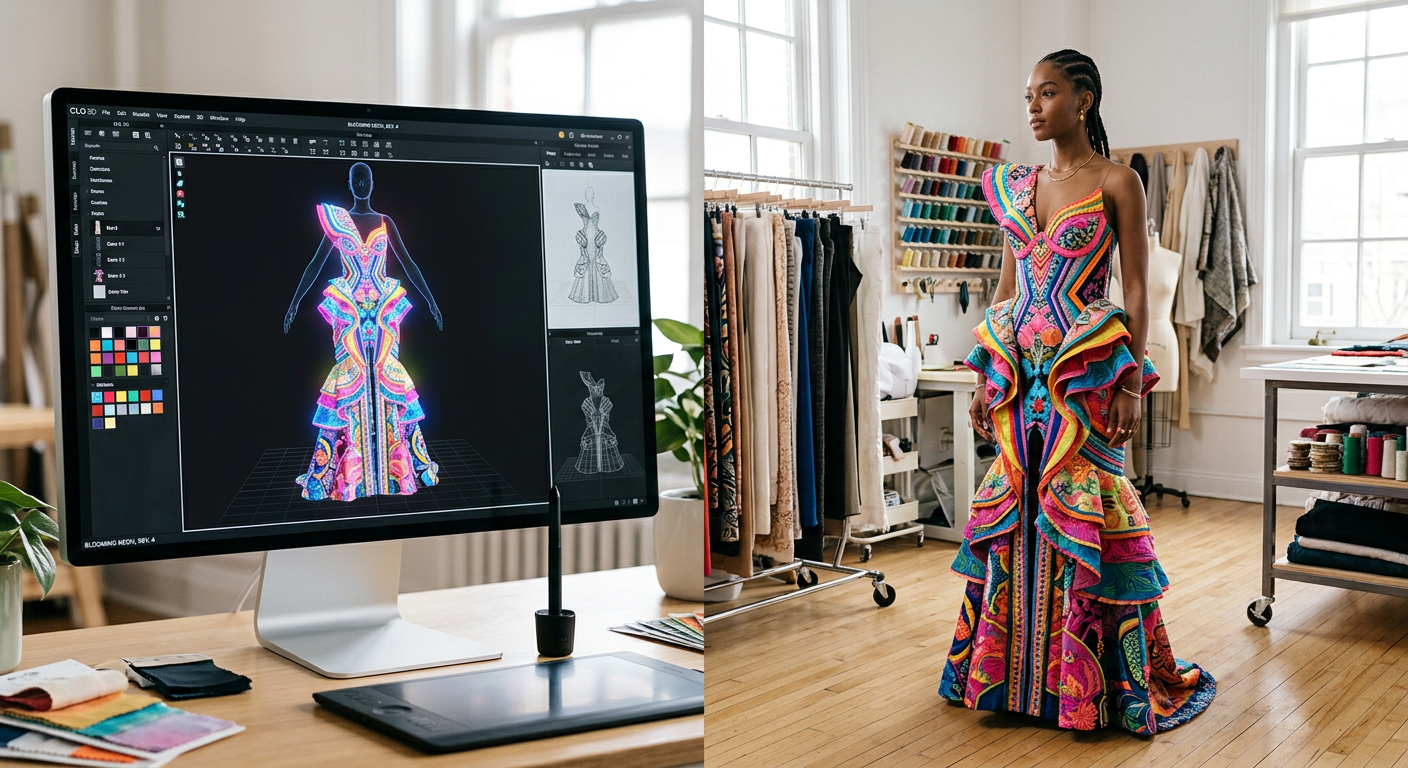
3D design tools form the foundation of digital fashion workflows. CLO3D has become an industry standard, known for its accurate fabric simulation and intuitive interface. Browzwear offers powerful tools for both design and technical development, with strong marker-making capabilities. Style3D provides cloud-based collaboration features and is gaining traction particularly in Asian markets. Each platform has strengths for different use cases—CLO3D for design exploration, Browzwear for technical precision, Style3D for team collaboration.
AI-powered platforms for design generation and optimization represent the cutting edge of fashion technology. These platforms use machine learning to generate design concepts, optimize patterns, predict trends, and personalize designs. While some are standalone tools, many are being integrated into existing design software or offered as platform features. The AI landscape is evolving rapidly, with new capabilities emerging regularly.
Pattern-making software has consolidated around several major platforms. Optitex offers comprehensive pattern-making and marker-making capabilities with strong 3D integration. Gerber provides end-to-end solutions from design through production, particularly strong in manufacturing environments. Lectra offers sophisticated pattern-making and grading tools with excellent automation features. Most brands use one of these platforms as their pattern-making backbone, often integrating it with other tools.
Rendering and visualization tools create the photorealistic images used for marketing, e-commerce, and presentations. Some are integrated into 3D design software, while others are specialized rendering engines. KeyShot and V-Ray are popular choices for high-quality rendering. These tools use advanced lighting simulation and material libraries to create images that are indistinguishable from photography.
Connected workflows across design, production, and retail represent the next evolution in fashion technology. Individual tools—however powerful—create silos when they don't communicate. Designers work in one system, pattern-makers in another, manufacturers in a third, and merchandisers in a fourth. Data doesn't flow between these systems, creating version control issues, miscommunication, and inefficiency. The future belongs to platforms that connect these workflows, enabling seamless data flow from initial concept through final sale.
Platforms like The F* Word bridge gaps between different tools, creating integrated ecosystems where data flows automatically. When a designer modifies a 3D garment, the pattern updates automatically. When a pattern-maker adjusts grading, the 3D visualization reflects the change. When a merchandiser approves a design, the tech pack generates automatically for manufacturing. This integration eliminates manual data transfer, reduces errors, and accelerates workflows.
The benefits of integrated systems extend beyond efficiency. Data flow enables analytics that aren't possible with disconnected tools. Brands can track which designs move fastest through the approval process, which patterns require the most revisions, which manufacturers deliver the best quality. This visibility enables continuous improvement. It also creates accountability—when everyone works in a connected system, responsibilities are clear and progress is transparent.
API integrations and interoperability ensure that brands aren't locked into single-vendor solutions. Modern platforms offer APIs (application programming interfaces) that enable custom integrations with existing systems. This allows brands to adopt new technologies while preserving investments in current tools. It also enables best-of-breed approaches—using the best tool for each function while maintaining integration across the workflow.
Considerations for independent designers versus large brands differ significantly. Independent designers need affordable, intuitive tools with minimal learning curves. They benefit from subscription pricing and cloud-based tools that don't require IT infrastructure. Large brands need enterprise features—multi-user collaboration, version control, security, integration with existing systems, and vendor support. They often require on-premise deployment or private cloud options for data security.
Learning curves and training requirements vary substantially between tools. Some platforms offer intuitive interfaces that designers can learn in days. Others require weeks or months of training to achieve proficiency. Brands should consider not just the power of tools but the realistic timeline for team adoption. The best tool is one that teams will actually use effectively, not necessarily the one with the most features.
Cost-benefit analysis of different tool combinations should consider total cost of ownership, not just subscription fees. Implementation costs, training costs, integration costs, and ongoing support costs all factor into the real investment. The benefits side includes time savings, waste reduction, quality improvements, and competitive advantages. Many brands find that digital tools pay for themselves within 6-18 months through reduced sampling costs alone, with ongoing benefits in subsequent seasons.
Concrete data on waste reduction through digital sampling demonstrates measurable environmental benefits. Physical sampling generates substantial waste—fabric scraps, unused samples, packaging materials. Each eliminated physical sample prevents 1-3 yards of fabric from becoming waste. Across an industry that creates millions of samples annually, the potential waste reduction is enormous. Leading brands report reducing sampling-related waste by 70-80% through digital workflows.
Energy savings from reduced physical prototyping extend beyond material waste. Sewing samples requires electricity for machines and facilities. Shipping samples consumes fuel. Storing samples requires climate-controlled warehouses. Digital workflows eliminate or reduce all of these energy inputs. While digital tools do consume energy—servers, computers, rendering—the net energy impact is significantly lower than physical sampling and shipping.
Lower carbon emissions from decreased shipping and logistics contribute meaningfully to climate goals. Sample shipments often travel by air freight to meet tight timelines, generating substantial emissions. A typical sample might travel 10,000-20,000 miles through its lifecycle—design studio to manufacturer, back to design studio, to fit models, to buyers, to storage. Digital files travel these distances instantly and with negligible emissions. For brands with global operations, eliminating sample shipping can reduce carbon footprints by thousands of tons annually.
Digital design enables better end-of-life planning by documenting garment construction and materials from the start. Digital records specify exactly what materials were used, how garments were constructed, and how they can be disassembled. This information is crucial for recycling and circular business models. When garments return at end-of-life, brands know exactly how to process them—which materials can be recycled, which components can be reused, how to efficiently disassemble them.
Digital twins for garment lifecycle tracking create permanent records of each garment's journey. A digital twin is a virtual representation linked to a physical garment, tracking its production, sale, ownership, repairs, and eventual end-of-life. This tracking enables circular business models like rental, resale, and recycling. It also provides data on garment durability and longevity, informing future design decisions. Digital twins represent the intersection of digital design, blockchain technology, and circular economy principles.
Designing for disassembly and recycling using digital tools enables circular fashion at scale. Designers can use digital tools to model how garments will be disassembled, ensuring that recycling is feasible. They can select materials and construction methods that enable recycling. They can document assembly sequences that inform disassembly. This design-for-circularity approach, enabled by digital tools, is essential for transitioning fashion from linear to circular models.
Digital design integrates into holistic sustainable fashion strategies alongside material innovation, circular business models, and transparent supply chains. It's not a silver bullet but rather one crucial component. Digital tools enable other sustainability initiatives—they make on-demand manufacturing feasible by compressing design-to-production timelines, they enable transparency by creating detailed digital records, they support circular models by documenting garment construction.
Connection to on-demand manufacturing and reduced overproduction addresses one of fashion's biggest sustainability challenges: unsold inventory. Traditional fashion operates on prediction—brands guess what will sell, produce it in advance, and hope they guessed correctly. Overproduction and unsold inventory result in massive waste. Digital tools enable faster response to actual demand signals, making on-demand and near-demand manufacturing feasible. This dramatically reduces overproduction and associated waste.
Transparency and traceability enabled by digital workflows build consumer trust and meet regulatory requirements. Digital records document where materials came from, how garments were made, what environmental impacts occurred. This information can be shared with consumers through QR codes or blockchain-based systems, enabling informed purchasing decisions. As regulations increasingly require supply chain transparency, digital documentation becomes not just beneficial but mandatory.
Increased AI sophistication will shift AI from assistance to co-creation. Current AI helps designers by generating options and optimizing processes. Future AI will engage in genuine creative collaboration, understanding brand DNA, learning designer preferences, and proactively suggesting innovative directions. The relationship between designer and AI will evolve from tool-use to partnership, with AI becoming a creative collaborator that enhances rather than replaces human creativity.
Real-time collaboration in virtual design studios will become seamless and ubiquitous. Imagine design teams working together in virtual reality environments, manipulating 3D garments with hand gestures, seeing each other's avatars, communicating naturally. Geographic distance becomes irrelevant. The design studio becomes a virtual space that team members enter from anywhere. This isn't science fiction—the technologies exist now and are rapidly improving in usability and accessibility.
Integration with Web3, blockchain, and digital ownership creates new business models and consumer relationships. Garments will have digital identities recorded on blockchains, enabling provenance tracking, authenticity verification, and digital ownership. Physical garments might come with digital twins that owners can use in virtual environments. NFTs might represent ownership of limited-edition designs. These technologies are experimental now but are likely to become mainstream within the next decade.
Haptic feedback and sensory digital design experiences will add tactile dimensions to digital design. Imagine feeling fabric texture through haptic gloves while designing in VR, or experiencing how a garment moves through full-body haptic suits. These technologies will help bridge the gap between digital and physical, addressing one of the main limitations of current digital tools—the inability to physically touch and feel designs.
Skills designers need to develop now include digital literacy, 3D thinking, and AI collaboration. Designers should become proficient in at least one 3D design tool and understand AI capabilities and limitations. They should develop the ability to think in three dimensions, visualizing how 2D patterns become 3D garments. Most importantly, they should learn to collaborate effectively with AI—how to prompt AI systems, evaluate AI outputs, and integrate AI suggestions into their creative process.
Fashion education is adapting to digital-first approaches, with design schools integrating digital tools throughout curricula. Students now learn 3D design alongside traditional sketching, digital pattern-making alongside draping, and AI-assisted design alongside trend research. This prepares graduates for the digital-first workflows they'll encounter in industry. It also democratizes fashion education—students without access to extensive physical resources can create sophisticated designs digitally.
The democratization of fashion design through accessible digital tools is creating new opportunities for independent designers and small brands. Digital tools that once cost hundreds of thousands of dollars are now available through affordable subscriptions. Cloud-based platforms eliminate the need for expensive hardware. This accessibility is lowering barriers to entry, enabling more diverse voices in fashion, and fostering innovation from unexpected sources.
According to expert predictions from NIF Global, digital tools will continue pushing creative boundaries, enabling designs that would be impossible or impractical with traditional methods. We'll see more experimental silhouettes, innovative construction techniques, and personalized designs. The constraint of physical sampling will no longer limit creative exploration. This creative freedom, combined with sustainability benefits and business efficiency, makes digital fashion design not just the future but the present.
Technical barriers still to overcome include improving digital fabric simulation accuracy, reducing rendering times, and creating more intuitive interfaces. Current tools are powerful but not perfect. Fabric simulation, while impressive, doesn't yet capture every nuance of how real fabrics behave. Rendering photorealistic images can take hours for complex scenes. Some tools have steep learning curves. These challenges are being actively addressed, with continuous improvements in each area.
Adoption challenges in traditional fashion houses include cultural resistance, workflow inertia, and investment concerns. Brands that have operated the same way for decades may resist change. Teams comfortable with physical workflows may be reluctant to learn digital tools. Leadership may view digital tools as experimental rather than production-ready. Overcoming these challenges requires demonstrating clear ROI, providing adequate training, and implementing changes incrementally rather than disruptively.
The human element—maintaining creativity and craftsmanship—remains paramount as digital tools become more powerful. Technology should enhance human creativity, not replace it. The craftsmanship and attention to detail that define quality fashion must be preserved even as workflows become digital. This requires conscious effort to keep human judgment and taste at the center of the design process, using digital tools as enablers rather than replacements.
Opportunities for innovation and competitive advantage are substantial for brands that embrace digital transformation. Early adopters gain experience and expertise that late adopters will struggle to match. They build digital asset libraries that accelerate future work. They attract talent that wants to work with modern tools. They establish reputations as innovative and sustainable. The competitive advantages compound over time, making early adoption increasingly valuable.
Q: Do I need to abandon traditional design skills to work in digital fashion?
A: No, traditional design skills remain foundational. Digital tools enhance and accelerate your existing skills rather than replace them. Understanding garment construction, fabric properties, and design principles is still essential—digital tools simply give you new ways to express and execute these concepts.
Q: How much does it cost to get started with digital fashion design tools?
A: Costs vary widely. Some tools offer free trials or student licenses, while professional subscriptions range from $50-500/month. Many brands find that the investment pays for itself quickly through reduced sampling costs and faster time-to-market. Integrated platforms like The F* Word can also reduce overall costs by connecting existing tools.
Q: Can digital fashion design really reduce waste significantly?
A: Yes, significantly. Digital sampling can eliminate 80-90% of physical samples traditionally required in the design process. Combined with digital pattern optimization and virtual fit sessions, brands report reducing fabric waste by up to 30% and cutting sample shipping emissions dramatically.
Q: How long does it take to learn 3D fashion design software?
A: Basic proficiency typically takes 2-4 weeks of focused learning, while mastery can take 3-6 months. Most designers find they can create usable 3D garments within their first month. The learning curve is similar to mastering Adobe Illustrator or other professional design software.
Q: Will AI replace fashion designers?
A: AI is a tool that augments human creativity, not a replacement for designers. While AI can generate variations, optimize patterns, and accelerate workflows, it lacks the cultural understanding, emotional intelligence, and artistic vision that human designers bring. The future is human-AI collaboration, where designers leverage AI to explore more possibilities faster.
Digital fashion design represents a fundamental transformation in how fashion gets created, validated, and brought to market. The technologies discussed—generative AI, 3D visualization, digital sampling, and integrated platforms—aren't experimental anymore. They're production-critical tools that leading brands use daily to design better products faster, with less waste and greater creativity.
Adoption is no longer optional for brands that want to remain competitive. The advantages are too significant: compressed timelines that enable trend responsiveness, reduced costs that improve margins, expanded creative capacity that drives innovation, and sustainability benefits that meet consumer and regulatory demands. Brands that delay digital transformation will find themselves at increasing disadvantages as competitors move faster, create more innovative designs, and operate more efficiently.
The triple benefit of creativity, efficiency, and sustainability makes digital fashion design uniquely valuable. It's rare to find technologies that simultaneously make work more creative, more efficient, and more sustainable. Digital fashion design delivers all three. Designers spend more time designing and less time managing logistics. Collections get to market faster with higher success rates. Environmental impact decreases measurably. This alignment of creative, business, and sustainability goals is powerful and compelling.
Starting your digital transformation journey doesn't require abandoning current workflows overnight. Begin with one technology—perhaps 3D visualization or AI-assisted design generation. Learn it thoroughly. Integrate it into existing workflows. Measure results. Build team proficiency. Then add additional capabilities. This incremental approach manages risk and builds organizational capability progressively.
The F* Word platform connects all these innovative workflows into a cohesive ecosystem. Instead of managing disconnected tools and manual data transfer, design leaders can work in an integrated environment where AI, 3D design, pattern-making, and production planning flow seamlessly. This integration enables the full potential of digital fashion design—not just better individual tools, but better workflows that amplify creativity while reducing friction.
The future of fashion is digital-first, AI-augmented, sustainably focused, and creatively liberated. It's a future where designers explore more possibilities, validate concepts faster, and bring innovative products to market with confidence. It's a future where sustainability and business success align rather than conflict. Most importantly, it's a future that's already here for brands ready to embrace it.