AI answers now sit above your blue links and siphon demand before the click. Generative engine optimization aligns your site to how AI Overviews, Perplexity, and Copilot extract and cite sources, so you still earn visibility, traffic, and trust. For a lean team, the move is to ship answer-surface content once and let engines reuse it across prompts and intents.
You rank when engines can parse, quote, and attribute your claims without ambiguity. That means direct answers, tight headings, date-stamped citations, and schema that machines recognize. Treat generative engine optimization as a build system for questions.
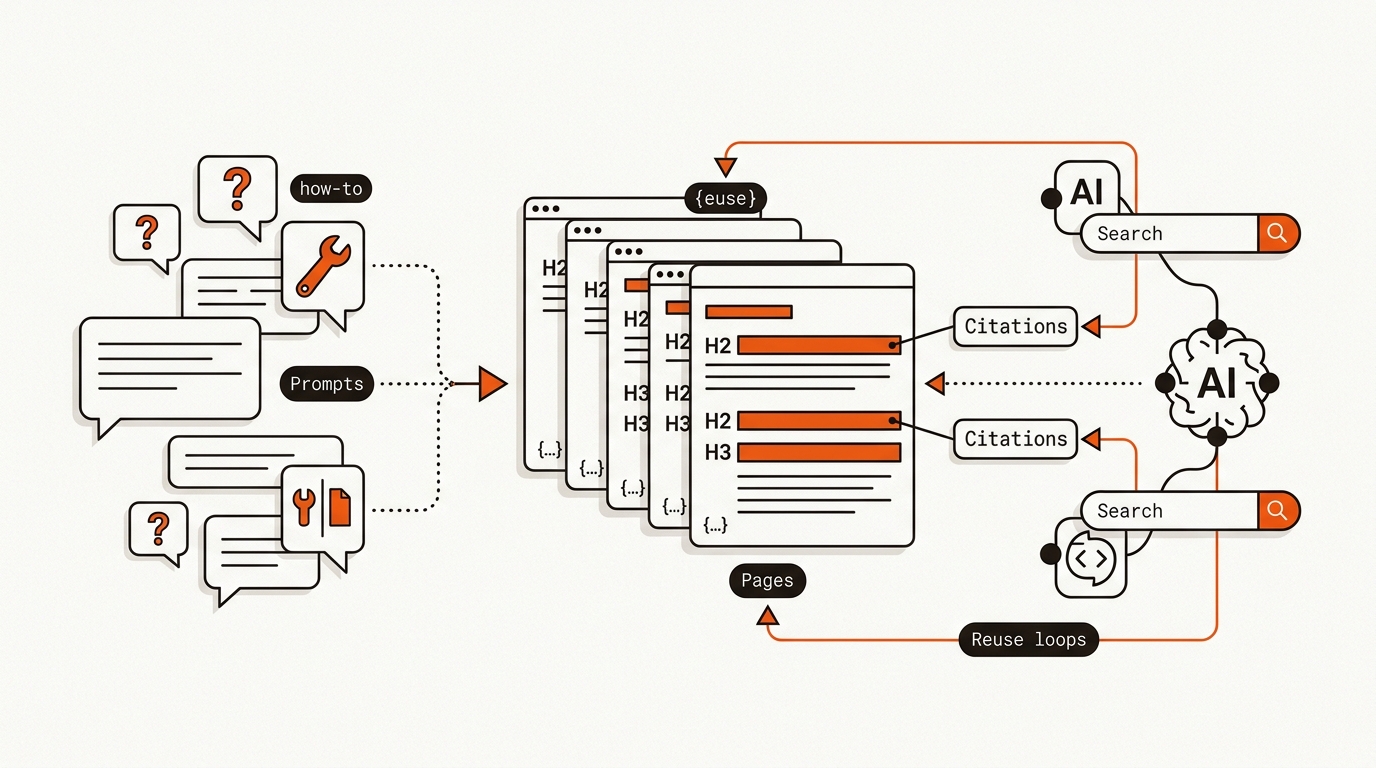
You publish every month and do not see movement. You run a small growth team, know Ahrefs and KD, and need a system that converts prompts into pages engines can cite without hiring an agency. You want clear workflows you can start Monday and scale as you grow.
You have basics covered: sitemap, decent Core Web Vitals, and a blog that publishes on schedule. What you lack is answer-surface structure and a way to measure share-of-answer across engines. This playbook gives you both with minimal dev effort.
Classic SEO aims at rankings on the Google results page, and answer engine optimization (AEO) formats individual pages so an AI engine can quote a specific URL. GEO works at the brand level. Its goal is to get your company named in generated answers, with or without a link, which also depends on brand identity and third-party presence that page formatting alone cannot supply.
Engines build an answer from training data (a snapshot of the open web up to a cutoff date), real-time retrieval of recent pages, and authority signals that weight some sources above others. A brand needs presence at each layer: its own content, third-party mentions, and an identity that models recognize as one company across many references.
This split sets your priorities. A startup with no published content should begin with answer-ready pages so each new URL is easy to cite. A startup with solid content and little AI visibility gains more from brand consistency, schema, and third-party citations.
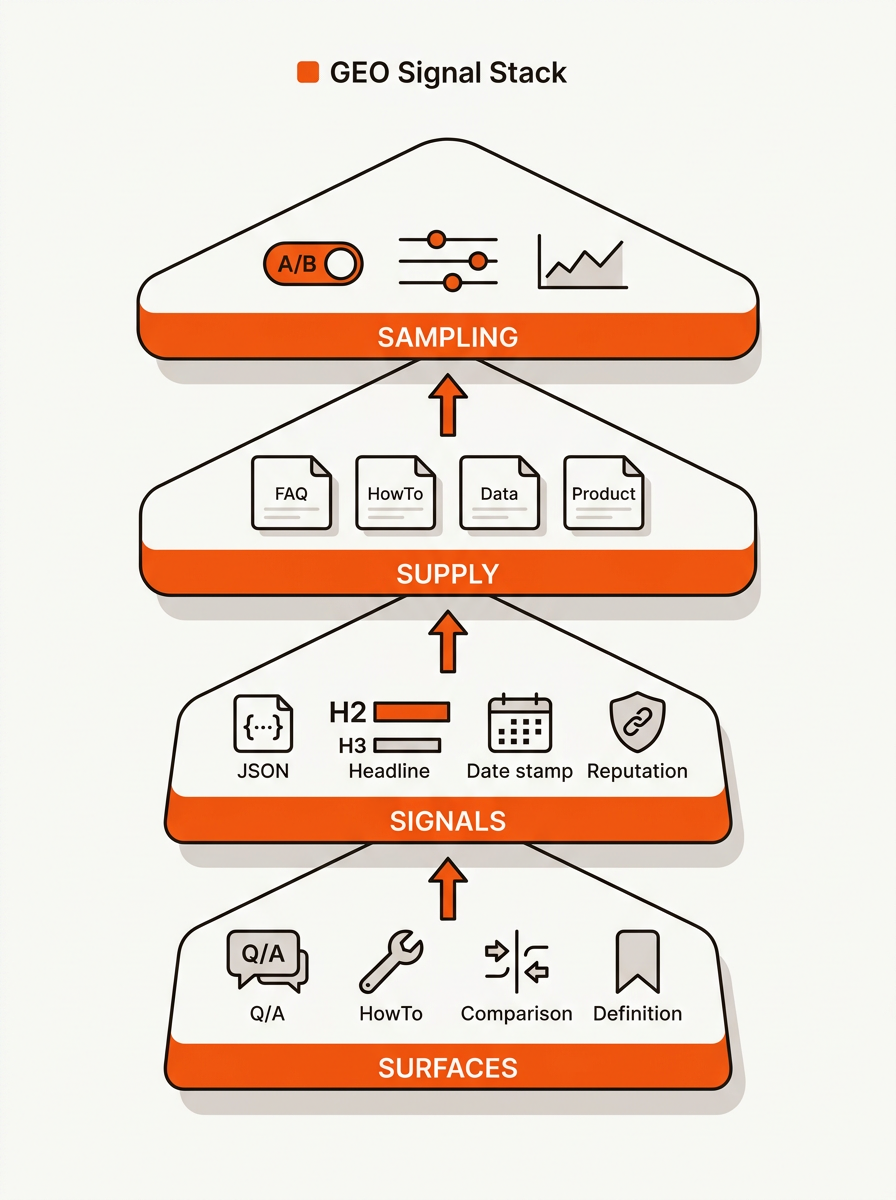
Engines cite pages that present precise answers with unambiguous structure. The GEO Signal Stack is a 4-layer operational model for shipping content AI engines ingest and select: Surfaces, Signals, Supply, Sampling.
Surfaces define the question frames engines answer: how-to, definitional, pricing, comparison, and troubleshooting. Signals are machine cues like JSON-LD, heading patterns, dates on claims, outbound citations, and source reputation. Supply is your atomic Q&A, HowTo, and data pages mapped to specific prompt families, each with a direct answer box. Sampling is iterative testing across engines to raise your selection probability without model access.
Apply it as a weekly cadence: map prompts to a page template, draft schema-first, publish to fast clean URLs, and spot-check citation presence by engine. Tradeoffs are real: overly generic answers fail selection; over-tuned formats can break when engines shift parsers. Common failure modes include missing or invalid schema, slow pages, ambiguous attribution anchors, and burying answers under prose.
Use FAQPage and HowTo JSON-LD to tell parsers exactly what you are answering; add Product or Dataset where relevant. Google’s documentation remains the technical source of truth for structured data (see Google Search docs) while a16z frames GEO as a system of record for LLM interactions with practical implications for content ops (see a16z’s write-up). Keep headings scannable and each section self-contained.
A small growth team can run this: one person mapping prompts and drafting briefs, one editor finalizing answers and schema, and one operator handling publication and spot checks. This replaces ad hoc blogging with a production line focused on selection probability and citation attribution.
Use these build rules:
• One page per intent; avoid mixing multiple how-to intents on a single URL.
• Add cite-ready anchors: short claims with a source link and a date so engines can quote cleanly.
• Ship clean canonical URLs, fast loads, and an XML sitemap to reduce indexing lag.
Operational tradeoff: as the page count grows, indexing lag compounds and spot-checking citations manually becomes slow. Batch-submit new URLs in Search Console, and rotate a fixed set of prompts for Perplexity and Copilot tests to maintain signal with limited hours.
Table: Engine Targets, Signals, and Measurement
Semrush has a helpful primer on structuring pages for GEO that you can use as secondary contexte).
You can model GEO traffic and cost before writing. Assume 30 Q&A pages. Each maps to 3 prompt variants with 80 monthly occurrences among your ICP. Engines show AI answers on 60 percent of those prompts. Your inclusion rate is 15 percent with a 10 percent citation CTR.
• Monthly visits from GEO: 30 pages x 3 prompts x 80 x 0.60 x 0.15 x 0.10 = 64.8 ≈ 65.
• Traditional SERP lift from the same pages (assume avg 3,000 monthly search volume at 2.1 percent CTR in positions 4-7): 63 visits.
• Combined: ~128 visits per month. If content production costs 1,500 dollars, first-month cost per session is ~11.7 dollars. If those visits held for 12 months, cumulative ~1,536 sessions would bring cost per session below 1 dollar.
This math assumes linear prompt frequency and stable inclusion, which will fluctuate. Instrumentation tightens the estimate: track Perplexity referrals by URL, log AI Overview presence by query weekly, and annotate publish dates in your doc. Pattern over 8-12 weeks to see which surfaces earn stable citations, then replicate those templates.
Most startup GEO problems trace back to a short list of gaps:
A few asset types carry the most weight at the brand level. A category-naming page defines your product category cleanly so models stop falling back on generic terms. Comparison pages that cover several competitors tend to earn citations when buyers ask "X vs Y". An About page with Organization schema is one of the clearest entity signals you can ship. Roundup placements and named-founder content, such as guest posts and bylined LinkedIn essays, extend those signals beyond your domain.
If competitors get named in AI answers while you do not, or buyers say they asked ChatGPT and heard another vendor recommended, treat gaps on this list as overdue. Mergeflo tracks Google positions and checks whether ChatGPT, Gemini and Claude mention you (weekly on paid plans, one check on the free plan), which gives you a baseline.
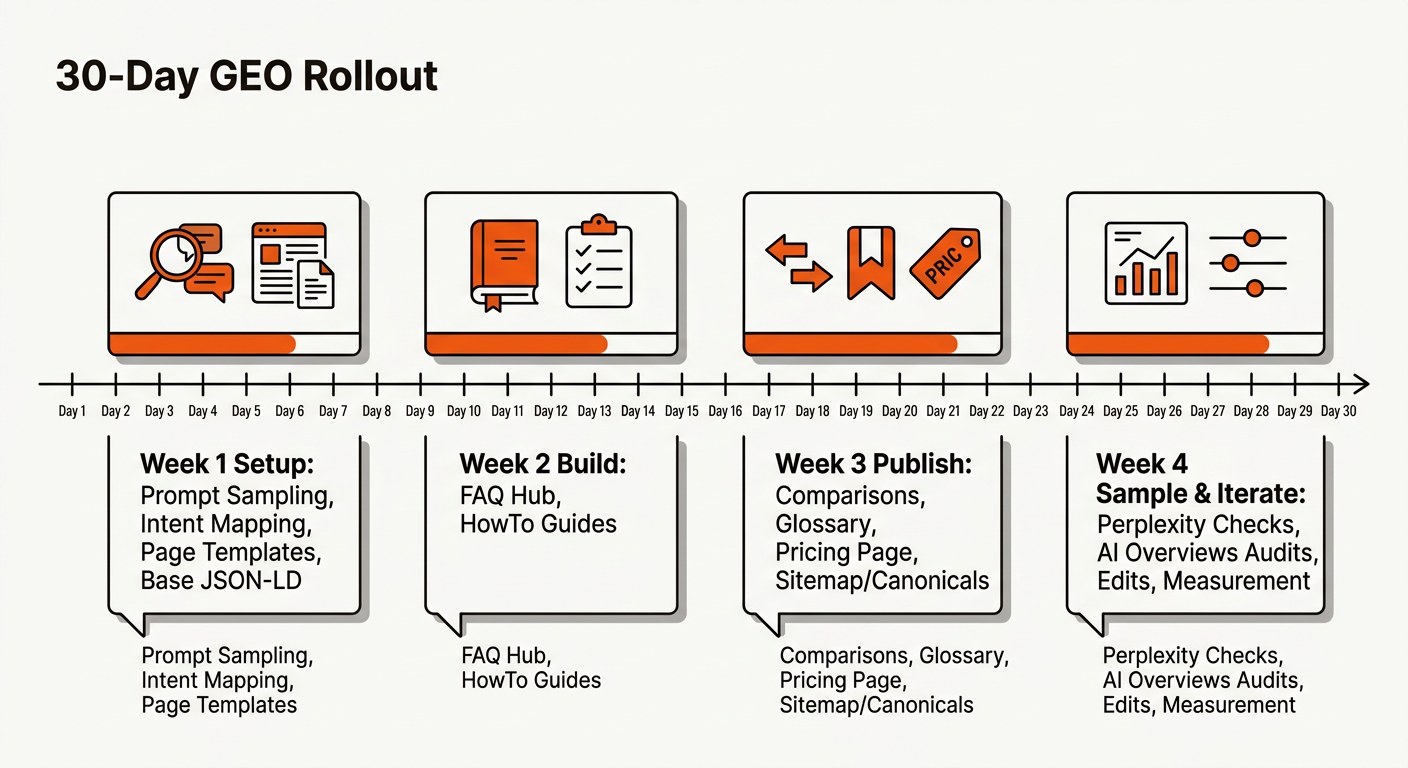
Most GEO guides stop at formatting and skip measurement and ops. Semrush’s primer (semrush.com/blog/generative-engine-optimization) and Moz’s overview (moz.com/blog/generative-engine-optimization) explain structure and E-E-A-T but do not give a budgeted 30-day rollout or a share-of-answer tracking method. Our angle: run GEO as a production workflow with prompt mapping, schema-first drafting, and cross-engine citation analytics you can execute with a small team.
For technical validation of schema types and properties, follow Google Developers documentation for structured data and keep to supported properties to avoid silent parser failures.
GEO places your claims where attention lands, so your next pages can earn citations and clicks, not just impressions. Build once, compound across engines, and measure inclusion by prompt set.
Keep reading: AI search visibility and AI Overview optimization.
Treat citations as a measurable asset and wire basic telemetry before scaling pages.
Track Perplexity and Copilot referrers in your analytics and add UTMs to example links you expect to be quoted. Annotate AI Overview presence per query in a weekly SERP crawl and store snapshots. Estimate share-of-answer by sampling a fixed prompt set monthly so movement reflects your changes.
Start with FAQPage and HowTo via JSON-LD. They ship fast, map cleanly to prompts, and are widely referenced across engines. Validate with Google’s Rich Results Test and keep to supported properties. Add Product for feature pages and Dataset when you host tables or benchmarks worth quoting.
No. The same structured, scannable content strengthens traditional rankings, improves snippet eligibility, and reduces pogo-sticking. GEO layers an additional exposure channel via citations in AI answers. The work is additive and compounds across both click-based and answer-based surfaces.
Update when evidence changes, when citations drop, or when you add materially better sources. Stamp dates on claims and rotate in new references so engines trust recency. Keep schema valid and page speed tight to avoid quiet de-selections during parser or UI updates.
AEO formats a page so an engine can cite that URL. GEO covers the brand level: consistent naming, schema, and third-party mentions that get your company named in a generated answer, with or without a link. AEO work feeds GEO indirectly, because pages that get cited add to brand mentions.
Audit your brand entity. Check that the company name, category, and product names read the same on the homepage, footer, About page, social profiles, and press kit. Inconsistent naming is a common reason models confuse a company with a competitor, and fixing it makes later results easier to attribute.
Treat GEO as a system. Map prompts to pages, ship schema-first answers, and instrument citations across engines. Then compound with the templates and surfaces that win inclusion.
