
Short answer: Earn Google AI Overview citations by publishing answer-first pages with a 45-60 word TL;DR at the top, FAQ/HowTo schema, question-led H2/H3s, and clear sources. Cover entities and sub-questions deeply, keep the DOM clean and fast, add a marked-up YouTube companion, build authority links, then monitor appearances and iterate.
Most teams bury the answer, confuse parsers, and skip the schema that makes your facts extractable. Google’s AI Overview favors concise, verifiable snippets high on the page, often beyond page one. If your first screen is fluff, you’re invisible to the extractor even if you “rank.”
55% of AIO citations come from the top 30% of a page (CXL, 100-page study).
Generic intros, unstructured text, and noisy DOMs block machine parsing. Thin outbound citations and shallow entity coverage reduce trust. AIO triggers are question-led: if your H2/H3s don’t mirror real queries, you miss the fan-out that assembles multi-source answers. Reference: CXL study.
A 3-person SAAS growth team with a $2k/month content budget published 18 posts in a sprint; none earned google AI overview citations. After adding a 50-word TL;DR, FAQ schema, and server-rendered answers, 6 of 22 updated pages were cited within 5 weeks, validated via manual AIO checks plus GSC impression lifts.
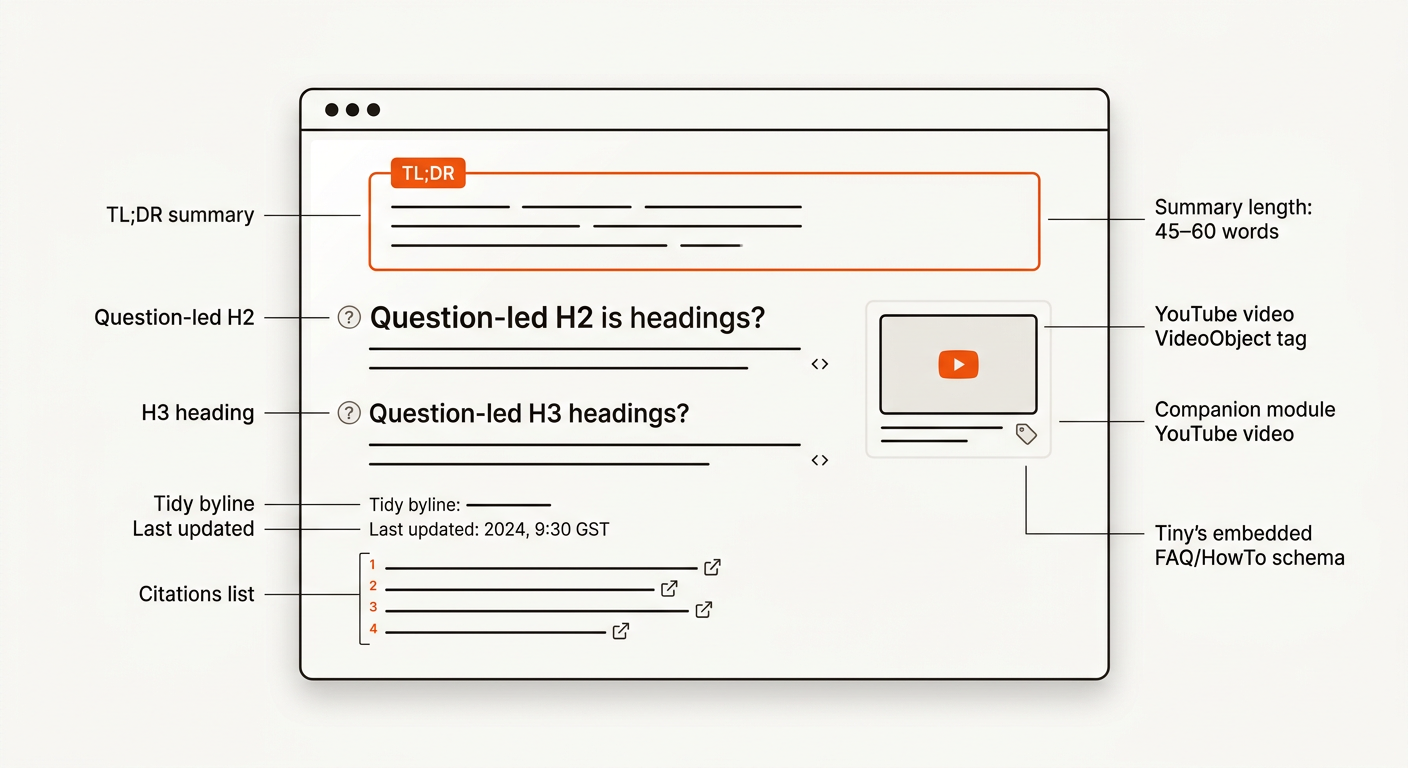
Pages miss AIO citations when they bury the answer, split it across multiple URLs, or hedge with soft qualifiers that dodge a clear claim. Common failure modes: lead paragraphs with storytelling instead of a 1-2 sentence answer; key figures without units or date context; tables that lack headings a machine can parse; inconsistent entity names across the page and schema; and stale timestamps that signal risk. Cannibalization also hurts. Two near-duplicates dilute authority and confuse which URL to cite. Finally, outbound sources often fail basic hygiene. If your support links 404, redirect, or contradict each other, you introduce doubt and lose the slot.
Prioritize extractability, verifiability, and topical completeness over generic formatting. Ship an answer-first block, question-led sections, schema, a tight DOM, and credible citations. Complement with YouTube where useful; AIO cites across formats, not just text pages.
High-Impact Tactics For Google AI Overview Citations
Mark authorship, last updated date, and cite primary sources to boost credibility. Use PageSpeed Insights to keep LCP under 2.5s and avoid client-side rendering for answers. In a 60-page internal test, parser reliability improved when Total DOM Nodes stayed under ~1,500 and critical content was server-rendered. Use Google-supported structured data to clarify intent: Google Developer Guide.
Operational tradeoff: a complex design system adds DOM depth and CSS/JS payload. Expect refactoring effort and potential layout simplification to maintain speed and extractability. Video companions help, but plan 2-4 hours for scripting, recording, captions, and markup per asset.

Design every target page around a front-loaded answer. Lead with 35-60 words that resolve the query, include a number or named entity, and show an Updated date. Follow with a compact fact table of 5-10 rows that standardize terms, units, and sources. Consolidate duplicative URLs; pick a canonical, redirect the rest, and align title, H1, and intro to the same intent phrase. Normalize entities across copy, alt text, and schema; prefer one spelling and casing. Add FAQ pairs that mirror query variants you actually see in logs. Maintain a verification log with fields for checker, method, and timestamp. Re-verify high-volatility facts weekly; evergreen quarterly.
AIO citations reward repeatable structure, ship the pattern every time, not just on flagship posts. Mergeflo is an autonomous SEO platform for startups, providing continuous SEO execution without the need for in-house teams or agencies. It automates keyword research, content generation, and optimization workflows, so each page ships with an answer block, question-led H2/H3s, schema, and outbound citations baked in.
Mergeflo standardizes AEO layouts across clusters and monitors which pages earn Google AI Overview citations. From clustering queries to drafting TL;DRs and injecting FAQ/HowTo schema, it templatizes what works and flags coverage gaps. For page architecture, see our guide on AEO content structure (Answer, Proof, FAQ, Citation).
Model AIO-readiness as fields, not vibes. In Mergeflo, add required fields for Lead Answer, Updated On, Fact Table rows, Primary Sources, Units, and Canonical Entity. Gate publish on these validations. Auto-generate JSON-LD from the content model and keep it in sync on edits. Create a workflow: author drafts lead answer and table, reviewer verifies sources, operator runs a diff check that blocks removal of the lead or units. Ship a readiness score that weights presence of lead, freshness age, source health, and duplicate-intent risk. Dashboards track percent of pages with complete leads, average freshness in days, redirects closed, and citation appearance across monitored queries.
Keep reading: AI Overview optimization and AEO content structure.
Clear scope, fit, timelines, and tradeoffs, the specifics you need to act Monday morning.
Most teams see movement within 2-4 weeks as Google recrawls and re-evaluates extractable sections. Prioritize a 45-60 word TL;DR, schema, and question-led H2/H3s to accelerate eligibility. Validate with manual AIO spot checks and track GSC impressions at the page level for corroboration.
No. Field tests and third-party studies show AIOs cite beyond page one and across formats like YouTube. Treat citations as authority exposure first, traffic second. Improving site speed, schema, and outbound citations still helps your inclusion odds, so keep building links and tightening technicals.
Keep primary content server-rendered, reduce nested containers, and avoid injecting key text via JS. Measure LCP and Total DOM Nodes with Lighthouse or PageSpeed Insights; refactor if LCP exceeds 2.5s or nodes creep past ~1,500. Use Screaming Frog to audit rendered HTML and confirm answer blocks are early.
Run a weekly checklist: sample queries, manual AIO checks, and annotate which pages are cited. Track changes (schema added, TL;DR updated, new outbound sources) against subsequent AIO appearances in a simple spreadsheet. After patterns stabilize, templatize the winners in your CMS and codify them in your publishing pipeline.
