
Internal links aligned to funnel stage turn stray sessions into revenue-path traffic. Most Startup SAAS blogs ship content but leave readers stranded. Map anchors to intent and you push authority and users toward demo, pricing, and product proof. Tie discovery posts to conversion assets with precise anchor patterns and you rank faster while lifting signup flow.
Reference your core offer early: the playbooks below feed directly into SEO for startups pages that must win. If you take nothing else, build a monthly cadence to add anchors from high-entrance blogs into BOFU pages you actually monetize.
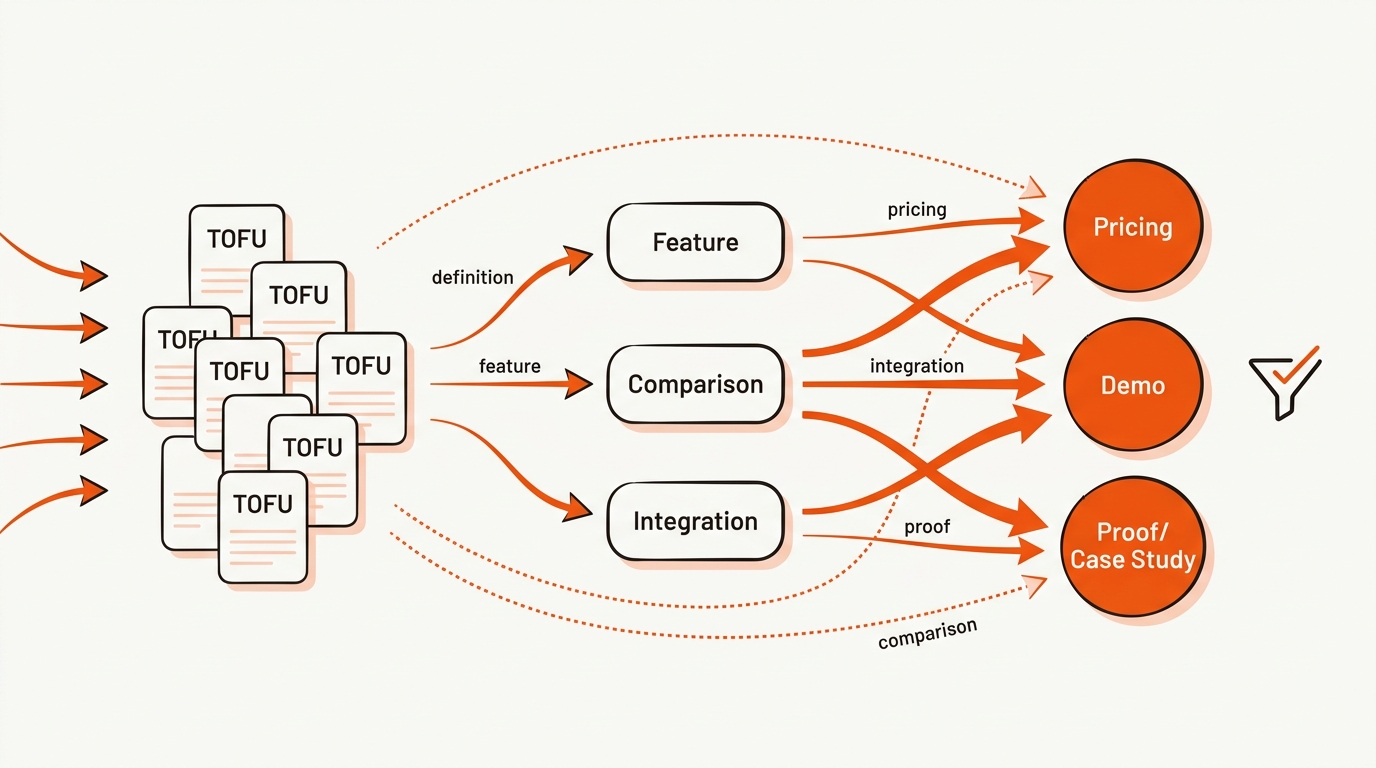
As the site grows, manual mapping breaks as indexing lag compounds and authority splits. This is where an autonomous engine or a central sheet with rules is required to avoid duplicate targets and stale anchors. When showcasing the platform, point readers to the Mergeflo product page from MOFU and BOFU content.
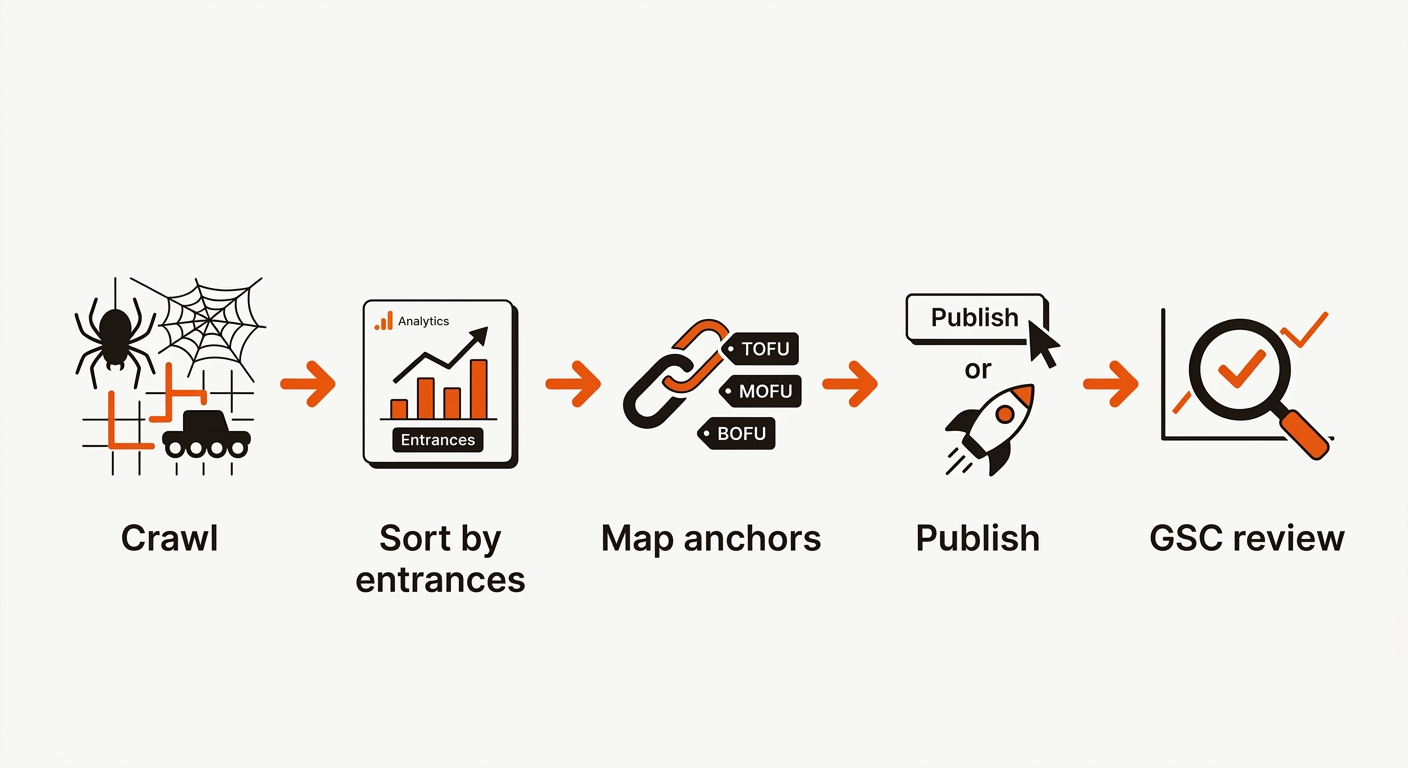
Handoff to content ops. In your CMS, create a reusable component for MOFU and TOFU posts with slots for pillar, feature, and pricing anchors. Editors select from a pre-approved list tied to the seven patterns. This reduces variance and enforces every post shipping with conversion paths.
Name: The 7-Pattern Funnel Anchor Map. This model standardizes anchor text to seven intent classes: definition, comparison, alternative, pricing, feature, integration, and proof. For every URL, assign a primary and secondary pattern that reflect what the page can satisfy next. Seed upstream posts with those anchors based on stage, and enforce one BOFU and one MOFU anchor per long-form article. The tradeoff: exact-match anchors move faster but can look spammy; mix partial matches and synonyms. Failure modes include stacking anchors at the bottom, pointing to pages that cannot meet the promise, or splitting authority across near-duplicate targets.
Here is how to estimate the return on a single linking sprint. Pick your highest-traffic early-stage posts and add contextual links from each to a few revenue pages such as Pricing, Demo, Case Study, Product and Alternatives.
• Before: record each target page's position, click-through rate and impressions in Search Console.
• After Google recrawls the linking posts, record the same numbers again.
• Compare clicks to the target pages, not just rankings, and keep the links that moved something.
Use your own Search Console click-through rate by position to set expectations; published CTR curves such as Backlinko’s study (https://backlinko.com/google-ctr-stats) vary by query type.
The funnel anchor map below turns internal linking from guesswork into a repeatable system. Each funnel stage gets a defined anchor pattern, a sample anchor, and the page type it should point at. Use it as the rule sheet your writers and your publishing agents follow on every post.
The pattern matters more than the exact words. Awareness anchors stay broad and descriptive so they read naturally inside educational prose. Decision anchors get specific and commercial so the link passes both relevance and intent to a money page. When a writer is unsure which anchor to use, they look up the stage of the paragraph they are writing in and pick the matching row.
Most startup sites do not have a linking problem, they have a measurement problem. Start with a crawl that lists every internal link, its anchor text, and its target URL. Export it to a sheet and tag each row with the funnel stage of the source page and the funnel stage of the target. Two numbers tell you almost everything: the share of links pointing at money pages and the share of money-page links using commercial anchors.
A healthy early-stage site sends a real share of its internal links to commercial pages, with descriptive anchors. If your audit shows blog posts linking only to other blog posts, authority is circulating inside the content layer and never reaching the pages that convert. Fix the worst offenders first: the five posts with the most impressions and the fewest links to a money page. Those are the pages already earning attention that leak it back into the blog instead of forwarding it to a page that sells.
The first mistake is exact-match overload. Pointing forty posts at one money page with the identical anchor looks engineered and flattens the topical signal. Vary the anchor inside the same pattern so the target page earns relevance for a cluster of related phrases, not one repeated string.
The second mistake is orphaned money pages. A pricing or product page with no inbound internal links has to rank on its own authority, which a young startup rarely has. Every money page should receive links from at least three supporting posts and two adjacent pages.
The third mistake is treating internal linking as a launch task instead of a publishing habit. Links decay as content grows: a post written before a money page existed never gets the link it should. The fix is a standing rule in your publishing workflow that every new post links to one main product page early in the article and repeats it in the call to action, then adds two supporting links to adjacent posts. Run that rule on every post and the funnel anchor map enforces itself. A practical way to make the habit stick is to bake the rule into the brief itself. When a topic is queued, attach its main product page and two adjacent posts to the brief so the writer never has to decide where the links go. That single change moves internal linking from an after-the-fact audit into the drafting step, which is the only place it scales as your post count climbs from twenty to two hundred.
Route interested readers to system pages and cluster siblings. If you need a blueprint for small teams, start with SEO for startups. For deeper platform context, review the AI SEO platform for startups and the Mergeflo product overview on your next pass through MOFU content.
External sources to consult:
• Google Search Central: Internal Links (https://developers.google.com/search/docs/crawling-indexing/links-crawlable)
• Ahrefs: Internal Links Guide (https://ahrefs.com/blog/internal-links/)
• Screaming Frog: Crawl Depth (https://www.screamingfrog.co.uk/learn-seo/crawl-depth/)
Start with a weekly cadence that fits a small team. Tag every URL by funnel stage and primary topic in a sheet. For each new post, write a few candidate anchors mapped to the pages it should support. Add a link early in the post, then one per major subsection where it helps the reader. Run a crawl to flag orphan pages and duplicate anchors. Ship in sprints, then re-crawl and check clicks per link once Google has recrawled the pages.
Internal linking startup SAAS covers the structural work of the article above: the page inventory, the workflow that keeps it shipping, and the measurement loop that confirms it's working. The sections preceding this FAQ describe each part in detail.
There is no fixed timeline. Google does not promise when, or whether, a page will rank. Watch Search Console impressions for the questions the page targets each week, because impressions move before clicks. A page with no impressions after a few months usually needs a sharper angle or more internal links.
Cost depends on who does the work: your own team's time, a freelancer, an agency or a software tool. Mergeflo has a free plan, and paid plans are listed on the pricing page.
Mergeflo researches topics, writes briefs and drafts in your brand voice, adds FAQ schema and suggests internal links. You choose the topics and approve each article, and it publishes to Webflow only when you press Publish. For pages losing reach, Mergeflo flags them, and when you press Refresh it writes a refresh brief for you to review.
