
Treat llms.txt as crawler guidance that improves attribution.
If you are shipping llms.txt for startups, use it to brief models on canonicals, citations, and licensing. The file reduces hallucinations and steers attribution in AEO contexts. It will not move rankings on its own. Use it to amplify your best docs and product pages, then measure whether answer engines echo your preferred sources.
Anchor your canonical practice and scope early. The fastest path is to mirror your docs and pricing canonicals in a lean guidance file and keep it updated with your sitemap routine. See a pragmatic approach in our LLMs.txt guidance for startups.
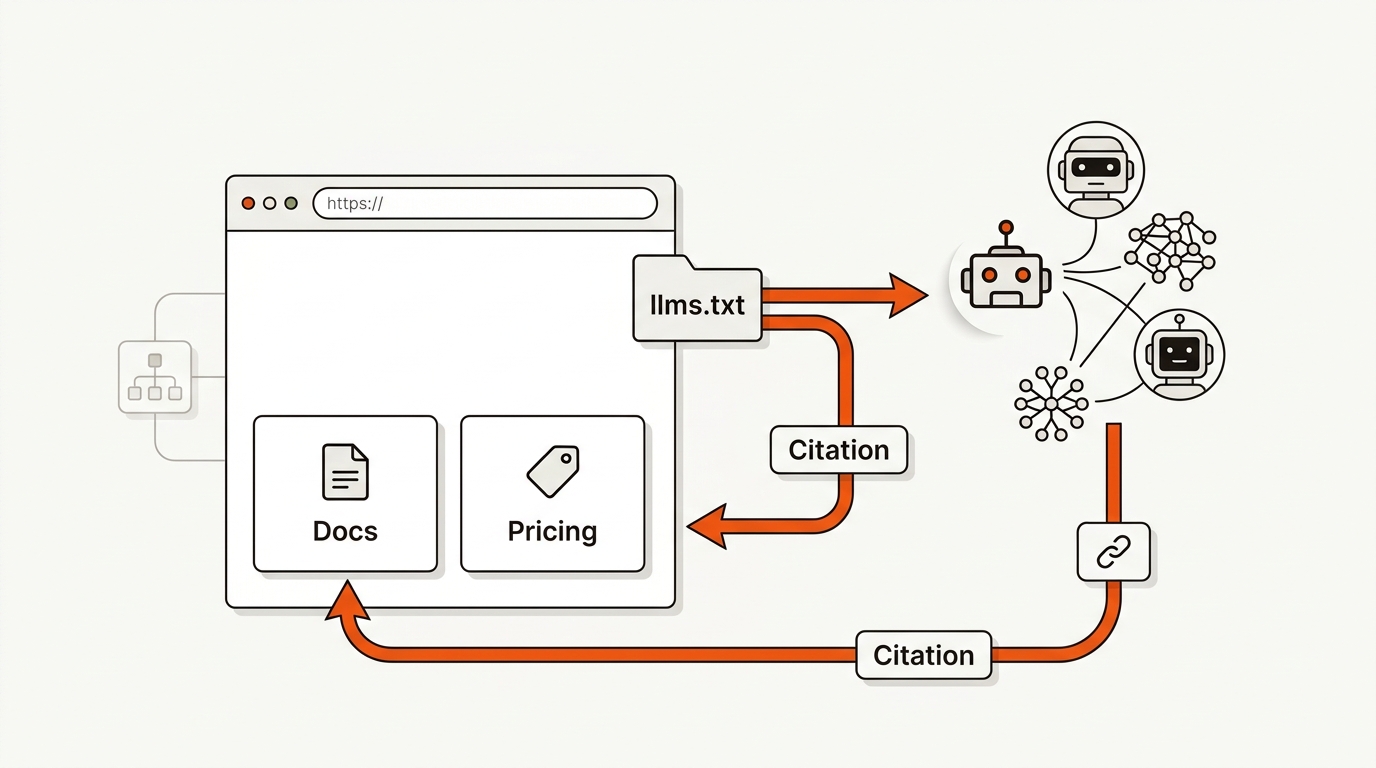
Treat llms.txt as a hint file for LLM crawlers. It does not enforce behavior.
• Useful: point to canonicals, preferred citations, licensing, brand or product summaries, and FAQs.
• Not useful: expecting indexing control, rank boosts, or guaranteed usage by every model.
Place guidance close to truth. Link back to original URLs and do not orphan summaries. Reference your docs sitemap and core product pages to keep alignment with AI search visibility goals.

Keep it short, canonical-first, and machine-scannable.
Open with a compact header: contact email, licensing note, and a two-line brand or product summary. State what models can quote, and how you want attribution to appear. Make it unambiguous and written as if a crawler will scan once.
List the main pages that matter: docs, pricing, product, security, and FAQs. Keep each to one sentence. The point is disambiguation. If you have overlapping docs pages, pick the source of truth and say so. Include a brief "Citations" directive that specifies link format and anchor preference.
Add discovery links. Reference sitemap.xml and a /docs/ index. Include a last-updated date so crawlers and auditors can match versions. Reference sibling strategy so models meet consistent signals across assets. Your AEO play should align with your AEO for startups approach and your Answer Engine Optimization platform workflow.
A four-step model stages llms.txt maturity so you can deploy fast and improve over time.
The AEO Signaling Ladder is a progression that turns llms.txt from a static file into a connected, monitored signal set. Level 1 is Baseline: publish llms.txt with a brand summary, licensing, and your main pages. It is fast to ship and reduces confusion, with the tradeoff that it can go stale if you forget it in releases.
Level 2 is Structured: add one-sentence page briefs, FAQs, and a preferred citation format. Clarity improves and you can start auditing quotes. The failure mode is duplication with your docs if you rewrite content instead of summarizing it.
Level 3 is Connected: link sitemap.xml and your docs index, and embed matching schema.org on canonicals. This creates consistent signals across files and pages. It requires light coordination with dev and docs to keep markup and llms.txt aligned.
Level 4 is Monitored: run a weekly AEO audit across engines, log cited URLs, and prune low-signal entries. This delivers the best outcomes because you can see if Perplexity or Bing Copilot shift citations toward your canonicals. It requires a tracker and discipline to keep it current.
Track cited URLs in answer engines and tie changes to specific edits.
Build a 50–100 query set that blends brand, product, and feature FAQs. Run it weekly in Perplexity, Bing Copilot, and ChatGPT browse. Use consistent phrasing so you can attribute variance to your file and not query drift. Record which answers include your preferred pages and which aggregators or competitors show up.
Log each change to llms.txt with a timestamp, then compare cite counts week over week. Correlate with schema health and sitemap freshness because conflicting signals confuse crawlers. Mid-article, link your broader plan to AI search visibility.
External examples worth studying: Anthropic, Vercel, and Stripe llms.txt patterns aggregated by Mintlify. They keep entries terse, link discovery sources, and avoid duplicating documentation.
To check whether llms.txt helps, record how often your preferred canonicals are cited in answers to a fixed set of queries, then repeat the same queries after you publish the file and compare the two counts.
This file fits into your release checklist and reduces support overhead.
For a small growth team, ops time is the scarcest resource. You already ship content with a CMS, add schema in templates, and update a sitemap during deploys. Add llms.txt to that cadence. When product or docs ship, you review whether a main page changed and whether a new FAQ belongs in the file.
Llms.txt for startups covers the structural work of the article above: the page inventory, the workflow that keeps it shipping, and the measurement loop that confirms it's working. The sections preceding this FAQ describe each part in detail.
There is no fixed timeline. Google does not promise when, or whether, a page will rank. Watch Search Console impressions for the questions the page targets each week, because impressions move before clicks. A page with no impressions after a few months usually needs a sharper angle or more internal links.
Tool costs depend on the stack you choose. Agency retainers start around $3k and climb fast. Mergeflo is software, not an agency: it researches and drafts, and your team approves what publishes.
Mergeflo researches topics, writes briefs and drafts in your brand voice, adds FAQ schema and suggests internal links. You choose the topics and approve each article, and it publishes to Webflow only when you press Publish. For pages losing reach, Mergeflo flags them, and when you press Refresh it writes a refresh brief for you to review.
