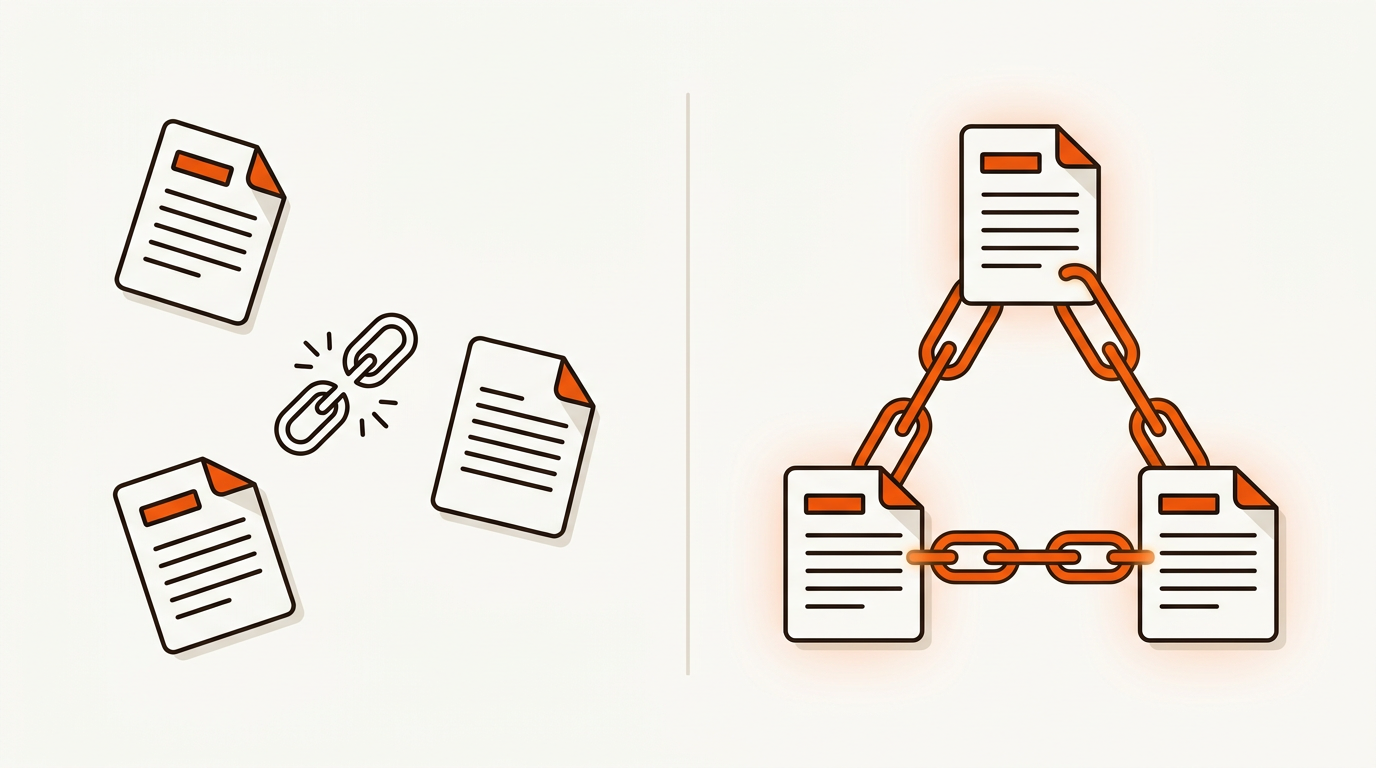
AI blog generators for startups fail without internal linking because they produce isolated pages with nothing pointing to them and nothing they point to. Search engines rank pages partly on how they connect to the rest of a site. A generator that writes fifty posts but links none of them builds fifty orphans, and orphans do not rank.
Modern AI generators are genuinely good at drafting. They produce clean structure, readable prose, and on-topic coverage in seconds. For raw text, they work.
They stop at the page boundary. A generator writes one post in isolation. It does not know your canonical pages, your pillar structure, or which two sibling posts this one should link to. It hands you a document, not a connected page inside a site.
Internal links do three jobs: they pass ranking authority between pages, they tell search engines what a page is about through anchor text, and they signal which pages are most important. Without them, every post is an island.
This matters most in clusters. A topic cluster only works because spokes link to the hub and to each other. Strip the links and the cluster is just a folder. The content can be excellent and still rank for nothing.
Orphan posts decay in predictable ways.
• Crawlers reach them rarely because few internal paths lead there.
• No ranking authority flows in, so they start from zero every time.
• Search engines struggle to place them in a topical context.
• They compete with your own pages instead of reinforcing them.
• Over months they slip out of the index entirely.
Publishing volume without structure does not build authority. It builds a graveyard.
A connected post has a predictable link footprint.
• One link up to the canonical money page it supports.
• One link up to its pillar page.
• Two links sideways to sibling posts in the same cluster.
• Descriptive anchor text on every link, never "click here."
• One relevant call to action to product, pricing, or signup.
That is the difference between a document and a ranking page. An AI SEO blog generator that ships this footprint automatically is worth far more than one that only writes text.
| Capability | AI blog generator | Autonomous SEO platform |
|---|---|---|
| Drafting quality | Good | Good |
| Internal linking | None | Automatic on publish |
| Cluster and pillar mapping | None | Built in |
| Schema and FAQ blocks | Sometimes | Standard |
| CMS publishing | Manual copy-paste | Direct to CMS |
| Content refresh | None | Scheduled |
If you have a back catalog of disconnected AI posts, you do not need to delete them. You need to connect them.
• Audit every post for inbound and outbound internal links.
• Map each post to one canonical page and one pillar.
• Group posts into clusters and link siblings to each other.
• Rewrite generic anchors into descriptive ones.
• Add a clear call to action where it is missing.
Retrofitting a link graph onto existing content is one of the highest-return SEO fixes available to a team that published volume without structure.
Mergeflo suggests internal links as part of drafting, not as a cleanup task. Each draft is planned within the AI SEO content structure, with suggested links up to its canonical page and pillar and sideways to siblings, and a person approves them before publishing.
That means you get connected pages, not orphans, from day one. For a broader look at the category, see our roundup of the best AI SEO tools for startups.
See it work on one real topic: Start free. The free plan has 250 credits once and needs no credit card.
Draft linked content and publish it with Mergeflo.
Most AI blog generators write each post in isolation with no links to or from the rest of your site. Search engines rank pages partly on how they connect to other pages, so isolated posts become orphans with no authority flowing into them. The writing can be strong and the page still fails to rank.
Yes. Internal links pass ranking authority between pages, tell search engines what a page is about through anchor text, and signal which pages matter most. For a topic cluster they are what holds the structure together. Remove them and even excellent content is just a folder of disconnected files.
At minimum, each post should link up to one canonical money page, up to one pillar page, and sideways to two sibling posts, plus a relevant call to action. That is roughly four to six contextual internal links. The exact number matters less than making sure no post is left orphaned.
Yes, and you should. Audit existing posts for orphans, map each to its canonical page and pillar, then add upward and sibling links with descriptive anchor text. Retrofitting links into a back catalog of AI content is one of the highest-return SEO fixes for teams that published volume without structure.
An AI blog generator drafts text. An autonomous SEO platform runs the full workflow: it maps topics to canonical pages, generates drafts, applies schema, wires internal links on publish, and pushes to your CMS. The generator is one step; the platform connects that step to the structure that makes content rank.
Yes. When Mergeflo drafts a post, it suggests links up to the pillar and sideways to sibling posts, and a person approves them. The link graph is built as part of publishing, not left as a manual cleanup task in a spreadsheet.
Use descriptive, keyword-relevant anchor text that matches the target page, not generic phrases like click here or learn more. For a money page, anchor with the topic it owns, such as AI SEO blog generator. Descriptive anchors help search engines understand the target page and improve the relevance signal.
