
AI SEO agents vs SEO automation comes down to autonomy: does the system plan, work, and iterate without prompts, or is it scripts with AI lipstick. Measure autonomy at the workflow level: research to publish to maintain. A production-grade agentic SEO platform recovers without human intervention. Anything else is theater in a nicer UI.
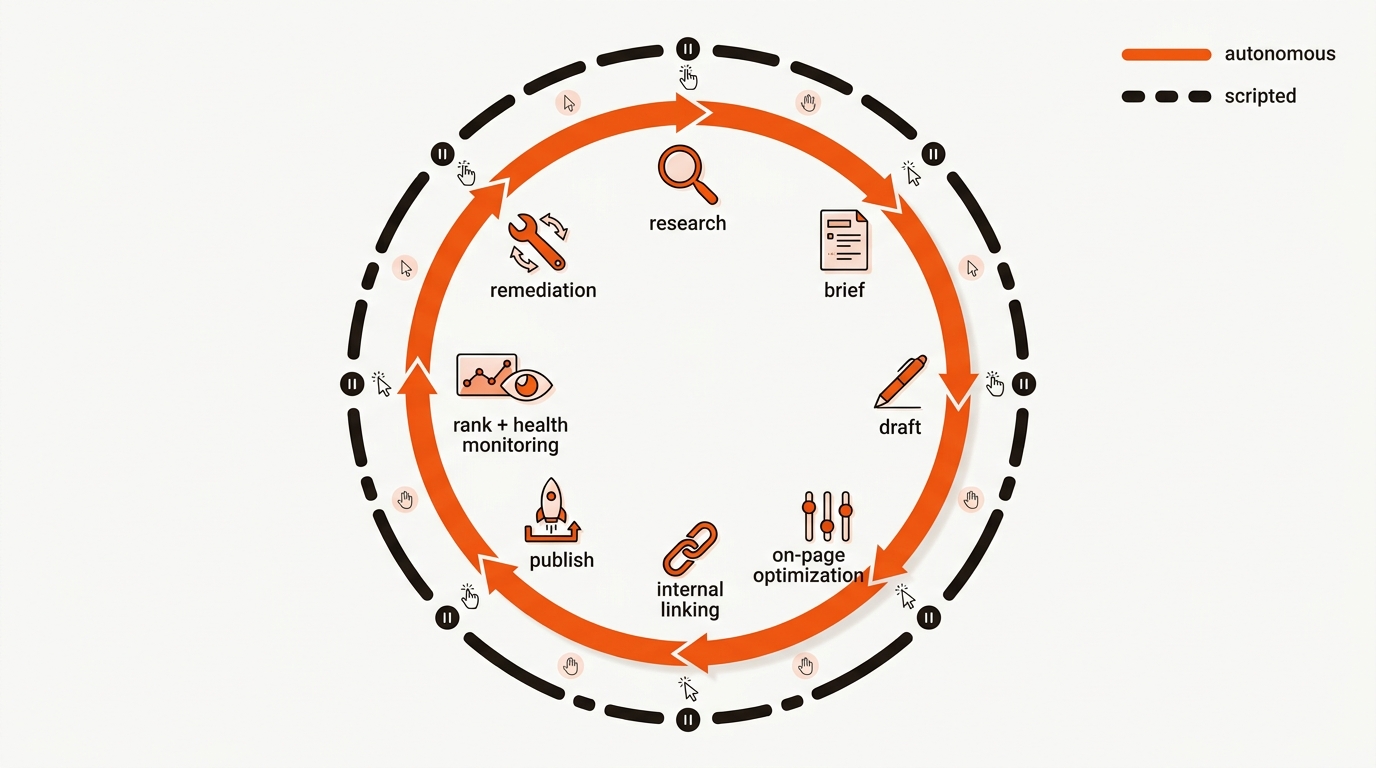
You are buying time-to-value; misreading autonomy costs months and budget. A 3-person growth team with a 2k/month content budget cannot babysit prompts. You need a workflow engine that converts inputs into published, optimized pages with measurable rank movement and minimal review time. Evaluate by throughput, accuracy, and the cost of exceptions.
Cite proof-of-work. Ask for data: pages per week to publish, average time to index, CTR lift from on-page updates, and human minutes per page. See practitioner takes from Ahrefs, vendor claims you can verify via Frase, and neutral reporting from Search Engine Land. Keep your eye on AI answer surfaces as well; GEO optimization now impacts click expectations for long-tail terms.
Many AI SEO agent pitches reduce to scheduled scripts, static prompts, and dashboards that still need you to click. Real agents use tools, hold memory, plan against goals, and run closed loops that ship content and attempt recovery when ranks slip.
If a vendor cannot show end-to-end autonomy wired to your CMS and GSC, you are buying an editor with a friendlier UI. For a system view beyond marketing pages, this perspective on autonomy is useful: what agentic SEO actually means.
Judge systems by capabilities that move rankings and revenue. If autonomy stops at draft generation, you still carry QA, publish, and remediation work.
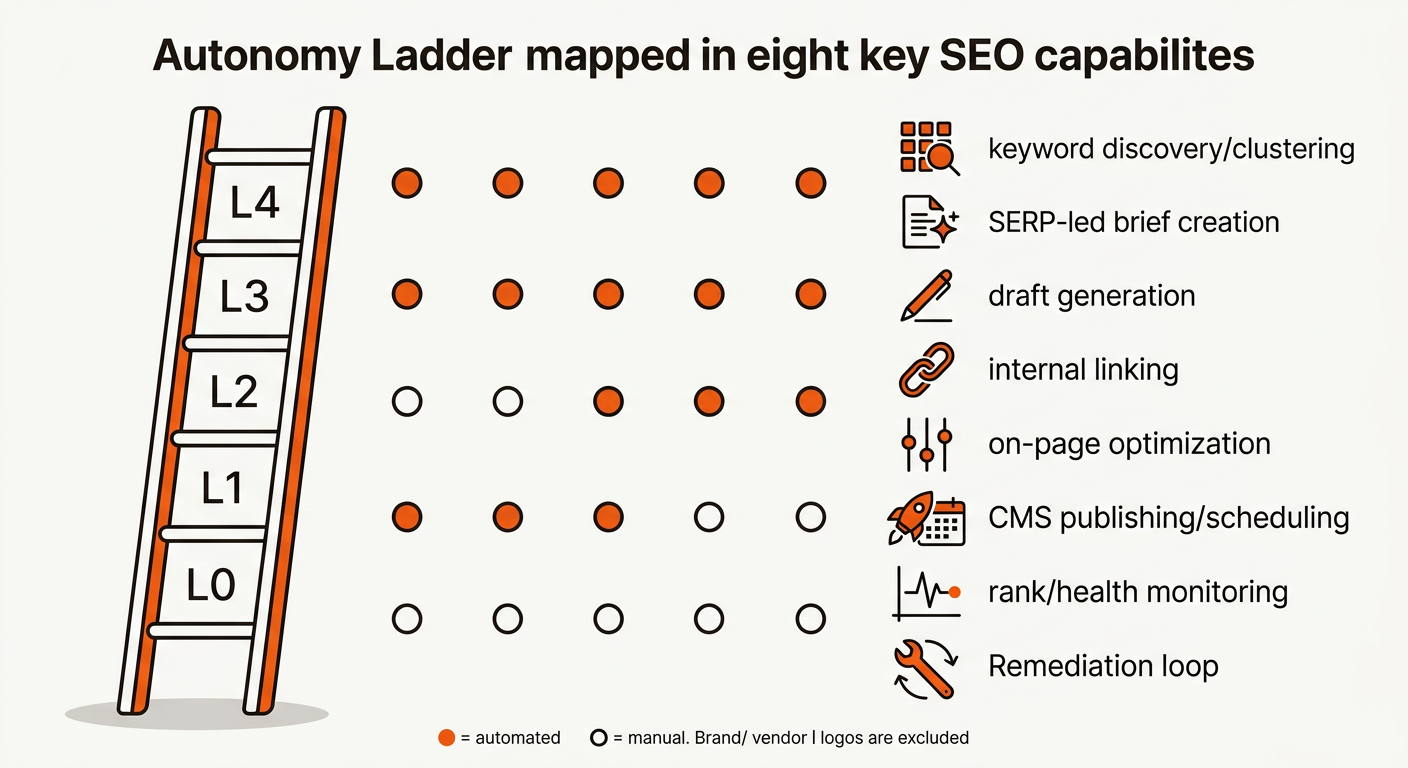
The Autonomy Ladder ranks systems from Level 0 to Level 4 across SEO tasks. Level 0 is manual doers. Level 1 scripts single tasks on a schedule. Level 2 composes tasks into flows but still waits for human prompts. Level 3 plans, executes, and self-checks with tool use and memory. Level 4 adapts to outcomes and triggers remediation without your direction. Target Level 3+ for research, briefs, on-page, internal links, and publication. Keep human gates where brand, compliance, and E-E-A-T matter. Tie the center of your stack to an autonomous SEO model that keeps pages healthy while your team ships product.
• Real automation assumes tool access, CMS and GSC integrations, and policy gates.
• Many tools claim the step but require human clicks or exports.
• The differentiator is closed-loop execution and safe publish rights.
A 40-page cluster at difficulty 28 with total monthly volume of 26,000 needs 10 pages per week to go live in 4 weeks. If your system automates clustering → brief → draft → optimize, and you cap human review before publish at 18 minutes per page, total human time is 40 pages x 18 minutes = 720 minutes, or 12 hours for the entire cluster.
At positions 3-7, assume a 2.2 percent average CTR. Estimated monthly clicks if the cluster reaches those positions: 26,000 impressions x 0.022 = 572 clicks. If refresh briefs save 30 minutes on each of 20 slipping URLs per month, you free 20 x 30 minutes = 600 minutes, or 10 hours per month. That reclaimed time funds new clusters that expand your footprint for the same budget.
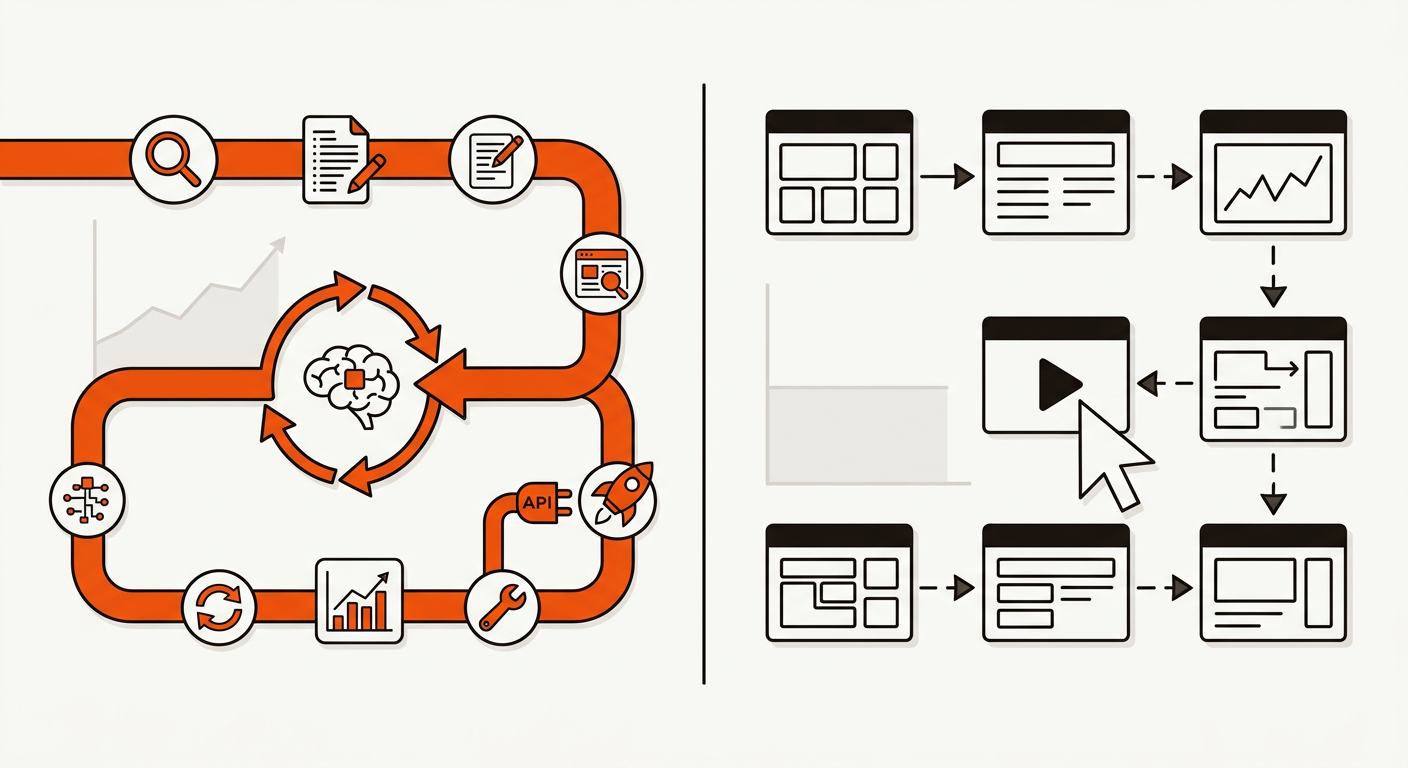
Compare models on throughput, cost, QA load, and iteration speed because those metrics predict rankings at scale. A small team must hit a weekly publishing cadence without quality collapse.
Dashboards produce reports. If you are comparing architectures, the autonomous SEO platform approach details how publishing rights and QA gates are modeled in production.
If your roadmap targets 200+ pages in two quarters, exception handling and indexing lag become the choke points. Manual and dashboard-led workflows stall first on handoffs. Agencies preserve quality but slow reseeding and remediation cycles. AI writers stall at CMS and break on internal linking. Mergeflo is built as an autonomous SEO platform that drafts pages and flags decaying ones, while your team guides topics and E-E-A-T.
If these checks fail, you are buying theater packaged as autonomy.
• Goal wiring: can the system take a target query list, constraints, and a traffic goal, then plan sprints without prompts.
• Live data: does it read GSC, crawl your site with Screaming Frog or similar, and pull SERP data at runtime.
• Tool use: can it call APIs for clustering, NER, schema, and publishing, with retries and logging.
• Memory: does it persist decisions per cluster and reuse learnings across pages.
• Policy gates: can you set brand, legal, and compliance rules that block publish when violated.
• CMS rights: does it create, update, schedule, and revert within your CMS with version control.
• QA budget: can you cap human review to under 30 minutes per page at 10+ pages per week.
• Recovery loop: does it detect rank drops and ship updates without waiting for your direction.
This is the moment to move to full autonomy: you pass the checklist, you have a backlog of 50+ target URLs, and you can map outputs to revenue pages. For agent design patterns and team shape, see autonomous SEO agents in practice.
Real questions teams ask before they ship.
Ask for a sandbox wired to your CMS. Measure pages published in 14 days, average human minutes per page, indexing time, and rank movement on 5 target queries. If the vendor refuses CMS wiring, you are not testing autonomy. Run a 3-step test: feed the tool a broken URL, an incomplete brief, and a 404 link, agents recover and surface the issue, automation halts with an error and waits.
Indexing lag and exception handling. Without monitoring and automated retries, long-tail pages stall. Ensure the agent can triage soft 404s, missing schema, and conflicting internal links without manual hunts. Internal link drift and schema validation break first; both compound silently for weeks before showing in GSC, so monthly automated audits are non-negotiable past 200 pages.
Strategy, E-E-A-T, and brand judgment. Keep humans on topic selection, brief acceptance, and final QA on sensitive pages. Automate mechanics; supervise meaning. Humans set strategy, approve brand voice on hero pages, and own stakeholder reporting, execution layers can run autonomously but those three decision gates still need founder eyes.
Model cost per page shipped and maintained. If an agent publishes 60 pages per month with 25 minutes of your team’s time per page and raises CTR by 0.4 to 0.8 percentage points, the math often beats a 10k retainer tied to 8 deliverables.
Yes, if you standardize templates, centralize rules, and connect CMS and GSC. Expect a 2-3 week setup and then 10-15 pages per week with a 20-30 minute QA budget per page.
Insist on transparent exports: markdown, JSON briefs, link graphs, and logs. Ask for API-first architecture and the ability to version policies outside the vendor UI. Demand markdown or HTML export plus a clean CMS API integration before signing; tools that lock content behind proprietary editors become exit pain at 100+ pages.
Create, update, schedule, and revert privileges for a service account, plus a pre-publish webhook for QA. No blanket admin rights. Grant publish on draft items only, with required-field validation enforced server-side and audit logs enabled so you can roll back any unauthorized field changes within seconds.
Map claims to the eight capabilities. Then review real CMS publish, automated remediation, and minutes-per-page. If you want a point-by-point view, see the Mergeflo vs Search Atlas Otto comparison. Compare on autonomy depth, not feature lists, ask each vendor to ship 5 pages end-to-end with no human prompts and measure how many actually publish without intervention.
• Agentic SEO for Startups: a Practical Mergeflo Playbook
• SEO Agency Retainer vs Autonomous SEO: Costs and Outcomes
