
Most teams overpay in hours for work AI agents can do in minutes; agentic SEO for startups compresses the content pipeline without sacrificing ranking control. You do not need a larger team to ship faster. You need agents that handle repeatable steps and guardrails that keep quality tight.
Agentic SEO for Startups is not theory. It is the practical use of interconnected AI agents to plan, produce, and publish search-optimized assets on a weekly cadence. Use agents where inputs are structured and outputs are checkable. Keep humans on brand, truth, and edge cases. That split wins rankings on constrained budgets.
Agents do not negotiate brand tone, resolve product nuance, or invent proprietary data. Keep those with humans. Everything else is a queue.
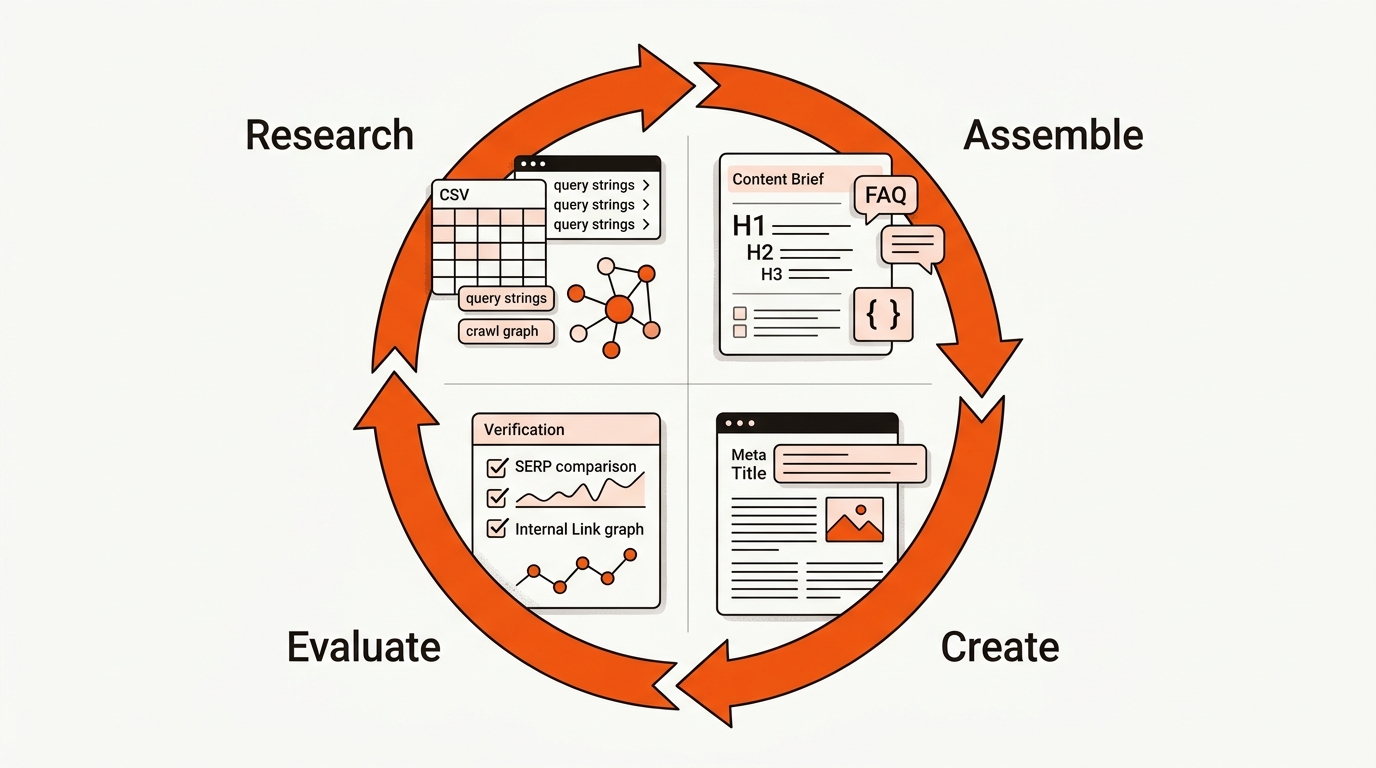
For deeper context, see Agentic SEO Platform.
You’re a founder or growth lead at a small startup, already shipping blog posts every month, and the marginal hour of operator time is killing you. You have Ahrefs or SEMrush, a CMS you control, and at least one main product page live. This guide is for you if you’re publishing manually with ChatGPT-as-copilot but the orchestration overhead (briefs, edits, schema, internal links, publish, refresh) is dominating your week.
Most startups bolt AI onto an existing manual workflow. ChatGPT writes a draft, an operator pastes it into Notion, an editor cleans it, someone publishes. Five tools, four handoffs, three days per post. The result: AI as a fancy autocomplete, with all the orchestration cost still on humans. Agentic SEO inverts this: agents own the orchestration (research, brief, draft, schema, publish), humans own brand voice, factual edges, and approval. The cost saving isn’t in drafting; it’s in eliminating the four handoffs.
Treat your SEO as a mesh of small, specialized agents with explicit contracts.
The Mesh Framework connects five agent roles: Discover, Decide, Draft, Decorate, and Deploy. Discover expands and clusters keywords; Decide prioritizes targets by KD, business value, and SERP fit; Draft creates briefs and first-pass copy to spec; Decorate adds schema, links, media, and GEO elements; Deploy publishes, pings endpoints, and verifies rendering. Each agent accepts structured inputs and emits structured outputs so you can swap models or tools without breaking the chain.
Tradeoffs: more agents mean more handoffs to validate, but clearer failure points. Failure modes include stale data (old SERPs), hallucinated facts in Draft, and link loops from Decorate. Mitigate with validators after each agent and a thin human review on claims and brand.
Agentic SEO for Startups works when agents are narrow and measurable. Write contracts first, prompts second.
For deeper context, see What Is Autonomous SEO.
Scope output and validate inputs before you estimate what a one-week cluster build could return.
Here is how to size a first batch without inventing a forecast.
• Inputs: a seed keyword list from Ahrefs or Semrush, filtered to a difficulty you can realistically win, with each keyword's monthly volume.
• Position goal: decide which pages you expect to reach page one, and write that assumption down so you can check it later.
Math:
• Projected sessions: for each page, multiply its keyword volume by the click-through rate you assume for its expected position.
• Use your own Search Console click-through rate by position if you have it; published CTR curves vary widely between studies.
Then check the projection against Search Console after a few months. Time savings: compare the hours your agent stack takes to produce a batch of briefs and first drafts with the hours the same work takes by hand. That delta funds deeper human edits where it matters.
Treat this as a rough estimate. Any compounding comes from internal links and additional pages in weeks 2-4.
For deeper context, see Autonomous SEO.
Build a repeatable lane: same inputs, same checks, weekly shipping.
Pull seeds from Ahrefs or SEMrush; export KD, volume, SERP features, and parent topic. Agents expand via related queries and PAA, then cluster by intent. Output a CSV with cluster_id, intent, KD, volume, and suggested URL slug.
Decide agent scores clusters by business value (bottom-funnel > mid), SERP gap (thin pages to beat), and authority fit (KD vs. your DA). Pick a weekly batch size that matches edit bandwidth. Start small enough that every page gets a real edit.
Draft agent creates briefs with H2/H3s, evidence notes, and internal link targets. It then drafts to the brief. Human editor tightens brand voice, verifies claims, and adds product truth. Set a time budget per piece that still lets the editor check every claim.
Decorate agent adds schema (Article + FAQPage), compresses and captions images, injects 2-3 internal links, and builds answer-first intros. It also adds a concise table when numbers matter because tables get cited by LLMs.
Deploy agent publishes to the CMS, updates sitemaps, triggers IndexNow for Bing, performs live URL fetch to confirm rendering, and logs canonical and noindex checks. This closes the loop so crawl and index events are actually visible.
For deeper context, see AI SEO Tools vs AI SEO Execution Platforms.
Answer engines prefer concise facts with provenance; format your content to be citable.
Agents can pre-build answer blocks that map to conversational prompts: short definition + 3-5 verifiable facts + 1-2 citations. Add FAQPage schema with the exact phrasing of common questions. Use fresh sources (updated within the last 12 months) for citations; agents can verify last-modified headers and cache dates.
Structure matters for GEO: Put the core answer near the top. Include one small table with key numbers or steps; tables are easy to extract. Generate claim-evidence pairs: sentence, citation, date. Agents can assemble these from the brief’s source list.
Keep answers neutral and specific. If a claim requires proprietary data, label it clearly. Ambiguity gets ignored by GEO systems.
Humans own brand, truth, and high-risk edges; agents own the rest.
Use agents to do the heavy lifting, but gate the failure modes that can tank trust or create thin content. The point is speed with quality.
Operational tradeoff: deeper edits reduce weekly page count. For early-stage teams, fewer strong pages beat many thin ones. Find the edit time per piece where your editor can keep factual accuracy high and still publish on a weekly schedule.
Constraint-led planning beats aspirational volume; scope output to your edit bandwidth.
Team setup: A product marketer, a content lead and a part-time no-code operator, with a modest tool budget, selling to SMB SAAS (all assumptions for this example).
Week 1-2: Discover/Decide agents propose a cluster of low-difficulty keywords. The first batch is small. The draft agent writes drafts for review, and the content lead edits each one. The team adds schema, approves suggested internal links, and publishes over 3 drops.
Bottlenecks: Editor exhaustion is the first limit. Cue: publish fewer pages per week and raise page depth on bottom-funnel terms. Indexing lag grows as volume grows. Stagger drops, maintain fresh internal links to new pages, and keep crawl paths short.
Target low-to-mid KD clusters with clear SERP patterns and repeatable structures.
The fastest wins come from: Glossaries and integrational pages with consistent formats. Problem-solution guides where answer-first intros and FAQ schema unlock snippets. Comparison pages where agents can draft structured pros/cons, then humans add product truth and differentiators.
Avoid starting with YMYL or highly narrative content. Those soak edit time and blur agent boundaries. Build authority on predictable structures first, then expand.
For deeper context, see Mergeflo vs Seobot.
Automate anything you can validate automatically; defer anything that needs original judgment.
Automate now: Keyword expansion, clustering, briefs, internal linking, schema, media ops, and GEO blocks.
Defer or co-pilot: Pricing strategy pages, security/compliance claims, customer stories, and any assertion tied to legal or revenue risk.
Agentic SEO for Startups works when you apply it to the work that is pattern-based and easy to audit. That frees people for the work that builds trust and conversion.
Stand up a small agent mesh, set an edit budget per piece, and publish a steady weekly batch you can review properly.
Use Ahrefs or SEMrush for inputs, Screaming Frog to inform interlinking, and GSC to verify enhancements post-publish. Keep the stack boring, fast, and measurable. The compounding effect of consistent shipping plus internal links will outperform sporadic, handcrafted posts.
Agentic SEO for Startups is not about more content. It is about more pages that rank, shipped on a clock, with facts that stand up when crawled and when cited by AI.
ChatGPT is a single agent (drafting) plugged into a human-orchestrated workflow. Agentic SEO is a mesh of specialized agents (Discover, Decide, Draft, Decorate, Deploy) connected via structured contracts where the OUTPUT of one is the INPUT to the next: no human in between.
Yes, but keep the weekly batch small enough to edit properly, and spend the saved time on edits and brief quality. When review becomes the bottleneck, add an operator or move more first-pass review to a stronger editing model.
Two layers catch it: validators after each agent (URL existence checks, citation date checks, schema validation against Rich Results) and human review on claims + brand. Solution: require agents to cite primary sources with date stamps, then auto-flag any claim where the citation 404s or the source is >24 months old.
Draft and Decorate (GEO answer blocks). Draft because factual claims need verification; Decorate because schema markup needs to match visible content. Discover, Decide, and Deploy run with minimal human oversight in steady state: they’re structured tasks where validators catch failures cheaply.
LLM costs scale with output, so check your provider's per-token prices against your planned volume. Add an SEO data tool such as Ahrefs or Semrush (see their pricing pages), your CMS, and operator hours every week. Compared with a managed platform, you may save cash but spend more time on orchestration. Compared with a tool stack plus freelancers, you may save both.
YMYL content (financial, medical, legal) where compliance review is non-negotiable: agents can draft but every claim needs SME approval, eliminating the throughput gain. Highly bespoke brand voice (e.g. Stripe’s, Linear’s) where several draft passes are needed per page. And very low-volume niches where the SERP doesn’t reward structural depth: you’re better off with a few hand-crafted pages than many templated ones.
• What Is Autonomous SEO? A Practical Guide for Startup Founders
• AI Blog Generators for Startups: What Actually Matters
