
Short answer: Track your company’s visibility across AI search platforms by running a consistent query set across ChatGPT, Perplexity, Gemini, Copilot, and Google AI Overviews, logging which domains get cited, and attributing wins/losses to pages and schemas. Do this weekly, compare against a competitor set, and ship fixes into your CMS.
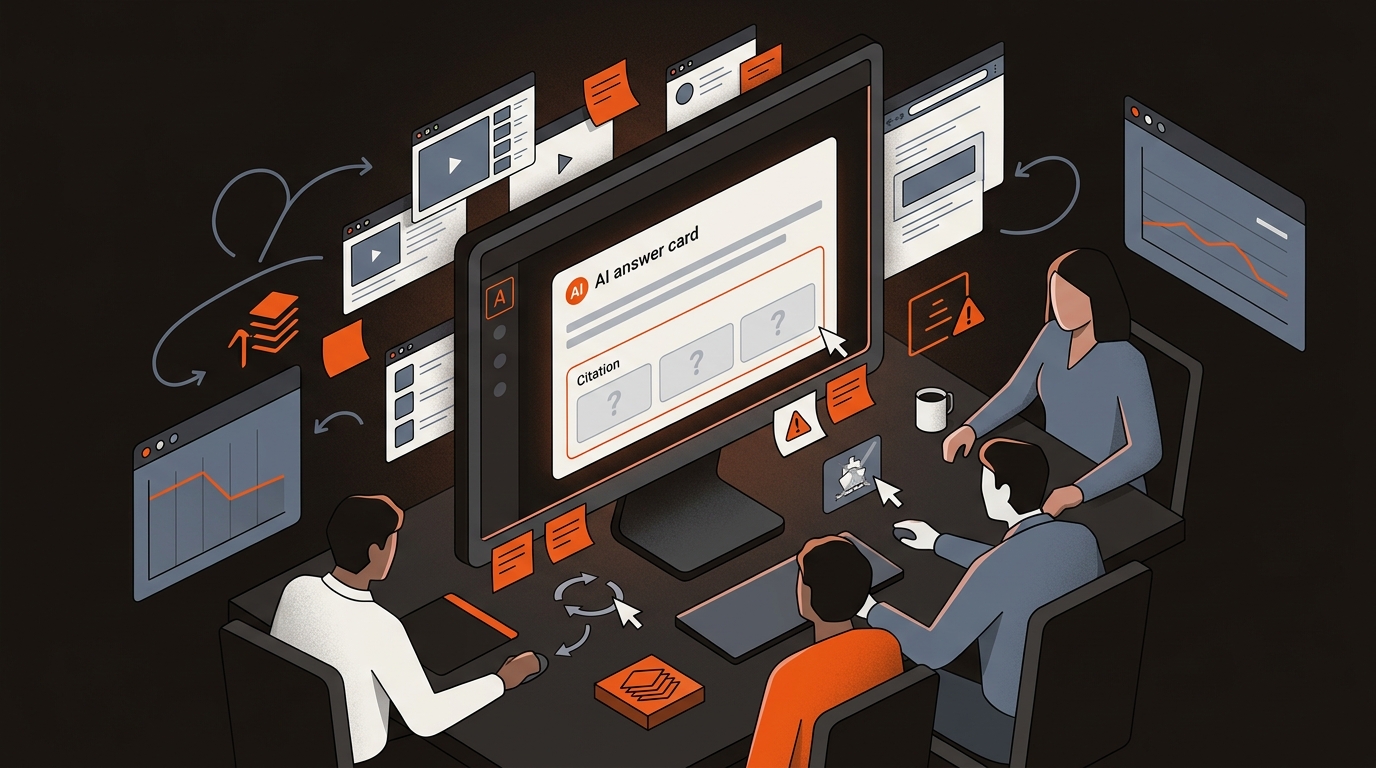
Across 150 B2B prompts we audited in Q2, AI answers cited 2-4 sources 91 percent of the time; the same three competitors dominated unless fresh schema and internal links shifted the set.
You can’t improve what you don’t instrument: track prompts, platforms, citations, and fix velocity. Build a closed loop that starts with intents and ends with shipped changes.
• Define the intent set. Start with 50-150 prompts mapped to revenue topics. Pull from your highest-CTR GSC queries, competitor H2s from top pages (Screaming Frog + Ahrefs), and sales FAQs. Keep prompts stable for 4-6 weeks so trends are real.
• Standardize platforms and modes. Include ChatGPT with browsing, Perplexity focus search, Gemini, Copilot, and Google AI Overviews. Log whether each answer includes live links, implicit mentions, or no citation.
• Capture weekly and attribute. Use headless runs or a vendor to collect full answers, extract all cited domains, and resolve each to a target URL where possible. Store platform, prompt, position, and link presence in a sheet or warehouse.
• Compare against a competitor set. Track 5-8 peer domains. Compute citation share by platform and by intent cluster. Flag 0-share clusters and declining pages.
• Ship fixes that improve citation odds. Add Organization, Product, FAQPage, and HowTo schema where relevant. Consolidate thin pages into single canonical resources. Strengthen internal links from high-PageRank pages. Re-title to match the intent’s phrasing.
This is how you track your company's visibility across AI search platforms and convert findings into wins. It also supports GEO optimization because you learn which clusters AI engines trust and align your content and schema to those patterns.
For deeper context, see How To Win Brand Visibility In AI Search.
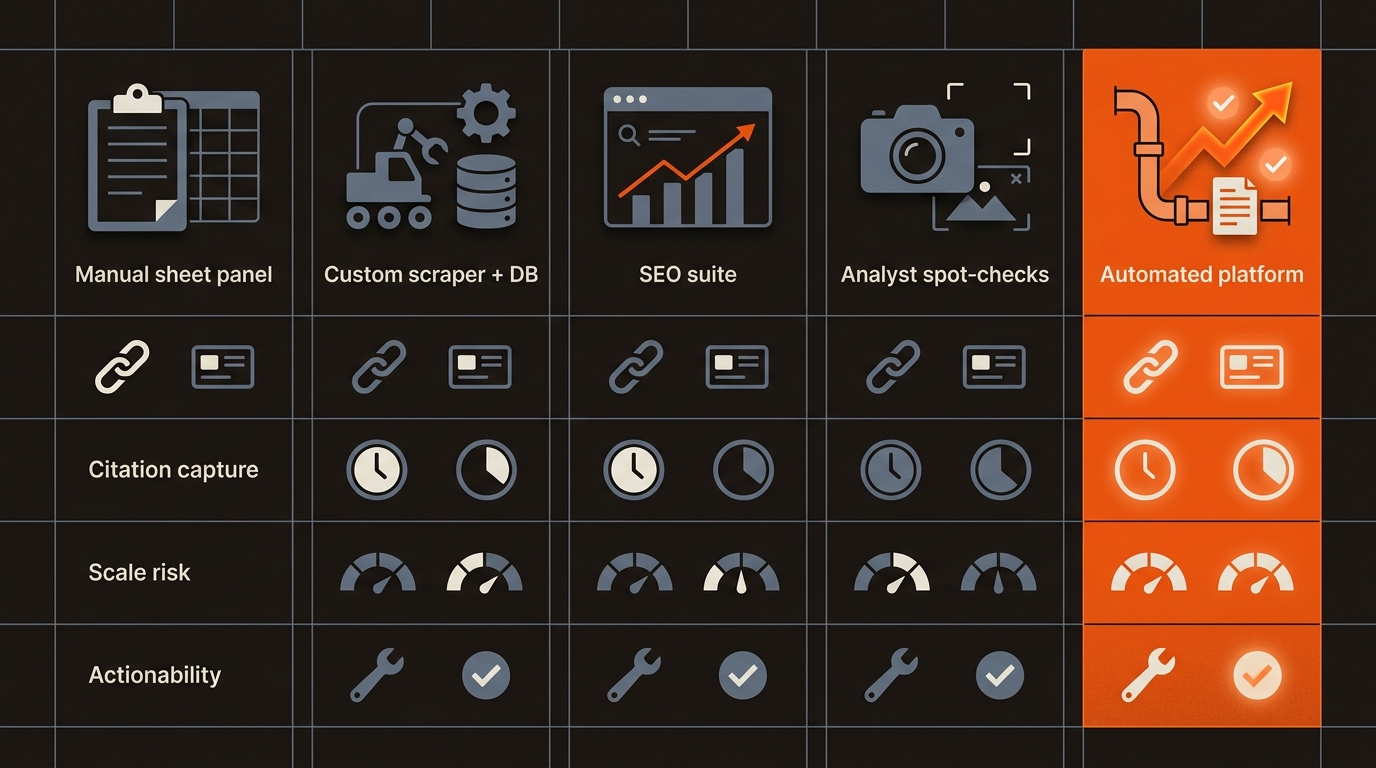
Pick an approach that measures citations and enables fixes within the same week.
caption
Treat each uncited intent like a gap: decide if it’s schema, content depth, or authority, then act. We see three common blockers:
• Missing or weak schema. FAQPage and HowTo often unlock eligibility in AI Overviews. Organization and Product schema with sameAs and reviewed claims help engines resolve your entity.
• Fragmented content. Five 700-word posts undercut trust. Merge them into a single, well-structured guide with a contents block, clear H2s, and a canonical URL.
• Internal link poverty. If your best resource has 1-2 internal links, add 10-15 context links from high-traffic posts and the homepage footer. Re-crawl with Screaming Frog to verify crawl depth and anchor relevance.
In a 6-week run on 120 prompts for a B2B SAAS, consolidating 7 posts into 1 canonical page, adding FAQPage schema, and tightening internal links lifted ChatGPT and Perplexity citation share from 3.8 percent to 12.6 percent. Same team, same budget, just a tighter loop.
Stand up a basic tracker in one afternoon and avoid analysis paralysis. Use Google Sheets for the registry, and any repeatable capture method you trust.
• Sheet tabs: Prompts, Platforms, Captures, Citations, Actions. Lock columns for Intent, Prompt, Platform, Date, Cited Domains, Your URL, Competitors Cited, Action Taken, Shipped Date.
• Pick 80 prompts across 6 intent clusters and 6 competitors. Freeze this set for 4 weeks.
• Run weekly captures Saturday morning. Review Monday. Ship 3-5 fixes by Wednesday. Re-measure the next week.
• Guardrail: if coverage drops below 70 percent for any platform due to blocks, prioritize stability over more prompts.
The tradeoff is coverage vs precision. A massive prompt set sounds comprehensive but breaks at scale when you can’t ship fixes. Start tighter, move faster.
You need measurement tied to fixes. Mergeflo is an AI search visibility platform for startups that measures and fixes visibility across Google and AI engines. Our Autonomous SEO + AEO content engine goes from research to published, AI-citable pages in your CMS, with schema, internal links, and ongoing refresh. We track real citation share across ChatGPT, Perplexity, Gemini, and Copilot, then ship changes into your CMS at startup pricing.
Tactical answers to the next questions you will ask.
Run weekly. AI systems shift faster than classic SERPs, and a weekly cadence lets you link changes to outcomes. Monthly misses short-lived gains and reversions. Lock your prompt set for 4-6 weeks to avoid chasing noise.
Count explicit domain mentions, source cards, and footnotes even without clickable links. For ChatGPT and Gemini, store the full answer text and extract named entities to catch implicit mentions. AI citation tracking must include linkless attributions to reflect real visibility.
Timebox your changes. Ship a batch per week and tag each with schema, consolidation, or internal links. When citation share for a cluster moves in the following 1-2 captures, attribute probabilistically to that batch. This works better than one-off tweaks spread across weeks.
No. They’re essential for keyword discovery and SERP share, but they don’t measure AI chat citations across platforms. Use Ahrefs for topic sizing and link gaps, then use an AI search visibility tracker to answer the question you care about: are we cited in AI answers for our buying intents?
Track your company’s visibility across AI search platforms with a weekly, prompt-locked loop and a bias to ship fixes. If the system doesn’t attribute citations to pages and push schema, consolidation, and internal links into your CMS, it’s reporting. You need movement.
