
Short answer: Translate product positioning into an SEO content map startup teams can ship by mapping category to a pillar, ICPs to segment landers, pains to problem pages, alternatives to comparisons, proof to case studies, and objections to FAQs. Assign intent and primary keywords with Ahrefs or SEMrush, cluster with internal links, and route each page to signup.
A content map is the front half of the startup SEO playbook. Once the map exists, SEO for startups shows how to build the pages in order.
Content that ignores page types and intents rarely converts, even if it brings traffic. The tell: dozens of blogs, no category pillar, thin comparisons, and a flat internal link graph. You chase volume and miss queries that mirror how your sales story lands.
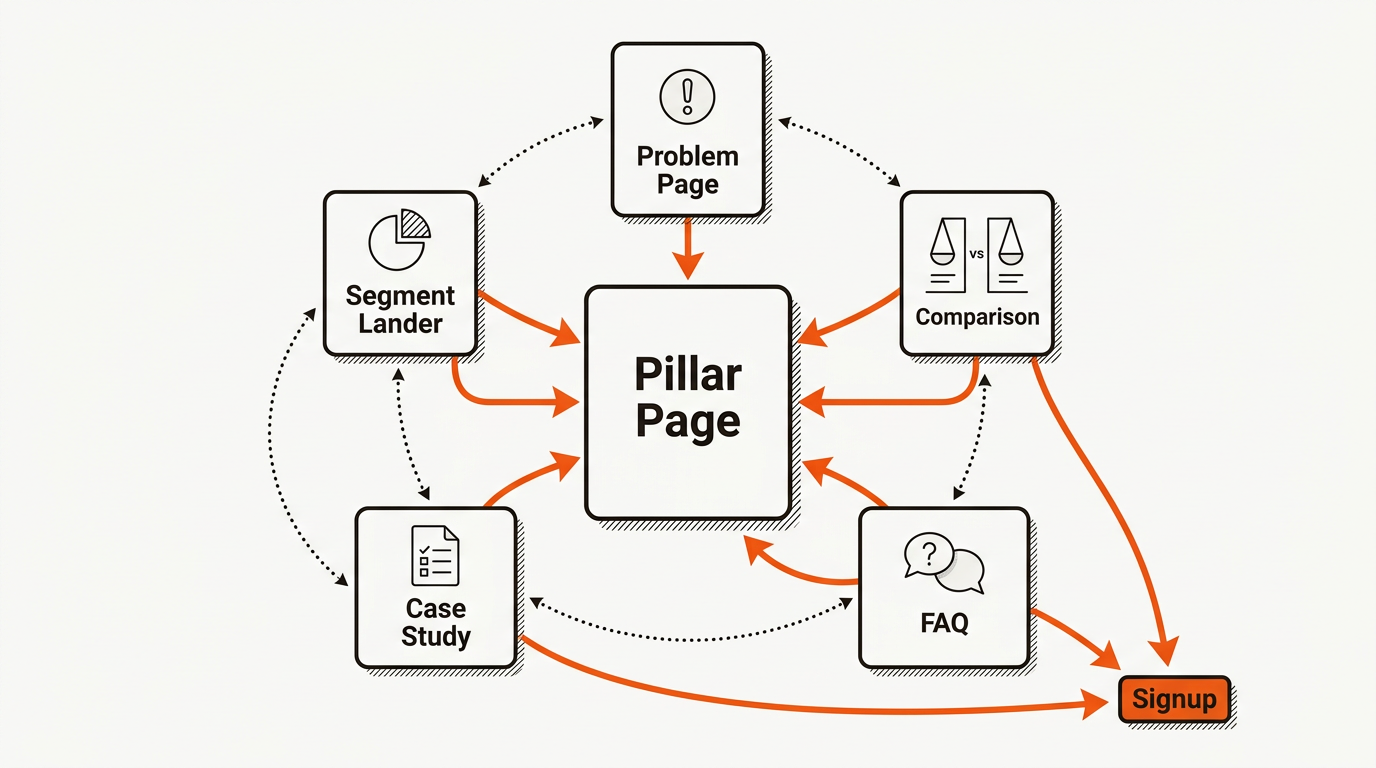
The fix is mechanical. Start with your positioning doc. For each pillar (category, ICP, pain, alternatives, proof, objections), define the page type, primary intent, target keyword, and the two-link path into your conversion pages. Publish only when every page is linked to the pillar and at least one segment lander.
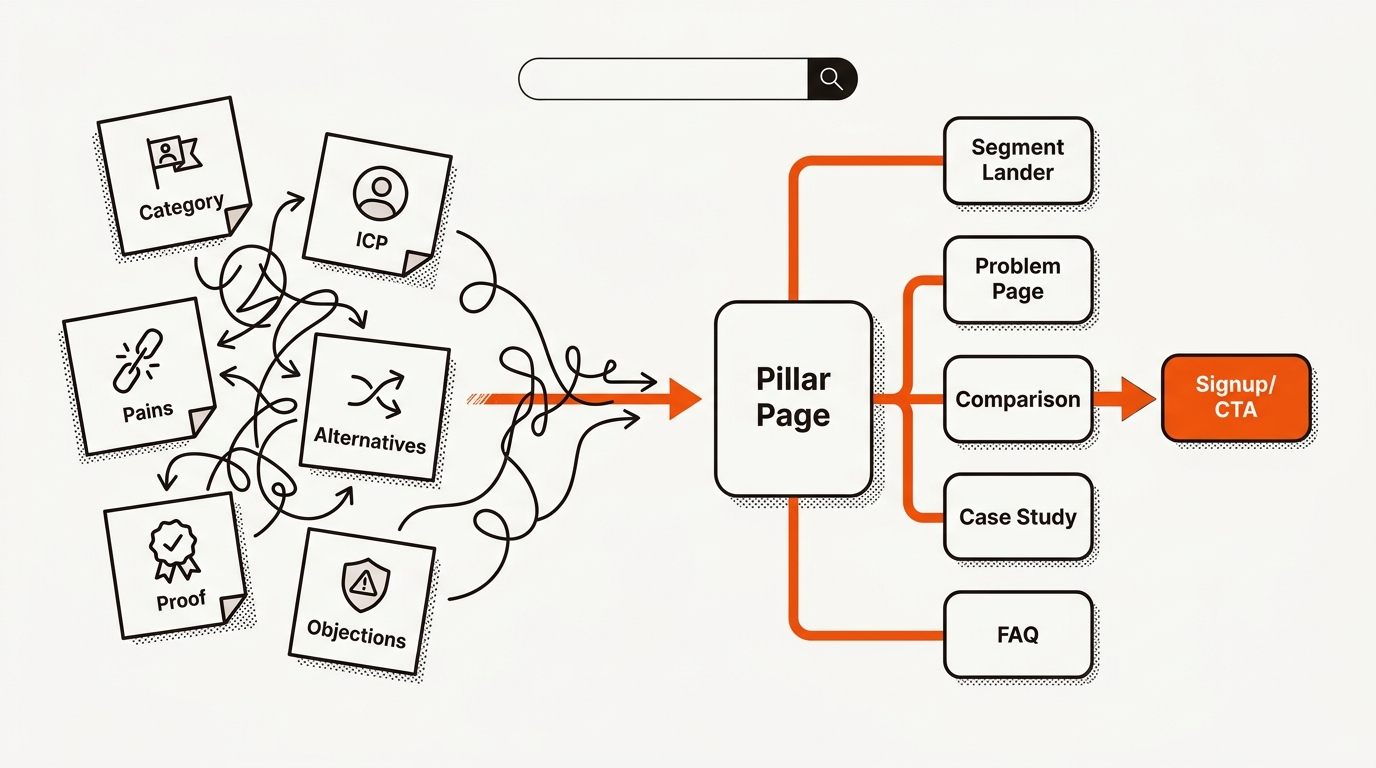
Every positioning input maps cleanly to a page type with a distinct query pattern and conversion hook. Validate demand in Ahrefs or SEMrush, then title to match intent modifiers users actually search.
Positioning-to-Page Map With Intent and Hooks
Wire the cluster. Each support page links up to the category pillar and sideways to the most relevant segment lander. Use exact-intent anchors like for startups, vs, or alternative to reinforce relevance. For deeper context on content mapping, see SEMrush on content mapping and Contentful’s content mapping guide.
For deeper context, see SEO for Startups: The First 20 Pages to Build Before Hiring an Agency.
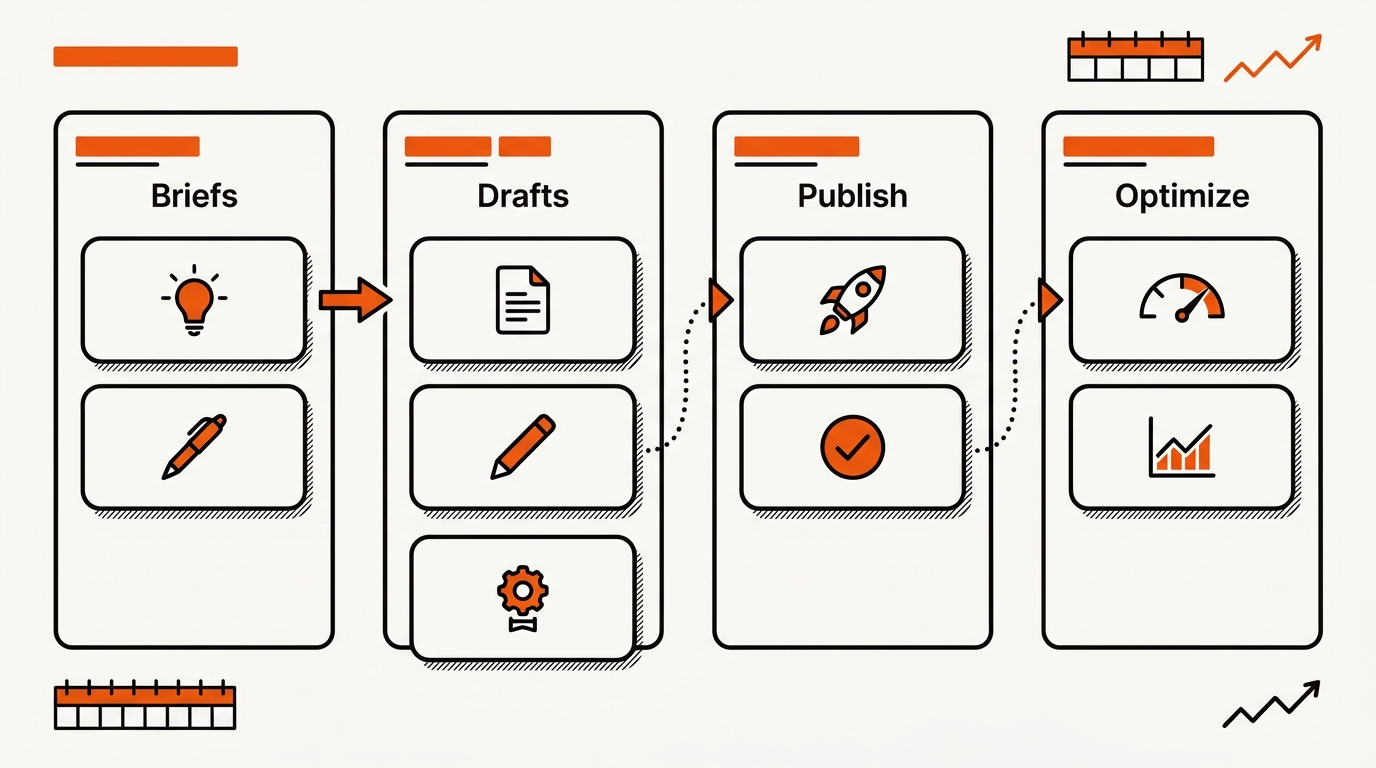
Turn the map into a weekly shipping board with briefs, programmatic outlines, and a fixed internal link pattern. Each brief should include the positioning angle, primary keyword, SERP gaps, and 3 internal links (pillar, segment, bottom-funnel). Generate outlines with an AI assistant, then human-edit for claims, numbers, and brand proof.
Scenario: A small growth team ships a steady weekly mix: a pillar first, then comparisons, problem pages, segment landers and case studies. On a young domain, target low-difficulty keywords in Ahrefs. There is no fixed timeline for first impressions or sign-ups; internal links that point to the right CTAs help both.
Operational tradeoff: Breadth vs depth. Ship the full set of page types quickly to cover the positioning surface area, but cap comparisons to 2 per week so you can keep them updated as competitors shift. As the site grows, crawl and indexing lag can compound. Run monthly Screaming Frog crawls and monitor GSC Coverage to keep the cluster healthy.
This is where automation compounds. Mergeflo is an autonomous SEO platform for startups: it finds search gaps, drafts articles, and publishes the ones you approve to Webflow. Our automated SEO services include keyword research, content generation, and optimization workflows. If you want a starter set of must-have pages by type, read SEO for Startups: The First 20 Pages to Build Before Hiring an Agency.
Take a startup whose positioning is "the autonomous SEO platform for lean teams." The category page is "autonomous SEO platform." The ICP pages are "SEO for startups" and "SEO for one-person marketing teams." The alternatives pages are "SEO agency alternative" and "AI writer vs platform." The proof pages are case studies and a methodology page. The objection pages answer "is autonomous SEO any good" and "does it replace an agency." Six positioning inputs become a dozen pages, and any founder can build the map and hand it straight to execution.
Aim for coverage that reflects your positioning and search intent, then scale with a consistent publishing cadence.
Start with one of each page type: a category pillar, a few segment landers, problem pages and comparisons, a case study or benchmark, and a structured FAQ. This set covers all positioning pillars and gives enough surface area for internal links and testing.
Filter by intent first, then difficulty. Use Ahrefs or SEMrush to find variants with a KD your domain can realistically win. Prioritize exact-intent modifiers like for startups, vs, alternative, and pain phrases. If KD is high, lead with a long-tail variant and plan an internal link ladder.
Track impressions to the category pillar, clicks to comparison pages, and assisted conversions from problem pages in GSC and analytics. You should see rising branded + category impressions, improving click-through on comparisons, and growing internal referral traffic from support pages to your signup.
Version your map quarterly. When messaging changes, update H1s, intros, and CTAs on affected pages, then republish. Add new comparison targets as the competitive set shifts. Use Screaming Frog to audit internal links so every new page connects into the cluster with the standard pattern.
