
You will capture more pipeline by shipping 20 intent pages than by publishing 30 blogs that never rank. This is the build order for SEO for startups that gets clicks, demos, and trials before you sign an agency retainer. It prioritizes money pages and proof, gives effort estimates, and ranks each page's search potential so a small growth team can schedule the work.
Build six money pages, five pillar pages, four evidence pages, three conversion pages, and two trust pages, in that order. Money pages capture demand that already exists (product, pricing, use cases, integrations). Pillar pages own the topical category. Evidence pages give buyers the comparisons, case studies, and methodology they need to choose you. Conversion pages turn intent into action (demo, trial, audit). Trust pages remove buying friction (about, security). Shipping in this order means every blog you publish later has a destination that converts.
For a startup with no SEO infrastructure, this is the startup SEO build order you run before considering an agency. The full execution flow is documented at startup SEO execution system.
Blogs only convert when the destination pages they link to already rank. A blog post that ranks for "internal linking for startups" still needs a /pricing page that ranks, a /product page that ranks, and a /comparisons page that ranks, or the traffic bounces. Many startups skip this and publish a pile of blog posts in month one, then wonder why none of the rankings produce signups. The fix is to build the 20 destination pages first, then layer blogs on top to compound authority into those money pages. See the SEO for startups reference for the full playbook.
Ship money, proof, and conversion pages first; expand to pillars once conversions have a home. Use hubs and spokes so every page pushes to pricing, demo, and trial. Estimated effort assumes template-based builds with design variants and partial AI outlining.
Standards make this shippable. Create one Use Case template with a hero, 3 pains, 5-feature checklist, proof module, and a customer pull-quote. Clone it three times and swap ICP language and proof. Same for Integrations with a specs block, setup steps, and screenshots.
Assign owners early. PMM drafts the outline and collects proof assets. AE sources quotes and screenshots. Ops publishes and wires analytics events. Copy can be AI-assisted from structured briefs, then human-edited for accuracy and tone.
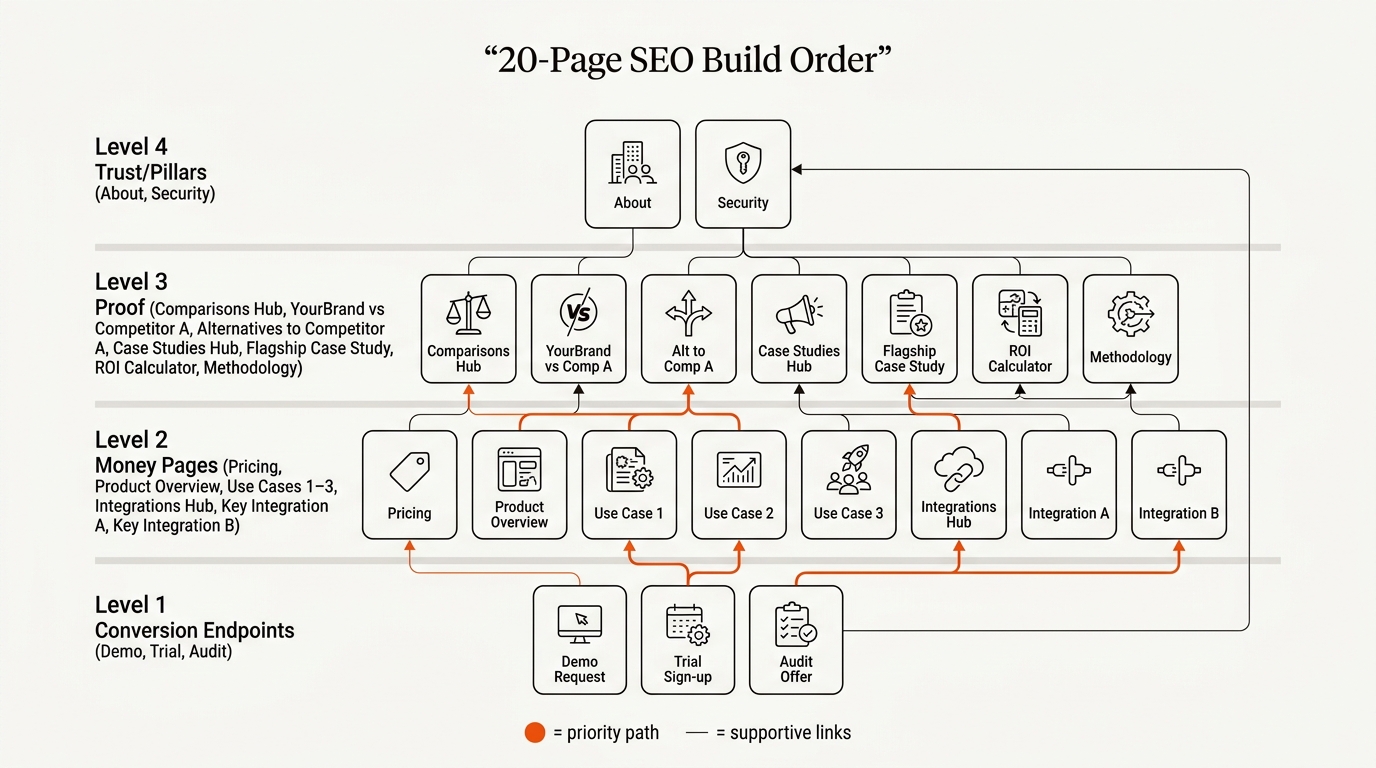
Two sprints, ten pages each, owners assigned at kickoff. A small growth team can publish all 20 pages in 30 days if you ship templates first and clone aggressively.
Check Search Console as you go: first confirm the early pages are indexed, then look for the first non-brand impressions on the use case and integration pages, and later for impressions on competitor brand terms from the comparison and alternatives pages. Google sets the pace, so treat this as an order of events, not dates.
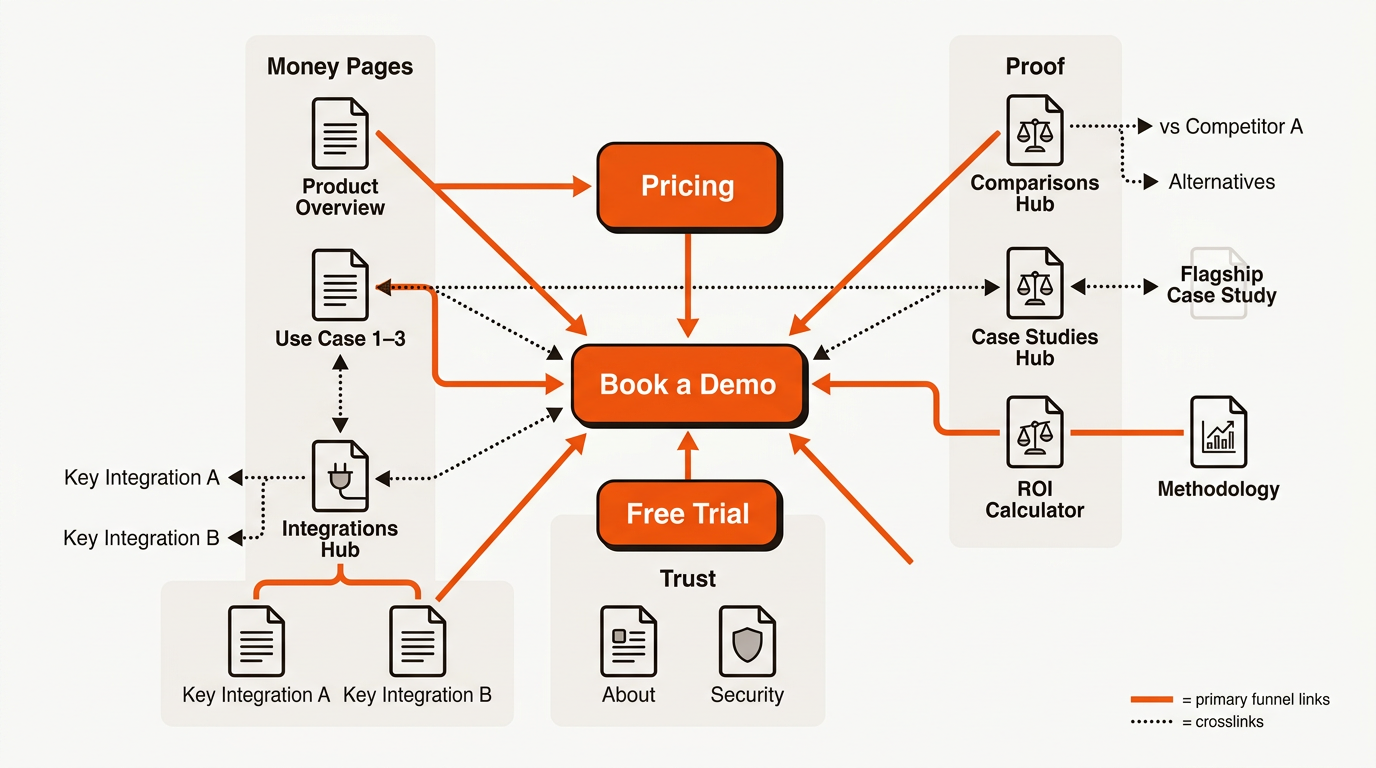
Every page links to one pillar, one canonical, two siblings, and one CTA. That is the linking pattern that pushes authority into money pages instead of letting it leak across the site. Use the startup SEO execution system as the canonical reference for the link patterns that matter, and the autonomous SEO platform page as the sibling that explains the publishing cadence.
Practical rules:
• Use Case pages link to Pricing (CTA), Integrations Hub (sibling), Comparisons Hub (sibling), Product Overview (pillar).
• Integration pages link to Pricing (CTA), Use Case for that ICP (sibling), Comparisons Hub (sibling), Product Overview (pillar).
• Comparison pages link to Pricing (CTA), Alternatives page (sibling), Case Study (sibling), Product Overview (pillar).
• Case Studies link to Pricing (CTA), Use Case (sibling), Comparison (sibling), Product Overview (pillar).
Mergeflo turns the build order into a weekly plan, not a checklist. Mergeflo researches topics, writes briefs and drafts, adds FAQ schema and suggests internal links. Founders keep control of the topic queue and brand voice, and each article publishes only when it is approved.
The practical effect: instead of paying a 6,000 to 8,000 USD monthly agency retainer, a startup ships the full 20-page stack in two sprints. The full execution rationale is at startup SEO execution system.
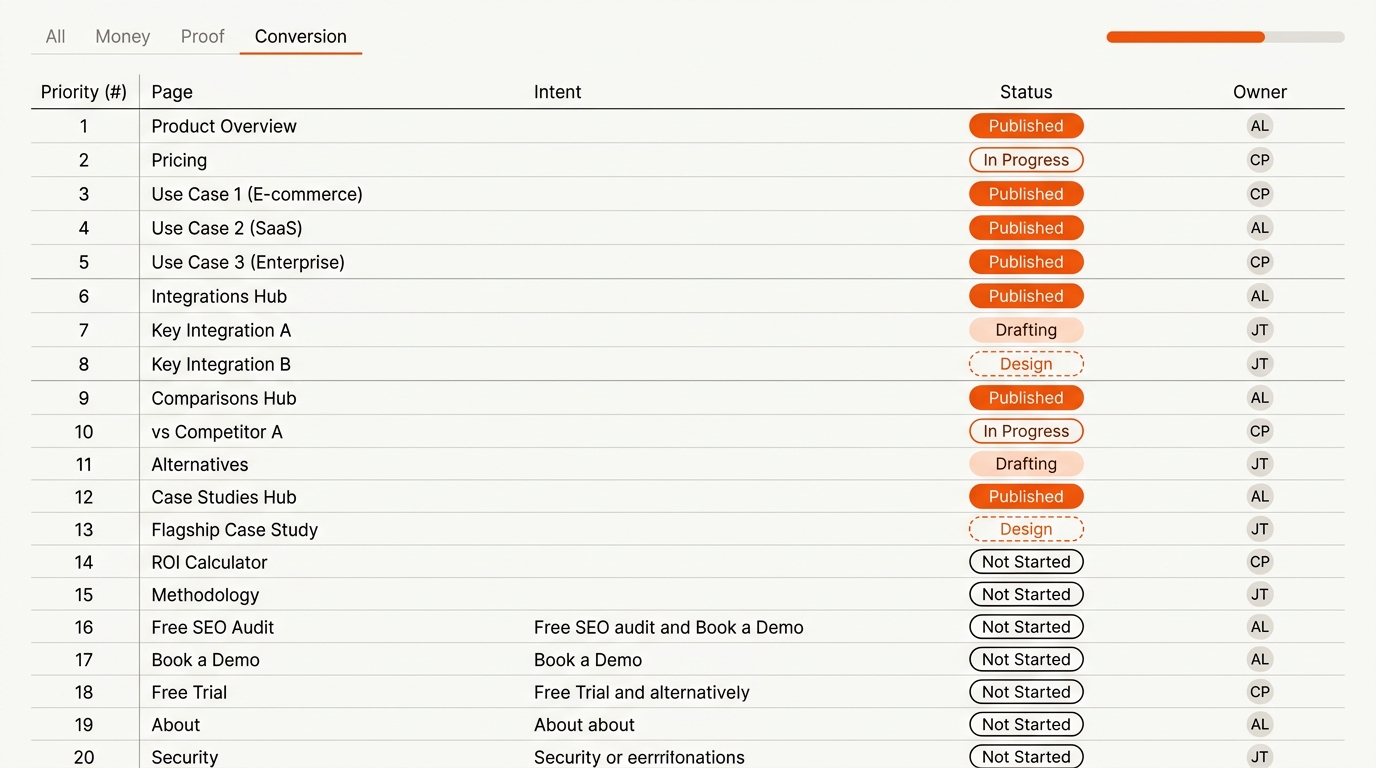
The first 10 (money pages, integrations hub, comparisons hub) should be live before blog content. Pages 11 to 20 can ship in parallel with your first batch of blogs, since they back up the cluster instead of forming it.
One PMM drafting briefs, one AE sourcing proof, and one ops owner publishing. Copy can be AI-drafted from structured briefs and human-edited. Three part-time people for two sprints is the realistic minimum.
Google does not promise when a page will rank. Direct-intent pages (product, pricing, comparisons) usually get indexed first when the page inventory and internal linking are clean, so track them in Search Console from launch. Broader pillar topics usually take longer. The variance is mostly content velocity and how quickly Google discovers the new URLs.
We found no reliable benchmark for in-house cost; it is mostly your team's time plus tools. Agency retainers start around 3,000 USD and climb fast. In-house usually wins when you have a small growth team and a working CMS.
Software gives you dashboards and recommendations. The work (research, briefs, drafts, publishing, refreshes) is still on you. An execution platform runs the work and ships the page. Software is rented expertise; execution is rented labor.
Mergeflo researches topics, writes briefs and drafts in your brand voice, adds FAQ schema and suggests internal links. You choose the topics and approve each article, and it publishes to Webflow only when you press Publish. For pages losing reach, Mergeflo flags them, and when you press Refresh it writes a refresh brief for you to review.
• Startup SEO Execution: the Weekly Workflow That Ships
• Startup SEO Stack: a 7-Layer Model That Ships Weekly
• External: Google SEO Starter Guide, Ahrefs: Site Structure
