
A 20-page stack outperforms a pile of random blogs because it captures demand where buyers actually convert. Most startups overproduce low-intent content and underbuild the pages that move pipeline. This SEO for startups guide gives you the exact page inventory, build order, and internal-link map to ship before you hire anyone.
Link early demand to a conversion spine by pairing this stack with a practical SEO for startups approach. The outcome: fewer pages, higher intent, faster revenue impact.
You’re a founder or growth lead at a small seed or Series A startup, publishing some blogs but seeing little conversion-relevant traffic. You’re considering hiring an agency or a full-time SEO. This guide is for you if you have a product page that already converts, you don’t have your main product pages live yet, and you can ship a few pages a week with templates. If you’re pre-product, this is too early: focus on your homepage and product page first.
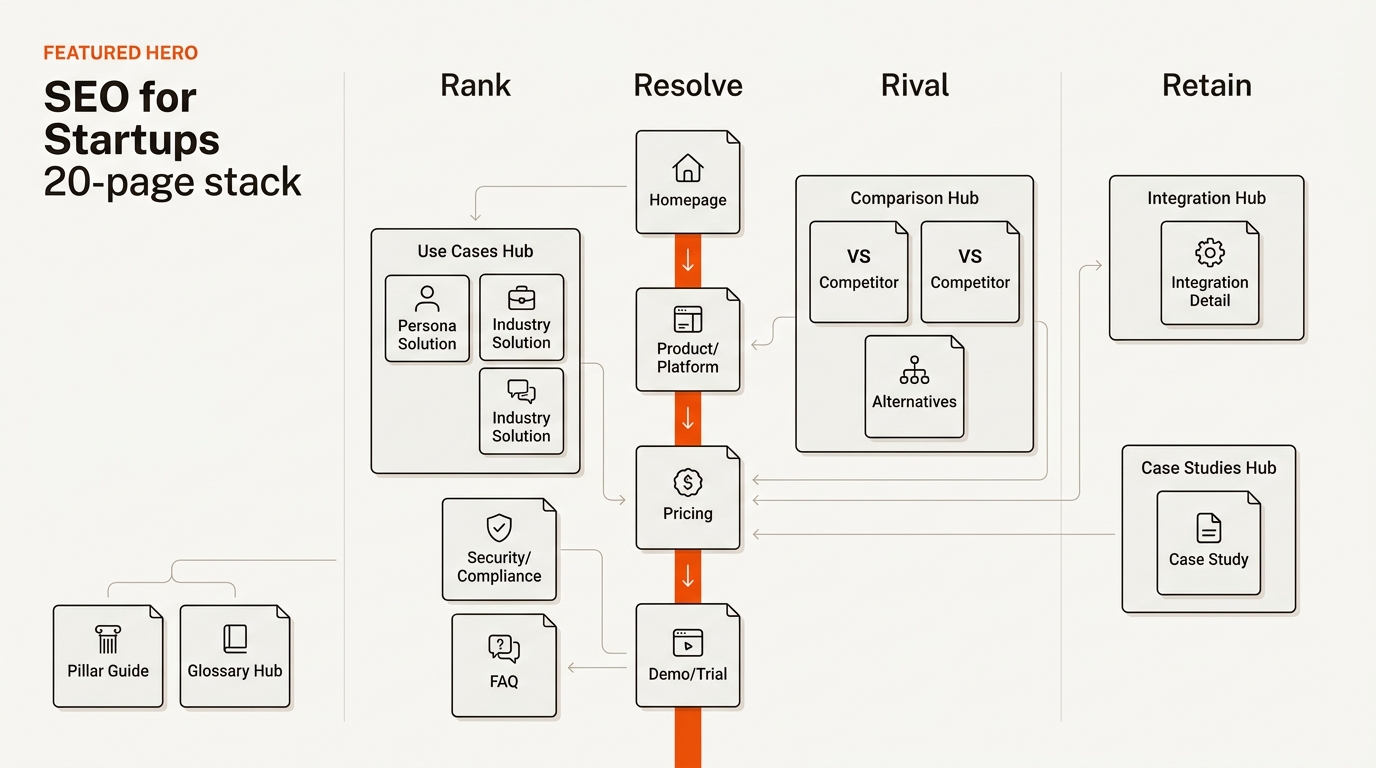
Work each page with tight on-page fundamentals: explicit H1s, intent-matched titles, and fast loads. Use descriptive nav labels like “Pricing and Plans” and “Compare vs Competitors,” not just brand names.
For hygiene, follow Google Search Central, then size queries and map intent with Ahrefs. Keep titles under 60 characters and meta descriptions under 155 to prevent truncation.
Most startup blogs publish without a money-page spine. The result: high impressions, low signups, and a backlog of posts that don’t compound. The fix isn’t more content: it’s the right 20 pages, wired together so every blog links to a buyer-intent page. Without this, your blogs bring visitors who have nowhere to go next. Agencies inherit this same gap because they’re paid for content output, not architecture.
Build these 20 pages in this order. Each maps to a buyer-intent query before any content marketing scales.
Conversion spine (3 pages)
1. Homepage: brand, value prop, primary CTA, primary keyword in H1.
2. Pricing: plans, comparison row, FAQs, schema.
3. Product / Features: what you sell, not just what you do.
Main product pages (5 pages)
1. /[primary keyword]: your highest-intent broad query (e.g. /SEO-for-startups).
2. /[use case 1]: the workflow your buyer needs solved (e.g. /content-execution).
3. /[use case 2]: a second high-value workflow.
4. /[ICP-specific]: page targeting your sharpest ICP (e.g. /SEO-for-SAAS-founders).
5. /[outcome-specific]: page targeting the measurable result (e.g. /rank-without-an-agency).
Comparison pages (4 pages)
1. /compare/[brand]-vs-[top competitor]
2. /compare/[brand]-vs-[second competitor]
3. /[category] alternative: e.g. /SEO-agency-alternative-for-startups.
4. /[brand]-vs-[adjacent category]: e.g. /[brand]-vs-content-agency.
Supporting blogs (5 pages)
1. The how-to for your primary use case.
2. The buyer’s guide for your category.
3. The benchmark / data piece (pillar).
4. The framework post (memorable named concept like the 4R Stack below).
5. The case study with real numbers.
Support pages (3 pages)
1. /docs or /resources: schema-rich help content.
2. /security and /compliance: trust signals.
3. /about: credibility, founders, customer logos.
Map each page to one intent query before drafting. Audit overlap across main product pages and comparisons so two pages never target the same intent. Pricing, Comparisons, and Use Cases should connect to the homepage in two clicks or fewer from any landing.
Route authority from high-traffic hubs to conversion pages with deliberate anchors. From Homepage and Product, link to Pricing, Use Cases, and the Comparison Hub using descriptive text. Each integration, case study, and glossary term should link up to the Pillar and laterally to related pages.
• Mid-cluster hub: connect learning to buying via the startup SEO guide.
• Lateral links: comparison pages cross-link to Alternatives and Pricing; integrations link to Use Cases and Case Studies.
• Footer nav: expose Security/Compliance, FAQ, and Reviews on every page to lift trust signals.
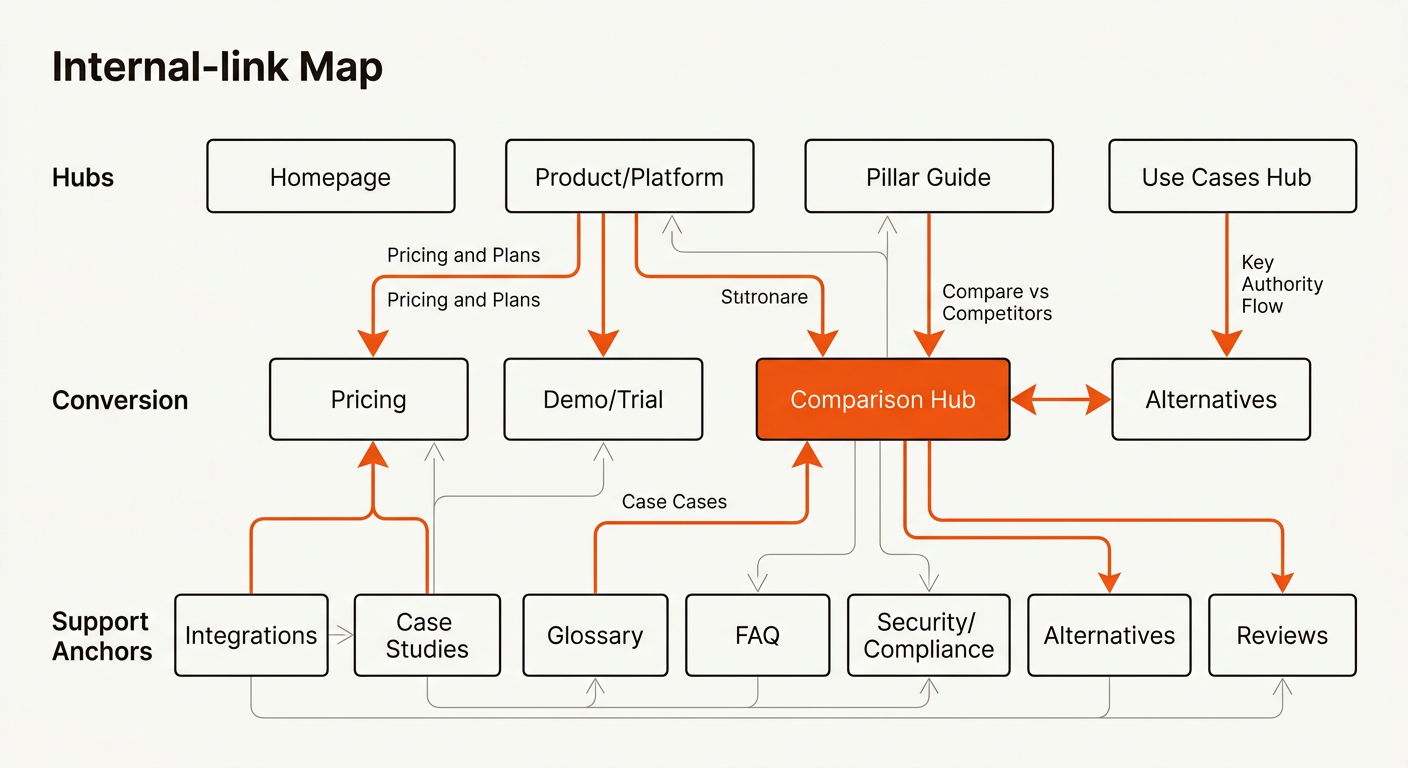
A practical pattern: every glossary term links up to the Pillar Guide and across to one Use Case and one Comparison. Every Case Study links to its highlighted integration and back to Pricing. This creates 2–3 internal links per page that concentrate equity on conversion paths.
Teams that document anchors in a simple sheet (Source URL, Target URL, Anchor Text) avoid orphaned pages. Reuse anchors consistently to help Google map topical relationships and to guide users toward action.
Use the 4R Stack to sequence and stress-test your build. Rank pages (Pillar, Glossary, Use Case hubs) attract discovery. Resolve pages (FAQ, Documentation, Security) remove friction that blocks signups. Rival pages (Comparisons, Alternatives) capture competitive demand near decision. Retain pages (Case Studies, Integrations) reinforce proof and expansion.
The 4R Stack is a simple gatekeeper: every page must attract, remove friction, capture, or reinforce. If a draft doesn’t pass one of these, cut it. Tradeoffs matter: too many Rank pages can lift impressions without pipeline, while too many Rival pages can spike demos with poor fit if Resolve is weak. Failure modes include orphaned hubs and vague nav labels that bury Pricing or Comparisons.
Run a quick weekly audit: count how many pages sit in each R, and fill gaps in the next sprint. Keep Rival and Resolve balanced to protect conversion rates as traffic scales.
Here’s the math you can plan around.
• Inputs: for each page, its keyword volume and the position you expect, with your own Search Console click-through rate for that position.
• Traffic: multiply impressions by that click-through rate, page by page.
• Conversions: apply your own conversion rate by page type; pricing and comparison pages usually convert better than support pages.
• Value: if each signup is worth V to your business, monthly value = signups x V.
Validate these assumptions with your GSC impression trends and the Ahrefs CTR study. Adjust targets by KD and SERP features in your niche.
Choose the model that fits your budget, your time, and your quality bar. Use this head-to-head to set expectations and avoid sunk cost.
If you’re comparing external help, see our SEO agency alternative for startups for how an autonomous workflow replaces manual delivery. The operational tradeoff here is speed vs depth: DIY protects brand nuance but slows shipping; agencies provide polish but often bottleneck on approvals; autonomous systems ship fast with templates that you can tune.
For a small team, Build Yourself typically means one PM splitting time with paid, one content generalist, and one part-time SEO. Expect context switching and missed internal links as the page count grows. Autonomous execution reduces coordination costs and keeps anchors consistent at scale.
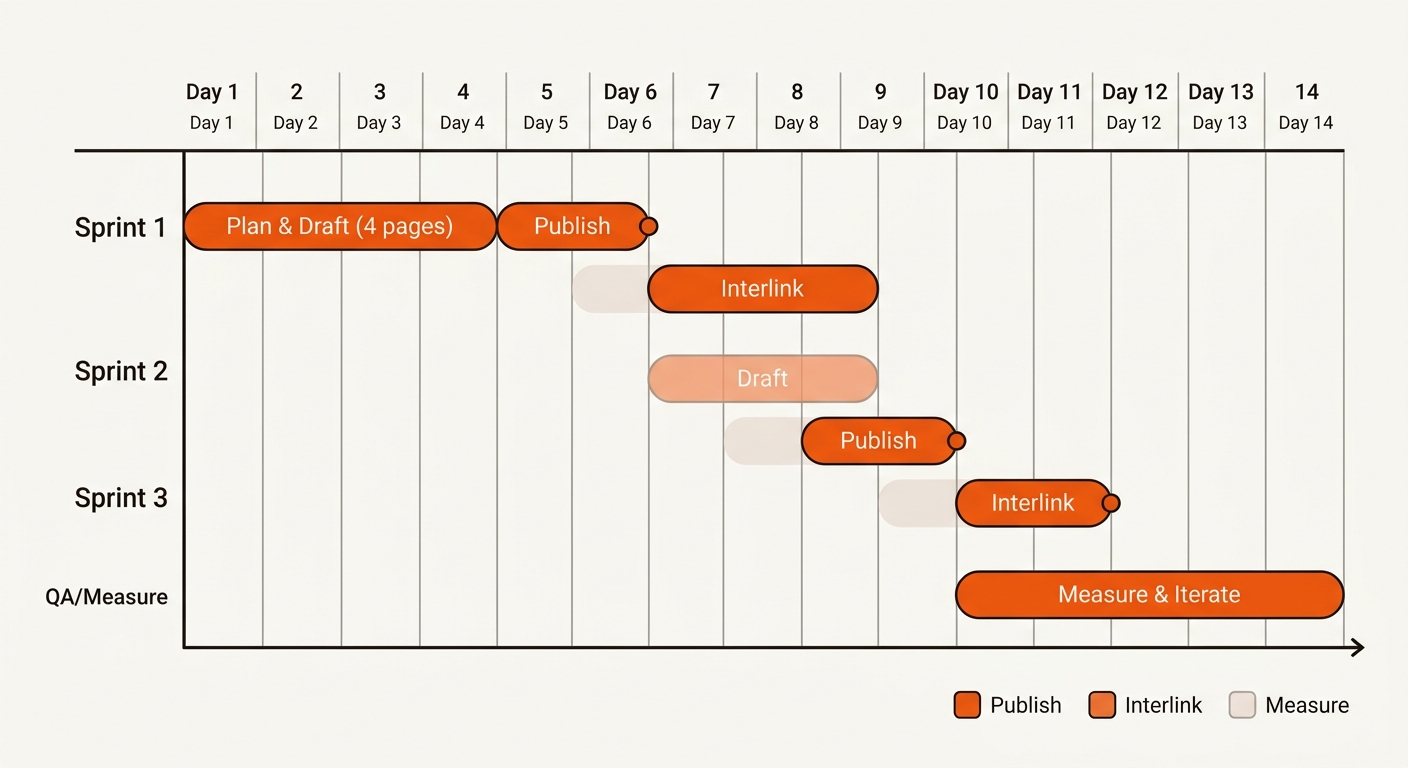
Compress planning and shipping into a two-week cadence and iterate from live data. Day 1–2: scope inventory, map 4R coverage, extract titles/H1s, create templates. Day 3–7: draft and ship Sprints 1–2 with nav + internal links. Day 8–12: ship Sprints 3–4, wire comparison and integration cross-links. Day 13–14: publish Sprint 5, request indexing, and set GSC/Analytics dashboards for SERP and conversion tracking.
Use prebuilt page templates for Comparisons, Integrations, and Case Studies. Standardize sections like Overview, Key Differentiators, Proof, and CTAs. This reduces decision fatigue and helps keep output consistent.
Pair this cadence with the startup SEO checklist and the ramp in SEO for startups: first 90 days. Validate technicals with SEMrush Site Audit or Screaming Frog, especially for sitemap coverage, canonical tags, and internal link depth.
Start with 2 competitor matchups plus 1 Alternatives page. If GSC shows steady impressions for competitor queries, add more comparison pages.
Yes. It builds topical authority and internal link equity to your Pillar and Rival pages, lifting mid-funnel rankings without chasing newsy blogs.
Prioritize Security/Compliance, Documentation, and FAQ in Sprint 3–4. Add schema, last-reviewed dates, and link them sitewide from the footer to pass trust.
Track Pricing and Comparison page signups, SQO rate, and influenced pipeline. Set an early target from your own baseline and the assumptions in the numerical example above.
Yes, if you templatize. Use repeatable layouts for comparisons, integrations, and case studies, and ship a few pages each week. The full stack takes as long as your review time allows.
After the 20 pages are live and indexed, and you see consistent impression growth but lack bandwidth to expand clusters or maintain internal links. Consider an autonomous platform over a headcount-heavy agency.
Don’t hire an agency to fix a missing spine: build the 20-page stack, wire it tight, then decide what to scale. This SEO for startups guide gives you the exact inventory, order, and links to own buyer SERPs and convert. Ship it, measure signups and SQOs, and expand with confidence.
• Startup SEO Checklist: What to Fix Before Publishing 30 Posts
• SEO for Startups: What to Do in the First 90 Days
