
Most startup blogs stall because the site skeleton fails under scale. You can publish every week and still plateau if your startup blog SEO runs on orphaned pages, missing canonicals, and zero refresh cadence. Fix the structure first, then scale publishing.
A working system ties every post to a money page, passes PageRank through disciplined internal links, and refreshes decaying URLs on a schedule. If your blog has no money-page map, start with the core offer and route posts to it using measured anchors; see the startup SEO platform for founders as the architectural target.
You’re a founder or content lead at a small startup with a few dozen blog posts already published and stagnant impressions. You have GSC connected, can run Screaming Frog, and you’re looking at a backlog that should rank but doesn’t. This guide is for you if your blog has many orphan URLs, few links into your money pages, or monthly impressions that have plateaued.
Real startup SEO architecture separates compounding traffic from random posts. Most startup blogs are publishing factories with no architecture. Posts ship into a flat directory, internal links default to in-prose mentions, and money pages collect only a handful of links. The result: GSC shows impressions but no clicks, money pages stall beyond page two, and every new post dilutes rather than compounds. The fix isn’t more content: it’s a money-page spine, a sibling-link discipline, and a short monthly refresh ritual.
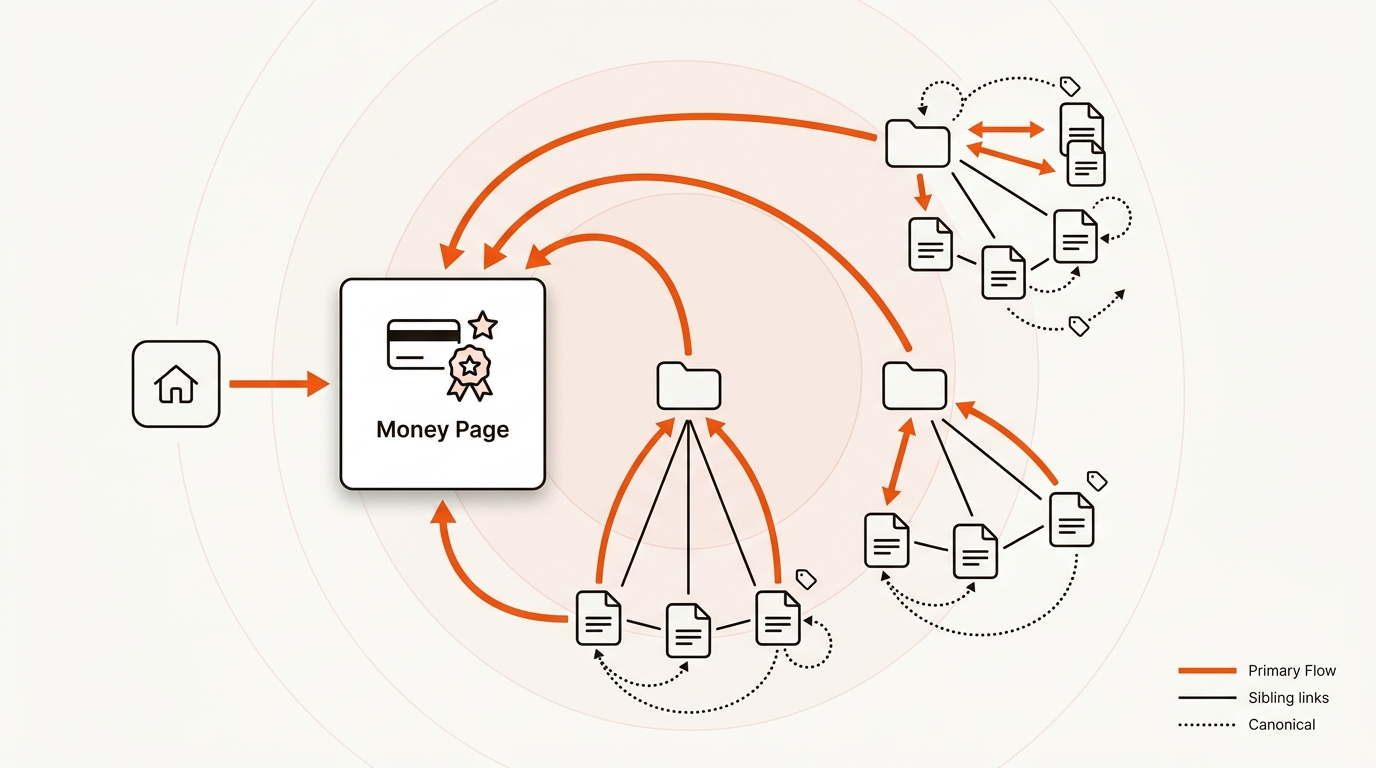
Audit canonicals, crawl depth, and inbound links before publishing more. Use Screaming Frog’s canonical audit tutorial and Ahrefs’ guidance on pages with no incoming internal links to find choke points. If startup blog SEO is failing, your fix starts with link paths and canonical intent.
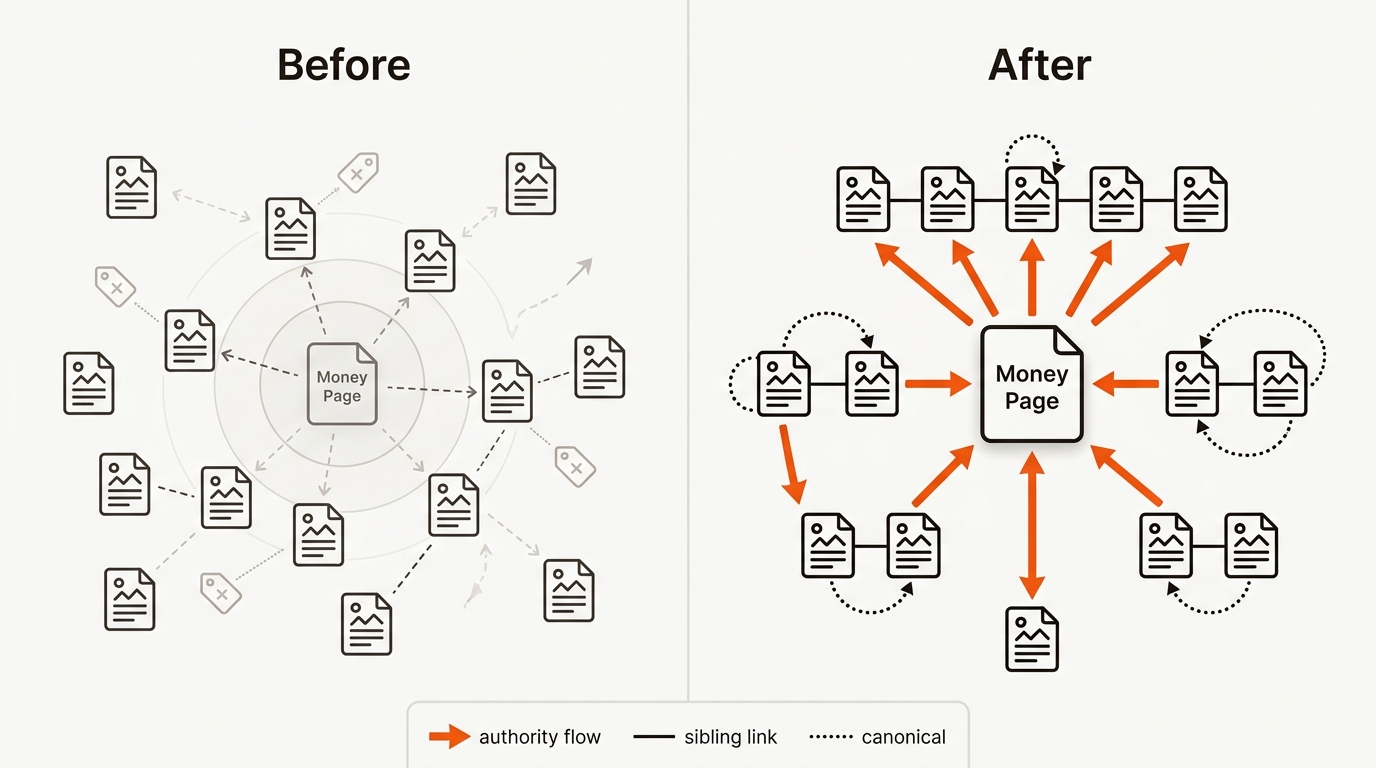
A simple hub → spoke → spoke loop turns dead posts into ranking assets. Every new post links up to the money page, sideways to 2-3 siblings, and down to 1 deeper resource. Existing high-authority posts get retrofitted with anchors back to the money page and across the cluster.
Mid-article reference for depth: see the broader startup SEO playbook that unifies architecture and content. For checklist-level execution, route by tasks from the startup SEO checklist.
Name: The Canonical-Anchor Matrix. Map every post to exactly one money page (row) and 2-3 sibling intents (columns). For each cell, define the rel=canonical target, one primary and one secondary anchor to the money page, and two contextual anchors to siblings. Apply it during drafting and when retrofitting legacy posts so every URL sends a single, consistent intent signal. Tradeoffs: too few anchors throttle authority flow; repetitive anchors look spammy and flatten relevance. Failure modes include ambiguous canonicals, duplicated intents across posts, and mismatched anchors that send mixed signals.
Small, consistent anchors to one money page add up over time. For example, point every new post in a cluster to the same pricing or demo page with a consistent anchor, then check that page's impressions in Search Console each month.
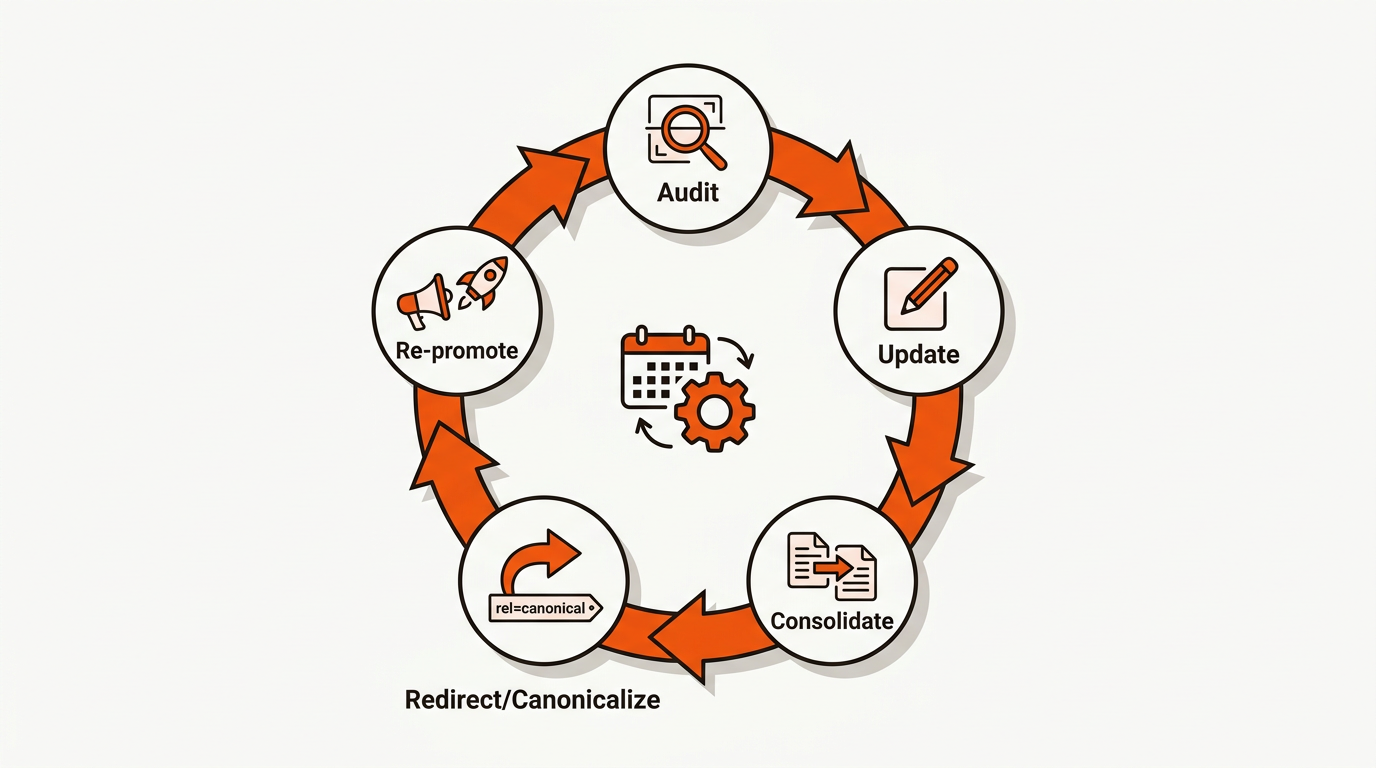
A scheduled refresh loop prevents decay and stops cannibalization early. Run this on the first Monday each month with a small team and keep it short.
• Pull a 90-day delta from GSC: pages with a clear drop in impressions or CTR are review candidates.
• In each candidate, update H1/H2 to match intent, add one new section, and insert 2-3 fresh internal links to the money page and siblings.
• Consolidate duplicates: choose a canonical, 301 weaker URLs, update anchors sitewide.
• Revalidate with Screaming Frog: canonical consistency and crawl depth ≤2 to money page.
• Re-promote: resubmit in GSC, syndicate via newsletter and LinkedIn.
For differences in org scale, compare expectations in startup SEO vs enterprise SEO. In practice for startup blog SEO, prioritize defensive fixes first, then resume aggressive publishing. The same sequence aligns with PostHog’s startup SEO take.
Template the architecture so execution becomes muscle memory. Put the Canonical-Anchor Matrix in your brief template with fields for money-page target, primary and secondary anchors, and sibling URLs. Your writer fills it before drafting, your editor verifies it on upload, and your SEO lead checks it in Screaming Frog.
Expect a tradeoff: speed vs depth. Many thin posts without anchors lose to a few thorough posts wired into a clean architecture. The latter unlocks crawl efficiency and consolidates intent, which translates into more stable rankings.
Architecture beats volume; fix the skeleton, then scale content. If your startup blog SEO lacks a money-page map, disciplined internal links, and a refresh loop, you’re paying content costs without capturing compounding returns. Near-term fix, long-term compounding.
See how this plays with AI content pipelines in our AI SEO blog generator comparison, then decide how you’ll enforce the matrix every week.
Indexation improves first, once Google recrawls the updated link paths. Position changes follow on Google's schedule, usually sooner for direct-intent queries than for pillar topics. The strongest early signal is a rising money-page UR in Ahrefs: that confirms authority is consolidating before clicks materialize.
No. Cut frequency in half, say from 8 to 4 posts per month, and use the recovered hours to retrofit anchors and refresh decaying URLs. Stopping entirely is worse than slowing: signal of "this site is alive" matters for Google, and you lose the brief queue momentum. Two new posts plus four refreshed posts per month beats six new orphan posts.
A post with zero incoming internal links from any other page on your domain. Run Screaming Frog, export inlinks per URL, or use Ahrefs Site Audit’ "no incoming internal links" warning. A large share of orphan posts is a structural problem, not a content problem.
Six is the sweet spot. Three to four inbound from sibling posts, one to two outbound to siblings, and one canonical anchor to the money page. Past eight, the user experience starts looking spammy and Google flattens relevance. Past twelve, you’re risking over-optimization signals.
301 when the old URL has zero value left and you want to consolidate authority into one stronger page. Canonical when the old URL still ranks for distinct queries but needs to share an authoritative parent. Rule of thumb: if the old URL has 5+ ranking keywords in GSC, canonical; if it has only direct traffic and no rankings, 301.
Yes for canonicals and anchors. CMS admin level work in Webflow, WordPress, Ghost, or Framer. 301s usually need devops support unless your CMS handles them in admin (Webflow does, WordPress with a plugin, Framer in-app). Budget a one-time architecture sweep plus a short monthly refresh loop. No backend changes required.
• Startup SEO Checklist: What to Fix Before Publishing 30 Posts
• Startup SEO vs Enterprise SEO: Why the Playbook Breaks
• SEO for Startups: The 20-Page Conversion Stack
