
Short answer: Run a time-boxed SEO content refresh startup workflow triggered by impression decay, title drift, citation loss, SERP changes, or competitor displacement. Update title/H1, intro, stats, internal links, and schema, then republish and request indexing. Use focused 30–60 minute passes for above-the-fold fixes instead of full rewrites.
For deeper context, see Autonomous SEO Platform.
Most teams wait too long and overspend on rewrites while leaving above-the-fold wins untouched. The cost is measurable: decayed impressions, falling CTR, and lost presence in AI Overviews for head terms and “how-to” queries.
Make refresh an always-on queue. Quarterly clean-ups miss compounding losses. In GSC, flag pages with 28–90 day impression declines, positions 4–20, and CTR under your position baseline. Then run a 30–60 minute pass: title/H1 realignment, intro rewrite, updated stats with fresh sources, internal link surgery, schema + FAQ, and reindex. Prefer automation? Mergeflo’s autonomous SEO platform flags pages losing impressions and writes a refresh brief when you press Refresh: https://mergeflo.com/autonomous-seo-platform
“Refreshing above-the-fold content is the #1 way to do a content refresh and can double traffic fast.”, https://edwardsturm.com/articles/content-refreshes-seo-double-traffic-fast/
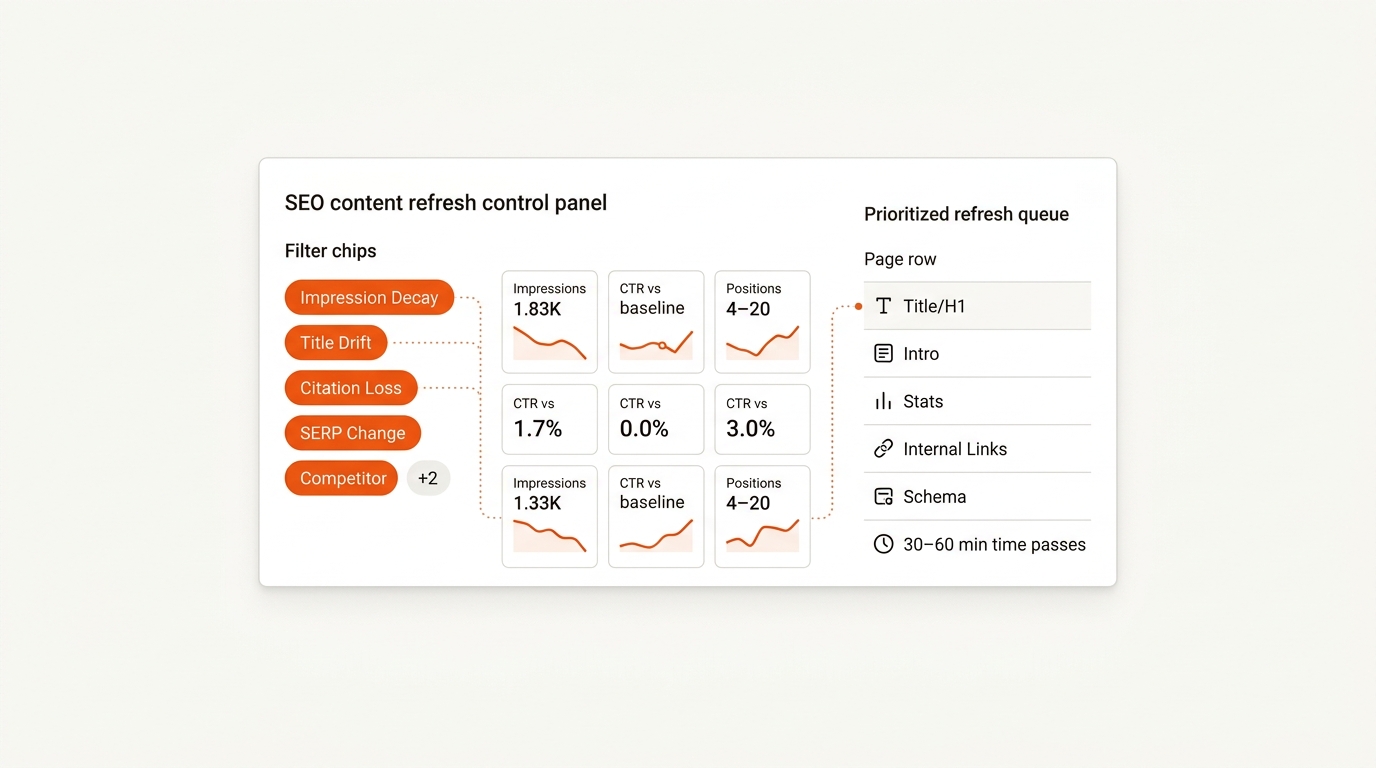
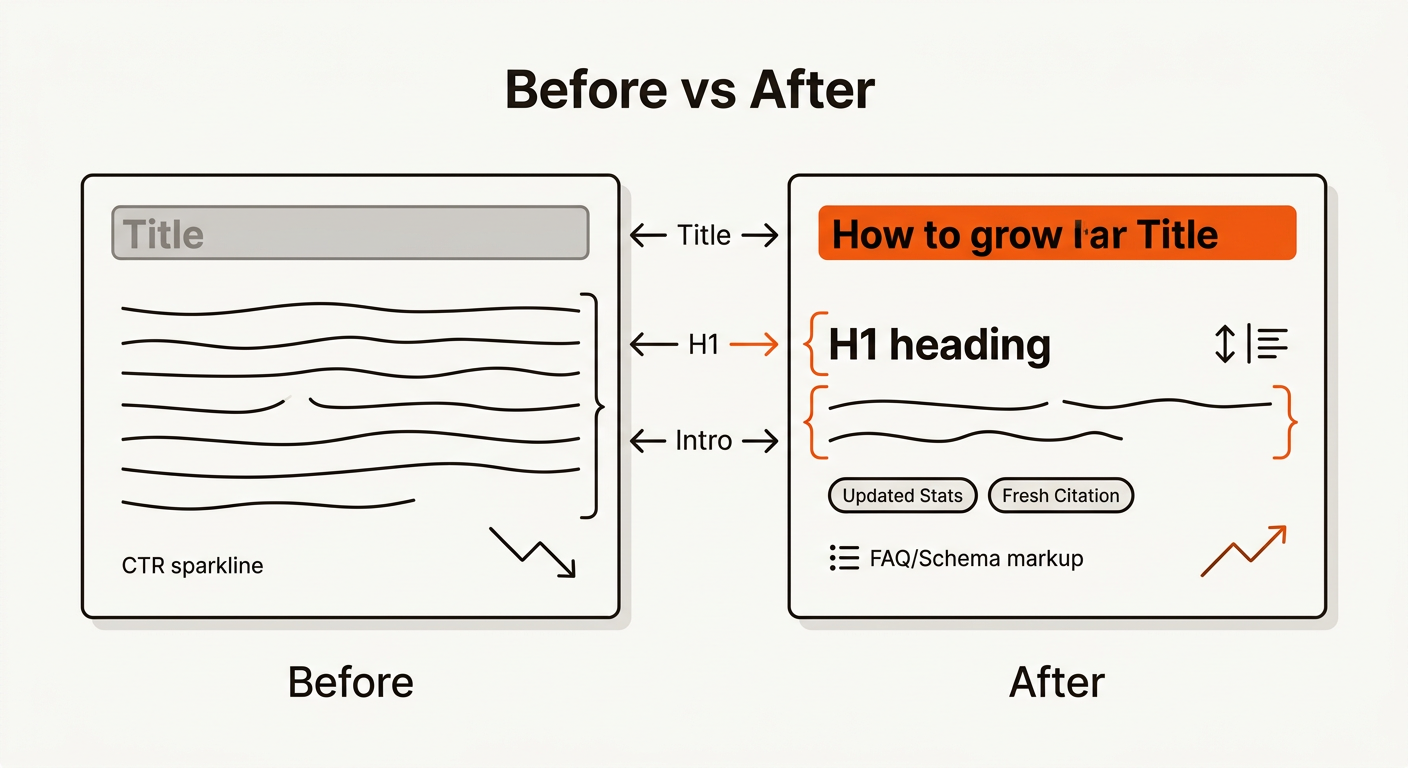
Start with high-visibility edits that lift CTR and intent match before touching deep rewrites. Tighten titles, intros, and stats; then repair internal links and add schema to win rich results.
Comparison of Refresh Tactics for Startup Teams
Back this with measurement. In GSC, compare 14–28 days pre/post refresh for impressions, CTR, and query mix. Ahrefs can confirm if a competitor added sections or a comparison table that now outranks you by 2+ positions. External walkthrough: https://keywordseverywhere.com/blog/content-refresh-101-what-to-update-and-why-it-works/
For deeper context, see AI SEO Platform for Startups.
Pull the last 90 days from Search Console and GA4, join to a CMS inventory, then score every post on Impact and Effort. Impact equals clicks weighted by funnel role and internal link centrality. Effort equals editable elements plus cross file touches. Prioritize high Impact, low Effort. Example: an API auth tutorial with 1,800 clicks, referenced by 14 docs, shows a deprecated header and four screenshots. Two files, three hours, fix now. A pricing migration explainer with 900 clicks appears in onboarding email and mentions two legacy plan names. Forty five minutes, text only, fix now. A founder story with 120 clicks waits.
Operators win by turning a refresh checklist into a trigger-driven queue with SLAs. Set thresholds your team can maintain: impression decline over 20% (28–90 days), CTR under your position baseline for two consecutive weeks, loss of a top external citation, or a competitor outranking by 2+ positions for your primary query.
Auto-generate tasks: title/H1 realignment, intro refresh, stats and citations swap, add 2–3 internal links to money or feature pages, run Article + FAQ schema, then request indexing. Cap weekly updates to 10–15 URLs if your site has <300 indexed pages to avoid crawl budget thrash. Tradeoff: quick passes stall when the page has an E-E-A-T gap or thin depth; that’s when consolidation or a full rewrite is warranted.
Mergeflo is an autonomous SEO platform for startups: it finds search gaps, drafts articles, and publishes the ones you approve to Webflow. It delivers automated SEO services including keyword research, content generation, and optimization workflows. Want visibility monitoring that feeds your queue? See our take on AI visibility tracking: https://mergeflo.com/ai-visibility-tracking
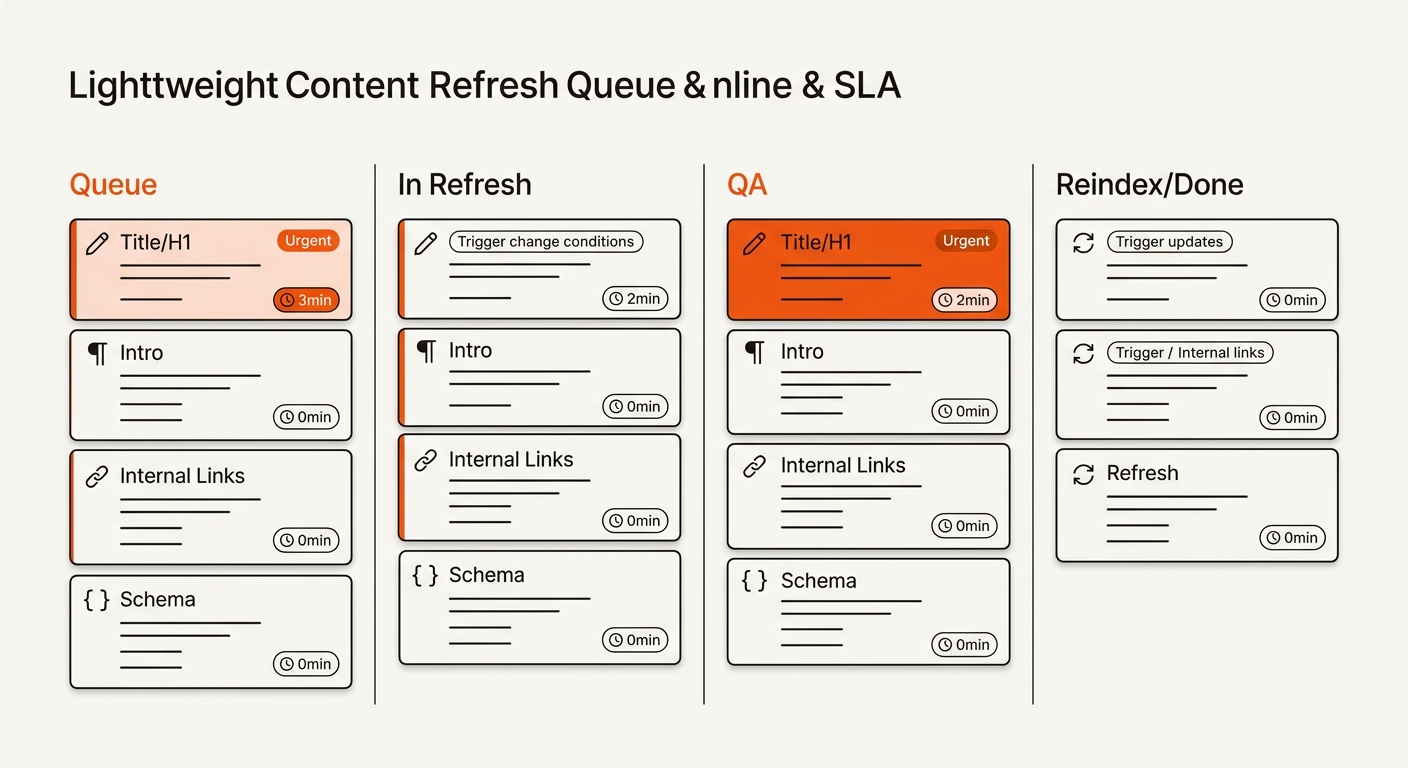
Wire GA4, Search Console, your CMS, Git, and the product changelog into a content registry. For each URL capture owner, product area, last refreshed date, component counts, screenshot hashes, referenced API versions, and plan names. Set tiers and SLAs. Tier A review every 30 days, Tier B every 90, Tier C every 180. Hold a 30 minute weekly triage to assign five to ten refreshes with due dates. Gate merges on checks for links, compiling code, schema, and canonical.
Use data to pick targets, edit where users decide to click, and measure outcomes within a 2–4 week window.
Filter in GSC for posts with declining impressions over the last 28–90 days, positions 4–20, and CTR below your position baseline. Cross-check for business value like feature pages or conversion-adjacent posts. Exclude thin pieces or overlapping topics you plan to consolidate with redirects.
Rewrite the title to mirror dominant SERP intent and align the H1 with the primary query. Tighten the first 3–5 sentences to answer the query directly and match entities competitors use. Add 1–2 internal links to relevant feature or pricing pages and refresh the hero image with descriptive alt text.
There is no fixed timeline. Google says a recrawl after you request indexing can take a few days to a few weeks. Track impressions, CTR, and top queries weekly for four weeks inside GSC. If there’s no movement, run a second pass focused on SERP format alignment or add an FAQ block. Still flat? Audit cannibalization with Ahrefs’ Content Gap and consolidate.
Consolidate when two or more posts target the same intent and split impressions, or when the refreshed page cannot reach depth without repeating another asset. Redirect weaker pages to the strongest URL with updated sections and keep the canonical stable. Re-measure after 2–3 weeks to confirm recovery.
