
Stage-first startup SEO budget planning prevents wasted retainers and compounds results faster. Your budget should fund foundations, consistent publishing, and light automation before any agency spend. Build a stage-based plan that ships weekly cadence first, then add complexity only when bandwidth breaks. If you need an agency alternative that executes continuously, review this SEO agency alternative for startups.
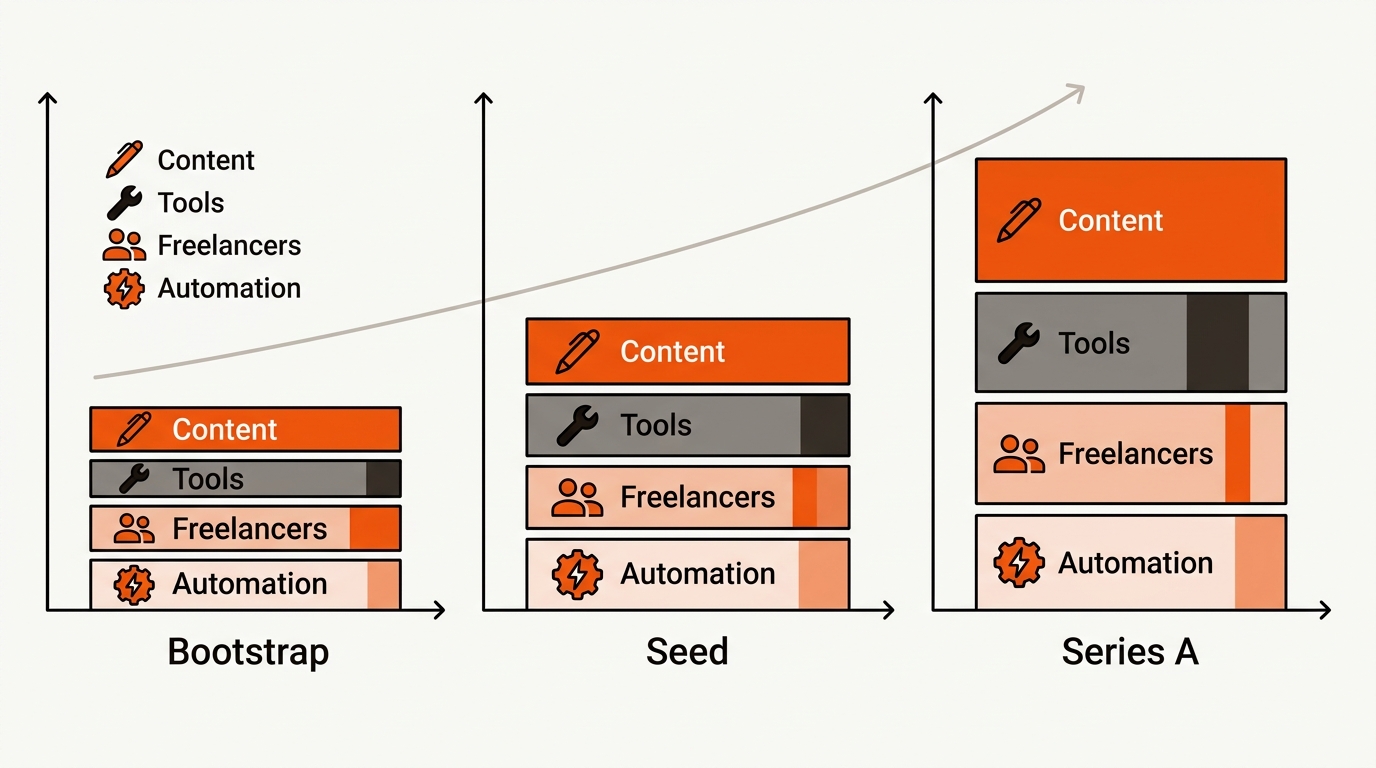
Founders hire SEO agencies because they do not know what to spend. A monthly agency retainer signed at pre-seed takes a large share of monthly burn. The math does not work. Most startups under-spend on tools and over-spend on retainers. Knowing your stage-based startup SEO budget, bootstrap, seed, Series A, protects 30-60 days of runway and forces you to test cheaper levers first.
Most SEO cost content comes from agency blogs that benchmark their own pricing. CXL and Semrush list '$500-$5,000/month' ranges without tying spend to stage, page count, or revenue. They sell aspiration, not allocation. For a startup at 1,180 impressions with 4 founders and $1.5M raised, the gap is concrete dollar ranges per category, tools, content, freelancers, automation, at each stage, plus the triggers that justify upgrading.
You run a lean team and need a budget that actually ships pages.
This is for 2-5 person growth teams at funded startups publishing 10-30 posts a month with tool fluency but limited bandwidth. You want a startup SEO budget that converts spend into crawlable pages, internal links, and measurable pipeline without bloated retainers.
Expect practical ranges, unit economics per URL, and a clear path to scale. The goal is predictable publishing that ranks.
Spend by stage, scale later.
Use this table to set monthly ranges across the four buckets that move rankings: tools, content, freelancers, and automation. Increase budget when cadence stalls or indexing lags. Decrease when drafts queue faster than you can publish.
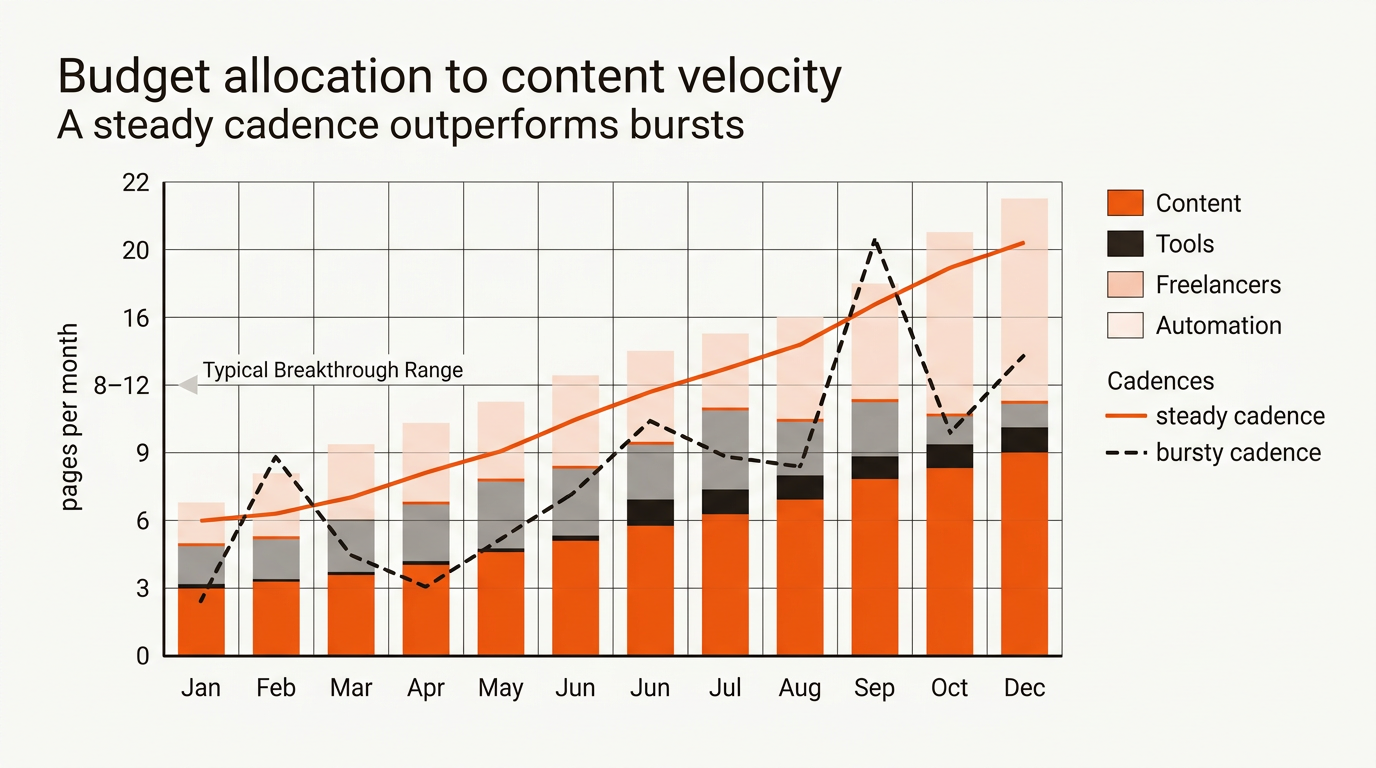
A steady weekly cadence beats bursts.
Bootstrap funds crawlability and a few high-intent posts per month. Seed supports 8-16 posts with editing and light SME review. Series A scales multi-cluster production, QA, and change monitoring.
Add an agency only after complexity clearly exceeds your team's capacity.
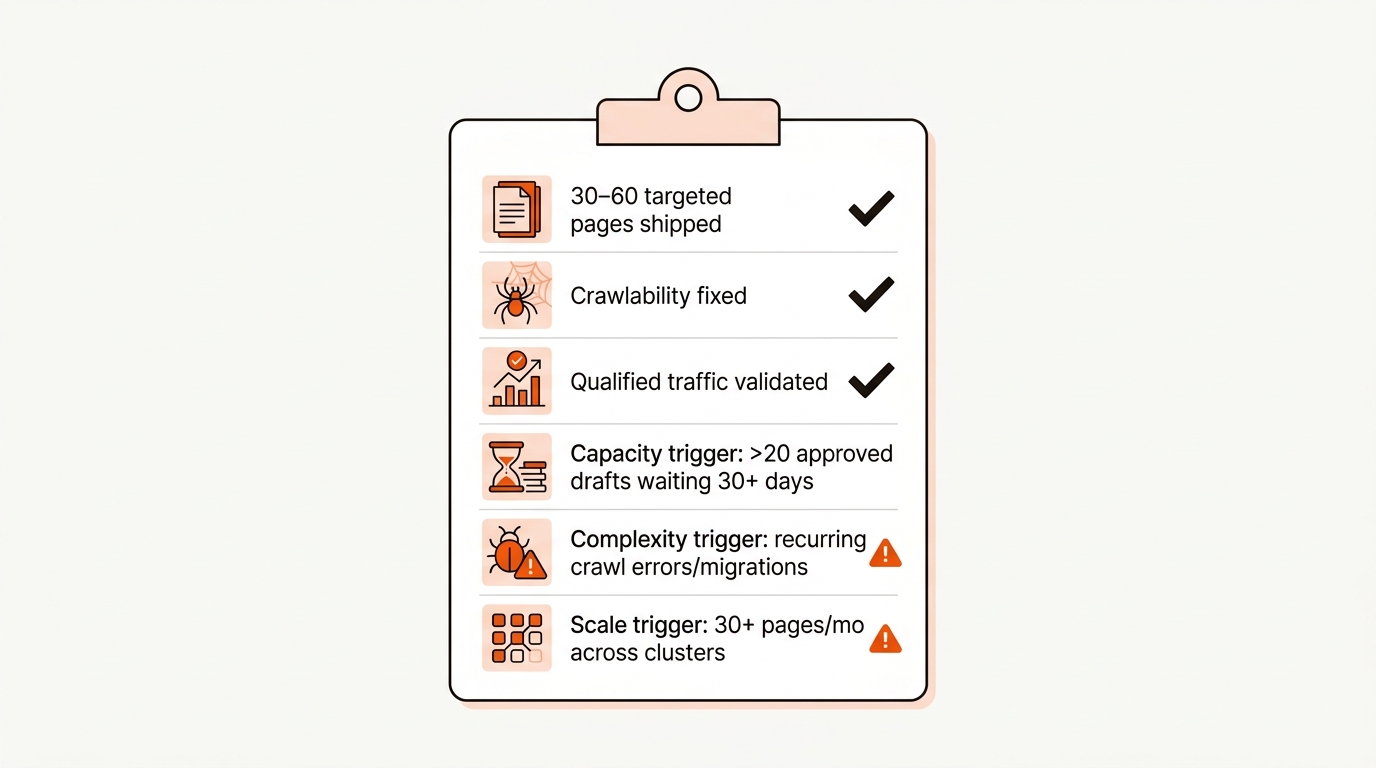
Hire once you have shipped 30-60 targeted pages, fixed crawlability, and validated qualified traffic. This creates a baseline and avoids paying an agency to build simple foundations. For broader context on structuring your roadmap, see the startup SEO guide.
Use these triggers to time the decision:
• Capacity trigger: more than 20 approved drafts waiting over 30 days to publish.
• Complexity trigger: recurring crawl errors or migrations you cannot model safely.
• Scale trigger: need for 30+ pages per month across multiple clusters.
If you have not resolved indexing coverage in Google Search Console or cannot sustain weekly cadence, fix that internally first. External help amplifies working systems; it cannot replace them.
Defer big tools until your pipeline demands them.
Start with Google Search Console, Sheets, and a crawler like Screaming Frog. Add Ahrefs or SEMrush once you are clustering beyond 100 keywords or tackling multi-intent SERPs. Introduce automation for briefs, internal links, and publish QA when manual steps create bottlenecks.
• Bootstrap: GSC, Screaming Frog free, schema tester, basic uptime.
• Seed: Ahrefs entry plan, bulk outline generator, internal link suggester.
• Series A: Content QA automation, scheduled publishing, change monitoring.
Avoid buying overlapping suites. One crawler, one research tool, and a focused automation layer beats a toolbox you cannot operate. The constraint is hours.
Pay for outcomes: mapped drafts published on schedule.
At Seed, a practical split is 70 percent to creation and editing, 20 percent to briefs and optimization, and 10 percent to lightweight outreach. Favor editing and SME polish over more words. Editing rates of 0.10-0.20 per word are typical for technical polish; plan 100-300 dollars per article for an SME pass to harden claims and examples.
Track unit economics per URL: cost to produce, days to index, position achieved by day 60, sessions by day 90, and conversions by quarter. If a vendor misses two publish dates in a month or drafts need heavy rewrites, reallocate budget immediately. For hard cost context, compare ranges in SEO cost for startups and execution paths explored in SEO without an agency.
For links, start with partner content, customer stories, and curated directories. Paid link programs are a last resort after 30-60 URLs when key pages plateau around positions 8-15 despite solid on-page and interlinking.
A simple model to sequence spend and hiring.
The Four Buckets are Tools, Content, Freelancers, and Automation. The Three Gates are Crawlability, Cadence, and Conversion. Fund buckets only to clear the next gate: first ensure pages are crawlable and fast, then sustain weekly cadence, then wire conversion tracking into CRM. Tradeoffs: push too fast on volume and editing quality drops; overbuy tools and your pipeline still stalls. Failure modes include scaling content without internal links, shipping slow templates, and hiring help before conversion signals exist.
Make the math decide your next dollar.
Assume a Seed startup targets 12 posts per month at 1,200-1,600 words. Content creation costs 12 x 250 dollars = 3,000 dollars. Editing and SME review at 12 x 70 dollars = 840 dollars. Tools run 220 dollars (a keyword tool at 200 plus a crawler at 20). Automation for briefs and interlinking equals 300 dollars. Add 800 dollars for light outreach.
The total monthly startup SEO budget is 5,160 dollars. After 5 months, 60 URLs are live. If those 60 pages average 150 sessions per month by month 6, that is about 9,000 sessions. With a 1.8 percent visitor-to-trial rate and 18 percent trial-to-paid, the model gives 162 trials and roughly 29 customers. Blended CAC from this content budget alone: 5,160 divided by 29 equals about 178 dollars before headcount. Track performance with Google Search Console and CRM-assisted attribution to validate pipeline impact.
A 3-person growth team can run this plan by batching briefs on Mondays, assigning two writers per week, and shipping four posts every Friday. The tradeoff is depth vs speed: if outlines stretch beyond 1,800 words routinely, cut to 1,300-1,500 and reinvest saved editing time into better internal links.
Prove readiness before you pay a retainer.
Ship a fast, crawlable site, map one cluster, and publish weekly for four weeks. Stand up dashboards for rankings, indexation, and conversions. If drafts pile up or technical debt blocks publishing, then consider an external partner with clear SLAs.
• 1 cluster briefed, 4 posts live, internal links added
• CLS < 0.1, LCP < 2.5s on key templates
• GSC coverage clean, no critical crawl errors
This is achievable with a 4,000-6,000 dollar monthly budget and existing tools. It also creates the before-and-after baseline you will need when you do bring on support.
Keep momentum with adjacent decisions dialed in.
For tactical support docs and budgeting principles, review Google Search Console setup guidance, the Ahrefs KD primer, and Brex budgeting guidance. For internal planning, align your roadmap with the foundational startup SEO material you already use and keep budget decisions tied to weekly publish capacity.
Bootstrap: 400-1,100 dollars per month covering tools, a few posts, and basic automation. Seed: 3,000-6,000 dollars focusing on 8-16 posts and editing. Series A: 9,000-25,000 dollars when scaling multi-cluster production and QA. Tie spend to the cadence you can sustain.
Defer premium tool tiers and paid outreach. Keep one crawler, GSC, and your publishing rhythm. Protect editing and internal links; those preserve quality and ranking traction. If you must trim content, reduce word count before reducing posting frequency. Cut the agency retainer before the content cadence, founder-led posts at 70% quality compound faster than agency posts at 95% quality delivered monthly.
When approved drafts exceed publishing capacity by 20+ per month, or you need 30-50 posts monthly across multiple clusters, external support makes sense. Also consider migrations, complex faceted navigation, or multi-language rollouts as complexity signals. Wait until you ship 12 posts per month in-house for two consecutive quarters and have a backlog you cannot clear, agencies amplify a working engine but cannot replace it.
Not initially. Partner content, customer case studies, and community placements can earn early links. Reassess after 30-60 URLs. If key pages stall at positions 8-15 with solid on-page and internal links, test a focused link program. Skip paid links until DR 25+; at startup stage, earn the first 10 contextual links through guest content and product launches that earn editorial pickup instead.
New pages getting indexed, impressions trending up, and a growing number of keywords in positions 4 to 20 for each new cluster. Expect first assisted conversions from non-branded traffic once 12-24 URLs are live and interlinked. Track three: pages indexed in GSC, impressions per page, and AI citation count, if any one stalls for two weeks, reallocate before adding agency spend on top.
Expect 150-350 dollars per article for competent drafts, plus 50-150 dollars for editing and SME review. Pay for briefs and editorial standards. Track each URL's cost to publish and its 90-day performance; prune vendors that miss SLAs or underperform.
Use them for briefs, internal link suggestions, and publish QA once manual steps slow you down. Budget 200-600 dollars monthly. Automation should collapse cycle time from keyword to published page and enforce internal links. Automation belongs at seed when one founder spends over 4 hours weekly on the workflow, at that point a $400/month tool pays back in 6-8 weeks of founder time saved.
Anchor on outcomes. If a platform replaces 20-40 hours of manual workflow monthly and improves publish velocity and on-page quality, that can beat an equivalent agency spend. For plan details, see pricing. Convert every retainer into 'pages produced per dollar', a $5k agency at 6 pages/month costs $833/page versus $300/page for in-house with the same workflow tool.
Budget by stage, clear the next gate, then scale with help.
Fund Tools, Content, Freelancers, and Automation only to clear Crawlability, then Cadence, then Conversion. Add outside support once capacity or complexity requires it, and make every dollar answerable to unit economics per URL and pipeline impact.
• SEO for Startups: What to Do in the First 90 Days
• SEO Agency Retainer vs Autonomous SEO: Costs and Outcomes
