
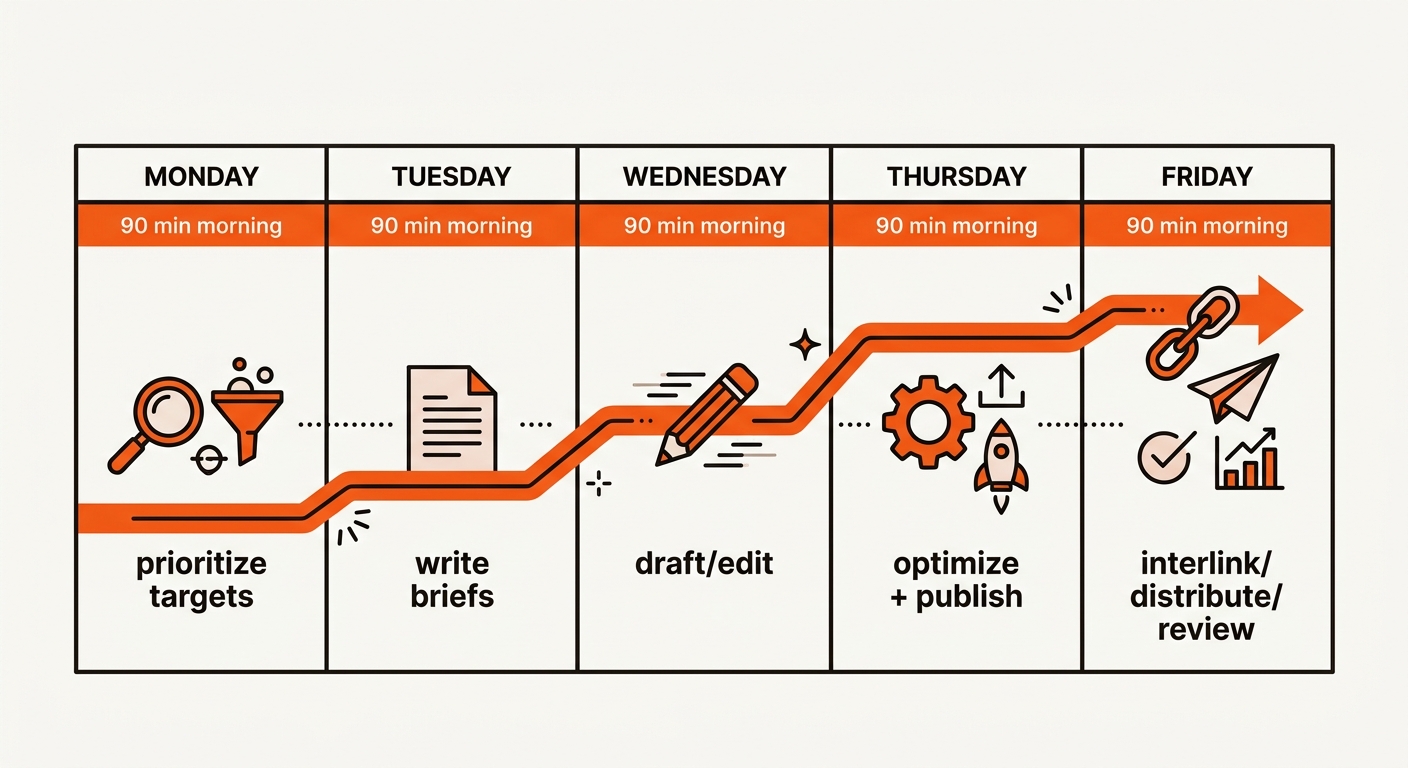
Weekly shipping beats quarterly strategy decks in SEO. A simple operating rhythm turns startup SEO execution into output you can measure every Friday. Here is the cadence founders can run in 2 hours per day: prioritize, brief, draft, publish, interlink, and review with hard success or failure gates.
Most teams stall on tooling and taste. You need speed and structure. If you want help running it, Mergeflo’s startup SEO execution system turns this cadence into a weekly plan and drafts for your review.
You’re a founder or growth lead at a 3-10 person startup with at least one canonical money page live and the bandwidth to commit two operator-hours per weekday. This rhythm assumes you have product-market signal, GSC connected, and a content brief template in hand. If you’re pre-product or your only marketer also runs paid ads and lifecycle, halve the cadence: publish one page a week instead of two.
Most teams swing between weekly bursts and three-month silences. The result: GSC impressions plateau, internal links drift, and the brief queue empties faster than it fills. The fix isn’t more strategy: it’s a defended weekly calendar where every task has an owner, an input, an output, and a measurable success metric. Without the gates, even strong execution turns into orphan pages and stalled clusters.
Pass Core Web Vitals, compress media before upload, and publish with Organization and Article schema. Add FAQ schema only when the content actually answers unique questions seen in the SERP.
Every day has one job, one owner, one output, one gate. Without this shape, the calendar drifts and the rhythm dies. Print this and tape it to the wall.
At two operator-hours per weekday, this calendar plans for 8 published pages per month (2 a week). Doubling to 4 hours buys throughput, not quality: if Tuesday’s drafts thin out, drop Wednesday to one page and keep the gate.
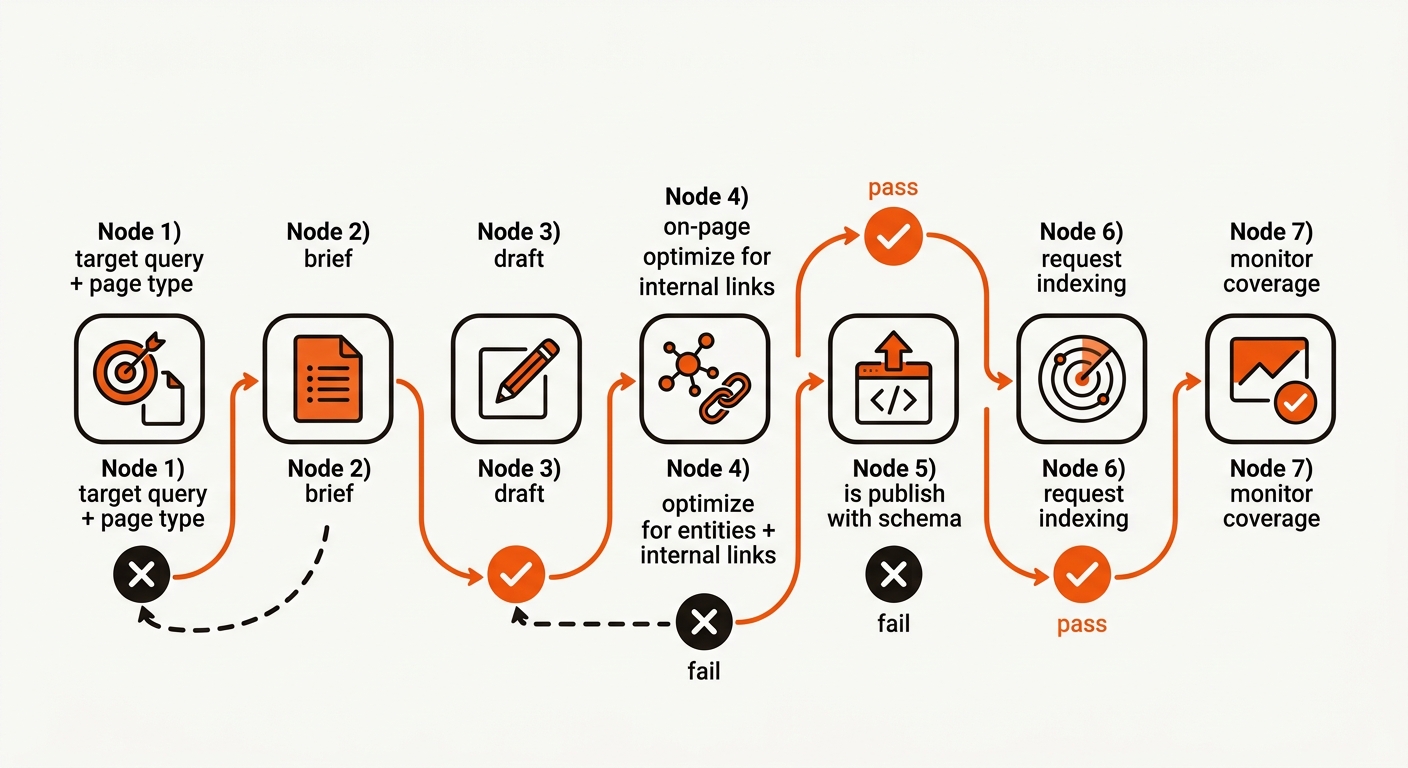
Define a single lane from keyword to indexed page, then protect it. Your steps: select query and page type, write a brief with angle and subheads, draft with sources, optimize for entities and internal links, publish with schema, request indexing, and monitor coverage. When scaling clusters, lean on the Startup SEO guide for page types and IA patterns.
Two guardrails keep quality high: every page must answer the SERP job to be done, and every page must join a cluster via 3-5 internal links. For checklists and cluster design, see the startup SEO checklist and how to build topic clusters for startups.
Operate SEO as a closed loop: Observe, Orchestrate, Output, Optimize. Observe: use GSC, Ahrefs, and sales notes to select targets with real intent and business value. Orchestrate: convert targets into briefs that specify angle, entities, examples, and an internal link plan. Output: draft, edit, and publish on a strict timebox with schema and UX checks. Optimize: interlink, distribute, earn links, and watch indexing, then feed wins and misses back into Monday’s picks. Tradeoffs exist: more throughput risks thinness, and too much polish kills velocity. The failure mode is skipping Optimize and starving the loop.
Use a simple funnel to judge whether the cadence is worth its hours. The numbers below are assumptions chosen for this example. They are not benchmarks and not results from any customer, so replace each one with your own data from Search Console and your sign-up reports. The calendar above publishes 2 pages a week, so a 4-week run yields 8 pages.
Assume those 8 pages earn 10,000 impressions in the month, with a 2% click-through rate and a 1% visit-to-trial rate. That is 10,000 x 2% = 200 visits, and 200 x 1% = 2 trials. If each trial is worth V to you, the value for the month is 2 x V, set against about 40 operator-hours (2 hours x 20 weekdays). If that is too small to justify the hours, change the topics or the page type before you add volume.
Treat each gate as binary to protect quality while keeping speed. Gate 1: brief acceptance under 15 minutes, otherwise rework. Gate 2: draft must include two external sources and one numerical example. Gate 3: publish only with schema, compressed media, and three or more internal links. Gate 4: indexing check at 72 hours, and if missing, adjust interlinks and resubmit.
Common failure modes: chasing KD without intent, over-relying on AI with no operator edit, publishing orphan pages, and skipping distribution. For patterns that scale, mirror winning IA from leaders in your niche, then differentiate in depth and UX, as argued in Founder Collective’s systems view of SEO (Founder Collective).
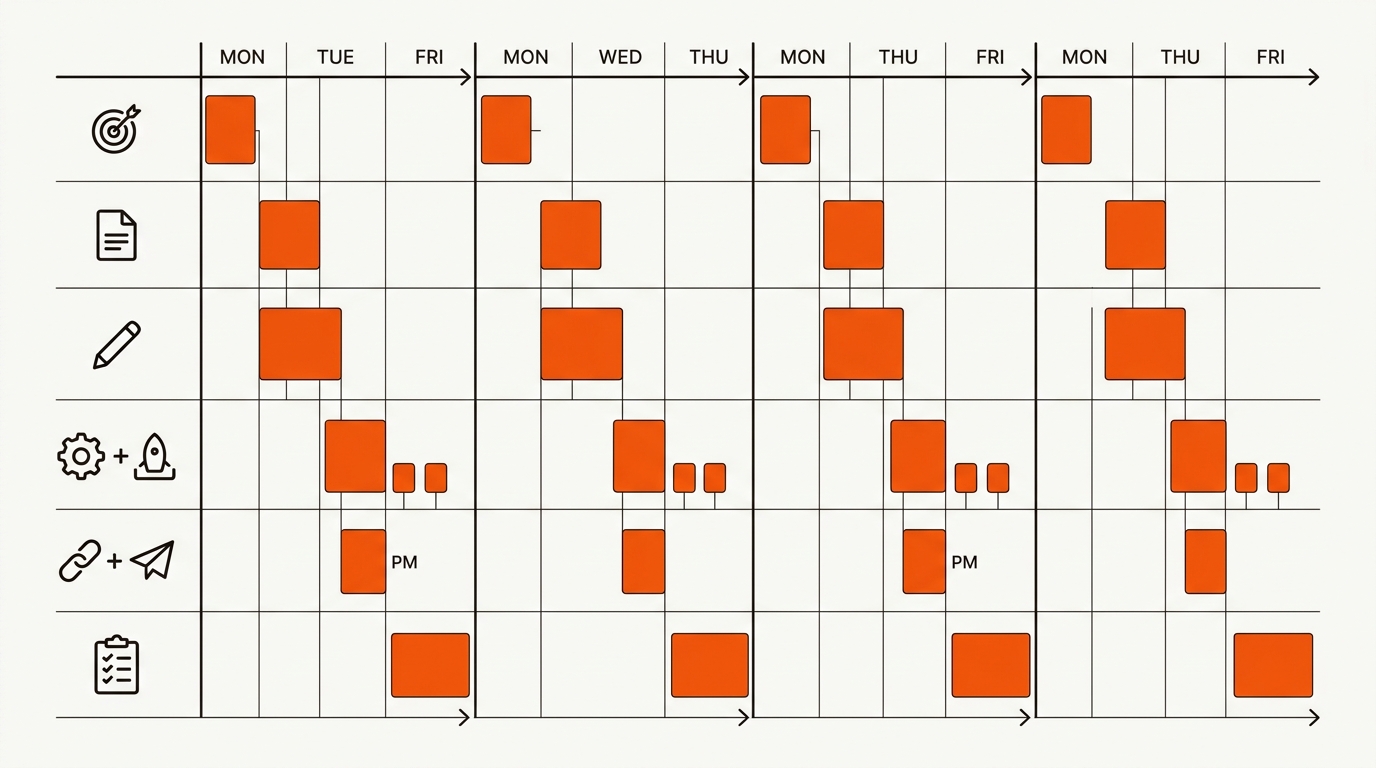
Run the rhythm for 8 weeks and judge it by indexed pages, impressions, and trials. This workflow turns ambiguity into a scoreboard you can review every Friday, then repeat. Protect the calendar, enforce the gates, and compound topical authority with disciplined internal links and distribution.
The calendar above is built on two operator-hours per weekday.
Founder or growth lead owns Monday (prioritization) and Friday (review + interlink). One operator owns Tuesday-Thursday end-to-end. The third person, usually product or paid, only touches Friday review to sanity-check intent against pipeline signal.
Catch up Saturday morning: losing the review skips the interlink pass and starves Monday’s prioritization. If you miss two Fridays in a row, the calendar is broken: drop to one page a week until the rhythm reasserts. Don’t accumulate missed reviews; they compound into orphaned clusters.
Set two checkpoints. At week 4, check that the planned pages are published and indexed and that GSC impressions are rising across the cluster. At week 8, look for position gains on some of the new pages and at least one article that brings a sign-up. If neither shows, revisit the briefs before you change the cadence.
As the page count grows, internal-link maintenance starts to dominate the calendar. Either dedicate Friday entirely to interlinking, or use a tool that proposes links and refresh briefs for you to approve. Manual interlinking gets heavy as the site grows, which is when teams tend to quit the cadence.
Yes, at half speed. Publish one page a week: Monday picks the query, Wednesday drafts the page, Thursday optimizes it, Friday publishes it and reviews. Skip the Tuesday separation.
• Startup SEO Checklist: What to Fix Before Publishing 30 Posts
• How to Build Topic Clusters for a Startup Website
• SEO Agency Alternative for Startups: Execution Without the Retainer
