
You can steer SEO with two numbers: the cost to get a page indexed and the cost to generate a qualified demo. Most teams track rankings and traffic but miss production efficiency and sales impact. When you quantify both, you can forecast payback by month, spot execution bottlenecks, and reallocate budget before runway slips. Tie the model to your actual funnel metrics instead of generic channel ROI.
Early-stage teams need a price-to-output line of sight. Map monthly expense to indexed pages first, then to qualified sessions and demos. If you are evaluating platform spend, align it to pricing tiers and expected indexation throughput using your historical demo rate. If you need pricing context, review the plan tiers on pricing.

You run a small growth team and need ROI clarity fast. You publish every month, know KD and CPC, but your GSC shows impressions without demos. You want an operator’s model you can use Monday morning to decide headcount vs platform vs agency.
A common scenario: a small growth team with a content budget and a tool stack publishes steadily, but only some pages get indexed and none drive demos. You need a ledger that exposes where money converts to indexed pages and where indexed pages convert to pipeline.
Model ROI with a leading efficiency metric and a lagging revenue metric.
• Cost per indexed page: total monthly SEO expense divided by new, canonical pages indexed in 30–45 days. This measures production throughput and technical health.
• Cost per qualified demo: total monthly SEO expense divided by demos attributed to organic from qualified queries. This measures commercial impact.
Track both. If indexed-page cost improves but demo cost stalls, you are indexing the wrong intent or failing to rank. If demo cost improves while indexed-page cost spikes, your execution engine is slowing and will cap growth.
Connect this model to execution patterns in SEO for startups.
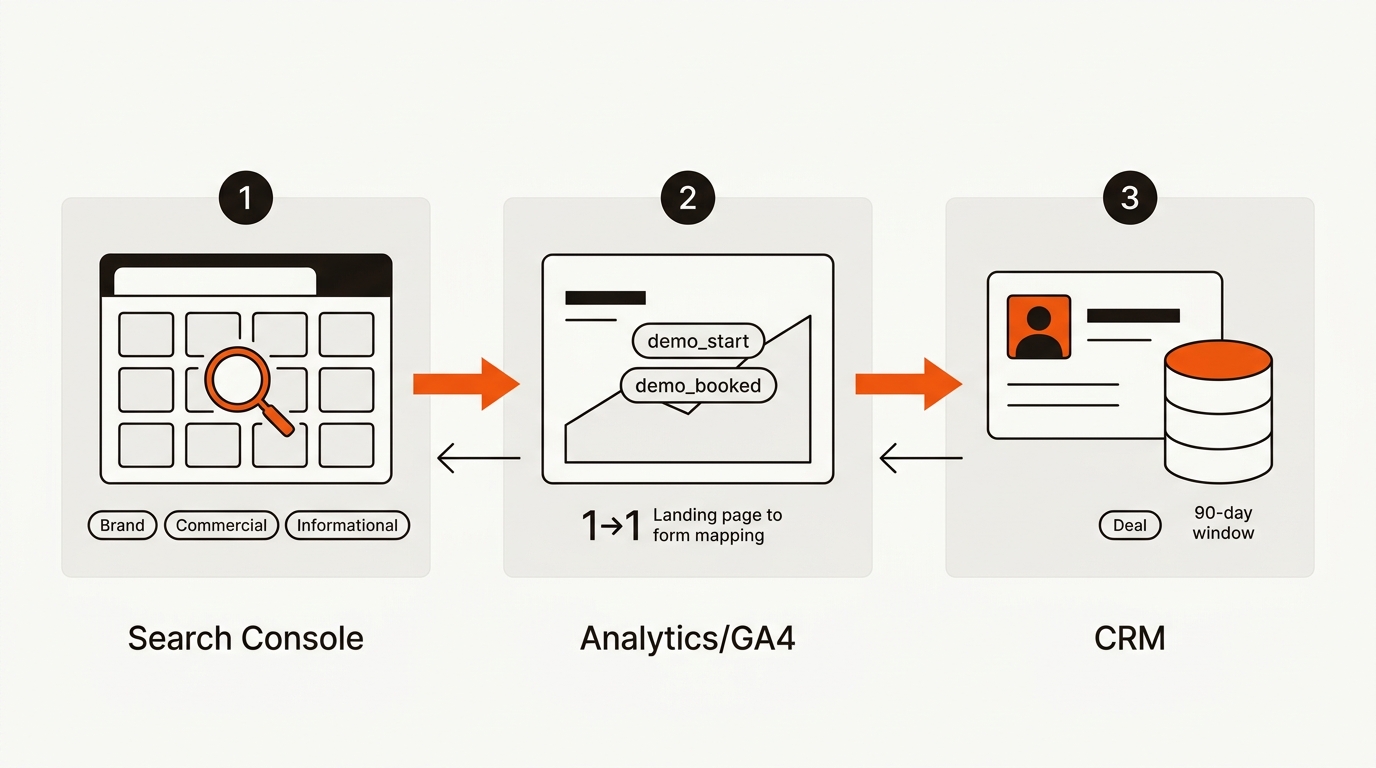
Attribution only works when your data layers talk to each other. Wire GSC for queries and indexation, GA4 for session and event-level conversions, and your CRM for MQL/SQL/demos and pipeline values. Use UTM discipline for demo forms and reconcile company domains to organic sessions to reduce false paid credit on branded queries.
• GSC: monitor Indexing report and query-level impressions/clicks. Google Search Central
• GA4: define demo-start and demo-booked events with source/medium = google/organic.
• CRM: set an Organic SEO campaign; auto-associate deals from demo events within 90-day windows matching your sales cycle.
Reference autonomous workflows when planning implementation with an autonomous SEO platform. The handoff from GA4 events to CRM objects needs to be automatic, or your demo attribution will drift as volume scales.
A large monthly SEO line item can take a big share of seed-stage burn. If cost per indexed page is high and the site keeps adding thin pages, you are paying agency rates for crawlable noise. Intent-weighted pages that index and convert shorten payback. The next section shows the system to do it.
Most ROI writeups stop at channel LTV:CAC and ignore the production denominator. Ahrefs’ coverage (ahrefs.com/blog/SEO-ROI/) and calculators optimize around traffic value proxies, while Moz’s SEO ROI guide generalizes enterprise assumptions. Siege Media’s blog (siegemedia.com/blog/SEO-ROI) maps value from CPC equivalents. They rarely price cost per indexed page or intent-weighted indexation rate. Our angle: manage ROI with a two-cost ledger tied to indexation throughput and qualified demos.
A simple ledger to manage execution and revenue on one page. The ledger tracks: (1) pages shipped, (2) pages indexed inside 45 days, (3) qualified sessions per indexed page, (4) demos per 1,000 qualified sessions, and (5) monthly SEO expense. Apply it weekly to catch indexation stalls, content-intent drift, or SERP mismatch.
Tradeoffs appear fast. Pushing volume can dilute intent density and depress demo rates; optimizing only for demos can starve authority-building content needed for rankings. Failure modes include thin clusters that index but never rank, and strong clusters throttled by technical delays that push indexation past 45 days. The ledger keeps both efficiency and revenue outcomes in the same view so you can correct early.
A 6-month model with stated assumptions beats vague funnels.
Assumptions:
• Monthly expense: everything you spend on SEO that month (platform, editorial QA, project management)
• Indexation: new pages published and the share indexed inside 45 days
• Qualified session yield: sessions per indexed page from qualified queries
• Demo rate: the share of qualified sessions that book a meeting
• Close rate, ARPA and gross margin from your own CRM
Calculations: Cost per indexed page = monthly expense / pages indexed. Qualified demos = indexed pages × qualified sessions per page × demo rate. Cost per qualified demo = monthly expense / qualified demos. New MRR = demos × close rate × ARPA. Each new cohort of pages adds to the next months. Compare cumulative gross profit with cumulative spend to find your own payback month.
Note: CPC value can sanity-check economics; use WordStream CPC benchmarks to compare implied traffic value to demo-attributed revenue.
Ahrefs found that 96.55% of the pages in its index get no traffic from Google; indexation and intent quality decide whether your content even enters the race. Ahrefs study
Lower cost per indexed page by fixing throughput; lower cost per demo by targeting intent. Throughput depends on crawlability, canonical discipline, and consistent on-page structures. Intent depends on choosing keywords that create qualified sessions and stacking clusters behind commercial endpoints.
Throughput: enforce clean sitemaps, canonicalization, and templated on-page elements; monitor time-to-index in GSC weekly. Ship clusters and avoid orphan pages. Intent: prioritize keywords with in-funnel modifiers (pricing, alternatives, integration, for ICP); cluster around commercial pages; measure qualified sessions per page.
If you plan to automate, see how an AI SEO platform for startups operationalizes cluster generation and on-page optimization. Automation brings a new tradeoff: faster publishing can expose weak intent selection. Counter by enforcing a brief schema that captures search intent, SERP features, and internal link targets.
A practical constraint: this approach gets harder as the site grows if you lack automated internal linking and sitemap management. Indexing lag compounds and dilutes the qualified session yield per page. Keep cluster-level sitemaps updated and use GSC to audit indexation weekly or production savings will be erased by crawl waste.
Use landing-page path plus query class from GSC. Attribute demos when the immediate prior session is google/organic and the query is non-brand or solution/competitor-modified. Deduplicate by company domain in CRM to prevent counting multiple demo forms from the same account as separate MQLs.
We found no published benchmark, so track it against your own history. A rising cost per indexed page usually means technical blockers, thin content, or overstaffed production. Use Screaming Frog to audit canonicals and noindex tags, and spot pages trapped by parameterized URLs.
We found no typical payback period we can source. It depends on your sales cycle, ARPA, and how quickly pages index and convert. Track cumulative gross profit from organic deals against cumulative SEO spend to find yours.
Indexing lag compounds and internal linking debt grows. Enforce cluster-level sitemaps, automated internal links, and weekly GSC anomaly checks.
