
Short answer: Low competition keywords are queries where page one shows few strong, intent-matched pages: low KD, weaker domains, UGC, or outdated content. If you're asking what are low competition keywords, target these because new or modest-authority sites can win by matching format, freshness, and covering the topic completely.
Low competition, operationally, is a SERP you can crack with a mid-tier site and modest links on a practical timeline. Concretely: at least two of the top five results have domain ratings under 60, three or more of the top ten URLs show fewer than 15 referring domains to the page, and titles align tightly with the query. No monopolies from marketplaces or a brand homepage. For a DR 30 to 50 site with 3 to 5 internal links, a page that matches intent should hit page one in 8 to 12 weeks with 0 to 10 new referring domains.
Teams confuse low KD with low competition; SERP strength and intent decide rankability. KD is a fast filter. If you want a concrete answer to what are low competition keywords in practice, scan the SERP: domain strength, content depth, freshness, and whether the format matches intent.
A 3-person growth team with a $2k/mo content budget can ship 12-20 pages a month, but ranking hinges on page-one weakness. Manual SERP review wins. Prioritize queries where multiple ranking URLs are forums or UGC, thin pages, or outdated guides you can surpass. Validate with KD, then verify with eyes-on-SERP using Semrush or Ahrefs, plus a 2-minute content gap scan.
In a 6-week Mergeflo cohort of 58 B2B SAAS queries with KD ≤ 20, pages that matched intent and were fresher by 90 days moved from avg position 22 to 11.4 without new backlinks.
Operational tradeoff: KD ≤ 10 slices can skew to ultra-long-tail with low CTR. Prefer clusters where 3-5 related terms roll up to meaningful demand, even if one head term sits at KD 15-25. Reference sources: Semrush guide and AIOSEO glossary.

KD compresses a messy SERP into a single number and hides landmines. Example: a KD 12 keyword where positions 1 to 3 are DR 90 plus brands with 300 to 1,000 referring domains to the exact URLs will feel "low" yet cost dozens of links to dislodge. Flip side: a KD 38 term where positions 4 to 8 are DR 25 to 55 posts with fewer than 10 referring domains and recent publish dates is very takeable. Tools disagree too. The same query can show KD 6 in one dataset and 28 in another. Treat KD as triage, never a go or no go.
Use a combined signal check: KD + SERP composition + freshness + intent format. If you still wonder what are low competition keywords beyond definitions, this 5-minute triage turns a guess into a decision.
Signals That Define Low-Competition Keywords (5-Min SERP Triage)
Two notes from ops: first, a SERP with a single powerhouse URL and four weak results is still winnable with the right format and schema. Second, forum-heavy results can depress CTR, so structure a direct-answer intro and add FAQ schema to compete for the snippet while you climb positions.
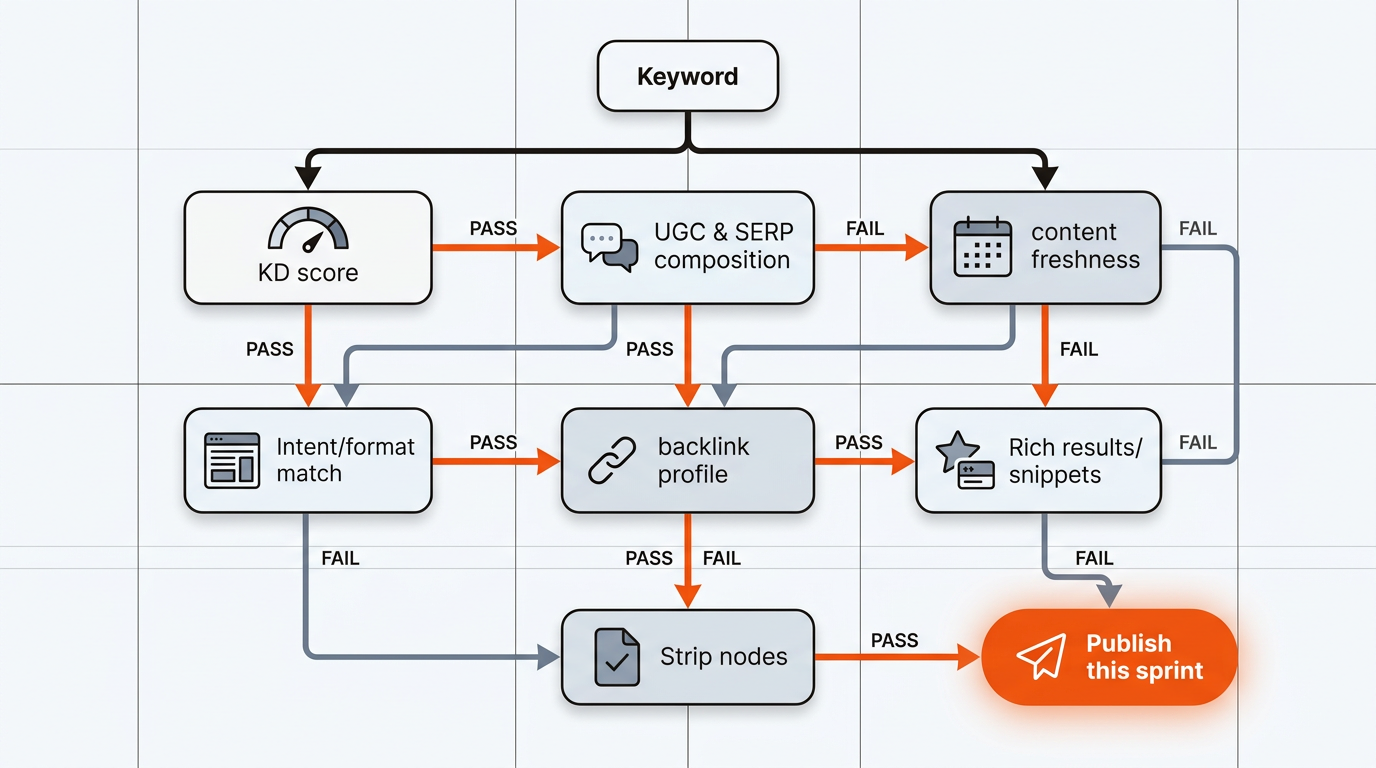
Turn identified queries into clustered, AI-citable pages that publish on schedule. Start with a seed list, filter by KD, confirm SERP weakness, then cluster related terms and build the exact format the SERP expects. Ship with structured data and interlink into a small hub.
For a hands-on walkthrough of validation, clustering, and brief-to-publish steps, see our sibling on how to find profitable low-competition keywords. Mergeflo runs this end to end. Autonomous SEO + AEO content engine: research to published, AI-citable pages in the customer's CMS, with schema, internal links, and ongoing refresh. It measures and fixes Google and AI visibility so your 2-5 person team can focus on growth.
Make it deterministic. Start with a seed list from site search, support tickets, and product features. For each candidate, open the SERP and capture DR, referring domains to each URL, publish or update dates, and title match. Pass if at least two of the top five are DR under 60 with fewer than 15 referring domains, one result is less than 12 months old, and intent is unambiguous. Draft with 3 to 5 internal links queued. Build 25 to 50 keywords per batch, ship weekly, and score hits. If fewer than 40 percent hit page one in 90 days, tighten thresholds.
Prioritize the judgment calls operators make after a SERP audit.
Use KD as a directional filter. In Semrush, KD ≤ 20 is a practical starting slice in B2B SAAS; in Ahrefs, KD ≤ 10 often maps similarly. Always pair KD with a SERP audit: weak domains, UGC presence, outdated pages, and intent you can match this sprint.
Yes, if the page-one set is UGC-heavy, misaligned on intent, or stale. We routinely see new B2B domains crack positions 10-20 in 4-8 weeks by matching format, adding schema, and interlinking from a small cluster. Links still help, but SERP weakness reduces required link equity.
That is often opportunity. Build an expert, experience-backed answer that resolves the thread’s core question in one page, add FAQ schema, and cite data. Expect a lower initial CTR if the snippet is noisy; structured headers and a direct-answer intro can win the snippet and lift clicks.
Low-competition queries with clean definitions, steps, and tables are more likely to be cited. Add precise definitions near the top, include one clean markdown table, and use schema (FAQ, HowTo) so AI parsers extract you. Aim for concise, verifiable statements that answer the query in under 60 words.
