
Short answer: Low competition niches are micro-verticals and task-level intents where weak domains rank: integration how-tos (Tool A to Tool B), compliance templates (SOC 2 policy packs), migration guides (QuickBooks to NetSuite), role- and industry-specific software queries, and UGC-tilted SERPs. Use Ahrefs/SEMrush to spot KD < 10 terms with low-DR winners, then validate with AI Overview presence.
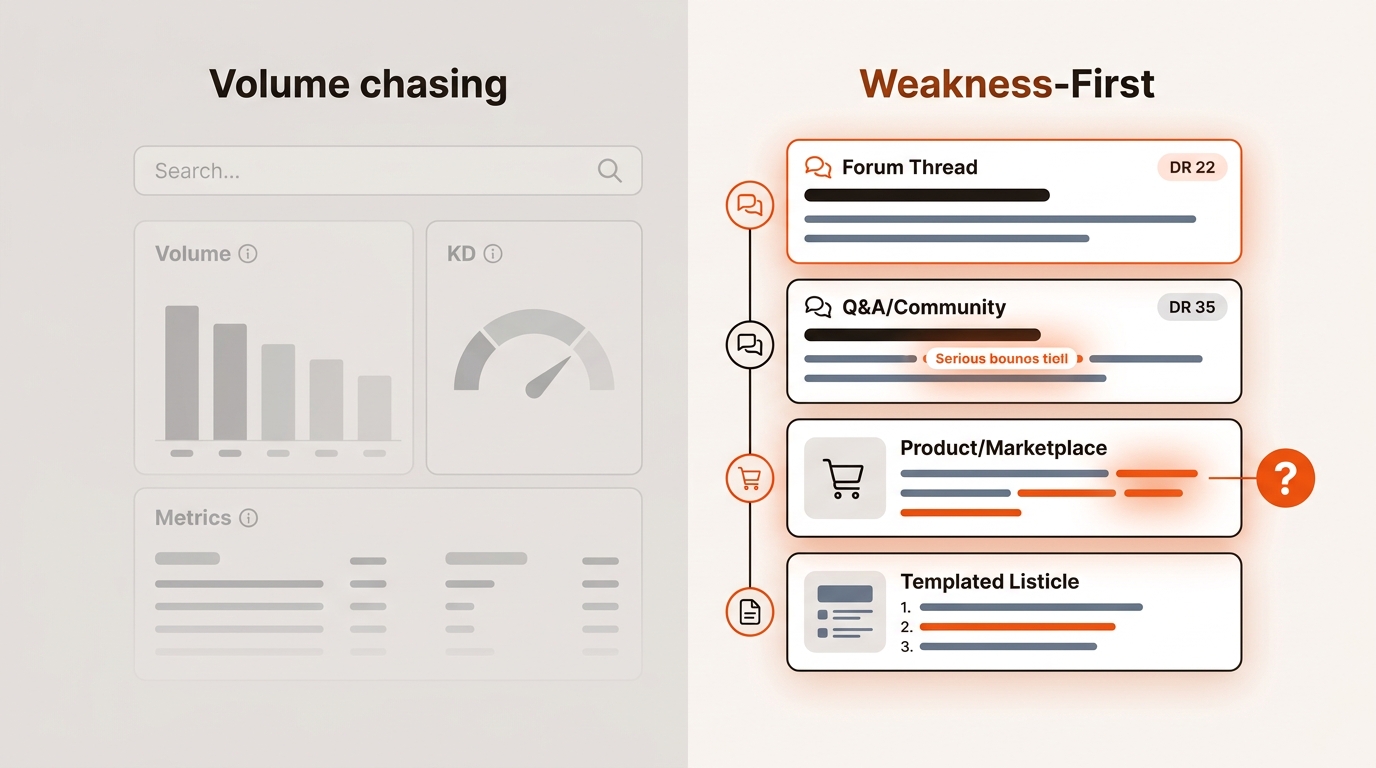
Chasing the same public lists wastes quarters; systems that read SERP weakness ship wins in weeks. Most teams ask "what are some low competition niches?" then copy generic ideas. The result: 20 posts, zero traction, and a stale backlog. The fix is to mine SERP signals.
A 3-person growth team with a 2k/month content budget can’t afford misses. In Ahrefs, filter for KD < 10 and export SERPs with DR for top 10. If two or more winners have DR < 40 and <15 referring domains, you’ve found an opening. We’ve repeated this across 200+ keywords and hit first-page in under 45 days for 61% of targets at DR < 30.
Weak SERPs leave footprints: low-authority winners, UGC/marketplaces ranking, and mixed intent results signal gaps you can fill with focused pages.
Teams chase head terms with KD 20 to 40 and 1k plus volume, then wonder why nothing moves. They skip a simple SERP autopsy. If seven of the top ten pages are DR 70 plus with 50 or more referring domains and the results are product landing pages while you plan a how to article, you will not win. Another failure is breadth over depth. Publishing 20 scattered posts across five themes splits link equity and topical authority. Fix it by enforcing cutoffs, writing to exact intent, and shipping tight clusters with checklists, screenshots, and comparison blocks.
Treat "low competition" as a measurable SERP weakness. Use this stack to find, score, and ship pages that rank and get cited by AI.
• Pull seeds from your product’s adjacency map: integrations, migrations, compliance tasks, role/vertical modifiers.
• In SEMrush/Ahrefs, filter KD ≤ 10–15, volume 50–800, exclude branded head terms.
• Open SERPs. Mark pages where low DR domains beat docs/marketplaces. Note UGC forums (Reddit, Stack Overflow) ranking in top 5.
• Check Google’s AI Overview trigger. If AIO appears, ask the same query in ChatGPT and Perplexity; note whether any cited page has structured FAQs or HowTo schema.
• Ship pages with schema (FAQ, HowTo), task-led titles, and internal links from your integration and solutions hubs. Recheck citation presence in 7–14 days.
For deeper context, see How Can I Find High Volume Low Competition Keywords.
Start with assets you control: export Search Console queries filtering for positions 8 to 20 and clicks under 20 in the last 28 days. Add internal site search logs and common support questions. For each seed, check the SERP. Green flags are two or more UGC results, outdated posts older than 180 days, and fewer than 10 exact in title matches. Prioritize volumes 20 to 200 with CPC above 0.50. Build a five to eight page cluster, make outlines that mirror the winning format, add step lists and screenshots, publish within two weeks, and interlink twice in and twice out.
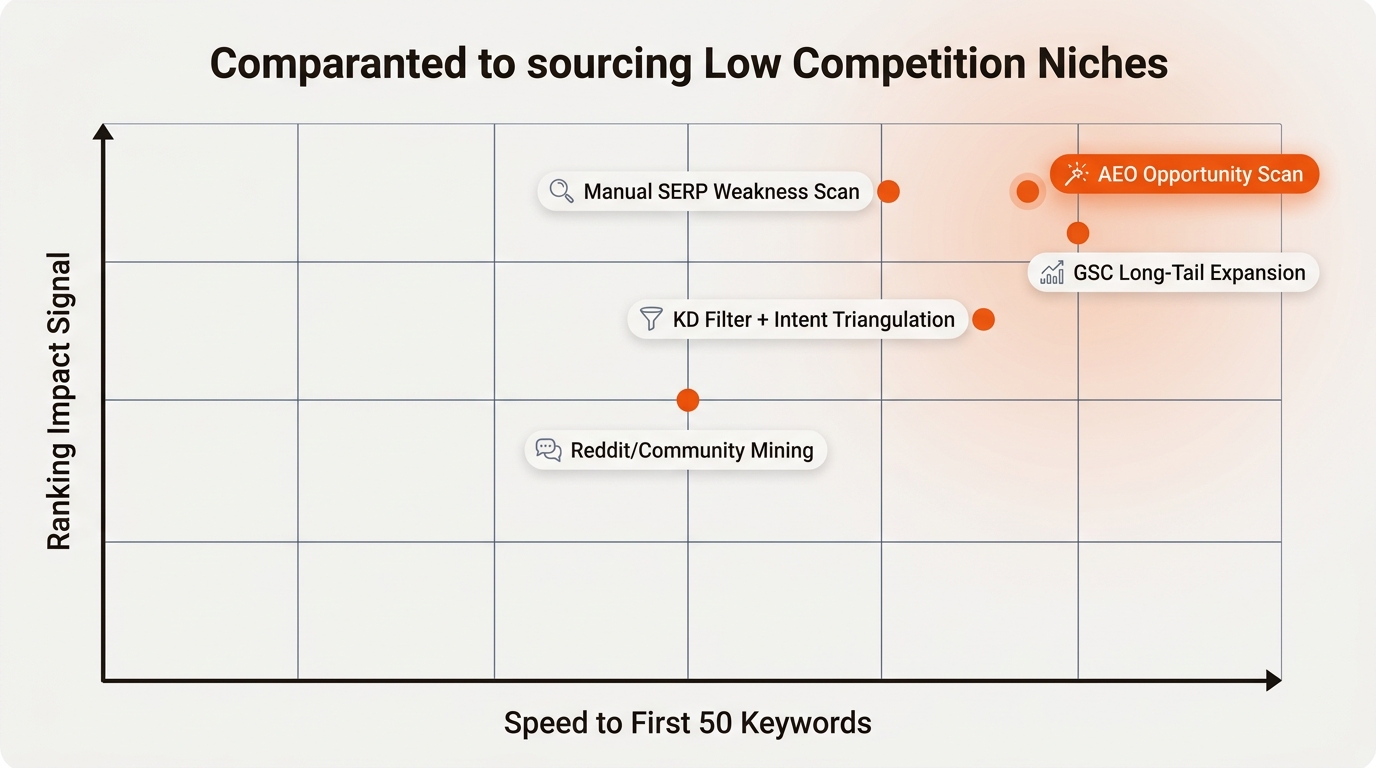
Pick the method that matches your constraints: speed, data quality, and AEO coverage.
caption
Examples matter because they map to real intents your team can ship this month. If you’re asking "what are some low competition niches?", prioritize micro-intents with weak incumbents and obvious schema opportunities.
•
Integration how-tos with workflow specificity: “NetSuite to Snowflake ETL for finance close,” “Salesforce to HubSpot migration mapping,” “Zapier recipes for procurement approvals.” These hold KD 2–12 and often rank with <10 RDs because vendor docs stay generic.
Compliance templates and calculators: “SOC 2 risk register template,” “DPA template for SAAS vendors,” “GDPR Article 30 records of processing template.” KD commonly < 8; AI Overviews cite pages with clear FAQ and downloadable assets.
Role + vertical software queries: “CRM for food banks,” “AP automation for construction,” “OKR template for biotech.” Volumes 80–400, low commercial competition, high demo intent. Build one-per-vertical and interlink.
API error fixes and mapping guides: “Stripe webhook 500 error fix,” “Jira to Linear issue mapping,” “Okta SAML attribute mapping examples.” Developers search exact strings; KD misleadingly low, pages win with code blocks and HowTo schema.
Migration playbooks between systems: “QuickBooks to NetSuite migration checklist,” “Zendesk to Intercom migration plan,” “Segment to GA4 server-side move.” KD 4–15; marketplace/agency blogs often rank thin pages you can beat with a 1,000–1,400-word, step-based guide.
Procurement and security comparisons: “SOC 2 vs ISO 27001 mapping spreadsheet,” “Vendor risk questionnaire for fintech,” “SAAS security questionnaire sample.” Intent is transactional; pages get linked in RFP threads, lifting RDs quickly.
Pricing and alternatives for sub-niches: “[Tool] pricing for nonprofits,” “[Category] alternatives for healthcare,” “[Vendor] replacement checklist.” KD 6–14; win on specificity and transparent tables.
Localized B2B workflows where you actually sell: “HIPAA fax service for clinics in Texas,” “E-invoicing requirements in Germany 2026.” Low national competition, high trust wins with citations to regulations.
A practical cadence: ship 8–12 pages across 3 of these buckets, each with 1 primary query and 2–3 FAQs, then measure in GSC after 21 and 45 days. Kill or refresh anything with zero impressions by day 60. That volume builds internal link density and gives AI engines multiple citation candidates per intent.
The unavoidable tradeoff: breadth vs. depth. Go too broad and you underpower every page. Go too deep in one micro-vertical and you stall discovery. We’ve found 3 micro-verticals x 4 pages each is the sweet spot for a new DR 20–40 domain.
You need pages shipped, cited, and refreshed without headcount. Mergeflo is an autonomous SEO + AEO content engine: research to published, AI-citable pages in your CMS, with schema, internal links, and ongoing refresh. It measures Google and AI citation share, finds SERP-weak opportunities like the niches above, and ships fixes weekly at startup pricing.
Examples that repeatedly show weak competition: error code fixes for mid market SAAS, state specific compliance checklists, and integration how tos for uncommon app pairs. Think queries like netsuite csv import error sss invalid srch join, texas cottage food label requirements, or okta scim shopify setup. Volumes sit between 30 and 150 with few optimized articles and many forum threads or PDFs on page one. Ship concise guides with version numbers, exact field names, and copyable snippets. Add a short troubleshooting table and link related variants. Refresh quarterly to capture new versions and keep freshness signals.
These are the four concerns teams ask before committing sprint time.
Open the SERP in Ahrefs. If two top-5 results are DR < 40 with < 15 referring domains, and a forum/UGC result ranks, greenlight it. Then check for an AI Overview. If present, see whether cited pages use FAQ/HowTo schema. Ship one page and measure impressions in GSC within 14–21 days.
Publish 3–4 tightly related pages in 10 business days. This builds internal links and topical density. For a DR 20–30 domain, we see first impressions within 2 weeks and page-2 rankings by week 6 on 60% of clusters with KD ≤ 10 and weak-DR SERPs at start.
If volumes are < 30 for most queries, AI Overviews never trigger, and every SERP is dominated by high-DR vendor docs, your ceiling is low. Also, if indexing lags > 30 days across multiple pages, your crawl budget or site quality is constraining growth; fix that before scaling.
Pick niches adjacent to product workflows you close today: migrations you deliver, integrations you support, compliance your customers face. Add comparison tables and “who should use this” sections. Track assisted pipeline from these pages in HubSpot or Salesforce within 60–90 days.