
Short answer: AI search visibility tools fall into three jobs: monitor where you appear (citations in ChatGPT, Perplexity, AI Overviews), diagnose why you don’t (entities, schema, topical gaps), and activate fixes (publish AI-citable pages, internal links, refreshes). Winning teams pair tracking with a workflow engine that ships changes weekly.
You can’t manage AI visibility with SERP-only tools; you need citation coverage, entity health, and an activation loop.
Most 2-5 person growth teams ship 10-30 posts per month and still get zero LLM citations because they track rankings. AI answers are volatile, multi-source, and entity-driven. You need repeatable test prompts, entity checks, and schema validation to earn inclusion.
Across 2026 roundups, the "best tools" counts vary wildly: 22, 10, 8, and 3. Fragmentation means no standard. Your stack must be modular.
AI Overviews behave differently than classic blue links. Google emphasizes helpful, verifiable outputs and structured data. Use that as your north star. See Google’s notes on AI Overviews at https://blog.google/products/search/ai-overview/ and structured data guidelines at https://developers.google.com/search/docs/appearance/structured-data.
A realistic scenario: a 3-person growth team with a 2k monthly content budget. They run a 50-query test set weekly across ChatGPT and Perplexity, find 0 citations, then discover missing Product schema and thin internal links on their top URLs. Fixing those basics moves inclusion faster than adding 10 more posts.
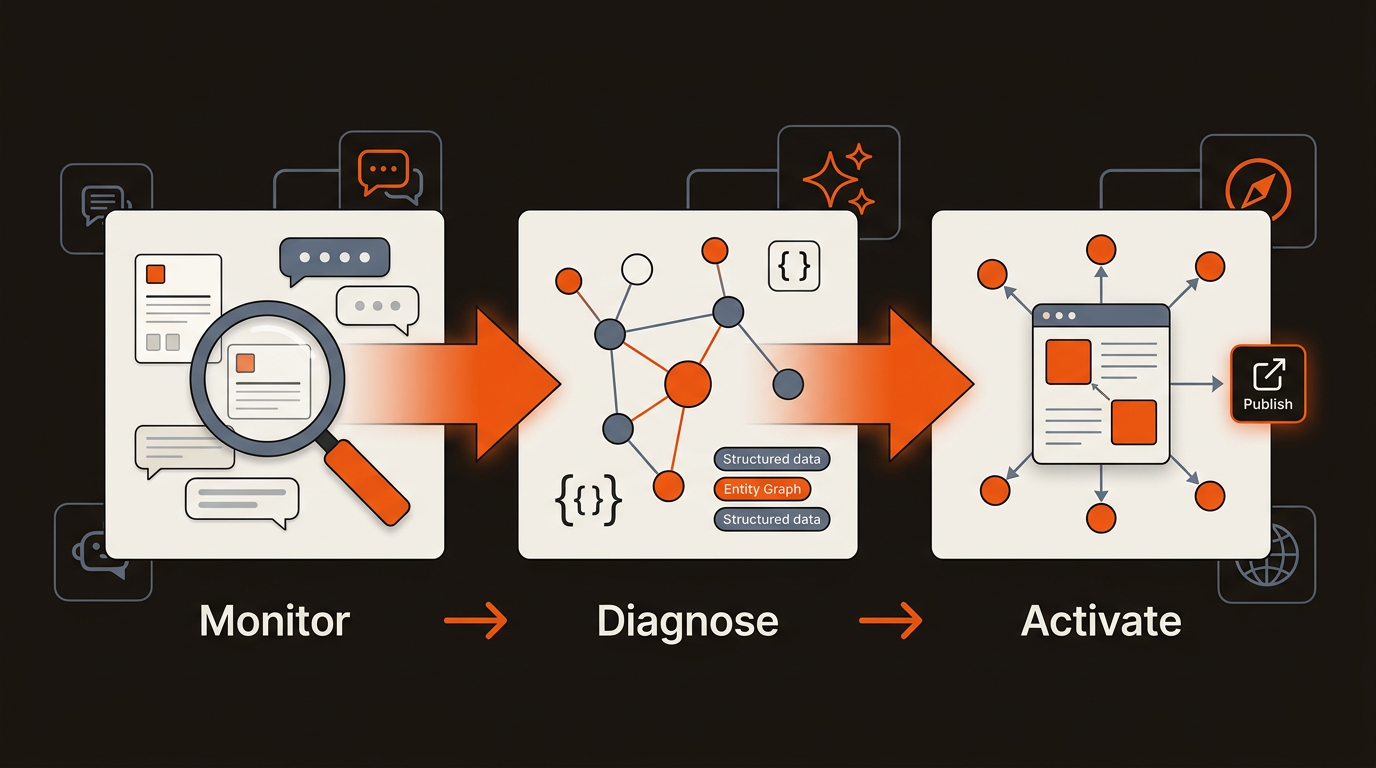
Group tools by job-to-be-done so you can measure, explain, and ship fixes on a weekly cadence.
caption
Measurement-only stacks tend to stall. An operator still has to translate gaps into shipped changes: add missing entities, upgrade schema, publish support content, and refresh sources. At 100+ tracked queries, a DIY prompt harness can consume 3-5 engineer hours per week for maintenance and diffing. That is the tradeoff: flexibility vs production velocity.
AI search visibility tools work best when the monitor feeds the publisher. For example, if your set shows 0 citations for a core category term, ship a spoke page that targets that entity, add schema, and link it from the hub. Re-measure next week. This monitor-diagnose-activate loop is how you compound inclusion across engines.
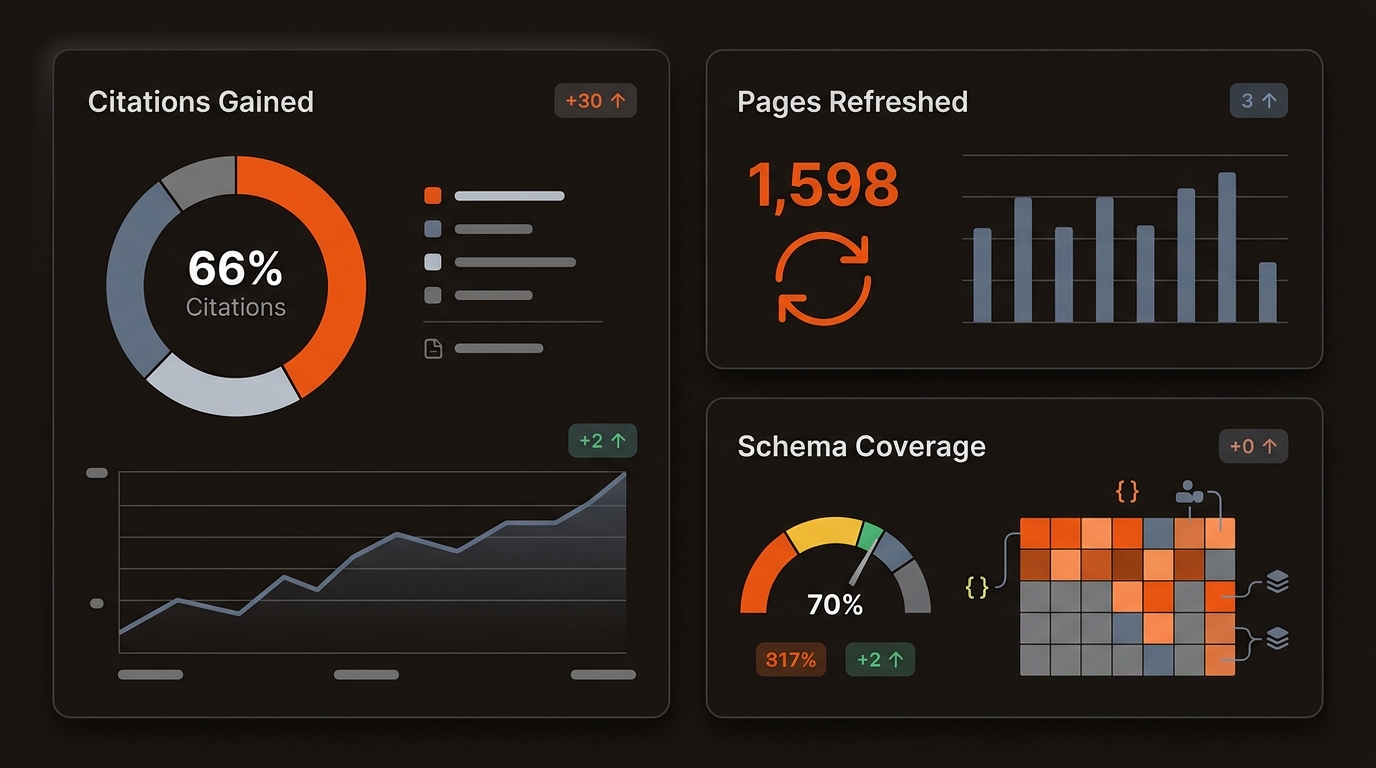
Visibility moves when diagnosis flows into automated publishing: entities, schema, internal links, and refresh cadence.
Map tracked gaps to ops: add missing entities, harden page schema, create supporting spokes, and refresh stale sources. That requires a workflow engine, not just dashboards. Mergeflo is an Autonomous SEO + AEO content engine: research to published, AI-citable pages in the customer's CMS, with schema, internal links, and ongoing refresh. It is end-to-end and autonomous: measures AND fixes visibility, not just an audit/tracking tool. Covers Google AND AI engines (AI Overviews, ChatGPT, Perplexity, Gemini, Copilot).
If you want more on measurement, this walk-through on AI visibility tracking tools to measure and grow share shows how to standardize prompts, track entities, and create weekly deltas.
Four operator questions, answered with specifics.
Check if the LLM lists your URL as a source and validate that the cited passage exists on the page. Run the same prompt with temperature 0–0.2 three times to reduce variance. If two of three runs cite you, count it. Log prompt, model, and timestamp for reproducibility.
Weekly. AI answers shift faster than SERPs, so daily creates noise and monthly hides regressions. A practical cadence: Monday pull (citations and AI Overviews), Tuesday decisions, Wednesday publishes, Friday verify deltas. This rhythm fits a 3-person team without drowning them in checks.
Track click-through from AI-visible pages, not just citations. Target a 10-20 percent week-over-week increase in AI Overview inclusion across your priority queries for the first 4-6 weeks, paired with net-new assisted conversions from those pages in GA4 or HubSpot.
Yes. Entities, schema, internal links, and topical coverage are foundational for both. AI Overviews and LLMs prefer sources that are authoritative and structured. Treat AEO as an extension of SEO ops: the same cluster planning, plus prompt-based measurement and faster refresh cycles.
