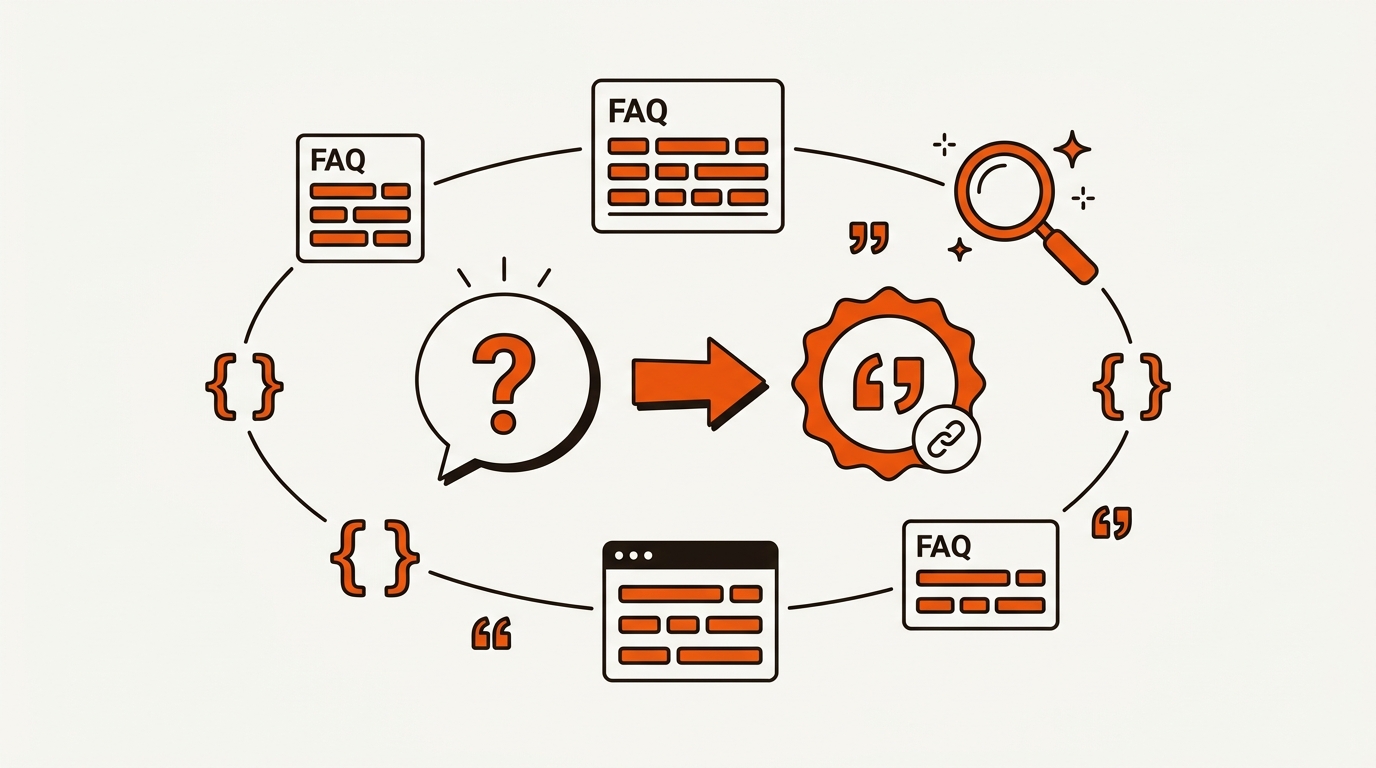
Answer engine optimization, or AEO, is the practice of optimizing web pages to be cited and quoted by AI answer engines like ChatGPT, Perplexity, Claude, Gemini, and Google's AI Overviews. For startups, AEO determines whether your brand surfaces in the answer when buyers ask AI tools about your category.
Traditional SEO targets one surface: a list of ten blue links on Google. AEO targets a different surface: the generated answer that appears above those links, or in a chat window, or inside a Perplexity citation block.
For a startup, the practical difference is this. A blog post that ranks fifth on Google might still get clicks. The same blog post, if it does not get cited in ChatGPT or Perplexity, is invisible to the growing share of buyers who never click through to a search results page.
AEO is how you stay visible as that traffic shifts.
AI answer engines do not run the same ranking algorithm as Google. They evaluate pages on different signals:
• Direct answers in the first 60 words of a page.
• Clear category definitions that can be extracted as standalone facts.
• Comparison tables that match the structure of a prompt.
• FAQ blocks that mirror how users actually ask questions.
• Schema markup (Article, FAQPage, Organization, Product).
• Entity consistency across the site (your brand name, category, products).
• Citation patterns on third-party sites, especially review and comparison pages.
None of those are exotic. They are the same things that help a page rank in Google's featured snippets and People Also Ask boxes. AEO is what happens when you take that format seriously instead of treating it as optional.
The blocker is rarely awareness. Most founders have heard of AEO by now. The blocker is execution. Three things break:
• The first 60 words are usually a hook, not an answer. Writers default to story leads instead of definitional leads.
• FAQ blocks are added as an afterthought, with vague questions that no buyer would type into ChatGPT.
• Internal linking is built for humans, not for extraction. Anchor text is generic ("learn more," "click here") instead of category-defining.
Fixing these requires changing the writing template, not adding tools. That is the kind of change that survives one quarter and then gets quietly dropped without enforced workflows.
Mergeflo can draft articles in an AEO style from the start, not as a checklist applied after the fact. A strong AEO page ships with:
1. A direct answer in the first 60 words, written as a standalone definition.
2. A category definition section that an AI model can extract as one paragraph.
3. A comparison table built from buyer prompts (not internal feature lists).
4. An FAQ block with six to eight questions written in the form buyers actually use.
5. Internal links with intent-matched anchor text pointing to canonical pages.
6. Schema markup for Article, FAQPage, and Organization where the CMS supports it.
7. AI visibility tracking after publish to see which engines cite the page.
You approve the topic and voice. Mergeflo can draft every article in this format, so you don't have to remember it.
The two are not opposites. AEO is a superset that includes traditional SEO and adds formatting requirements. Here is the practical comparison.
| Dimension | Traditional SEO | Answer engine optimization |
|---|---|---|
| Primary surface | Google SERP (ten blue links) | Generated answers in ChatGPT, Perplexity, AI Overviews |
| Page opener | Hook or narrative lead | Direct answer in first 60 words |
| Keyword strategy | Head terms and long-tail | Questions in the form buyers ask AI |
| FAQ block | Optional, often skipped | Required, six to eight questions |
| Schema markup | Helpful, often missing | Required for extraction |
| Comparison content | Optional | Critical, AI engines love them |
| Measurement | Rank tracking, traffic | Citations, brand mentions, prompt coverage |
Category-definition pages. A startup that wants to be cited when buyers ask "what is X" needs a page that defines X cleanly in the first 60 words.
Comparison pages. When a buyer asks "X vs Y," AI engines pull from comparison content. A page titled "Mergeflo vs SEOBot" is more likely to be cited than a generic feature page.
Question-target pages. Map the 20 questions buyers ask AI before they decide, then build one page per question.
FAQ-heavy hubs. A single category hub with 30 to 50 FAQs covering the long tail of buyer prompts.
Citation-bait posts. Original data, frameworks, or workflows that AI engines cite as reference material. These often outperform feature pages in citation count.
Brand entity pages. A clearly structured about page, organization schema, and consistent brand spelling across all surfaces.
Refresh of existing pages. The fastest AEO win for most startups is reformatting their top ten organic pages with direct answers and FAQ blocks.
You need it if any of these are true:
• Buyers in your category ask ChatGPT, Perplexity, or Gemini before they Google.
• Your competitors are showing up in AI-generated answers when you are not.
• Your top-ranking pages get fewer clicks than they used to (likely AI Overview cannibalization).
• Your blog posts have no FAQ blocks or comparison tables.
• Your homepage hero is a tagline instead of a definition.
• You have no idea whether AI engines cite your pages at all.
If two or more describe you, AEO is the highest-leverage SEO work you can do this quarter.
The operating model has six standards:
• Every page opens with a 45 to 60 word direct answer to its target query.
• Every page has an FAQ block with six to eight questions written in buyer language.
• Every category-defining page has a clean comparison table.
• Every page has Article, FAQPage, and Organization schema where applicable.
• Every page has internal links with intent-matched anchor text.
• AI visibility is tracked monthly across ChatGPT, Perplexity, Claude, and Gemini.
That is the floor. Pages below this floor rarely get cited.
A manual AEO retrofit takes two to four hours per page when you count rewriting the opener, adding the FAQ block, building the comparison table, adding schema, and updating internal links. At 20 pages, that is one full week of operator time, indefinitely, before you count new content.
An autonomous SEO platform that treats AEO as the default format produces these elements on every page from the first draft. The marginal cost of AEO drops to roughly zero per new page. The marginal cost of refreshing existing pages drops to whatever review time you want to invest.
Estimated numbers. Your real ratio depends on how strict your editorial review is.
AEO targets answer engines that cite specific URLs (ChatGPT browsing, Perplexity, Google AI Overviews). Generative engine optimization (GEO) targets the same engines plus the generative summaries that do not necessarily cite a URL but still mention your brand by name. Together AEO and GEO make up the practice of AI search visibility.
The overlap is large. Most of the AEO playbook (direct answers, FAQs, comparison tables, schema) also moves GEO. The differences show up at the brand-mention layer: GEO cares about brand entity consistency, citation density across the open web, and structured data that asserts who you are. AEO is closer to a page-level discipline. GEO is closer to a brand-presence discipline.
Measuring whether AI engines actually cite or mention your brand is a separate practice. AI content visibility tracking covers the measurement layer.
The fastest path to AEO results is to refresh your existing top organic pages first, then build category-definition and comparison pages second. Mergeflo's answer engine optimization platform helps with both: it writes refresh briefs for pages losing ground and drafts new pages for your review.
Use Mergeflo to plan, write, optimize, and ship your next AEO-ready cluster.
Answer engine optimization, or AEO, is the practice of structuring web pages so AI answer engines like ChatGPT, Perplexity, Claude, Gemini, and Google AI Overviews cite or quote them when users ask questions. AEO adds formatting requirements on top of traditional SEO: direct answers, FAQ blocks, comparison tables, and clean schema markup.
Traditional SEO targets the Google search results page. AEO targets generated answers above or instead of that page. Both reward quality content and clean structure, but AEO is stricter about format. The opening paragraph must be a direct answer. FAQ blocks are required. Schema markup is no longer optional. Comparison content becomes critical.
No. AEO is a superset of SEO. Every AEO-optimized page should still rank in Google search, get internal links, and earn backlinks. The added layer is formatting that helps AI engines extract and cite content. Teams that drop SEO fundamentals to chase AEO usually rank in neither.
Citation appearance in AI engines often happens faster than Google ranking, because AI engines re-crawl frequently and weight recency. Expect to see first citations within two to four weeks of publishing AEO-formatted content. Full citation density across a category usually takes three to six months of consistent publishing.
Start with ChatGPT and Perplexity. ChatGPT covers the broadest user base. Perplexity is the most transparent about citations, so you can measure progress directly. Google AI Overviews and Gemini follow naturally if your traditional SEO is healthy. Claude tends to weight authority more than the others, so it follows brand-mention density.
Yes. Mergeflo can write drafts in an AEO style, and it adds FAQ schema at publish. Direct answers, FAQ blocks, comparison tables, schema, and intent-matched internal links ship as defaults. On paid plans it also checks if ChatGPT, Gemini and Claude cite you, so you can refresh what lags.
Track four signals: number of unique pages cited across major AI engines, brand mention count across the open web, share of prompt coverage in your category, and assisted product signups from AI-referred traffic. Skip vanity metrics like keyword rank for AEO purposes. Citations and mentions are the load-bearing data.
Refresh your existing top ten organic pages first. They already have authority, so AEO formatting compounds quickly. Then build one category-definition page ("what is X") and one comparison page per major competitor. That mix covers the most common buyer prompts in nearly every category.
