
Short answer: A good Core Web Vitals score means at least 75% of real-user visits meet Google’s “Good” thresholds: LCP ≤ 2.5s, INP ≤ 200 ms, and CLS ≤ 0.1, measured in CrUX and Search Console over a 28-day window. Hitting this on mobile and desktop qualifies pages as “Good,” reducing speed-related ranking drag and improving crawl/render efficiency.

Teams ship fixes to individual posts when Core Web Vitals are a template-level problem.
A 3-person growth team publishing 20 posts/month rarely wins by tuning single URLs. You fix the layout, image pipeline, and script budget for the blog template, author template, and docs template. That lifts 80% of pages at once and moves the CrUX 75th percentile.
Most misses come from chasing Lighthouse 95s. Lighthouse is lab. Google ranks on field data. If your field INP is 280 ms on mobile because of a consent banner and chat widget, a 99 lab score won’t help. Field beats lab every time.
Target the three Core Web Vitals first; optimize support metrics only when they gate LCP, INP, or CLS.
Core Web Vitals Thresholds and First Fixes
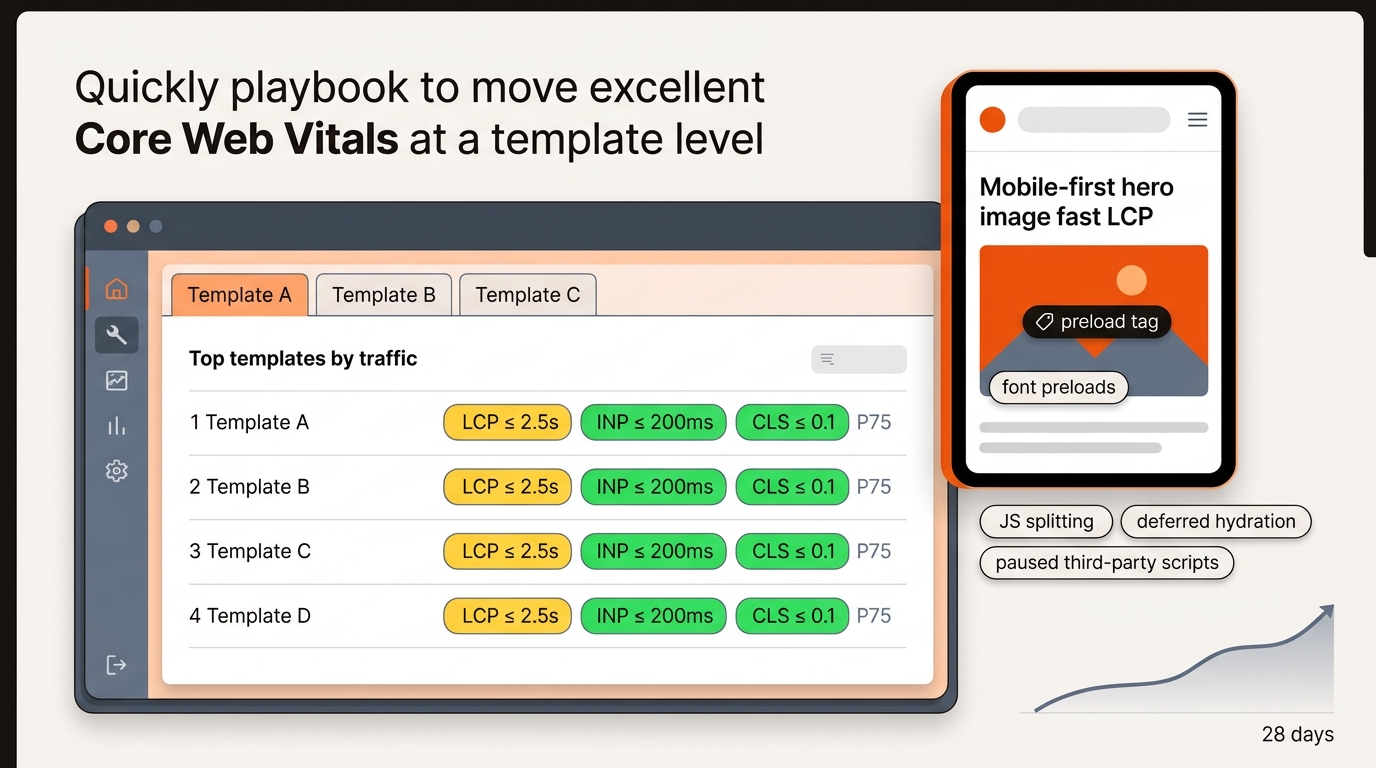
Google evaluates Core Web Vitals at the 75th percentile of field data over ~28 days (CrUX/GSC). One slow cohort (e.g., low-end Android on 3G) can block a “Good” rating until template-level fixes land.
0.8s, move to an edge host/CDN and enable HTML caching for anon traffic. Pair with SSR/ISR for app frameworks.
Operational tradeoff: Perfection slows content. Aim for “Good” thresholds. A week shaving 150 ms from INP is rarely better ROI than publishing 10 pages on a revenue cluster once you’ve cleared “Good.”
Rankings and eligibility depend on field data; treat lab tools as diagnostics.
• Measure field with Search Console Core Web Vitals and Chrome UX Report. That’s the canonical source for your “Good/Needs/Poor” status.
• Use PageSpeed Insights and Lighthouse to find offenders, then verify changes in field after deployment. Expect 7–14 days to see trend movement; full stabilization takes ~28 days.
A good Core Web Vitals score is earned when field data crosses “Good” at the 75th percentile. That status matters more to ranking and AI citations than any single lab run.
Fix the pages and templates that drive revenue and crawl first; don’t treat every URL equally.
• Triage by business impact: pricing, top blog template, docs template, and funnel landing pages. These see the biggest ranking drag from slow LCP/INP.
• Triage by crawl/AI visibility: pages linked sitewide and cited externally. Faster render increases crawl efficiency, improves snippet stability, and reduces timeouts that can block AI scrapers.
For a 2–5 person growth team, a realistic week: 1 sprint to ship template fixes (images, CSS/JS budget, layout constraints), 1 sprint to prune third-party scripts, then monitor GSC for 28 days. Publish normally in parallel. Ship, don’t stall.
Shipping fast pages at scale beats hand-tuning; automate the parts you repeat.
Mergeflo’s Autonomous SEO + AEO content engine goes from research to published, AI-citable pages in your CMS, with schema, internal links, and ongoing refresh. That matters because Core Web Vitals wins are template and pipeline work. When content ships through a consistent template with structured data and internal links, you get repeatable “Good” outcomes across the whole cluster.
Answer the operational questions that block progress.
No. Lighthouse is a lab snapshot. Google evaluates Core Web Vitals on field data at the 75th percentile over ~28 days. We’ve seen pages pass with Lighthouse 70–80 when templates are stable, JS is trimmed, and the worst mobile cohort still lands under thresholds.
Mobile first. Mobile CrUX data is often the limiter due to weaker devices and networks. Search Console splits mobile and desktop; prioritize the channel with “Poor/Needs improvement” status and your highest impressions. Desktop usually follows once you fix template and JS bloat.
Expect 7–14 days to see early movement and up to 28 days for the status to flip, since CrUX is a rolling window. Deploy broadly (template-level), or the signal gets diluted across too few pageviews to shift the 75th percentile.
Chat widgets, heavyweight analytics suites, tag managers with many tags, and A/B testing SDKs often add 50–200 ms of main-thread work. Remove what you can, load with defer, and gate low-value scripts behind user interaction to protect a good Core Web Vitals score.
Pass the thresholds at the 75th percentile on your heaviest templates, then keep publishing.
A good Core Web Vitals score is not about chasing perfect lab numbers. It’s about template discipline, JS restraint, and predictable media. Fix the system once, validate in field, and keep shipping content the same way. That’s how you rank and get cited.
