
Short answer: The 80/20 rule in SEO means roughly 20% of pages, queries, and fixes drive about 80% of organic traffic and AI citations, so you prioritize those. Identify the few clusters and pages with conversion intent, remove friction (internal links, schema, crawl waste), and shape answers for AI Overviews. That’s how you ship ranking impact fast.
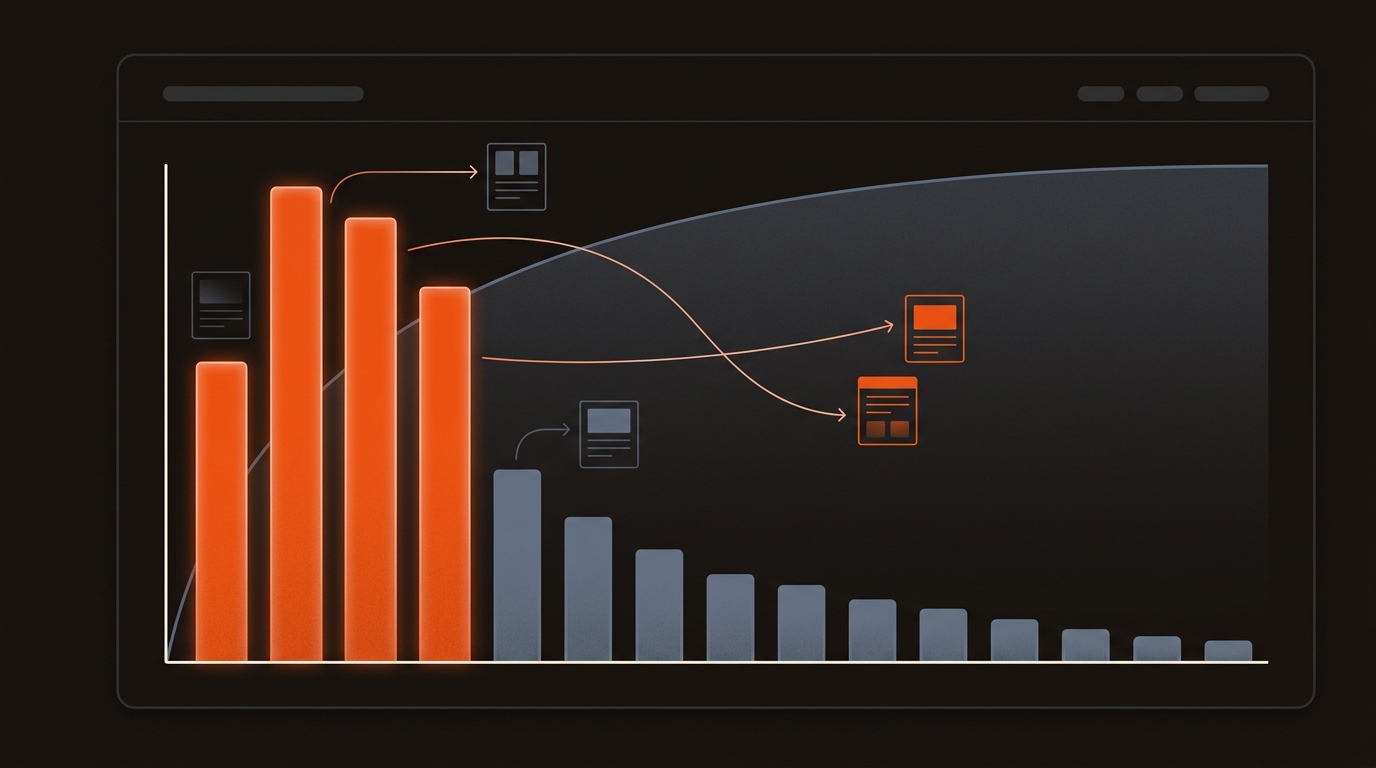
Most teams spread effort evenly across every URL even though a small share of pages drives most of the clicks.
The result: new articles cannibalize weakly-connected URLs, Core Web Vitals regress from template bloat, and no one earns AI citations because answers aren’t extractable. The 80/20 fix is simple: pick the few winners, then route your crawl, links, and schema toward them.
Prioritize the few pages and fixes with measurable uplift inside 2-6 weeks.
Pull GSC and Ahrefs: sort by conversions and click potential. Grab Screaming Frog for crawl waste and internal links. Then execute the small set of moves below that compound toward both Google and AI Overviews.
caption
Work from proven winners outward, then support with structure and distribution.
• Find the winners: In GSC, filter last 28-56 days. Export pages with conversions or top-20 positions and >0.3% CTR deltas. Cross-check with Ahrefs for Keyword Difficulty and SERP features.
• Patch extractability: Add a 45-60 word Short Answer at top, question-led H2s, and FAQPage schema. Use the exact question users search.
• Route authority: From every related post, add 1-2 contextual links using descriptive anchors to those 10-15 target URLs. Update nav/footer only if you can measure CTR impact.
• Contain crawl: Noindex archives, parameter URLs, and thin programmatic variants. Keep your XML sitemap to money and bridge pages plus their supporting cluster.
• Shape for AI: Include concise, fact-forward answers, entity names, product types, pricing ranges, and tables. AI Overviews and chat engines cite clean, structured, and scannable answers.
Operational tradeoff: focusing on these few pages slows net-new top-of-funnel growth in the short term. Accept it for 30-60 days. Depth beats breadth when you need citations and revenue.

For deeper context, see How To Rank Without Backlinks.
You can do this by hand, or you can use Mergeflo to find the gaps, draft content for your review, and track the results.
Mergeflo is an AI search visibility platform for startups. It tracks your Google positions and, on paid plans, checks whether ChatGPT, Gemini and Claude mention your brand. The autonomous SEO + AEO content engine finds gaps, drafts articles with FAQ schema and suggested internal links, and publishes the ones you approve to Webflow, with a free plan and paid plans on the pricing page. It also tracks citation share across ChatGPT, Perplexity, and Gemini so you see the compounding effect.
Use data to choose the 20% and structure pages so engines can extract and cite you.
Export GSC for the last 56-90 days, then sort by conversions and impressions. Keep URLs already ranking in positions 4-20 with >50 impressions/week. Cross-check Ahrefs to confirm non-brand volume and KD you can realistically win. That shortlist is your 20% pipeline.
Yes. For links, prioritize 5-10 high-authority referring domains to your money pages instead of scattered low-quality placements. For technical, fix the 3-5 template issues harming many pages at once: CLS, slow LCP images, and duplicate titles. Broad fixes beat micro-tweaks.
AEO rewards extractable answers. Put a 45-60 word Short Answer at the top, add question H2s, include one clean comparison table, and add FAQPage schema. The Pareto principle SEO mindset keeps you focused on the few pages worth that extra structure.
Every 4-6 weeks. Use 28-day vs prior 28-day deltas in GSC to catch movers. Re-run Screaming Frog after template changes. If a page crosses into top 5, protect it with fresh internal links and schema; if it stalls in positions 8-20 for 6+ weeks, reassess content depth or consolidate.
Turn the principle into a weekly operating rhythm that compounds.
Monday: refresh your shortlist of 10-15 URLs and their target queries. Tuesday-Wednesday: ship on-page updates and add 5-10 contextual internal links across recent posts. Thursday: apply FAQPage schema and compress images on those pages. Friday: log changes and annotate in GSC. Repeat. Track position, CTR, and AI citations on those pages over the following weeks.
Use the phrase you target as an H2 exactly: What is the 80/20 rule in SEO? Then answer it in 50-60 words at the top. That makes your page liftable by AI systems and scannable for humans.
