AI Answer Visibility Metrics That Actually Predict Wins
If you are not a cited source, you are functionally invisible in AI answers. Most teams chase model impressions while missing the four signals that govern whether you get named, linked, and chosen. This piece defines the AI answer visibility metrics that matter and shows how to measure them with a stable prompt panel across engines.
You will learn how to collect, score, and act on AI answer visibility metrics so you can prove progress, prioritize fixes, and win recommendations across Google AIO, ChatGPT, Perplexity, and Copilot. When you track what drives inclusion, you stop guessing and start moving pipeline.
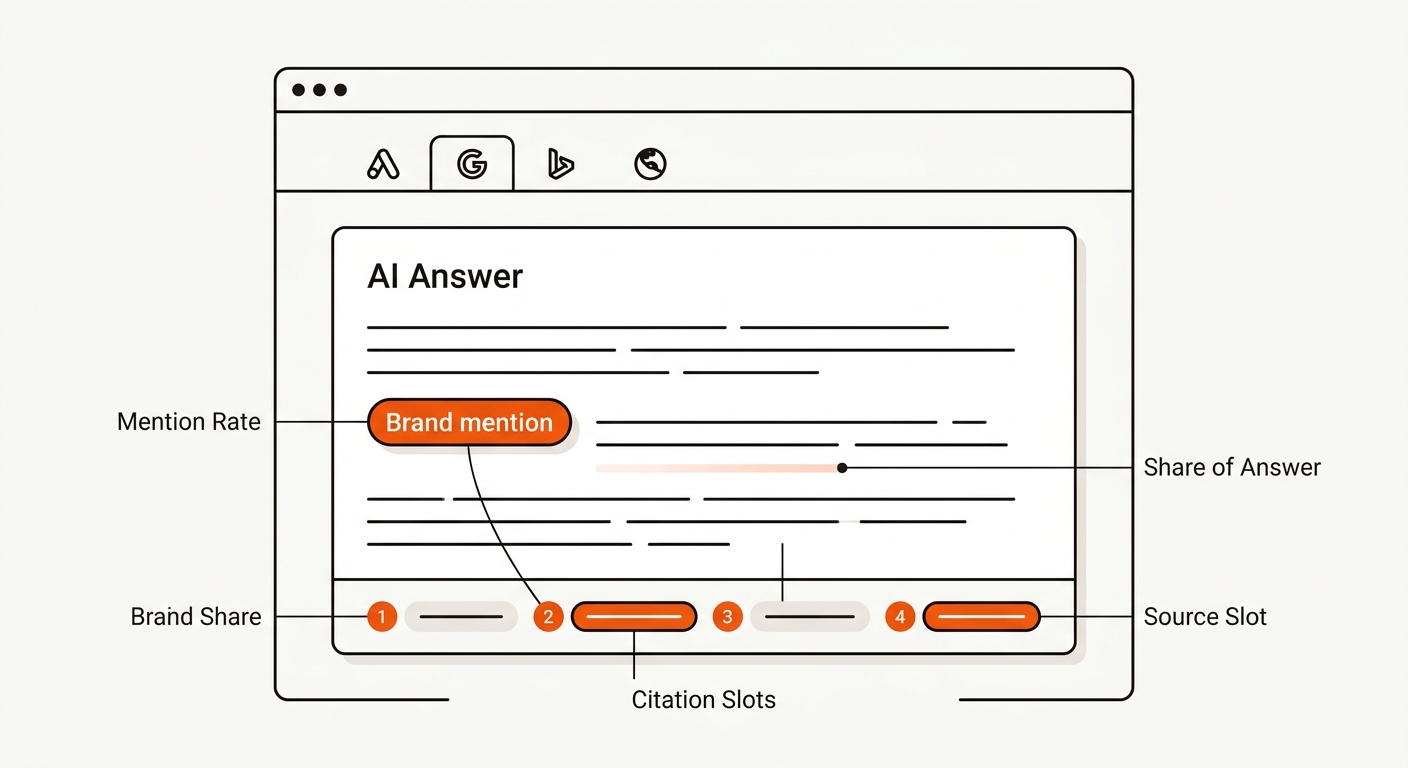
Annotated AI answer showing citation slots and highlighted brand mention
Who This Is For
You run a lean growth team and need signals that predict pipeline over vanity charts. If you publish every month, use Ahrefs or SEMrush, and want a Monday-ready workflow to measure presence and prominence in AI answers, this is your playbook.
You operate under time and budget pressure. You want a short loop from measurement to action: capture answers, score the four signals, then route fixes to content, links, and facts. No dashboards that stall decisions.
The Metrics That Matter: Presence, Prominence, Preference
Four outcome metrics govern AI visibility: Mention Rate, Citation Share, Share of Answer, and Source Slot. Everything else is diagnostic. Track these across a consistent prompt panel and engines, then route fixes to content and links.
Metric
What it measures
Primary data source(s)
How to instrument
When to prioritize
Tradeoffs or limits
Effort to maintain
AI answer presence rate by query
Percent of tracked queries that render an AI-generated answer module
SERP captures via headless browser or SERP APIs; geography and device variants
Sample queries daily, detect AI module, log presence flag per query and market
Sizing market exposure and planning coverage
Volatile by user, location, and test buckets; scraping risk; layout drift
Medium
Inclusion rate of your domain in AI answers
Percent of AI answers that cite your domain
Parsed AI answer citations and cards
Parse links in the module, normalize domains, compute inclusion per query and over time
Brand and product terms, high-value head queries
Citations rotate; inclusion does not guarantee clicks
Medium
Citation share by domain
Share of all citations across the tracked set that point to each domain
Aggregated AI answer citations
Aggregate by domain, compute share of voice by query class and market
Competitive benchmarking and trend tracking
Not a traffic metric; sensitive to sample mix
Low-Medium
Top-citation position rate
Percent of times your domain appears in the first visible citation/card
AI module layout parse
Extract order by layout type, record position, compute rate of position 1
When most clicks concentrate on first positions
Some layouts have no stable rank; UI experiments can flip order
Medium
Estimated clicks from AI answers
Modeled clicks to your site attributed to AI answers
Clickstream panels, on-site logs, GSC time series, AO presence flags
Build model linking AO presence to click deltas; calibrate with panel data; validate vs holdout queries
Impact forecasting and ROI reporting
No AO dimension in GSC; modeling error and leakage; panel bias
High
Brand mention rate without citation
Share of answers that mention your brand without linking
False positives from generic terms; no direct traffic
Medium
Query class coverage in AI answers
Percent of target topics where you are included in answers
Query taxonomy, AO inclusion flags
Map queries to categories, compute inclusion by class and market
Content planning and gap analysis
Taxonomy upkeep and drift over time
Medium
Freshness lag to inclusion
Days from content publish or update to first inclusion in answers
CMS timestamps, crawl timestamps, AO sightings
Track URLs to citations over time; compute lag distribution by content type
Time-sensitive content and newsy topics
Causality unclear; crawl and index latency confounders
Medium
Platform coverage
Inclusion across Google AI Overviews, Bing Copilot, Perplexity, ChatGPT with browsing
Platform-specific captures; APIs where allowed; manual audits
Rotate user agents and data centers; schedule platform runs; standardize parsers
Diversification and risk management
Access constraints and ToS; layouts differ; higher ops load
High
Competitor overlap index
How often you and named competitors co-appear in the same AI answer
AI answer citations by query
For each query, compute Jaccard overlap of cited domains with a competitor set
Category competition analysis
Sensitive to small samples and rotating citations
Low
Zero-click displacement in organic
Change in organic clicks after AI answer rollout for tracked queries
GSC clicks and impressions; AO presence timelines
Difference-in-differences vs control queries without AO; adjust for seasonality
Budgeting and stakeholder reporting
Many confounders; requires careful controls
High
Source diversity
Count and concentration of unique domains cited per answer and topic
AI answer citations
Compute unique domain count and HHI by query class
Assessing consolidation and moat risk
Not directly actionable for optimization
Low
Answer quality alignment
Semantic similarity between AI answer text and your canonical page
AI answer text, page text, embeddings
Compute embedding similarity or ROUGE; flag low-alignment answers
Content rewrites and brief generation
Similarity is a proxy; may miss factual issues
Medium
Studies from Ahrefs, Semrush, and BrightEdge confirm that AI surfaces weigh authority and clarity heavily. Use those insights to benchmark, then instrument your own panel so you can move from theory to weekly deltas.
A stable, versioned prompt panel is the difference between noise and signal. Group 50-150 prompts by intent cluster, weight by commercial value, and test across engines weekly so you can attribute lifts to specific fixes.
Run the panel across Google AIO, ChatGPT with a pinned model, Perplexity, and Copilot. Fix the model version when possible. Variance drops when you standardize engines and keep the prompt set stable for at least 4 weeks.
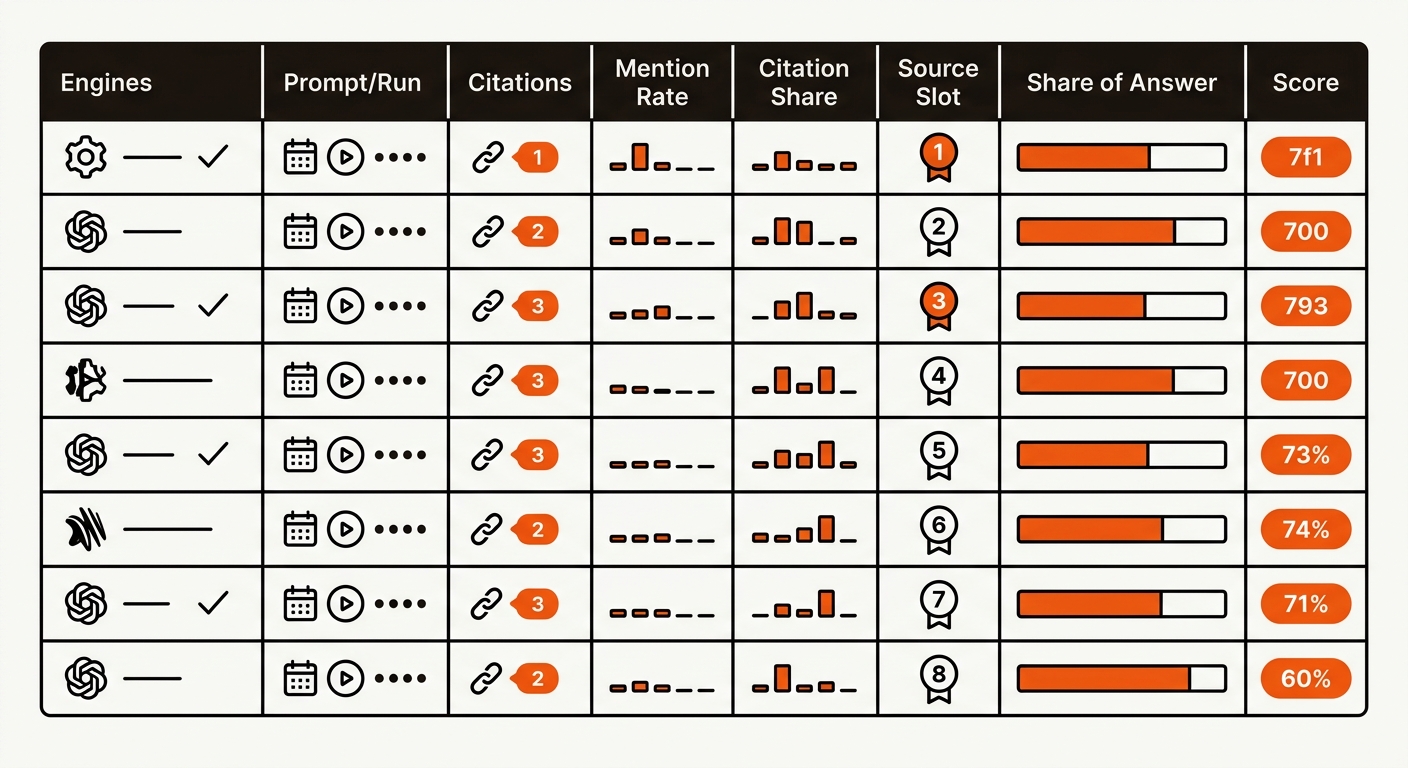
Sample 3 runs per prompt per engine and store snapshots with timestamps and model/version. Annotate answer text, citations with URLs and slot, brand mentions, and outbound link presence. Consistent annotation makes AI answer visibility metrics comparable across time.
Prompt panel spreadsheet with engines, runs, citations, and scoring columns
Pick a threshold that counts as a change event, for example a 10-point swing in share of answer, and review the cause the following week.
Mergeflo checks whether ChatGPT, Gemini and Claude mention your brand for your buyer questions (a weekly scan on paid plans, one check on the free plan) and drafts answer-first articles for your review.
What Does AI Answer Visibility Metrics Actually Involve?
AI answer visibility metrics covers the structural work of the article above: the page inventory, the workflow that keeps it shipping, and the measurement loop that confirms it's working. The sections preceding this FAQ describe each part in detail.
How Long Until AI Answer Visibility Metrics Produces Measurable Results?
There is no fixed timeline. Google does not promise when, or whether, a page will rank. Watch Search Console impressions for the questions the page targets each week, because impressions move before clicks. A page with no impressions after a few months usually needs a sharper angle or more internal links.
What Does AI Answer Visibility Metrics Cost?
Cost depends on who does the work: your own team's time, a freelancer, an agency or a software tool. Mergeflo has a free plan, and paid plans are listed on the pricing page.
How Does Mergeflo Fit Into a AI Answer Visibility Metrics Workflow?
Mergeflo researches topics, writes briefs and drafts in your brand voice, adds FAQ schema and suggests internal links. You choose the topics and approve each article, and it publishes to Webflow only when you press Publish. For pages losing reach, Mergeflo flags them, and when you press Refresh it writes a refresh brief for you to review.