
Short answer: Use Ahrefs or SEMrush to run a keyword gap on 3-5 true peers, export missing and weak keywords, filter by intent and KD, then cluster and map to pages. For speed, add GSC overlap, scrape SERPs for People Also Ask, and review competitor site sections by URL. This workflow finds competitor keywords you can realistically target.
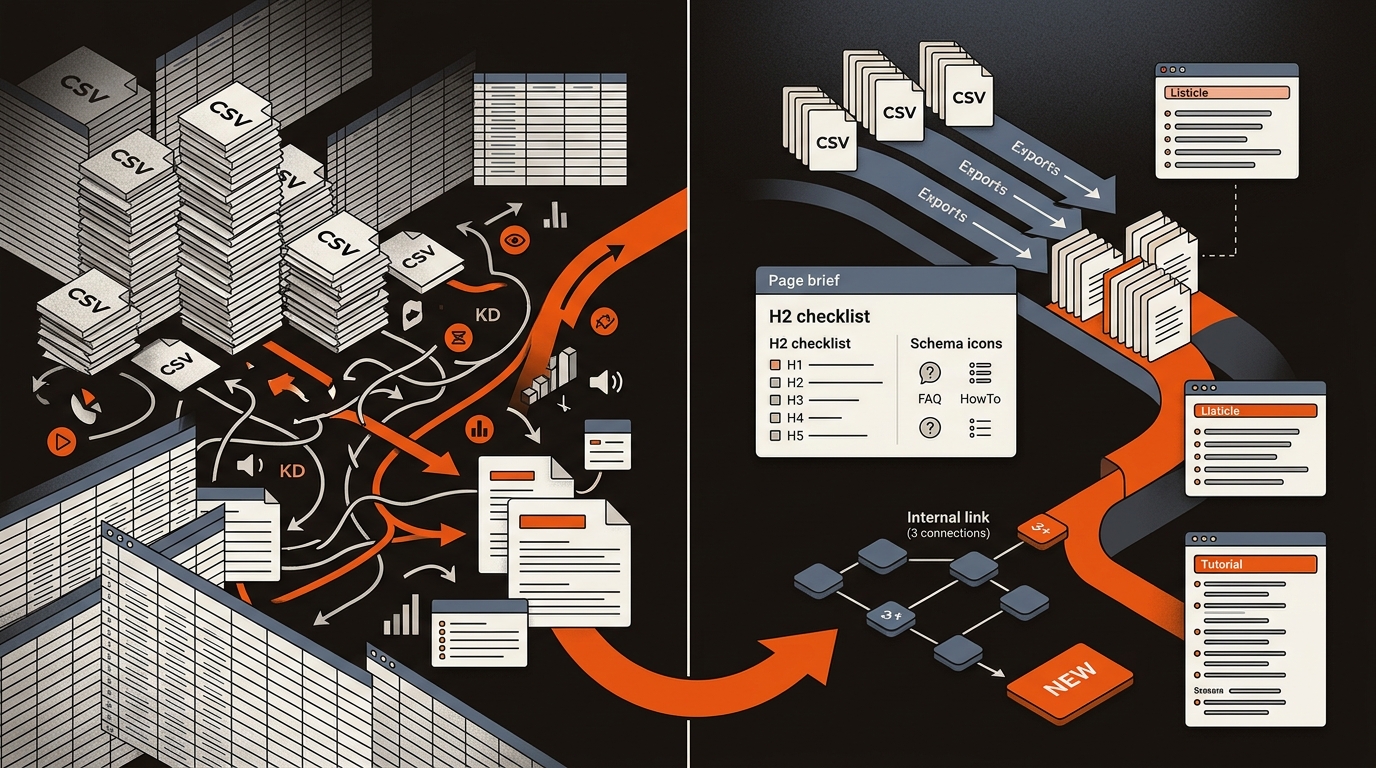
The fastest wins come from competitor URL-level gaps with low KD (our rule of thumb is under 20) and informational or commercial intent.
Treat competitor research as a weekly pipeline: inputs, filters, clusters, outputs. The goal isn’t a giant CSV; it’s prioritized pages that rank and get cited in AI answers.
• In Ahrefs Keyword Gap or SEMrush Keyword Gap, add your domain + 3-5 peers your buyers also evaluate. Start with peers that share your ACV and ICP. Export Missing and Weak keywords.
• Pull Google Search Console queries where your URLs overlap with competitor URLs. Use regex on competitors’ brand and product terms to spot near-misses you can convert.
• Crawl top competitor sections by folder (/features/, /integrations/, /compare/) with Screaming Frog. Extract titles and H1s to infer keyword targets that tools undercount.
• Add SERP reality: scrape People Also Ask and Related Searches for each short-head seed using AlsoAsked or a simple SERP scraper. These fill the intent graph.
• Filter (our rule-of-thumb starting points, not standards): KD 0-25 for net-new sites, Volume 30-1,000, SERP with <2 high-DR docs dominating, and intent you can satisfy. Assign each keeper to a cluster and a target page.
Choose peers from the results page. The rivals you name in sales calls and the sites that compete for your buyers' clicks are often different sets. For a group of target queries, log who ranks, tally the domains that recur, and run the gap on those. Before any keyword reaches a brief, check which format wins (guide, comparison, category page or docs), how fresh and authoritative the ranking pages are, and how strong their links are. If you cannot credibly reach the top positions, drop the term or reframe the angle.
Operational tradeoff: API pulls and SERP scraping speed up discovery but add quota costs and data noise. Keep a tight filter or you’ll ship unrankable pages and burn crawl budget.
For deeper context, see How To Find Profitable Keywords With Low Competition.
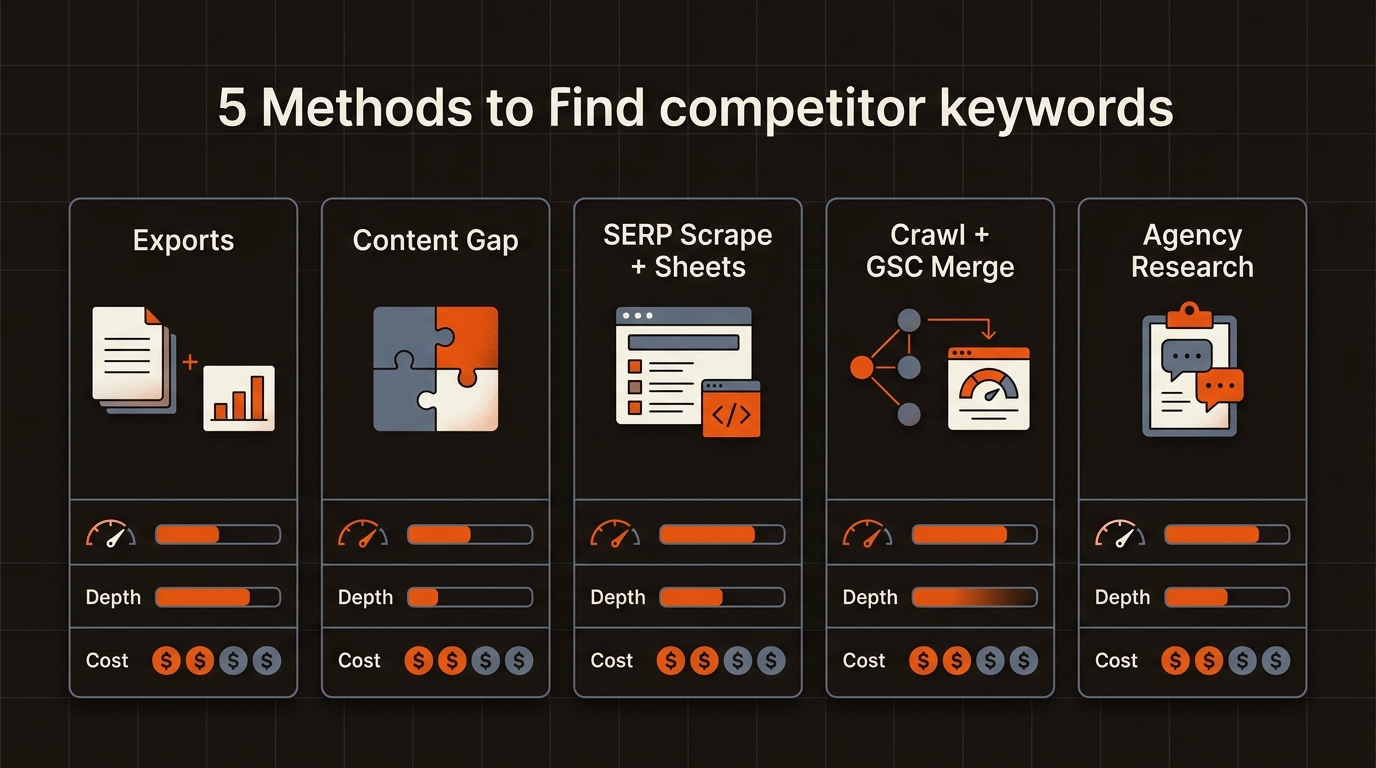
Pick methods by speed vs depth; blend 2-3 to ship pages sooner.
Pair a domain gap with a folder-level sweep, then validate with SERP PAA. That three-step combo delivers enough coverage without bloat.
Want help turning the gaps into briefs and drafts? Start free.
Turn gaps into publishable clusters with clear mapping and internal links. Name the cluster by buyer task. Assign one primary page and 3-5 supporting articles. Use comparison and integration pages where competitors already earn intent.
Size each cluster before briefing it: combine realistic volume with a click-through curve for the position you can credibly reach, and rank clusters by that upside. Rerun the analysis when the SERP shifts, a competitor launches, or a page loses ground in Search Console, then refresh briefs and internal links.
Structure for visibility across Google and AI engines:
• Lead with a concise 1-2 sentence answer, add a scannable table, include FAQs. This gives answer engines a clean passage to quote, but nothing guarantees a snippet or a citation.
• Add Product, HowTo, and FAQ schema where applicable. Use consistent anchors between cluster pages to pass relevance.
• Map each cluster to a single URL. Avoid cannibalization; deprecated pages 301 to the primary.
A common failure mode: copying competitor formats without matching user intent. If their /compare/ pages win on feature matrices, ship your own matrices and quantified differences. If their features pages own SERPs with implementation steps, add real steps and screenshots.
Make this your Monday morning: pick 5 peers, run the gap, filter by intent and KD, and map to 10 pages you can ship this month. If you want help with the briefs and first drafts, see the plans on the pricing page.
Mergeflo covers the research and drafting steps of this pipeline. It finds search gaps and buyer questions, drafts briefs and articles in your brand voice for review, and publishes approved articles to Webflow. It also tracks Google positions, checks whether ChatGPT, Gemini and Claude mention you (weekly on paid plans, one check on the free plan), and flags pages losing impressions with refresh briefs.
Pick 3-5 true peers your buyers also shortlist. More than 6 adds noise and overlaps identical queries. In Ahrefs or SEMrush, include at least one adjacent product to reveal integration and use-case terms your direct peers miss.
For DR under 60, a rule of thumb is to start with KD 0-20 and volume 30-800, the terms a young domain can realistically compete for. If you have a strong link profile in one cluster, you can push KD to 30. Always check SERP composition; KD alone won’t flag branded walls or forums.
In Ahrefs, open the page’s Organic Keywords report. Export, then filter by intent words in the query and title (vs, best, alternative, integration, pricing). Mirror the page type and structure the same block order, but add clearer tables and explicit FAQs to earn snippets.
Two checks: SERP features and content shape. Queries with PAA, definitions, or matrices often surface in AI Overviews. Build pages with short answers, tables, and clean headings. Then track citation share across ChatGPT, Gemini and Claude; if you see none after a few weeks of checking, add schema and tighten the opening summary.
Start with Weak keywords when speed matters: you already rank, so better intent fit, clearer headings and a few links can move you up. Batch Missing keywords into intent clusters and brief the right format for each. Size both with a click-through curve, and map every keyword to a unique URL to avoid cannibalization.
All tools infer volume and traffic from crawls and click models, so treat the numbers as directional. Validate your top terms on live SERPs by checking the ranking content type, freshness and link profile. For expensive themes, a small paid search test can show intent and conversion rate before you invest in content.
