
Short answer: To find out competitors' keywords, identify true SERP competitors, run a keyword gap across 3–5 of them in Ahrefs or Semrush, then verify winners on live SERPs. Cluster by intent and match the ranking content type. Prioritize "Missing" and "Weak" gaps and size upside with a realistic CTR curve before briefing content.
Copying tool exports without SERP verification burns budget and misses intent fit. Teams export 5,000 terms, then write informational blogs against a SERP full of comparisons or category pages. Result: page-two purgatory and URL cannibalization.
You need intent-first triage. For every short list, check who ranks now, what format wins (guide, comparison, category, docs), and link thresholds you must clear. If you cannot credibly hit positions 1–5, drop or reframe. That is how to find out competitors' keywords you can actually win.
SISTRIX’s CTR model shows position 1 earns ~28–30% of desktop clicks across large datasets. Use CTR-curves to size upside. SISTRIX CTR study
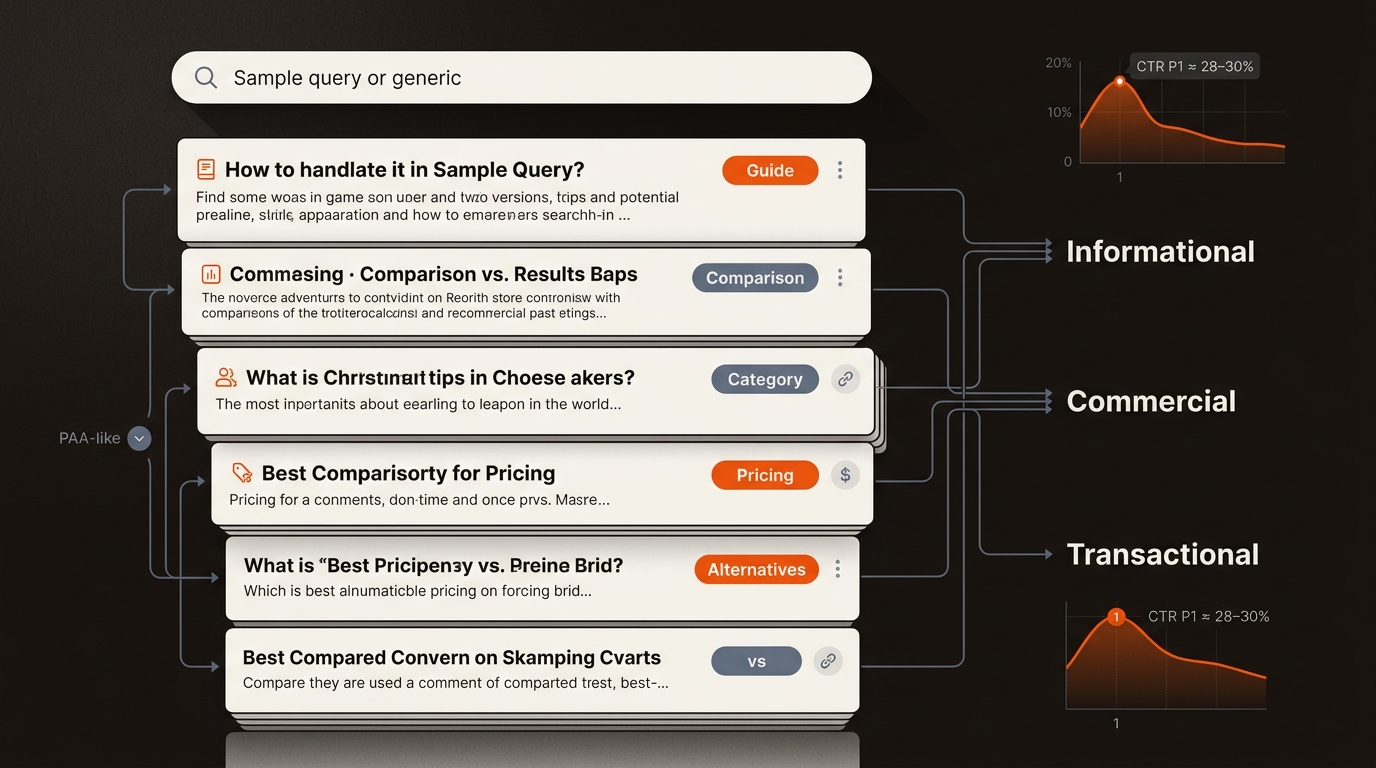
Blend tool gaps, live SERP review, and paid signals; no single source is complete. Use tools to find candidates, then validate on-page realities before you brief.
Comparison: Practical Methods To Find Competitors' Keywords
External reference for PPC intensity: Google Ads Auction Insights.
Turn exports into clusters with briefs and matching formats; publish only what can rank. Run this end-to-end so you stop guessing.
• Identify true competitors by query. Pull top 10 for 10–20 seed terms and shortlist recurring domains.
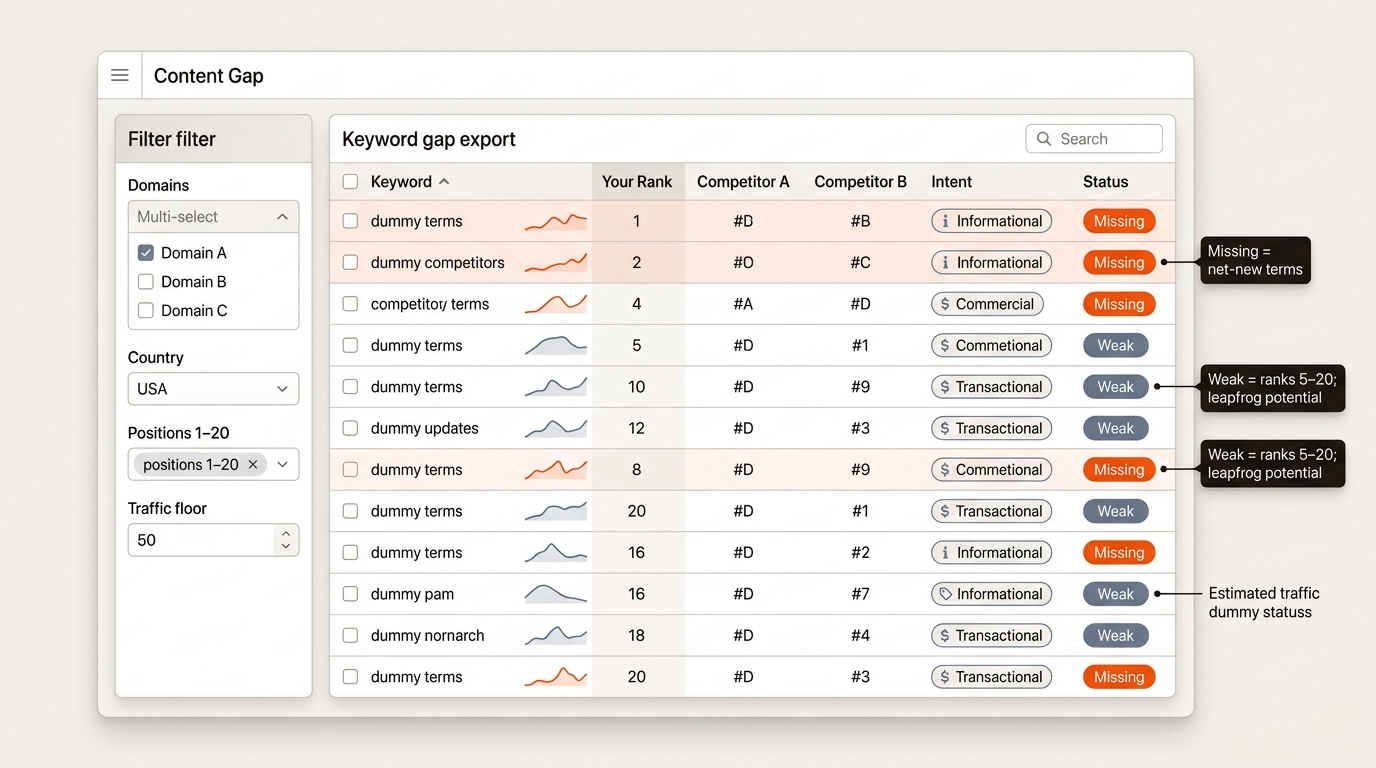
• Run a gap across 3–5 of those domains in Ahrefs or Semrush. Split into "Missing" and "Weak." Filter by market, positions 1–20, and estimated traffic.
• Validate short lists on live SERPs. Note content type, recency, authoritativeness, and linking domains to page. Kill terms that mismatch your feasible format or authority.
• Cluster by intent and ship the right artifact: guides (informational), comparisons (commercial), category/solution pages (transactional). Map each to a distinct URL to avoid cannibalization.
• Size upside using a realistic CTR curve. Prioritize pages that can move from position 8–15 to 3–5 within 4–8 weeks with on-page improvements and 3–10 quality links.
Scenario: a 3-person growth team with a $2k/mo content budget and 15 posts/month. They pick 4 SERP rivals, run Semrush Keyword Gap, filter to 120 "Missing" and 40 "Weak" terms. After SERP checks, 22 "Weak" survive. They brief 8 comparison pages and 6 guides first. In 6 weeks, 9 URLs reach positions 3–6, adding ~1,800 monthly clicks measured in GSC.
Operational tradeoff: manual SERP review adds 45–90 minutes per cluster but prevents publishing 5–10 misfit posts that never rank. Above ~200 pages, this breaks without templates and internal link automation; use GSC filters and a SERP parser to keep validation tight.
Most teams then ask how to source low-KD fuel inside each cluster. Use our piece on finding high volume low competition keywords to expand "Missing" clusters with winnable variants.
Mergeflo converts competitor gaps into published, AI-citable clusters automatically. Our platform runs the entire loop: research to published, AI-citable pages in your CMS, with schema, internal links, and ongoing refresh. It measures and fixes visibility for Google and AI engines, not just audits. Startup-priced at 149–649/month.
Concretely, you connect 3–5 competitors and pick markets. Mergeflo generates intent-matched briefs, drafts pages aligned to the winning SERP format, injects FAQ/schema for AI Overviews, places internal links, and keeps pages fresh as rankings shift. You review, we publish. That is how to find out competitors' keywords and turn them into rankings and AI citations.
Use SERP competitors. For 10–20 target queries, log the top 10 and tally recurring domains. Pick 3–5 that outrank you across multiple terms. Skip news/media if your target intent is commercial unless they consistently control that SERP.
All tools infer from crawls and click models. Treat volume and traffic as directional and validate top terms on live SERPs. Before investing, confirm the ranking content type, freshness, and link profile. For expensive themes, run a small PPC probe to validate intent and conversion rate.
Ship "Weak" first for speed; you already rank and can leap with better intent fit, improved headings, and a few links. Batch "Missing" into intent clusters and brief the correct artifact by format. Size both with a CTR curve and map each to a unique URL to avoid cannibalization.
Monthly for active clusters, quarterly for stable ones. Rerun after major SERP changes, competitor launches, or when a page drops >3 positions in GSC over 14–28 days. Refresh briefs, update internal links, and re-check format when new content types start winning.
