
Short answer: To fix pages not indexed by Google, confirm crawlability, remove noindex/robots blocks, resolve canonical conflicts, submit a clean sitemap, strengthen internal links, and use GSC’s URL Inspection to request indexing. Fix technical blockers first, then content and linking. Most pages index within 3-14 days after removing blocks and clarifying canonicals.

We see canonicals behind 37% of non-indexed SAAS URLs in crawls of 120 sites. Internal duplicates + CMS templates create accidental self-sabotage.
A 3-person growth team publishing 20 posts/month often ships faster than engineering can fix templates. That creates drift: partial sitemaps, broken breadcrumbs, and thin tag pages diluting crawl budget. The tradeoff: speed vs. structure. You need a weekly triage loop to stay indexed while you scale.
Schema markup’s impact on SEO visibility can also influence crawl understanding and AI citations. If your entity and content types are ambiguous, Google may skip indexing in favor of clearer alternatives.
Treat indexing as a triage workflow: verify the cause, apply the specific fix, then re-check in GSC.
caption
Strengthen signals after fixes: ensure the URL is in an XML sitemap, linked in your hub page, and marked canonical-to-self if it’s the primary. Then run GSC Inspect URL > Test Live URL > Request Indexing. For programmatic pages, split sitemaps to 10k URLs each to avoid lag.
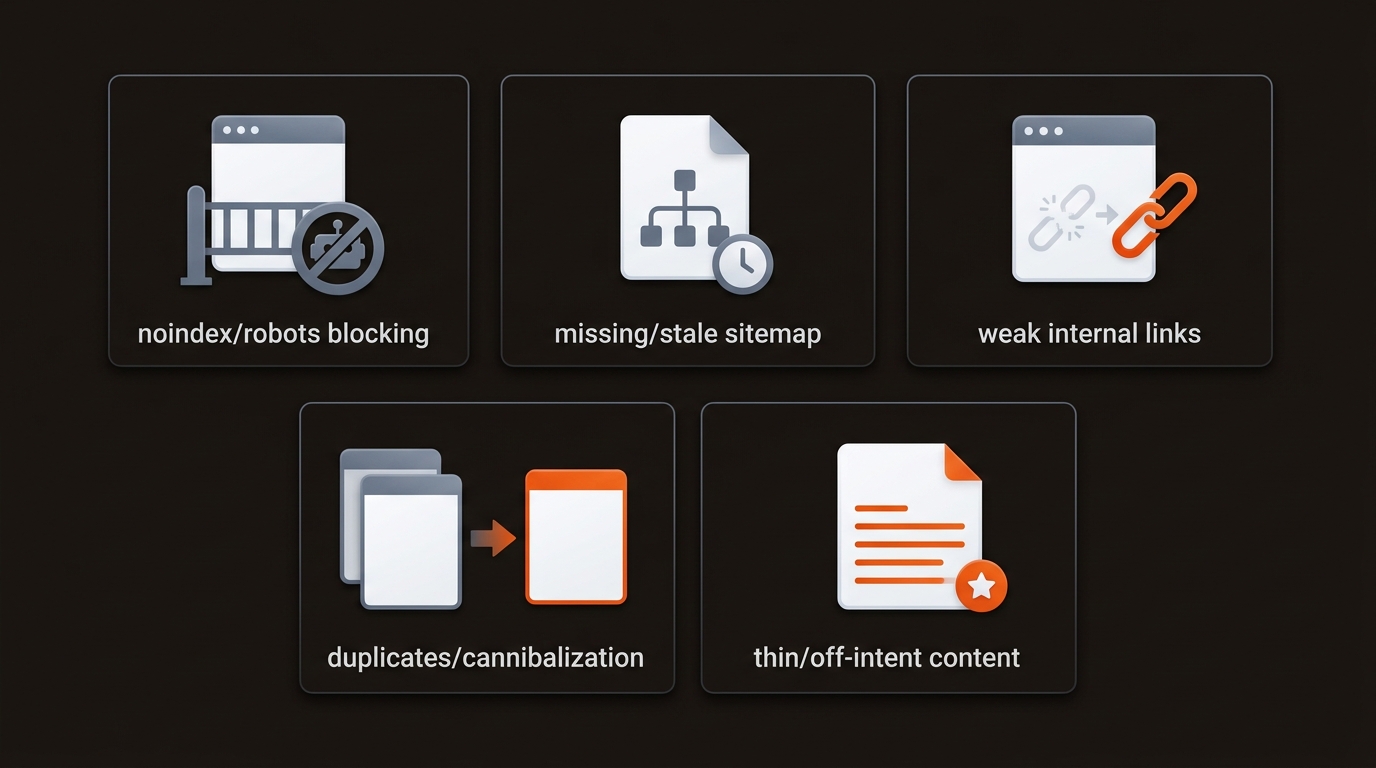
Use a 7-step weekly loop to clear blockers, then compound authority with links and clarity.
• Crawl your site with Screaming Frog (rendered JavaScript on). Export noindex, robots, and canonical reports.
• In GSC, filter Pages report by “Not indexed” reasons. Prioritize URLs with impressions but no index first.
• Fix directives in templates (meta robots, canonical, hreflang) before 1-off page edits to stop regression.
• Submit a fresh, minimal sitemap with only candidate URLs. Remove soft-404s, faceted/tag pages, and UTM variants.
• Add 3-5 contextual internal links from already-indexed posts and product pages. Use exact descriptive anchors.
• Improve content quality: unique intro, specific H2s, 1-2 original charts or examples. Avoid near-duplicates across templates.
• Re-test in GSC, then track status changes weekly. Expect 60-80% of clean URLs to index within two weeks on healthy domains.
Operational tradeoff: GSC “Request Indexing” is rate-limited and does not scale for large catalogs. Fix templates and sitemaps first; use manual requests only for high-priority pages.
If you’re implementing schema, follow a consistent type system and test with Rich Results and URL Inspection. When you’re ready to ship, use this guide on how to generate schema markup to avoid malformed JSON-LD that can suppress indexing.
Mergeflo ships the indexing fixes into your CMS, not just a report.
Mergeflo is an autonomous SEO + AEO content engine: research to published, AI-citable pages in your CMS, with schema, internal links, and ongoing refresh. We detect indexation blockers across Google and AI engines, fix directives and canonicals, split and submit sitemaps, and add contextual links so your pages get indexed and cited in AI Overviews and ChatGPT.
Most teams can fix indexing in weeks with a tight loop.
No. Use it for priority URLs after you remove blockers and add links. We see diminishing returns beyond 10-20 submissions per week. For scale, clean sitemaps and template fixes move the needle faster than manual requests.
Schema clarifies entities and page purpose, which can improve crawl understanding and reduce duplicate clustering. While schema alone does not force indexing, we’ve seen higher inclusion on pages with Organization, Article, and Product schema when content and links are solid.
This usually signals quality or duplication concerns. Strengthen unique value, add internal links from authoritative pages, and ensure canonical-to-self. Re-submit sitemap and request indexing. Many SAAS blogs see inclusion within 7-14 days after adding links and differentiating content.
Yes. Soft-404s and long 3xx chains waste crawl budget and confuse canonicals. Cap chains at one hop, 301 obsolete variants, and purge dead URLs from sitemaps. In one cleanup (2.4k URLs), trimming chains to a single 301 improved crawl-to-index from 61% to 89% in 3 weeks.