
Short answer: Monitor AI search visibility by running a fixed prompt set across ChatGPT, Gemini, Claude, and Perplexity, then logging brand mentions, linked citations, and context. Baseline and trend weekly against a changelog of shipped pages. Use consistent test timing and 3-5 replicates to cut variance, and ship schema-rich, internally linked answer pages to win more citations.
Stand up a weekly panel that asks your top 100 buyer intents to 4 to 6 leading AI search surfaces. Standardize prompts, run each intent 3 prompt variants and 5 replicates at temperature 0.2 to smooth randomness. Score four things per answer: did we get cited, how many links, first link position, and whether our brand is named correctly. Roll up by intent cluster and by model. Set your own green threshold, for example coverage of 60 percent or more across at least three models. Anything red routes into a content brief within 48 hours with a single accountable owner.
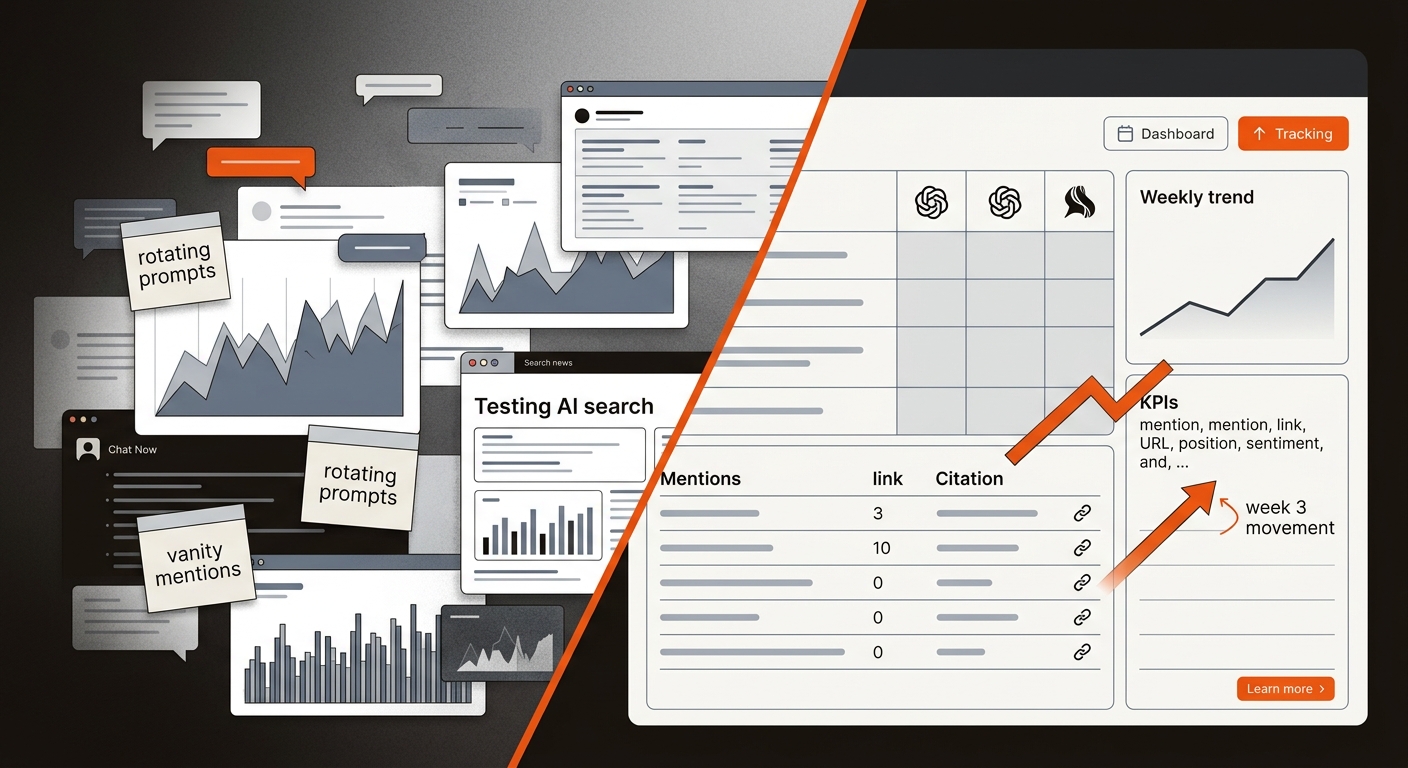
Most teams test ad hoc, don’t baseline, and can’t attribute movement to content shipped. Two failure modes repeat: changing prompts week to week and tracking only vanity mentions. When prompts shift, you measure the prompt. When you only count brand strings, you miss linked citations and which URLs win.
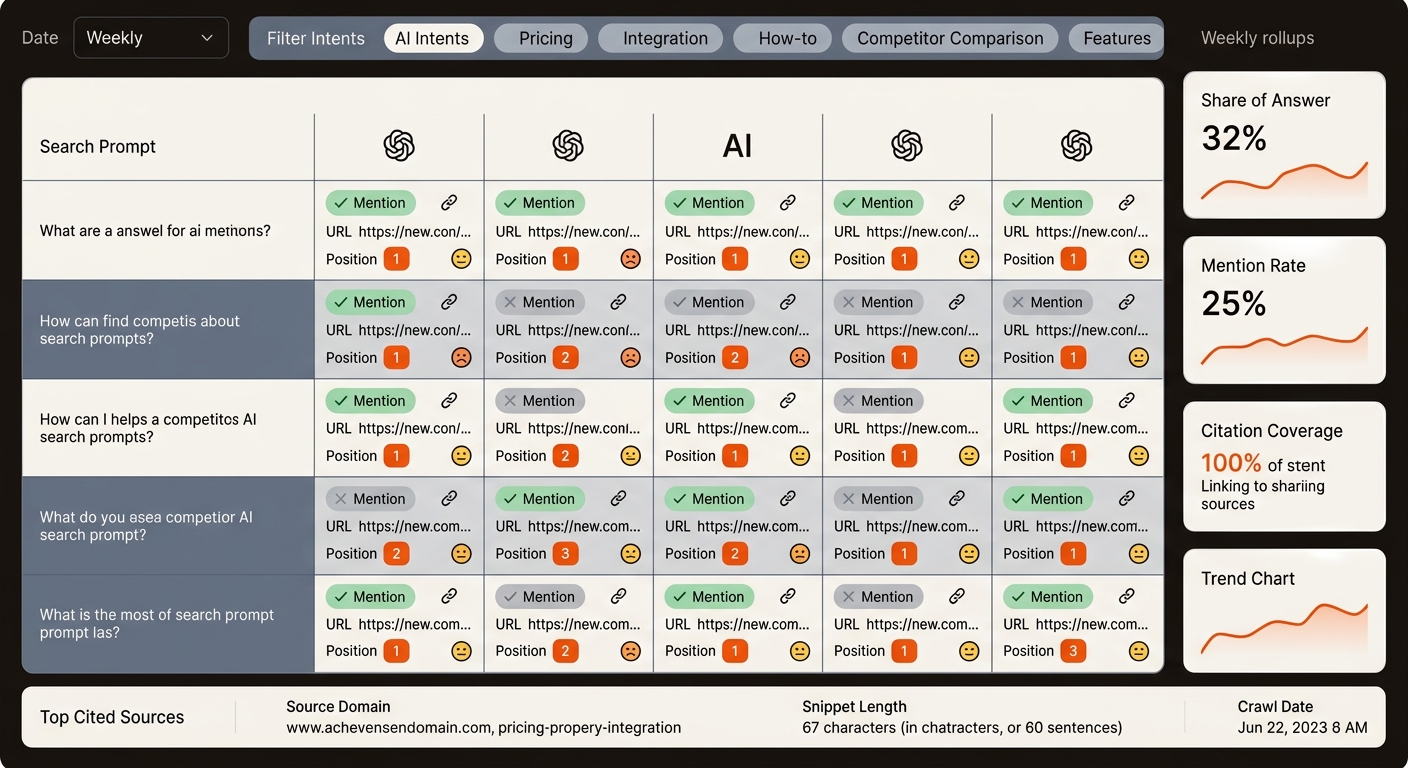
Normalize with a stable test set and explicit KPIs. Lock a 60-120 prompt list tied to ICP tasks, test at the same time weekly, and record five fields per run: mention, link, URL, position/visibility, and sentiment/context. Model updates happen; annotations in your log make deltas explainable against your shipping calendar.
Build the panel from questions buyers actually ask. Cover buyer questions, how-tos, integrations, and comparisons, and segment by engine and region to see where you already qualify. Fill these patterns with your own category, customer type, and competitors:
Pick the smallest system that captures cross-model coverage, mentions, links, and a cadence you can sustain. Weekly checks are enough for small teams; daily adds noise unless you ship changes daily.
Monitoring options compared: coverage, KPIs, cadence, and fit
SpyFu’s SpyGPT is useful for precise ChatGPT mention counts: https://www.spyfu.com/spygpt. For structured markup AIs pick up, validate FAQPage and HowTo on Schema.org: https://schema.org/FAQPage.
Direct model QA via API gives ground truth of what users see. Pros are fast iteration and granular scoring. Cons are rate limits, cost, and variance. Use 50 to 200 intents monthly, 4 models, 3 prompt frames, 5 runs. SERP scraping of AI Overviews captures blended flows and jurisdiction gaps. Useful for market context, weaker for brand specifics. Referral telemetry using tagged links in answers confirms impact but the sample is small. RAG recall tests benchmark your owned assistant and surface gaps in core facts. Use all four, but weight decisions on direct QA and confirmed referrals.
Use a fresh chat or a logged-out session for every prompt so earlier context cannot shape the answer. With assistants that can browse, test with browsing on and off and record which sources they open. For Google AI Overviews, capture a screenshot and the source URLs, since the panel can change between loads.
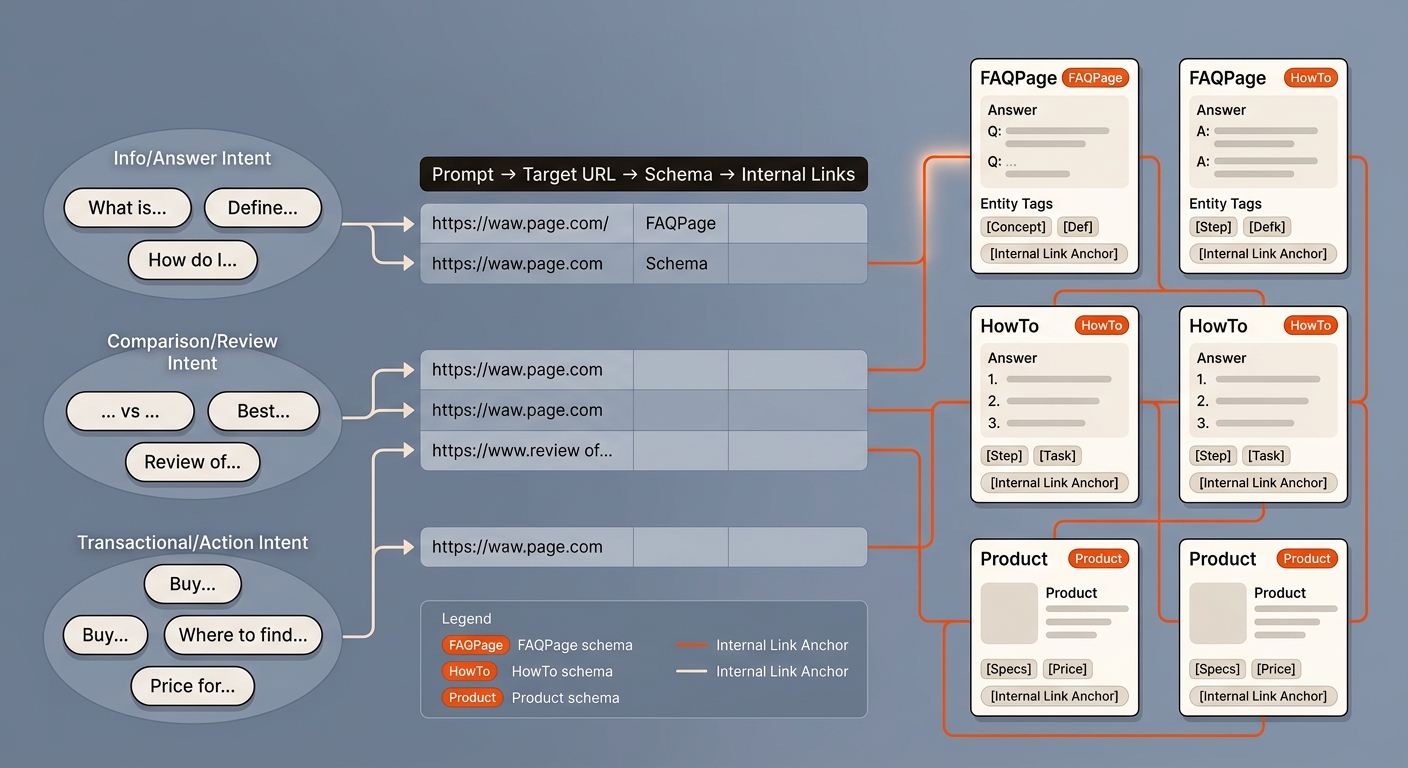
Monitoring without a ship-list is scoreboard watching; tie every KPI to a page you can publish or fix this week. Map each tracked prompt to a target URL. If no page exists, create one with a concise answer block, entities, and 3-5 FAQs. Add internal links from supporting pages and ensure valid schema (FAQPage, HowTo, Product).
Operate on a weekly loop you can keep. Monday: run the fixed prompts and roll up KPIs. Tuesday: pick 3-5 prompts with weak coverage and ship or refresh mapped pages. Wednesday: add 3-7 internal links from adjacent pages.
Add a short list of peer domains to the panel and compute citation share by engine and by intent cluster. Clusters where peers are cited and you are absent come first. Then match the miss to a likely cause: an absent mention usually points to an entity or schema gap, an answer that cites a different URL points to a canonical mismatch, and a buried or thin link points to a weak summary. When several thin pages cover one topic, merge them into a single canonical guide with a contents block and clear headings.
Mergeflo is an AI search visibility platform for startups. It tracks Google positions and checks whether ChatGPT, Gemini and Claude mention you (weekly on paid plans, one check on the free plan). It also finds search gaps and buyer questions, drafts briefs and articles in your brand voice for review, publishes approved articles to Webflow, and flags pages losing impressions with refresh briefs.
If you are still tool-shopping, here is a pragmatic angle on selection in our sibling post: AI Visibility Tracking Tools to Measure and Grow Share.
Turn red intents into briefs that specify a short, direct answer, three supporting facts with sources, a diagram or table, and a unique angle. Publish on a stable URL with clear H1, H2 questions, anchor links, and a Key Facts block at the top. Include exact product names, entities, units, and dates. Add a concise TLDR section and a glossary. Link related pages to consolidate signals. After the page is indexed, rerun the panel and compare citation coverage for the affected cluster. If nothing moves, tighten the answer and prune fluff.
Standardize prompts, define KPIs, and attribute gains to shipped pages to monitor AI search visibility with signal.
Start with 60-120 prompts that reflect your ICP’s tasks and buying questions. Split evenly across awareness, consideration, and product queries. That size produces stable weekly trends without burying a small team in data. Lock them for 6-8 weeks before revising based on gaps.
Track four: mention rate, citation with link (and which URL), answer position/visibility within the response, and sentiment/context. Add prompt-triggered visibility rate: percent of tracked prompts that produce a mention or link. These KPIs map cleanly to page-level work: answer blocks, schema, and internal link updates.
Hold prompts constant, test at consistent times, and run 3-5 replicates per prompt, then average. Trend weekly, so shipping cadence can explain changes. When a model updates, annotate the week in your log. Variance drops when you standardize and analyze deltas against your content changelog.
Maintain a changelog: URL, change type (new page, refresh, internal links, schema), and ship date. Use a fixed detection window after each change and tie prompts to their mapped URLs. If multiple changes overlap, assign first-touch attribution, then confirm by improving a secondary page in the same cluster and watching adjacent prompts move.
Count explicit domain mentions, source cards, and footnotes even when the link is not clickable. For assistants that answer without sources, store the full answer text and extract named brands so implicit mentions are logged.
Use directional proxies: branded query growth in Google Search Console, referral spikes from engines that do link, and sign-up or demo-form answers about how people found you. Tag known links with UTM parameters and line up citation gains with changes in branded searches in the same weeks.
