
Short answer: Monitor brand citations AI by running a weekly probe set across ChatGPT, Perplexity, and Google AI Overviews, capturing answer text, citation links, and source lists. Track share of voice, citation inclusion rate, and model or geography coverage. Correlate changes with your content updates to see what moves visibility.
Ad-hoc prompts create noise, hide trends, and leave you with nothing to compare next week.
Most teams ask a few one-off questions and call it monitoring. That misses how answers vary by model, locale, and prompt pattern, and it produces no baseline. Fix it by locking a prompt set across generic, branded, and category-intent queries, and running the same models and locales on a schedule.
Run weekly in ChatGPT, Perplexity, and Google AI Overviews. Save transcripts, screenshots, and the assistants source lists. Segment by country and language; assistants localize evidence and answers, so a UK result often cites different pages than a US result (Omnia).
Treat AI assistant visibility as a channel with prompts, KPIs, and evidence logs; avoid turning it into a side-check during content standups.
A small growth team can run a few dozen prompts weekly across a couple of locales if the runbook is fixed. The tradeoff is depth vs coverage: each locale you add multiplies the run time, and evidence quality drops unless you script parts of the capture.

Match your monitoring approach to coverage needs, evidence depth, and budget so your SOV data is reliable.
For early motion, a disciplined manual run works. At scale, add specialized monitors and light scripting to reduce variance. For AI Overviews snapshots, teams often pair headless browser captures with a SerpApi pull; for Perplexity, use its API; for ChatGPT, treat UI runs as a separate track to reflect consumer answers.
Approach Options For Monitoring Brand Citations AI
Anchor KPIs to what your stack captures cleanly: share of voice in answers, citation inclusion rate (linked vs unlinked mentions), model-level coverage, and sentiment or context drift. See examples for defining brand mentions and SOV baselines from Adobe and Ahrefs guidance (Adobe, Ahrefs).
As you scale, expect a breakpoint as the prompts and locales grow. Manual capture quality declines and run-to-run variance spikes unless you normalize prompts, time windows, and model versions.
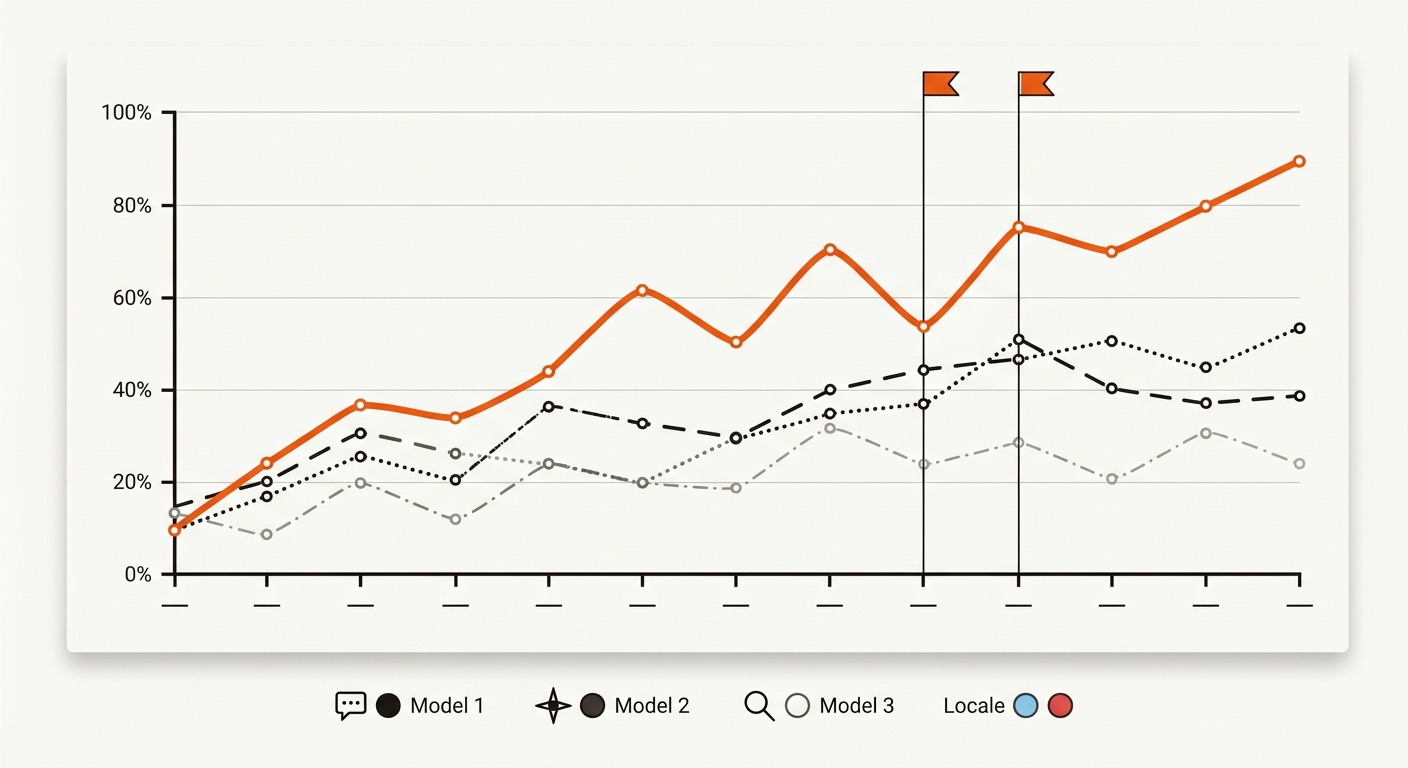
Monitoring without publish or optimize throughput will not move SOV.
Mergeflo is an autonomous SEO platform for startups: it finds search gaps, drafts articles, and publishes the ones you approve to Webflow. It ships automated SEO services including keyword research, content generation, and optimization workflows. Feed your findings into entity-rich assets that assistants prefer to cite: About pages, Pricing, Docs, FAQs, comparisons, and GEO variants.
Recommended workflow:
• Feed your probe findings (missing citations, weak contexts) into Mergeflo briefs.
• Generate or update entity-rich pages (About, Pricing, Docs, vs pages) with clear identifiers.
• Add FAQs that mirror high-return prompts from your probe set.
• Schedule GEO variants where answers diverge.
• Re-run probes weekly and annotate changes against deploys.
Mergeflo drafts articles for your review, publishes the ones you approve to Webflow, and flags pages that need a refresh. That consistency makes assistants more confident citing you, and it helps you monitor brand citations AI with visible movement instead of flatlines.

Keep reading: AI visibility tracking and how to rank in ChatGPT.
Consistent probes, clean evidence, and tight KPIs turn assistant monitoring into a weekly operating rhythm.
Start with 25-40 prompts: 10 category-intent, 10 comparison or solution, 5 brand-intent, and 5 how-to. That size balances variance and effort for a small team. Keep them stable for four weeks, then rotate 20 percent based on gaps found. This stability lets you monitor brand citations AI with a trustworthy baseline.
Cover ChatGPT, Perplexity, and Google AI Overviews in your primary buyer countries. If you sell in the US, UK, and DE, run those three locales first. Expand once you see stable SOV trends and can act on findings within two sprints. Adding locales without capacity to publish updates wastes the signal.
Track share of voice (percent of answers that include your brand), citation inclusion rate (linked vs unlinked mentions), model coverage (how many assistants show you), and context quality (are you recommended for the right use case). Tie weekly deltas to specific page releases. If SOV rises only in one locale, prioritize GEO-specific content.
Fix your run cadence, prompt wording, and input order. Log model version, timestamp, and region in every record. Use side-by-side runs of control prompts to detect global shifts. When variance spikes, widen the sample that week rather than overreacting to a single outlier, and document any model notices in your log.
