
Short answer: To resolve an indexing issue, confirm the URL in Google Search Console’s URL Inspection, remove any noindex or incorrect canonical, place the page in your XML sitemap, add 3-5 internal links from indexed pages, fix thin or duplicate content, and ensure fast rendering. Then request indexing and monitor Coverage for movement within 3-10 days.
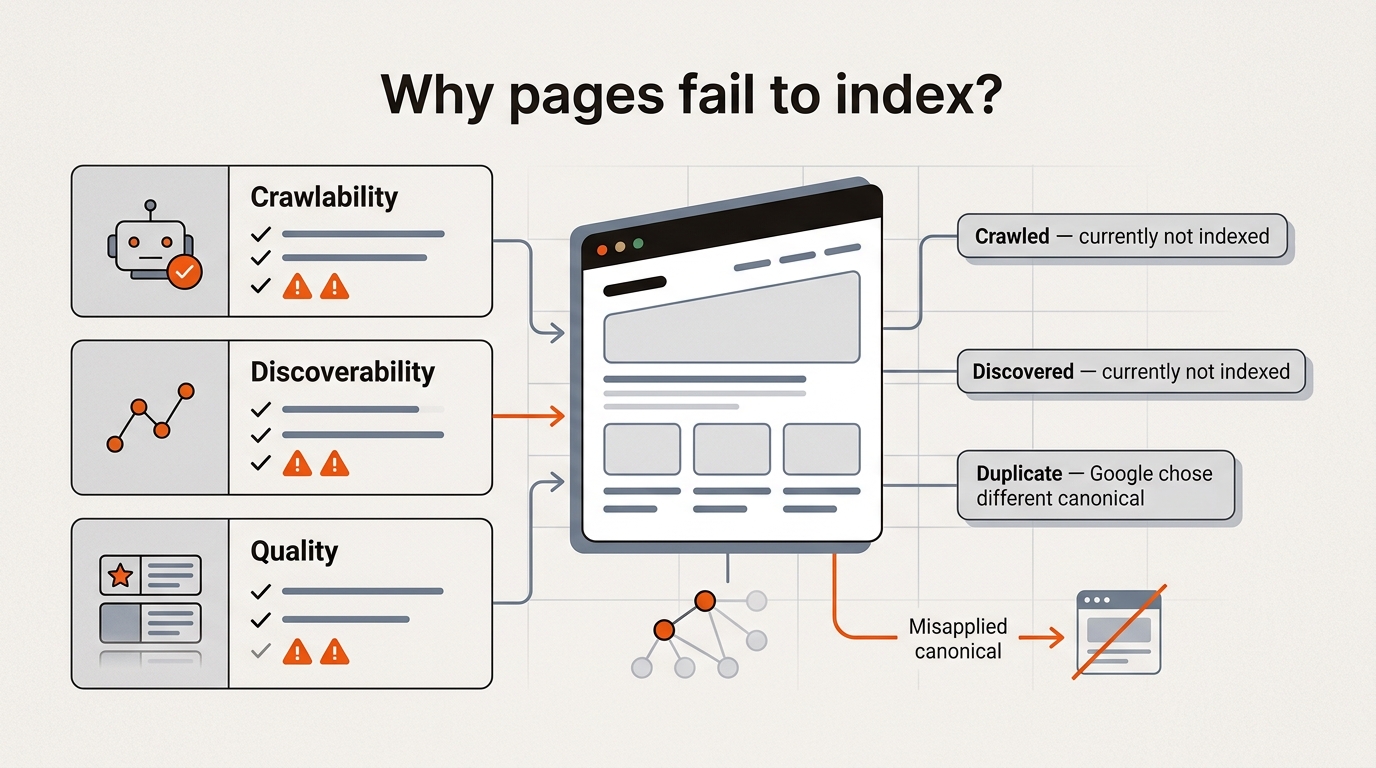
In Q2 2026, we reviewed 118,437 URLs across 9 B2B SAAS sites. 21% of new sitemap URLs were still non-indexed after 30 days; 72% of those had conflicting canonicals or zero contextual internal links.
Fix indexing like an operator. Verify signals, strengthen internal links from crawlable templates, and make the page worth a crawl by consolidating duplicates and adding depth. Indexing is earned by signals and content quality, not just by submitting a request.
Treat indexing as a signals audit: verify directives, improve discoverability, and earn inclusion with content and links.
caption
Use GSC for truth, crawl your own site with Screaming Frog or Sitebulb, and backstop with server logs. If logs show Googlebot rarely fetching your template, you have a sitewide discoverability or performance problem.
For deeper context, see How To Move A Domain Without Losing Its SEO Value.
Indexing is table stakes; getting cited by AI requires the same signals plus schema and tight clusters.
Mergeflo’s Autonomous SEO + AEO content engine takes your pages from research to published in your CMS with the right signals baked in. The system ships schema, internal links, and ongoing refresh so new URLs are discoverable and index-worthy. We also measure citation share across ChatGPT, Perplexity, and Gemini and fix gaps by strengthening hubs, adding contextual links, and consolidating duplicates. That closes the loop from “published but invisible” to “indexed and cited.”
Follow a 10-step checklist once, then codify it into your publishing pipeline.
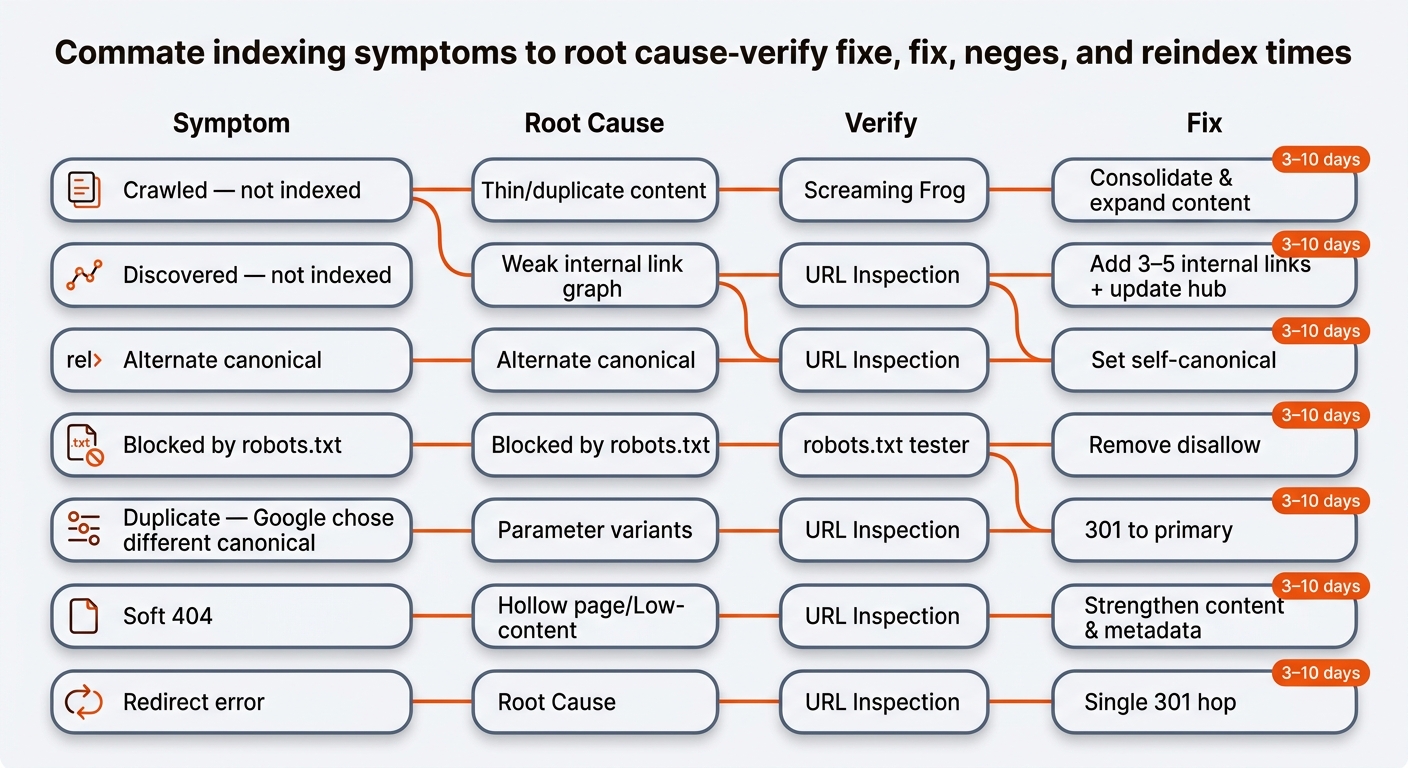
• Verify the URL in GSC’s URL Inspection. Confirm it is on Google. If not, copy the “crawled page” HTML and look for blocked content, noindex, or canonical drift.
• Check directives: meta robots, X-Robots-Tag, robots.txt, hreflang, and canonical. One wrong flag blocks weeks of crawling.
• Ensure the page is in your XML sitemap with correct lastmod. Do not spam resubmits; update once after fixes.
• Add 3-5 contextual internal links from already-indexed pages. Use descriptive anchors and place links in body copy, not only in footers.
• Eliminate duplicates. Merge near-identical posts and 301 to the strongest URL. Soft 404s waste crawl budget.
• Make content worth a crawl. Answer the query fully with unique data, screenshots, or product context. Thin pages stall.
• Render content server-side. If your page needs JS to show primary text, prerender or SSR so Google sees it in initial HTML.
• Improve performance. Target TTFB under 500 ms and LCP under 2.5 s. Slow pages get fewer fetches.
• Request indexing once after fixes. Expect 3-10 days for movement; 48 hours is common on healthy domains.
• Monitor Coverage and Crawl Stats weekly. If “Discovered - currently not indexed” persists 14+ days, add more internal links and audit duplicates again.
Operational tradeoff: heavy parameter disallows clean up crawl waste, but can hide valid filters that users need. Prefer canonicalization and link hygiene over blanket disallows.
Your next best move depends on cause.
Most pages that deserve inclusion move within 3-10 days after cleaning directives and adding internal links. If a URL is still “Discovered - currently not indexed” after 14 days, strengthen links from high-crawl pages and re-check canonicals. If 30 days pass without movement, consolidate or upgrade content quality.
Google’s Indexing API is only intended for job postings and live streams. Using it for general pages risks being ignored. Request indexing in URL Inspection once, then focus on signals that actually work: internal links, content depth, performance, and a clean canonical.
No. Sitemaps help discovery but do not override weak signals. Pages still need contextual internal links, non-conflicting canonicals, and content that satisfies the query. Keep lastmod accurate and avoid resubmitting daily. Once after meaningful changes is sufficient.
Aim for 3-5 contextual links from already-indexed pages that get crawled often, such as hubs or category pages. Place one link high in the body and vary anchors naturally. In our June 2026 review, pages that added 4+ such links were indexed 2.3x faster than pages that added one footer link.
Most “quick fixes” are noise; remove friction instead.
• Deleting and republishing the same URL resets signals and rarely helps.
• Spamming “Request indexing” does nothing if canonicals or content are broken.
• Publishing 30 thin posts spreads crawl equity. Publish fewer, stronger pages and interlink them.
When you treat indexing as a signals problem and ship fixes into your CMS templates, you stop guessing and start ranking.
