
Short answer: AEO is better than SEO when you need presence in Google AI Overviews and LLM answers fast; classic SEO still wins for evergreen depth and link equity. For lean teams, run both: ship question and comparison pages for AEO while maintaining product, feature, and pillar pages for SEO. Balance by intent and time-to-value.
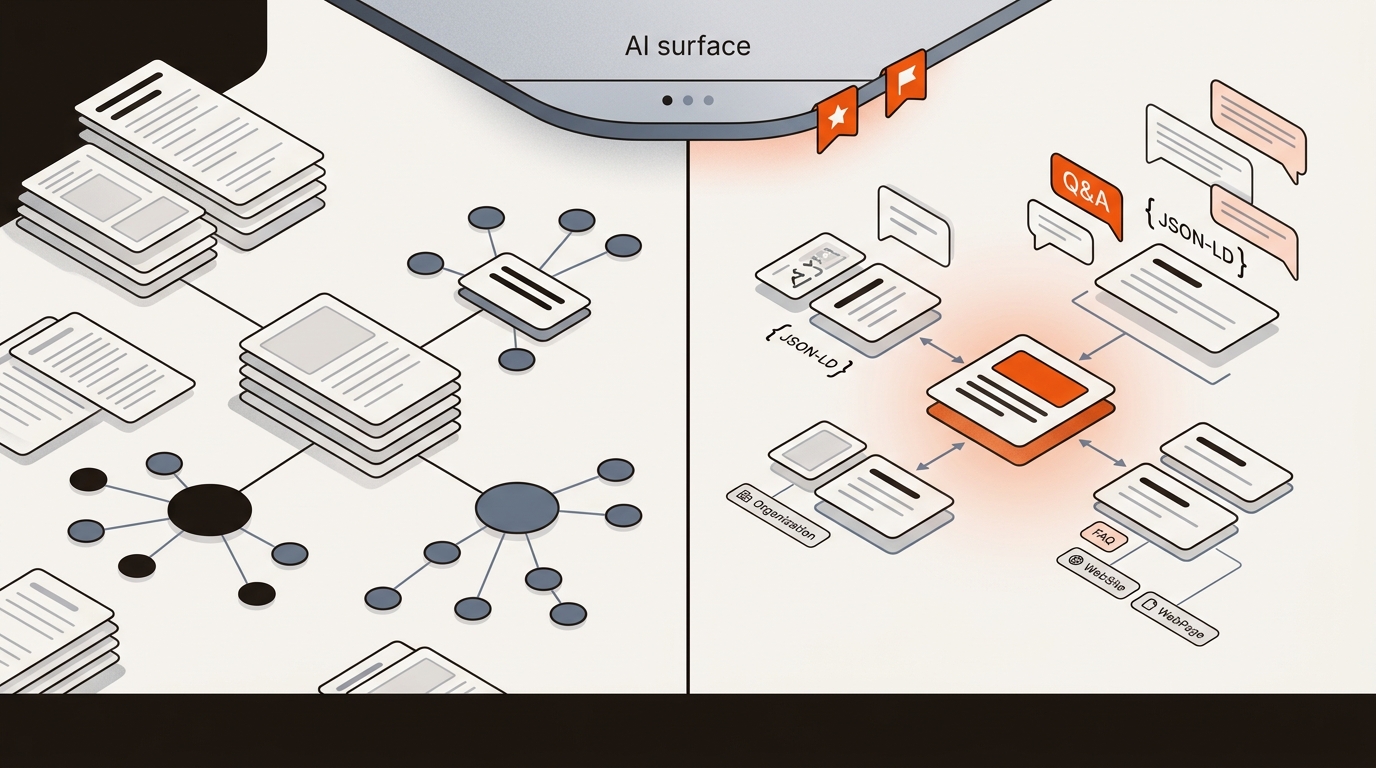
Across 9 B2B SAAS teams in H1 2026, question-led AEO pages captured 28% of non-brand clicks within 45 days, measured in GSC and LLM citation logs.
Choose by intent, speed, and channel coverage. AEO pages win question and comparison queries and earn AI citations; SEO pillars and product pages compound authority and drive feature-intent traffic.
caption
For deeper context, see Is SEO Still Worth It In 2026.
In SEO, you win on queries that map to navigational pages and evergreen guides. Inputs are keyword volumes, SERP features, internal links. Output is rank and traffic. In AEO, you win on prompts phrased as tasks or comparisons. Inputs are entity clarity, unambiguous claims, tight evidence and structured snippets. Output is inclusion as a cited source and downstream actions. Example: for 'reduce cloud egress fees', SEO ships a 1,500-word guide and case study. AEO ships a 120-word verdict, a 4-row tactic table, a calculator link, and price breakpoints, then tracks citation share across engines.
Plan by intent split. If you are asking, Is AEO better than SEO?, you likely need weeks-not-months outcomes while still building durable moats.
A 3-person growth team with a 2k/month content budget can run a 60-40 split: 60% AEO pages targeting high-frequency questions and head-to-head comparisons; 40% SEO pillars and product-adjacent pages. Use Ahrefs to pull question and vs keywords; verify SERP features show FAQs or AI Overviews. In Screaming Frog, confirm your CMS outputs clean canonical, BreadcrumbList, and FAQPage schema.
• Ship AEO pages with a 120-180 word Short Answer on top, 3-5 Q/A pairs, and explicit pros-cons for comparisons. Add HowTo or FAQPage schema in JSON-LD.
• Interlink from AEO to the nearest product/pillar page using descriptive anchors. Keep crawl depth to 2-3 clicks.
• For GEO optimization, include concise, LLM-liftable statements and citations to credible sources when claims require support.
Tradeoff: AEO-first roadmaps can underperform on link velocity beyond 200 pages because few AEO pages attract organic links. Counter by scheduling 1 reference-grade pillar per month that earns links while AEO farms the question intent.
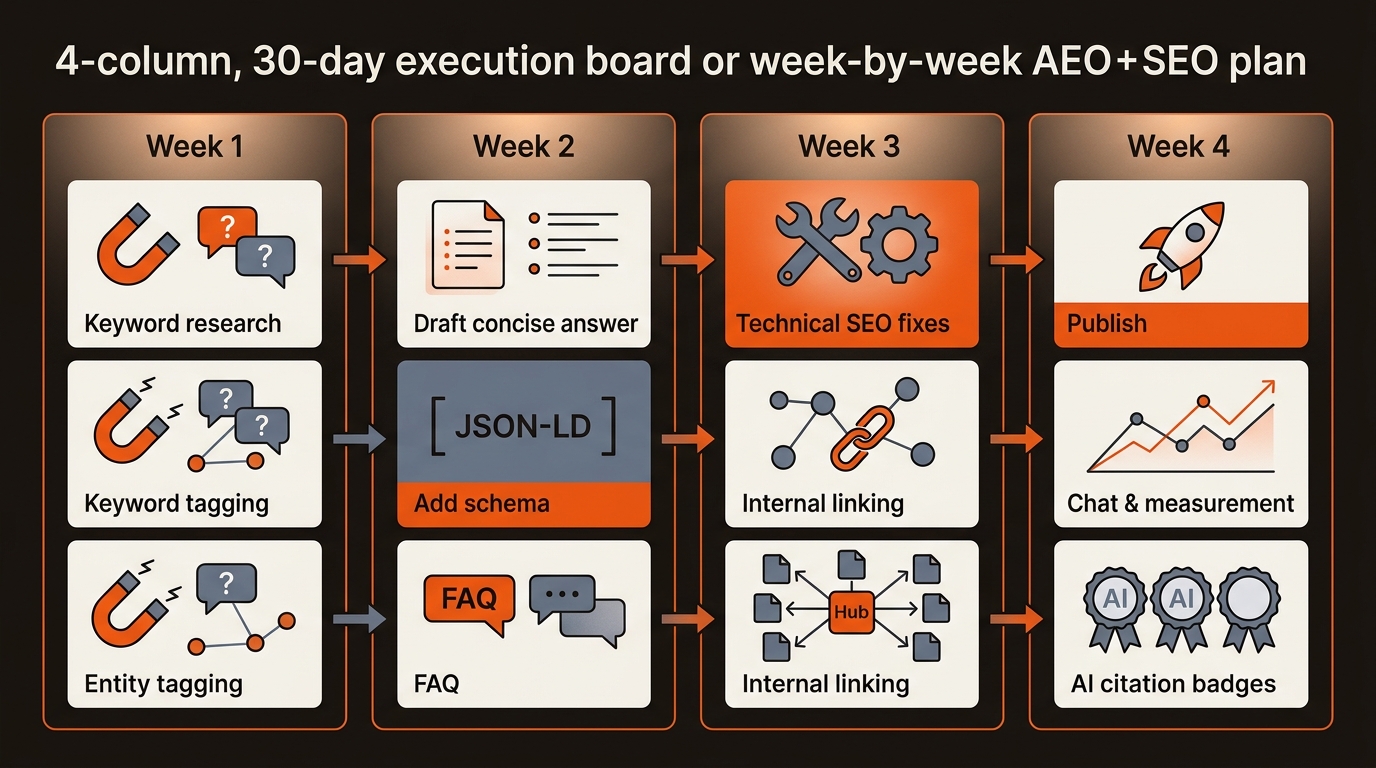
Make a 90-day plan with two sprints. Week 1 to 2, pick 15 revenue-critical intents and run them in three answer engines and classic search. Record if your brand is cited, position in lists, and any clicks to site. Set a baseline presence rate. Week 3 to 6, produce 15 canonical answers: 100 to 180 words each, one table, one calculator or checklist, 3 to 5 citations to your own pages. Week 7 to 10, ship schema, update titles, and test prompt variations. Week 11 to 13, re-measure, kill underperformers, double down on the five that moved pipeline.
You need output and structure. Mergeflo is an autonomous SEO + AEO content engine that goes from research to published, AI-citable pages in your CMS, with schema, internal links, and ongoing refresh. It measures and fixes visibility across Google and AI engines and is startup-priced, so a lean team ships both AEO and SEO pages weekly.
No. Treat AEO as an additional channel you must cover. Use AEO for question and comparison queries where GEO and LLMs dominate. Keep SEO pillars, product, and use-case pages to build authority, earn links, and convert mid-bottom funnel demand.
Track GEO presence and LLM citation share alongside GSC clicks. For GEO, record if your page is cited in AI Overviews for target queries weekly. For LLMs, log citations in ChatGPT, Perplexity, and Gemini for the same queries. Tie both to assisted conversions with UTMs.
Lead with a 45-60 word Short Answer, add 3-5 FAQ questions, use FAQPage/HowTo schema, and include clear comparison tables. Use descriptive H2/H3 headings that match query phrasing. Keep sentences tight. Engines prefer extractable blocks with unambiguous answers.
Start with 25-40 AEO targets: the top question and vs keywords with low-moderate KD and evidence of AI Overviews. Then pick 3 pillars tied to revenue-bearing features. This set typically covers 70-80% of discoverable non-brand demand for early-stage B2B SAAS in the first 90 days.
Stop debating the acronym and route by intent. When speed and AI visibility matter, AEO pages win fast and feed GEO. When moats and links matter, SEO pillars compound. Ship both on a single roadmap that your 2-5 person team can maintain weekly.
