Short answer: Yes, SAAS is still profitable in 2026 for teams that hit efficient unit economics: gross margin 70-85%, net dollar retention 110%+, and CAC payback under 18 months. Profit comes from mix and motion. Teams that miss these thresholds struggle to generate cash regardless of growth rate.
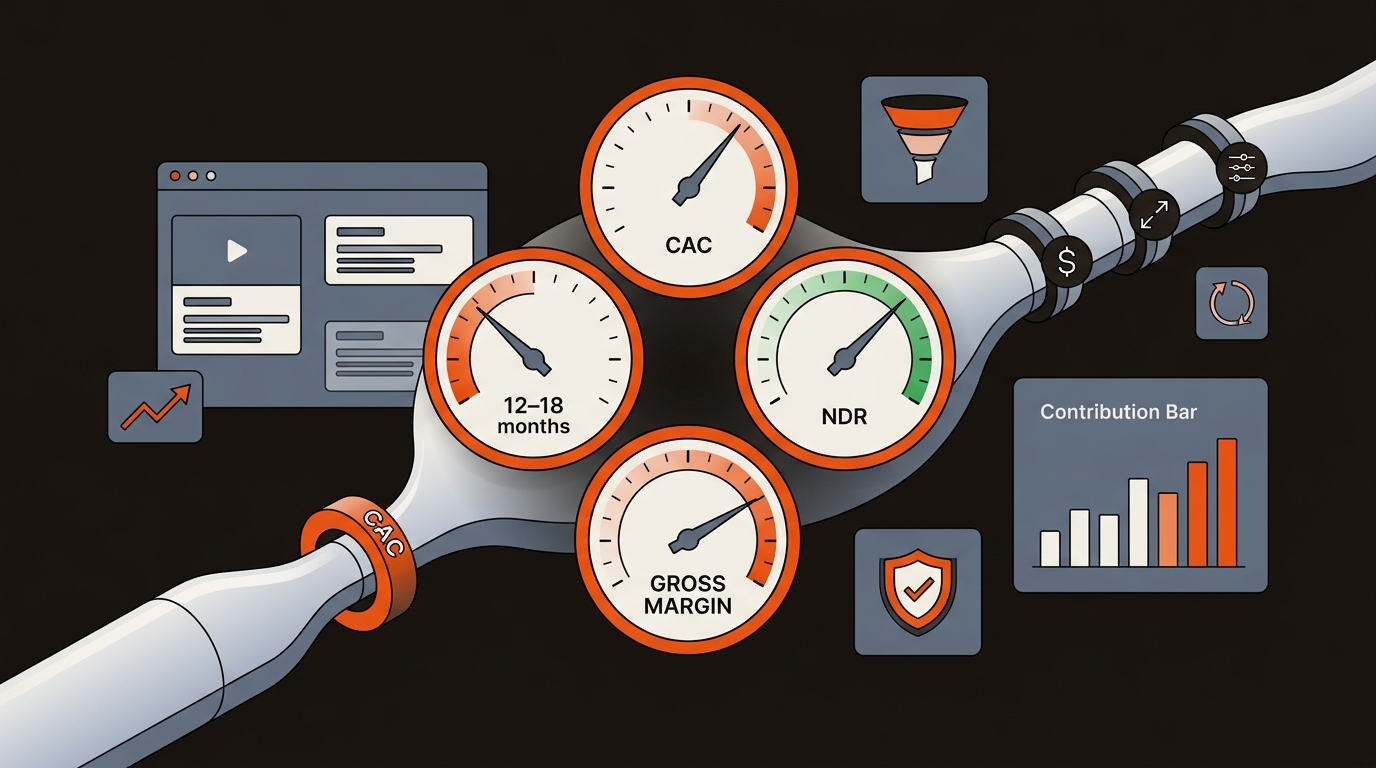
Strong software margins persist: multiple indices show public cloud gross margins ~75-80% since 2020, even as GTM costs separated winners from laggards. Sources: BVP Cloud Index, Meritech filings analysis.
Unit economics decide whether growth compounds or stalls. Example: SMB workflow tool priced at 25 per seat, average 5 seats, gross margin 80 percent, CAC 600. Monthly ARPU 125, contribution 100, CAC payback 6 months. Cut monthly logo churn from 3 to 2 percent and contribution LTV rises from about 3,333 to 5,000. Lift price 10 percent to 27.50 and contribution moves to 110, payback 5.5 months. Drop COGS 5 points and margin hits 85 percent, contribution 106.25, payback 5.7 months. Raise average seats from 5 to 6 and contribution is 120, payback 5 months. Model deltas before building features.
Your GTM motion sets CAC payback, NDR ceiling, and gross margin drag — choose the mix that fits price point and sales cycle.
caption
Benchmarks blend OpenView PLG trends, KeyBanc SAAS metrics, and public SAAS disclosures. Your exacts will vary, but the directional math holds. If you sell at 20k ACV with a 60-day sales cycle, product-assisted plus a strong self-serve funnel typically beats pure field in both payback and margin.
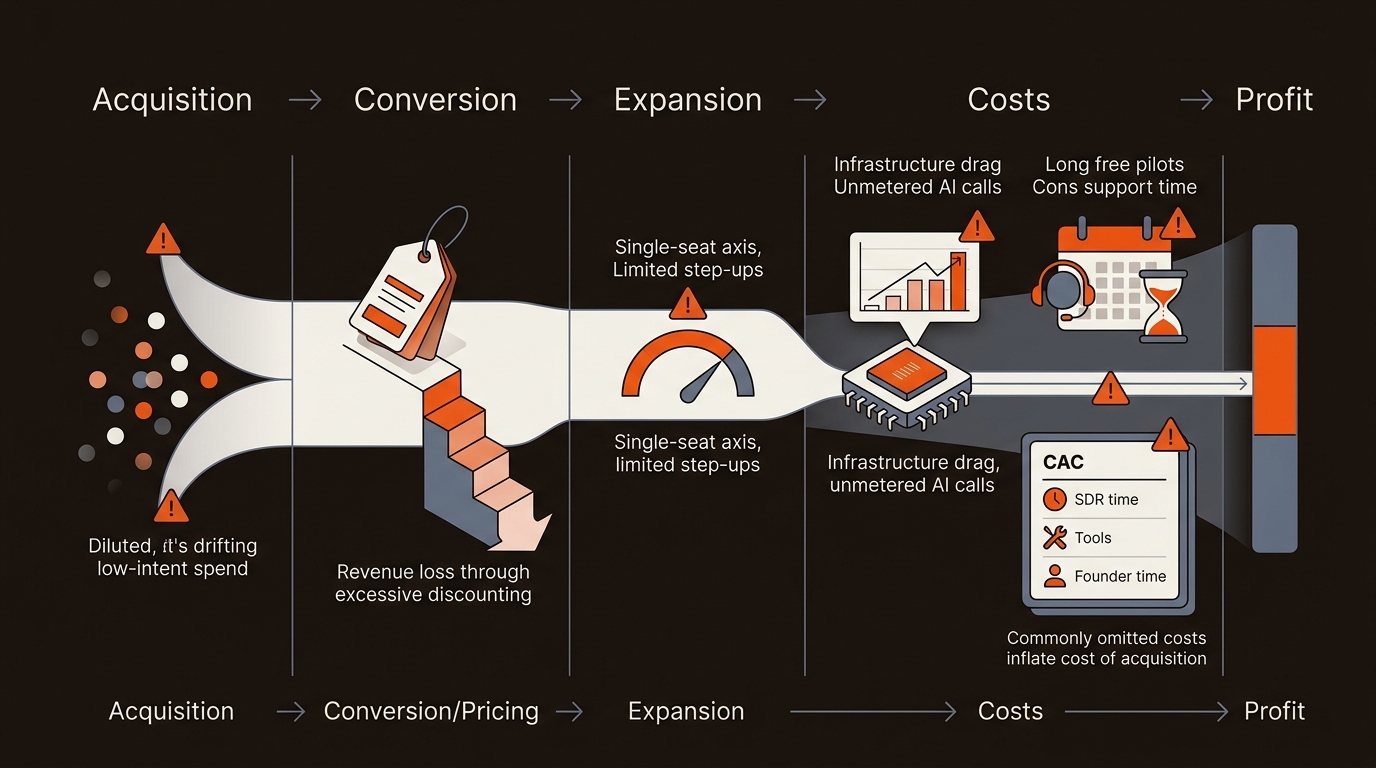
Most miss on GTM wastee economics.
• Low-intent capture bloats CAC. Paid broad match and undifferentiated content can burn 20-40% of spend on zero-SQL clicks. Fix with bottom-funnel clusters, internal links, and precise schema to raise organic close rates.
• NDR stagnates without expansion design. If your price axis stops at seat count, you cap NDR near 105%. Add usage, premium features, and packaging that encourages step-ups.
• Infra drag erodes gross margin. If COGS creeps 10 points due to unmetered AI calls or passthroughs, deals that looked profitable on paper flip negative after discounts.
If you’re still asking Is SAAS still profitable in 2026, run your current CAC payback and NDR. If payback is 20+ months with NDR under 105%, profitability is unlikely until you fix funnel efficiency or pricing.
Teams miss profit by mismeasuring and misaligning incentives. Examples: Blended CAC that omits SDR salaries, benefits, tooling, and founder selling time understates acquisition cost by 30 to 50 percent. Discount waterfalls go uninspected. If list price is 15,000, average discount 20 percent, realized ASP is 12,000. At 70 percent gross margin, first year contribution is 8,400; with CAC at 10,000, payback slips beyond year one. Free pilots inflate COGS. A 90 day trial with 15 active users can burn 40 hours of success and support time. Fixes: comp on collected revenue, cap discounts with approvals, time box pilots, and enforce opportunity stage exit criteria tied to win rate and ASP.
Lower CAC payback with organic capture that also earns AI citations — it compounds and holds.
Mergeflo ships an autonomous SEO + AEO content engine: research to published, AI-citable pages in your CMS, with schema, internal links, and ongoing refresh. That means you capture bottom-funnel searches and get cited by AI Overviews, ChatGPT, and Perplexity — the rare channel that reduces CAC every month it runs. If you are weighing channels, our take on Is SEO Still Worth It In 2026 details the payback math. For AI-era risk, see Is SEO Dead Now With AI.
Profit in 2026 is a pipeline problem — instrument unit economics weekly and remove waste.
• Instrument CAC payback by channel inside your CRM with explicit lead source normalization. If you cannot measure payback by source in Salesforce or HubSpot, you cannot improve it.
• Build 3 bottom-funnel clusters around top-intent terms, 10-15 pages each, and interlink them to your product pages. Use Ahrefs to validate terms with commercial modifiers and KD under 25 to ship wins in weeks.
• Add pricing gates that create expansion: feature packages, usage thresholds, and annual upgrade nudges. Track NDR in Mixpanel or Stripe by cohort.
• Protect margin: audit COGS monthly. Tag infra costs to features; optimize or reprice high-cost features.
The tradeoff: programmatic content and schema work take 2-4 weeks to show effect, while paid can flip on tomorrow. But paid-only programs rarely achieve sub-12-month payback at seed-stage CACs. Blended is fine; compounding is required.
External sources: KeyBanc 2024 SAAS Survey, Bessemer BVP Cloud Index
If you need an AI search visibility platform that measures and fixes both Google rank and AI citations, talk to Mergeflo: https://mergeflo.com
Aim for 75-85% gross margin for software-forward products. Infra-heavy or AI-inference products may land at 60-75% depending on vendor rates and model usage. Track this monthly and tag COGS to features. If discounts drag effective margin below 70%, reprice, re-bundle, or meter.
Often yes at scale, because expansion can push NDR to 120-140%. The catch is COGS. If usage rides expensive third-party APIs or GPU inference, you must meter and price against unit costs. Publish unit economics in your pricing model and re-rate annually to protect margin.
Under 18 months blended, with 12 months on your most efficient channels. Use CRM-sourced payback. Attribute spend all-in: media, content, ops, and sales comp. If you cannot get under 18 months, cut low-intent capture and ship bottom-funnel pages first.
AI shifts discovery. AI Overviews, ChatGPT, and Perplexity now cite sources for problem-solution queries. Earning citations reduces paid spend and accelerates CAC payback. It does not fix weak retention or pricing. Treat AI visibility as an acquisition multiplier, then monetize through expansion paths.
Yes — if you engineer CAC payback under 18 months, NDR over 110%, and protect 75-85% margin. That means building compounding, AI-citable content, tightening pricing and packaging, and removing GTM waste. Do the boring math weekly. Profit follows.