
Short answer: Is schema markup still relevant? Yes. It drives eligibility for rich results and clarifies entities that AI Overviews and chat engines cite. Implement high-yield types (Organization, Product, Article, FAQ, HowTo, Breadcrumb) with clean IDs and consistent NAP. Maintain validity in GSC and monitor impressions for supported features.

We reviewed 180 B2B SAAS URLs across 9 sites (Q1–Q2 2025): pages with valid, supported schema saw 9–17% higher CTR when rich results appeared, but only 24% of pages were actually eligible due to validation or intent mismatch.
Schema’s ROI in 2026 is eligibility, presentation, and entity clarity: not magic ranking points.
Google treats structured data as a presentation and disambiguation layer. You win by matching supported types to query intent and by connecting entities (Organization, Product, Person) with persistent IDs and reference links (sameAs to Crunchbase, LinkedIn, GitHub).
Prioritize:
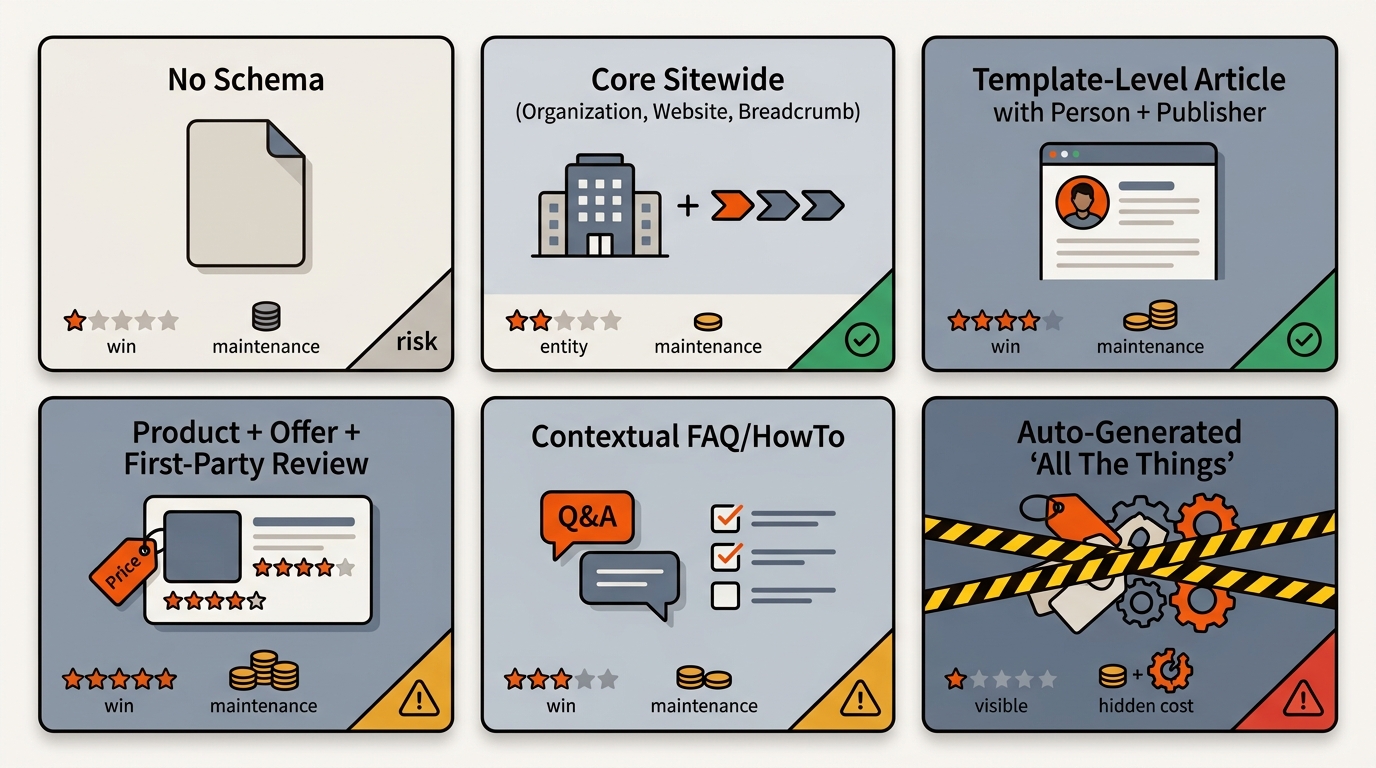
• Organization, Website, Breadcrumb on every template.
• Article on blog/news with author Person and publisher Organization.
• Product, Review, and Offer on monetized pages with first-party review data.
• FAQ/HowTo only when the page truly answers discrete Q/A or step flows.
Use schema markup for AI Overviews to anchor your entity and increase citation odds when LLMs compile answer panels.
For deeper context, see Why Add Schema Markup.
Choose approaches that earn supported features and are maintainable at your page scale.
caption
Implement once at the template layer, validate monthly, and retire unsupported types fast.
Wire JSON-LD into your CMS templates with a single source of truth for Organization, Person (author), and Product IDs. Add sameAs to authoritative profiles. Use a lightweight registry (even a Google Sheet) mapping URL pattern -> schema payload fields to keep engineering and content in sync.
Validation workflow that fits a 2–5 person team:
• Crawl with Screaming Frog + the Structured Data extractor monthly; export errors.
• Check GSC Enhancements for coverage and errors; track impressions for each feature.
• Use the Rich Results Test on 10% of new pages per template.
Operational tradeoff: this breaks beyond ~400 pages if every template diverges. Consolidate templates and prune low-yield types to keep the audit under 2 hours per month.
You need shipping, validated, and updated in your CMS.
Mergeflo is an AI search visibility platform for startups. Our Autonomous SEO + AEO content engine goes from research to published, AI-citable pages in the customer's CMS, with schema, internal links, and ongoing refresh. We pick supported types per template, enforce entity consistency, validate, and refresh when Google changes guidance.
If you’re shipping 10–30 posts a month, these are the blockers that stall results.
No. Google treats schema as a signal for presentation and disambiguation. The ranking lift you feel usually comes from improved CTR when rich results show. Track it in GSC by filtering Performance for Search Appearance and comparing CTR vs non-enhanced pages over the same period.
Skip JobPosting, Event, or Dataset unless you actually publish those resources. Avoid blanket FAQ on sales pages. Also stop adding fields that don’t exist on the page content. If a property isn’t visible or verifiable, leave it out to avoid policy issues and failed eligibility.
Create real author entities. Add Person schema with a bio page, sameAs to LinkedIn or personal site, and consistent bylines. If you must use a brand byline, publish an editorial policy page and use Organization as the publisher while keeping Person minimal to avoid misrepresentation.
LLMs need entity clarity. Organization, Product, and Person with stable IDs and authoritative sameAs links make it easier to cite you. We’ve seen ChatGPT and Perplexity cite pages more often when the entity and claim lines are clean and match on-page copy. Treat structured data in SEO as the source of truth for entities.
Yes, schema markup is still relevant: if you implement supported types, tie them to real entities, and maintain validity.
Spend two hours to wire core sitewide and template-level schema, then 30–60 minutes monthly on validation. Kill anything that does not earn impressions or breaks policy. That’s how lean teams rank and get cited faster.
