
Scale only when your signals say scale; pausing early beats recovering from a traffic cliff. Programmatic SEO for Startups can unlock compounding traffic, but it punishes weak datasets, generic templates, and rushed indexing. The winning move is a staged rollout with go/no-go gates that protect crawl budget, brand quality, and revenue targets.
Link your early testing cohort to a conversion path and monitor indexation, CTR, and assisted signups before expanding. If the first 100 pages underperform, the next 1,000 will amplify mistakes. See a focused approach in programmatic SEO for startups.
You’re a founder or growth lead at a startup with a large structured dataset and at least one hand-built page ranking in the top 20. You’re considering shipping hundreds of programmatic pages to capture long-tail intent. You have engineering time available for template work and GSC connected. This guide is for you if you can answer "what entity am I shipping at scale" in one sentence. If your dataset is messy, your entity is fuzzy, or you don’t have a single hand-built page proving traction, programmatic SEO is premature.
Most startups treat programmatic SEO as "ship 1000 pages, see what ranks." The result is often a low indexation rate, traffic cliffs as Google de-prioritizes thin templates, and cannibalization between programmatic and hand-built money pages. The fix isn’t paid template tools; it’s gating cohorts of 50-150 pages, measuring against pre-set indexation + CTR thresholds, and ONLY scaling after green signals across two consecutive weeks. Without gates, programmatic SEO becomes "scale the mistake."
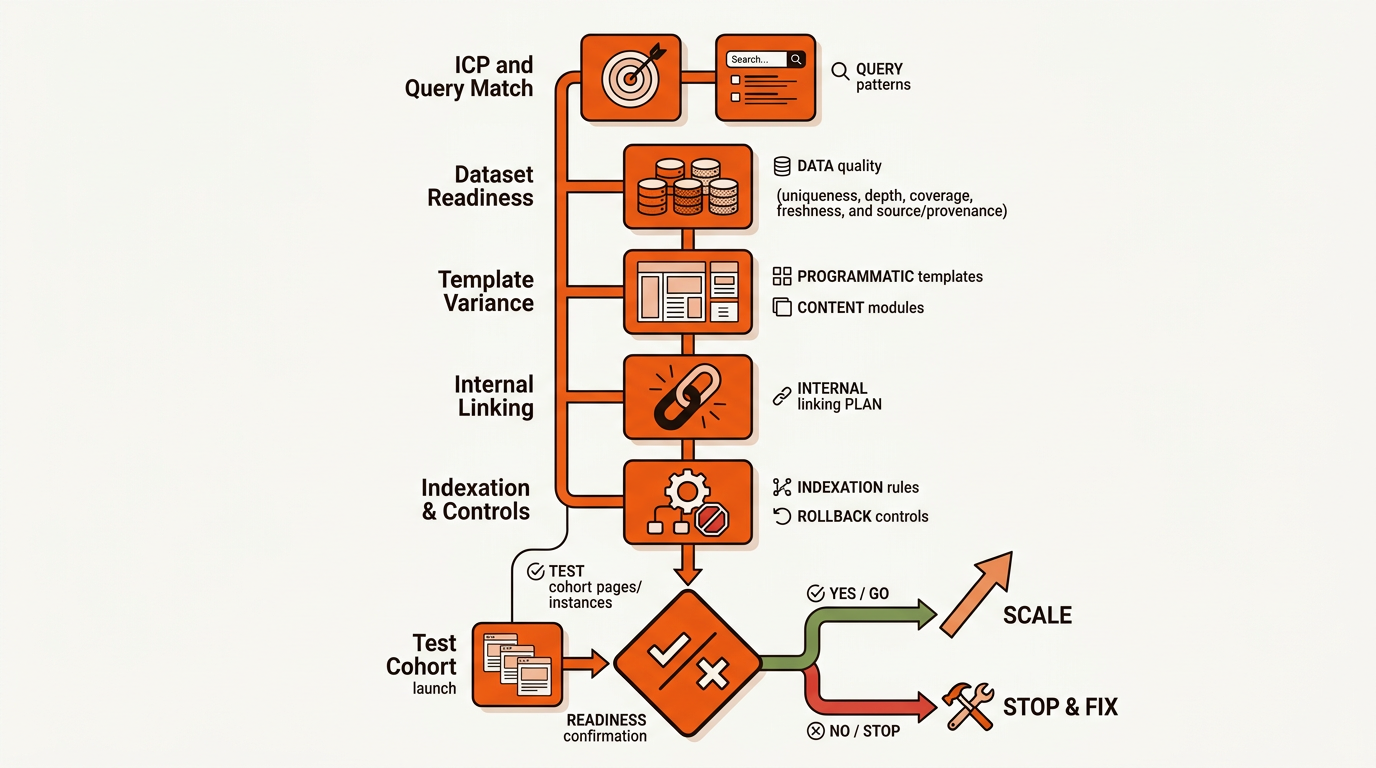
Before shipping a single template at scale, validate four gates. Failing any one means stop: programmatic SEO isn’t ready yet.
1. Dataset quality
• A large dataset (our rule of thumb is about 1,000 records; with fewer, build pages by hand)
• 3-5 verifiable attributes per record from primary sources (not scraped, not synthesized)
• Each attribute has a clear data lineage (when collected, from where, last verified)
• Unique records (no near-duplicates that will trigger cannibalization)
2. Template quality
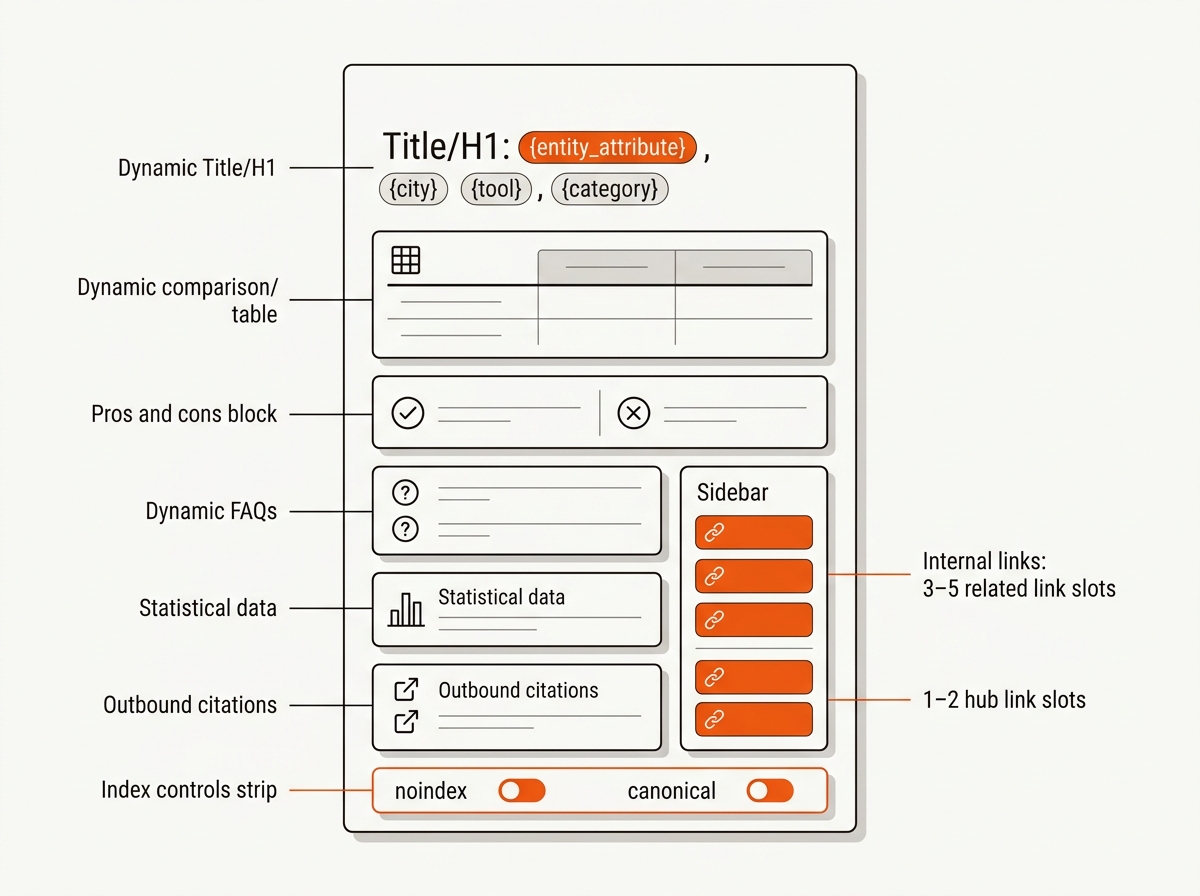
• 3+ variable modules pulling distinct dataset attributes (not just "fill in the name")
• One FAQ block with at least 4 dynamically-generated Q&A pairs
• One comparison table or stat block with dynamic numbers
• Enough unique content per page that it is more than the template with a name swapped in
• Title and meta variance: each page’s title differs in more than just the entity name
3. Cannibalization risk
• Programmatic URLs use a distinct path prefix from hand-built money pages (e.g. /catalog/* vs /products/*)
• No programmatic page targets a query already ranking in positions 1-10 for a hand-built page
• Canonical strategy decided upfront: self-canonical or consolidated to a parent
• Search Console "Pages" report monitored weekly during rollout for unexpected query-page rerouting
4. Indexation infrastructure
• Sitemaps within Google’s limit of 50,000 URLs or 50 MB per file (smaller files are easier to monitor)
• Robots.txt and noindex policy documented for thin-tag templates (author archives, etc.)
• Internal link plan: every programmatic page linked from at least one hand-built page within 30 days of publish
• Server can handle a higher crawl rate without 5xx errors during cohort rollout
If you can check every box, you’re ready for a small Stage 1 Gate cohort. If not, hand-build more pages first and revisit.
Route authority through a central hub to keep clusters coherent. Map your rollup linking to startup SEO or a comparable parent guide that unifies entities. Use AWR’s CTR study as your numeric guardrail for CTR vs. position; adjust titles when you lag expected rates.
Reference CTR baseline: Advanced Web Ranking CTR study
The Gate-Scale Loop is a 3-stage model that prevents traffic cliffs during programmatic expansion. Stage 1 Gate: ship 50–150 pages and measure indexation, CTR, and assisted conversions against pre-set thresholds for two weeks. Stage 2 Stabilize: fix dedupes, improve variable modules, and re-target cannibalizing pages; only expand if signals remain green across two consecutive weeks. Stage 3 Scale: increase cohort size 2–5x while preserving crawl health using dynamic sitemaps, rollup hubs, and automated internal links. Tradeoffs include slower initial throughput and higher engineering time on templates. Failure modes include overfitting to an early-win slice, widening entity scope too fast, and ignoring server performance as URLs increase.
A small math check beats months of rework. Consider a pilot of 200 pages targeting queries with an average search volume of 250. That is 200 x 250 = 50,000 monthly searches addressed by the cohort.
Suppose that after 21 days, 62% are indexed (124 pages). Of those, 80% have impressions (99 pages). Assume an average position of 7 with a 3.1% CTR. Impressions estimate: 99 x 250 = 24,750. Clicks: 24,750 x 0.031 = 768.
If site-to-signup conversion is 1.8%, that is 768 x 0.018 = 14 signups from the pilot. Scaling by adding 800 pages with the same performance yields about 496 indexed pages, roughly 3,072 clicks, and around 55 signups. If indexation on the new cohort drops to 30%, clicks fall to about 1,488 and signups to 27. The scale decision hinges on protecting indexation and CTR at the template level before you multiply page count.
A 4-week check on assisted conversions closes the loop. If you see pageview-to-trial assists rising for the same query families, expand coverage of those entities first. Programmatic SEO for Startups works when each expansion increases both visibility and pipeline, not just page count.
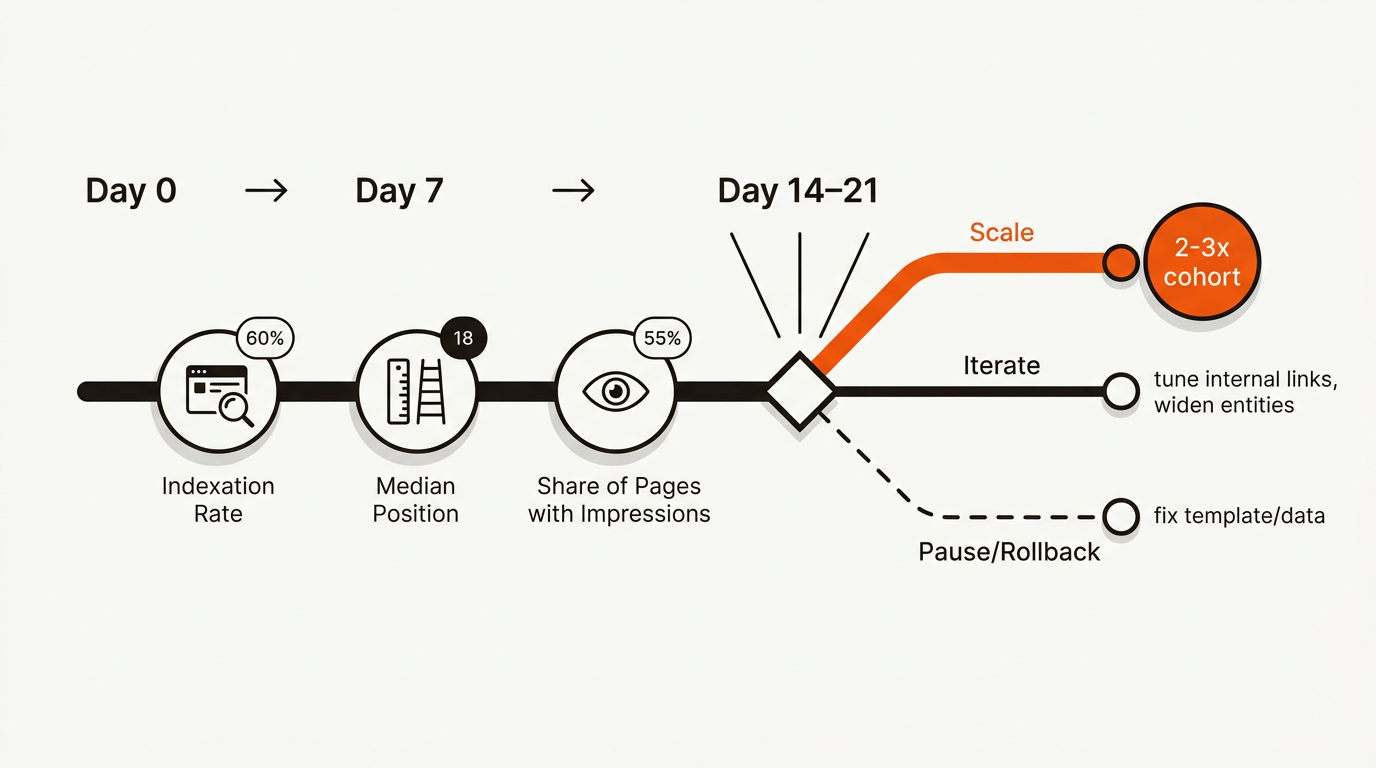
Programmatic SEO for Startups wins when gates decide the pace. Hold the line on dataset and template quality, use cohort math, and only scale on green signals you can prove in GSC.
See also: how to turn one product page into a search cluster, and the wider case for programmatic SEO for startups.
If you have fewer than 1000 dataset records, your hand-built page hasn’t cracked top-20 for its target query, or your entity definition shifts month-to-month, you’re too early. Build 10-20 hand-crafted pages first, validate the entity converts, then templatize. Premature programmatic SEO at 200 pages can burn months and produce little indexable traffic, which is worse than waiting.
50-150 pages. Smaller than 50 = not enough signal to validate the template. Larger than 150 = too much sunk cost if you have to roll back. The narrower the entity, the smaller the gate: a 50-page gate for niche B2B SAAS comparisons, a 150-page gate for broader B2C catalog templates.
You ship 200 programmatic pages targeting "X for Y", and within 30 days your hand-built /x-platform page drops from position 4 to position 9. Google sees overlapping intent and starts splitting authority across both URL templates. The fix: either no-index the programmatic cohort and consolidate intent to the hand-built, or 301 the hand-built into the programmatic path. Don’t let both fight.
Yes for the template and dataset pipeline (expect a real engineering project for the initial setup). No for ongoing operation once the template is live: a content operator can manage cohort rollouts, monitor GSC, and decide gate go/no-go. Teams often underestimate the ongoing work of keeping records fresh.
Every 2-3 weeks during scale phase. Tighter than 2 weeks doesn’t give you enough indexation signal; wider than 4 weeks means template improvements stall.
Three signals: (1) indexation falls sharply from one cohort to the next, (2) your hand-built money page drops several positions across several queries, (3) a large share of programmatic pages still has zero impressions a month after publishing. Any two of these = stop, audit, fix template + dataset. Pushing past these signals wastes crawl budget for the rest of the site.
• Startup SEO Checklist: What to Fix Before Publishing 30 Posts
• SEO for Startups: What to Do in the First 90 Days
• Mergeflo vs SEObot: Quality Gates vs Volume Generation
