
SEO automation for startups works when you treat it as a loop: research, brief, draft, publish, link, refresh.
Most teams automate fragments and wonder why rankings stall. Define the work as a pipeline, let a platform run the repeatable steps, and keep founder judgment on positioning, topic selection, and quality gates. That split wins speed without burning brand equity.

This is the operator's view of what Mergeflo's autonomous SEO platform handles for you, and where founder judgment still earns its keep. For the full sequence, see the startup SEO playbook.
Use a 70-20-10 split to decide what the platform owns vs what the founder keeps.
The 70-20-10 Ownership Model assigns 70 percent of SEO work to rules-based automation: clustering, templated briefs, AI drafts, CMS formatting, internal link insertion, and refresh triggers. The next 20 percent is operator QA and exception handling: entity gap fixes, on-page nits, and resolving keyword cannibalization. The final 10 percent is founder-only judgment: positioning, topic selection tied to pipeline stages, and relationship-driven link opportunities.
Apply it by wiring your platform to ship the 70 without waiting, reserving review bandwidth for the 20 that actually moves rankings or reduces risk. Tradeoffs are clear: more speed can compress narrative nuance if the 10 percent is ignored. Failure shows up as generic angles, product inaccuracies, or slow throughput when operators over-review the automated 70.
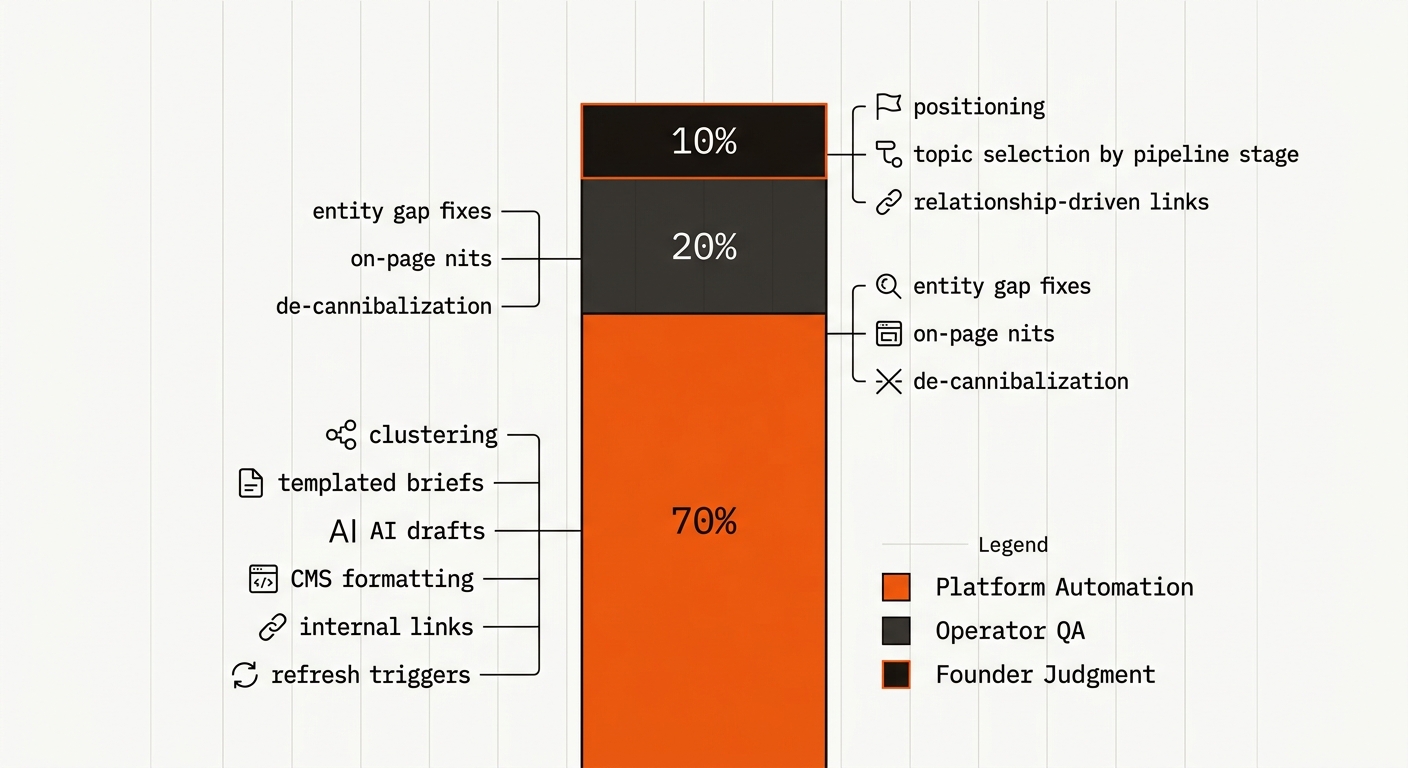
Clarity on ownership prevents throughput from dying in approvals.
Use this as your operating agreement with the platform. Treat it as the single source of truth for who acts and when.
SEO automation for startups performs best when this table becomes policy. Publish it in your internal wiki and point every contributor to it before the first draft ships.
Model throughput before you buy.
Compare your current month with the month you expect after automation, keeping the same keyword difficulty and SERP types.
• Before: posts per month, hours per post, and clicks per post after a fixed window, from your own Search Console data.
• After: the same three numbers, with hours per post taken from a real trial of the tool rather than a vendor estimate.
Then apply your own lead rate and close rate to the difference in clicks, and multiply by your own ACV.
If these assumptions hold for you, the math changes your staffing plan. Thirty-three hours per month is one operator and a platform. Speed creates more surface area for rankings, which increases the odds that some pages reach the top positions.
A large monthly SEO retainer can take a big share of pre-seed burn.
You need a loop that converts spend into throughput, replacing status updates with shipped pages. Automation handles the volume; founder ownership maps topics to revenue. The next sections show where to draw the lines so you keep both speed and narrative control.
Tool vendors describe features; operators need ownership lines and SLAs.
Advice from Ahrefs at ahrefs.com/blog/SEO-automation and Semrush at semrush.com/blog/SEO-automation centers on checklists and features. They do not define who approves what in a small startup or how to set weekly throughput targets. Our angle: treat the pipeline as a system with founder-defined rules, where the platform researches and drafts and a person approves links, publishing and refreshes.
Ship a mini-cluster in 7 days using your current stack.
Day 1-2: Export keywords from Ahrefs or SEMrush. Cluster by intent and KD thresholds. Pick 12 topics aligned to one product use case and two sales stages. Define the founder-only angles for 6 topics with higher deal impact.
Day 3: Generate briefs with entity lists and target internal links. Use SERP diffs to set section-level requirements and examples. Set a rule to include one product explainer where intent is commercial investigation.
Day 4-5: Draft with AI assistance and operator passes for entity coverage. Run Screaming Frog locally to validate titles, meta, and canonical tags. Founder redlines only product claims, brand tone, and announcement-sensitive copy.
Day 6: Publish 6 and schedule 6 via the CMS API. Wire internal links to cluster parents and related siblings according to a 3 links per page budget. Add schema where it materially influences rich results.
Day 7: Annotate GSC, submit to indexing, and verify crawl with server logs if available. Set refresh triggers by delta CTR and average position shifts across the cluster. For AI visibility and GEO optimization, include short definitional blocks, one table per post, and consistent H2/H3 patterns so answer engines can quote cleanly.
Reference models: read the startup SEO stack to define layers, and decide when to use AI SEO agents vs SEO automation for autonomy.

Founders earn outsized returns by making 3-4 high-stakes calls per cluster.
Kill topics that look good in KD but fail your ICP or current pipeline. Move budget to adjacent long-tails where you can own the definitional answer and a feature walkthrough with real data.
Handle product-led content with more care. A pricing change, security claim, or roadmap mention can create rework across dozens of pages. Gate these with a simple rule: anything that can affect sales calls gets a founder pass before publish.
Acknowledge tradeoffs. Many thin posts lose to a few thorough ones when the SERP rewards depth and examples. Conversely, over-investing in one hero piece while competitors ship a full cluster usually underdelivers. Use Ahrefs Traffic Potential and parent topic data to set the proper split.
Interlinking is the cheapest ranking lift you can automate.
Set link budgets per page and per cluster. A simple rule like 3 internal links out and 2 in, biased to cluster parents and transaction pages, moves averages without manual fiddling. Recompute suggestions weekly using your sitemap and crawl data.
Use Screaming Frog custom extraction to confirm anchors include target entities. Mismatched anchors waste equity and confuse crawlers. You can enforce a minimum of one exact anchor and one partial per target URL without sounding spammy.
Link recency matters. Prioritize adding links from new posts to older money pages within 48 hours.
Templates and SERP diffs deliver consistent quality at scale.
Build your brief templates to require evidence: a number, a how-to, and a product tie-in where relevant. SERP diffs front-load what you must cover to outrank position 3, which prevents thin duplication and drives time into differentiation.
SEO automation for startups covers the structural work of the article above: the page inventory, the workflow that keeps it shipping, and the measurement loop that confirms it's working. The sections preceding this FAQ describe each part in detail.
There is no fixed timeline. Google does not promise when, or whether, a page will rank. Watch Search Console impressions for the questions the page targets each week, because impressions move before clicks. A page with no impressions after a few months usually needs a sharper angle or more internal links.
Cost depends on who does the work: your own team's time, a freelancer, an agency or a software tool. Mergeflo has a free plan, and paid plans are listed on the pricing page.
Mergeflo researches topics, writes briefs and drafts in your brand voice, adds FAQ schema and suggests internal links. You choose the topics and approve each article, and it publishes to Webflow only when you press Publish. For pages losing reach, Mergeflo flags them, and when you press Refresh it writes a refresh brief for you to review.
