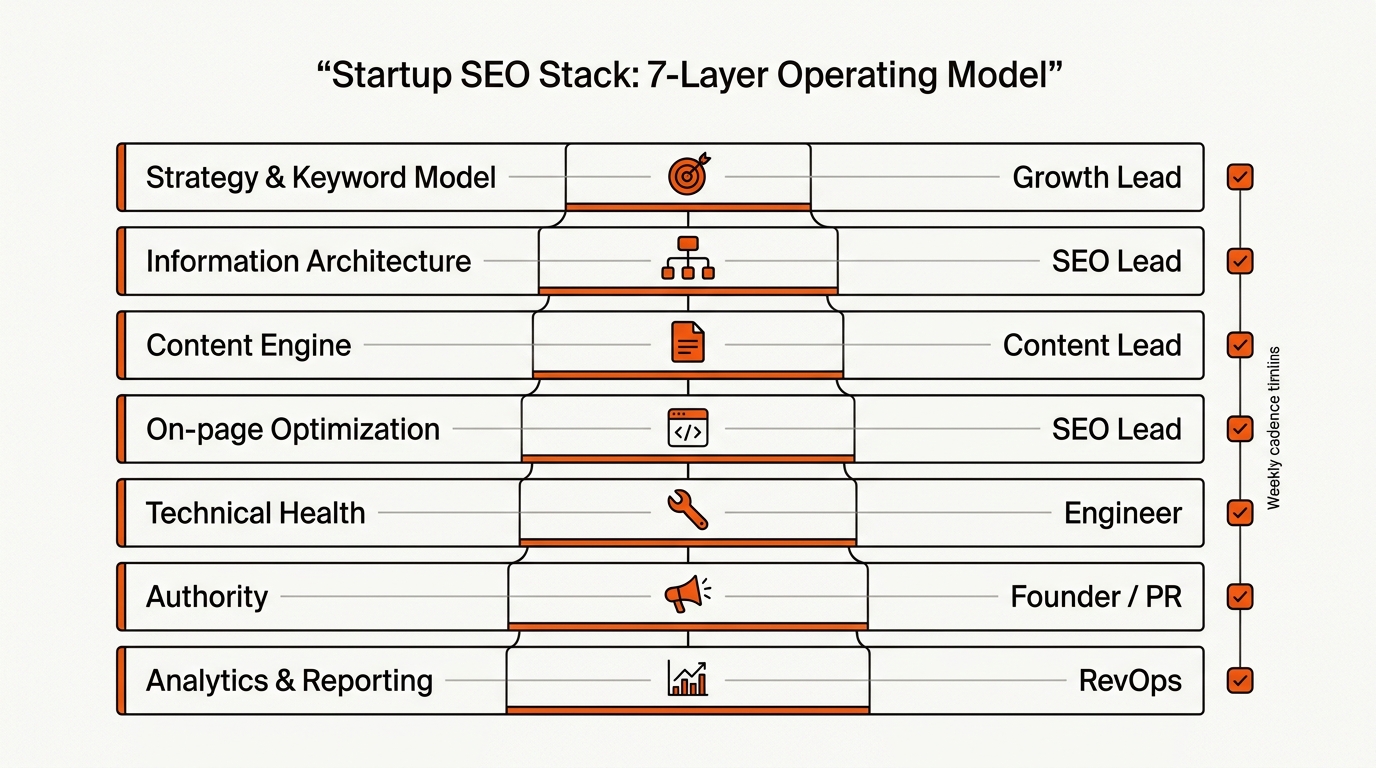
The startup SEO stack is a 7-layer operating model that assigns owners, tools, and page types so you can ship ranked value every week. Most teams stall because they mix tools without a workflow and no clear ownership. Define the stack by outcomes: pages that convert, scripts that publish, and checks that catch regressions.
If you want an AI SEO platform for startups that runs this model for you, map your goals to an AI SEO platform for startups and audit gaps against the owners below.
High intent lives in comparison and alternatives pages, integrations and use cases, plus pricing and documentation. Your model must make those pages inevitable.
Ahrefs catalogs features; your startup SEO stack must catalog owners and workflows that move keywords into pages and pages into sessions.
A clear 7-layer startup SEO stack, keyword source, briefs, drafts, schema, links, refresh, tracking, tells you what to own, what to outsource, and what to automate.
Tool listicles from G2, Capterra, and Search Engine Journal rank by paid placement, not by what actually ships content. They name Ahrefs + Surfer + WordPress + Frase in every list without explaining which layers Mergeflo replaces vs which still need a human or external tool. The gap is the operating stack, owners per layer, decisions per layer, not the tool inventory.
Run SEO like product: seven layers, one owner per layer, and a weekly shipping rhythm. This puts strategy, architecture, content velocity, optimization, technical checks, authority, and analytics on rails.
Link planning lives here too. Your broad model should align with your core guide on startup SEO and your execution blueprint in the startup SEO execution system. That keeps planning connected to publishing.
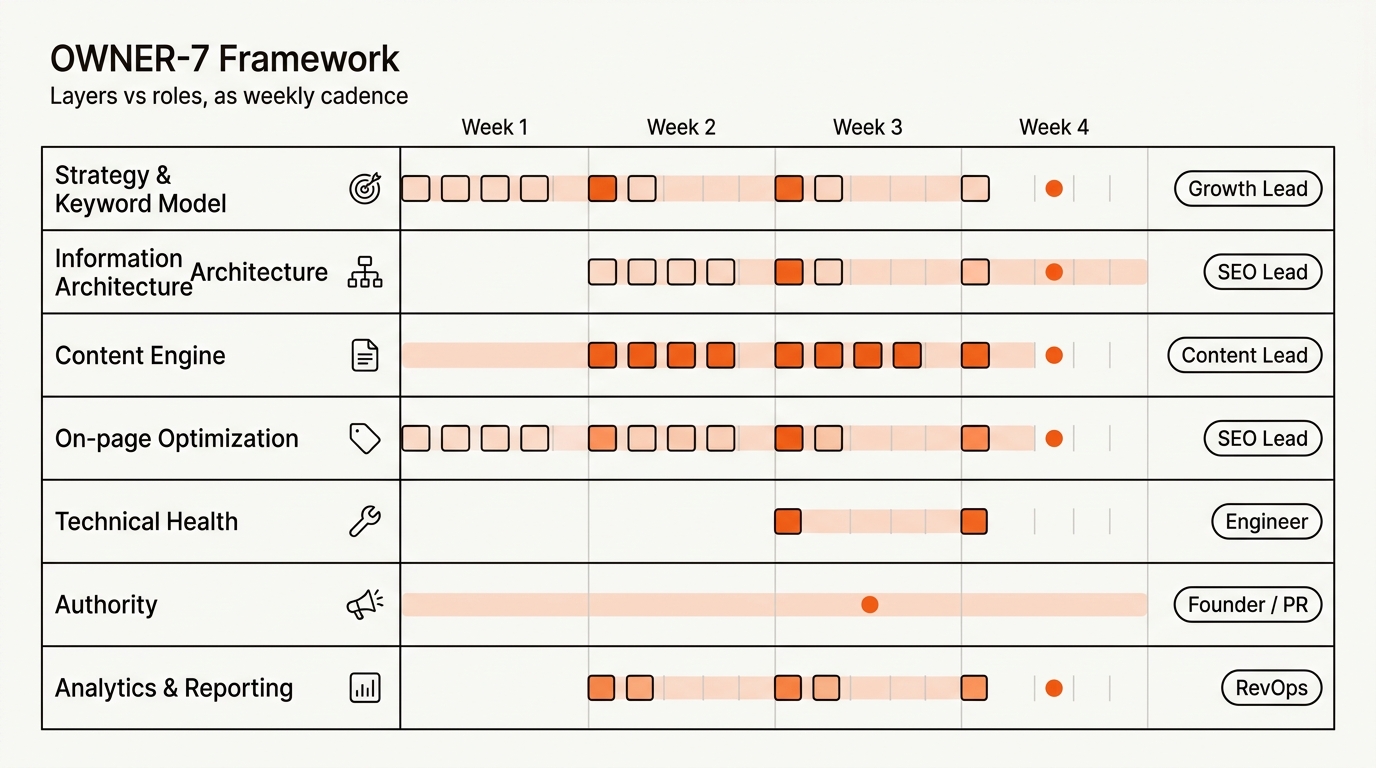
The OWNER-7 Framework maps seven stack layers to a single accountable owner and a minimal tool set. Start with page types that convert and backfill support pages only after you prove traction. Tradeoffs: tighter ownership speeds decisions but can expose skill gaps, so document handoffs and automate checks. Failure modes: content velocity without IA creates cannibalization; IA without shipping creates zero impact; outreach without assets creates vanity links. Apply OWNER-7 to every sprint so no layer blocks the others.
Layers and owners:
• Strategy and Keyword Model: Growth lead sets goals, targets, and cluster maps.
• Information Architecture: SEO lead designs clusters, URLs, and internal links.
• Content Engine: Content lead ships briefs, drafts, edits, and publishes.
• On-page Optimization: SEO lead enforces structure, schema, and internal links.
• Technical Health: Engineer fixes crawl, indexation, and performance.
• Authority: Founder/PR drives digital PR and partner links.
• Analytics and Reporting: RevOps measures ROI per page type and cluster.
Assume a 60-page cluster across 6 page types with average KD 28 and 350 volume per term ships in 6 weeks at 10 pages/week. If 45 pages index to positions 3-10 with an average CTR of 4.2% on a blended monthly volume of 21,000, that is 21,000 x 0.042 = 882 sessions/month. Assume 60% of sessions hit comparison/use-case pages at 2.4% signup, and 40% hit TOFU pages at 0.7%.
Signups/month = 882 x (0.60 x 0.024 + 0.40 x 0.007)
= 882 x (0.0144 + 0.0028)
= 882 x 0.0172
= ~15 signups/month.
If each signup is worth V to you, the monthly value of the cluster is ~15 x V. Compare that with tool costs under 300/month, and keep the weekly ship cadence and page ownership intact.
Select an execution model for throughput and tie it to the seven layers so nothing drops. The table combines approach tradeoffs and the 7-layer owner map so you can make one call and one plan.
If you cannot check these 12 boxes, fix them before adding tools. The goal is a startup SEO stack that ships every week and never loses state.
• One-page strategy that maps targets to page types and revenue.
• Keyword spreadsheet or database with clusters, KD, and intent.
• IA map with slugs, parent-child linking, and breadcrumb logic.
• Templated pages for comparison, alternatives, use cases, industries, integrations, features, pricing, docs, and case studies.
• Brief template with H tags, FAQs, internal links, and schema fields.
• Publishing pipeline with draft, review, QA, and go-live steps.
• Crawl budget check and XML sitemap policy; weekly Screaming Frog crawl.
• Title/meta and schema standards; automated checks before publish.
• Internal linking script or rules engine; 3+ links per page to siblings and parent.
• Authority plan with 5 partner domains and 2 PR hooks per quarter.
• Analytics: GSC connected; events for demo/signup; page-type dashboards.
• Reuse policy: refresh thresholds by rank delta; redirects for cannibal pages.
Tie these to a system that executes. Your plan should map to startup SEO, and your execution cadence should match an SEO for startups play you can sustain.
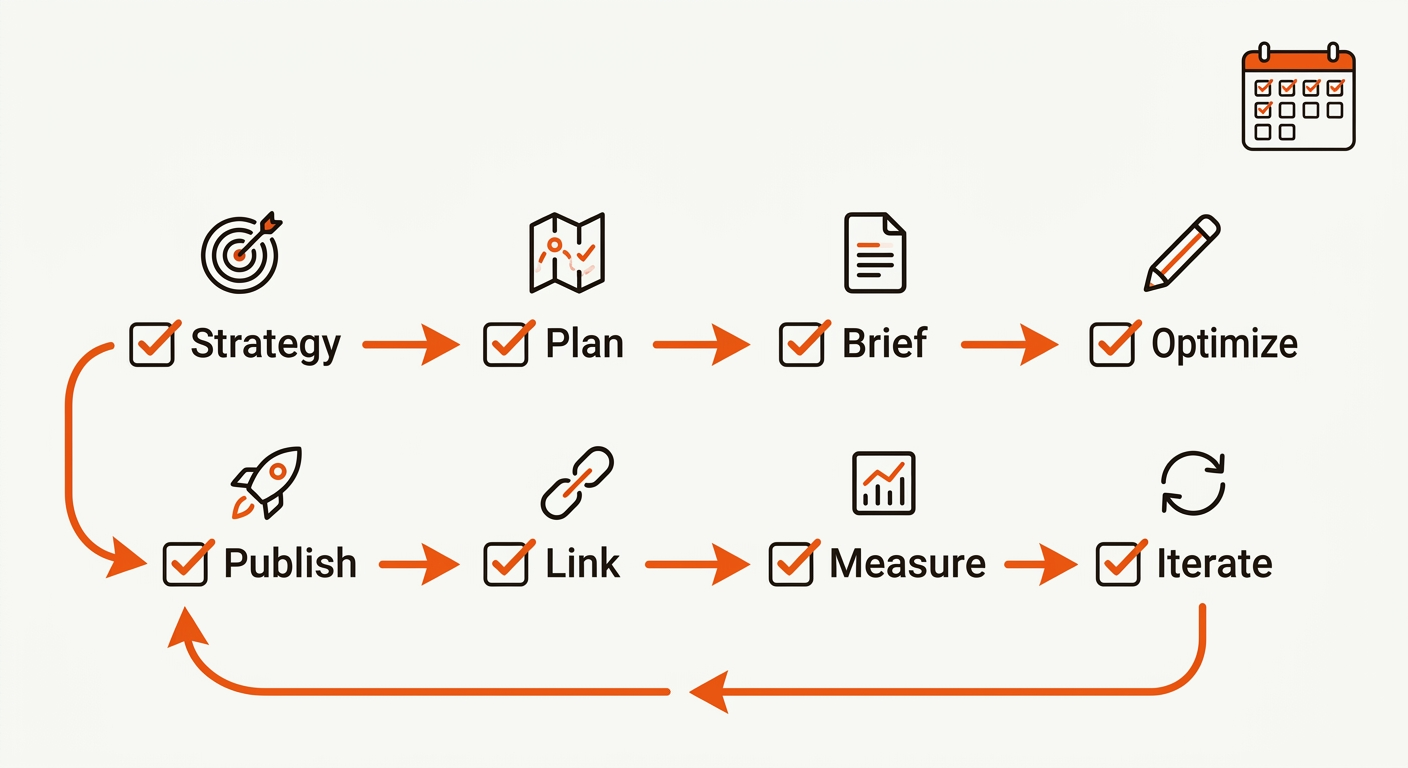
Tight systems beat tinkering; these answers focus on execution choices you can run next week.
Strategy doc, IA map, 3 high-intent templates, briefs, crawl/QA, and analytics. One person can run it with Ahrefs, GSC, and Screaming Frog. Add Mergeflo when you want gap finding and first drafts handled for your review. Keep it to GSC (free), one keyword research tool, and one workflow platform, three tools are enough to start.
PMM or growth lead owns comparison and alternatives; content lead owns blogs. This keeps product truth in high-intent pages and frees editorial to scale support content. Comparison and alternatives pages are PMM territory because they convert directly; blog posts can sit with content marketing or founder-led writing until headcount allows specialization.
Expect first impressions in 2-3 weeks, first rankings in 4-6 weeks for KD < 20, and early-signup pages landing page 1 in 8-12 weeks if internal links and schema are correct. Track positions and ROI by page type, not just overall traffic.
Use agencies for discrete work: a one-time technical audit, digital PR sprints, or specialized schema. Keep strategy, IA, and content velocity in-house or automated so you do not lose momentum. Agencies fit at Series A as expansion levers, they amplify a working engine but cannot replace the workflow ownership that the founder and PMM still need to drive internally.
AI tools draft; dashboards report. Mergeflo is an execution engine that plans clusters, drafts articles with suggested internal links, and publishes the ones you approve to Webflow. See how this contrasts with point solutions in AI SEO content. Mergeflo covers research, drafts and tracking while AI tools draft sections and dashboards report results; with Mergeflo, you still own the publish gate.
Indexing lag, cannibalization, and stale internal links. Prevent with a living IA, automated link updates, refresh rules tied to rank deltas, and weekly crawling. If throughput is already high, automate the checks and the linking. Internal links go orphan, schema drifts, and CMS field hygiene collapses past 200 pages, automation per layer plus a quarterly stack audit prevents most of the drift.
Yes. GSC is free; Screaming Frog 259/year; mix Ahrefs Webmaster Tools for free with trials. You can start lean, then layer automation when content velocity becomes the constraint. Yes if you accept manual GSC inspections and slower briefs; under $100 buys keyword research and a CMS, leaving you to handle research-to-publish manually until cadence justifies upgrading.
Build page-type dashboards in analytics. Group URLs by templates and track demo/signup conversion for each. Compare cohorts before and after launches to assign lift to comparison, use-case, and integrations pages. Tag every internal link with a UTM that encodes source page type, then segment downstream demo-request and signup events by source-type in your CRM to get clean attribution.
• Startup SEO Execution: the Weekly Workflow That Ships
• SEO for Startups Guide: Build the 20-Page Conversion Stack
