
Answer engines reward entities that ship consistent citations. If you need a shortlist of the top aeo tools 2026 can actually move for a lean team, start with coverage across ChatGPT, Perplexity, and Google AI Overviews, then filter by workflows your team can run weekly. Most misses come from poor orchestration and weak measurement.
You win AEO by closing the loop: track panels, route tasks, and ship fixes every week. Tool choice only matters if it increases multi-LLM visibility and reduces the ops time from signal to published artifact.
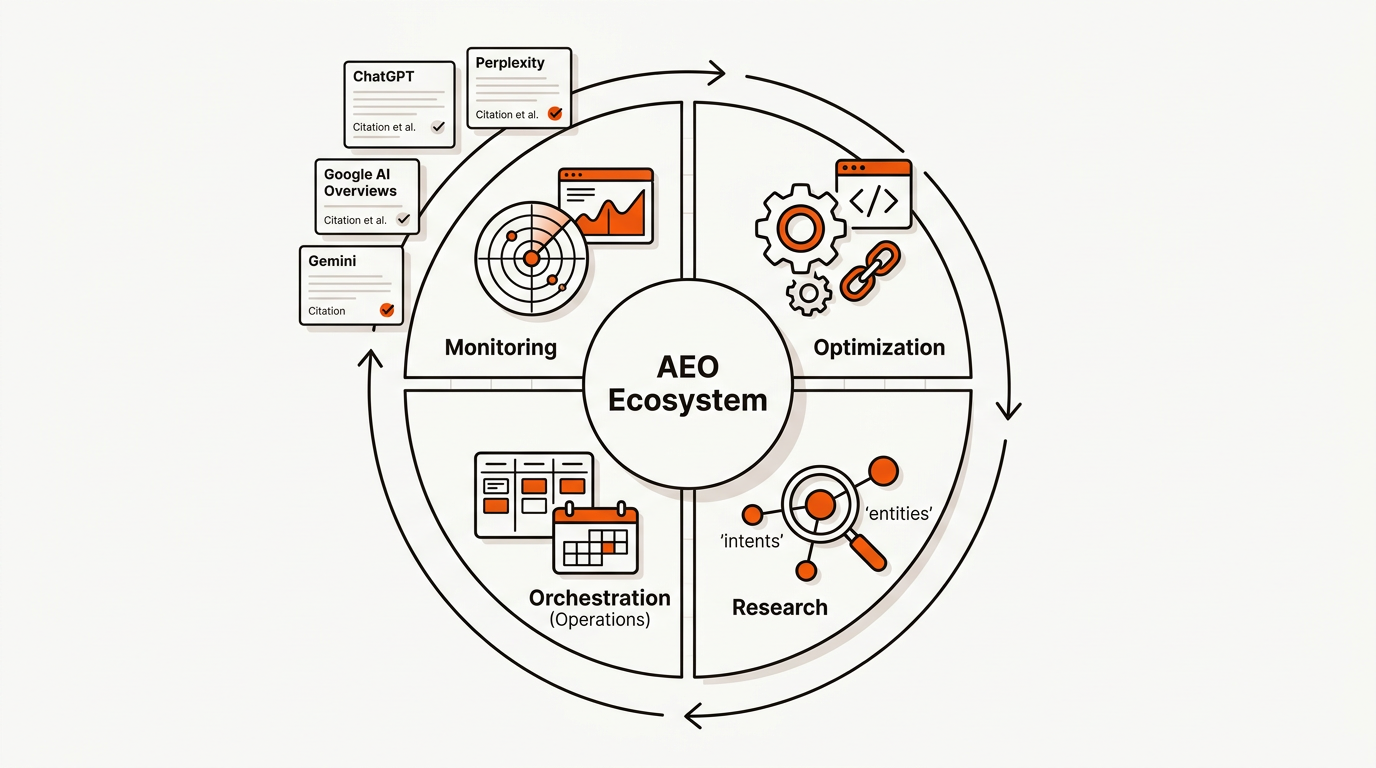
• External signal: TechnologyAdvice frames AEO as AI discovery plus answer visibility and flags HubSpot AEO for integrated reporting: https://technologyadvice.com/blog/sales/best-aeo-tools/
• Traditional suites are shipping AEO modules: Ahrefs on AI Overviews (https://ahrefs.com/blog/ai-overviews/) and Semrush on AI Overviews (https://www.semrush.com/blog/ai-overviews/) outline how content gets surfaced.
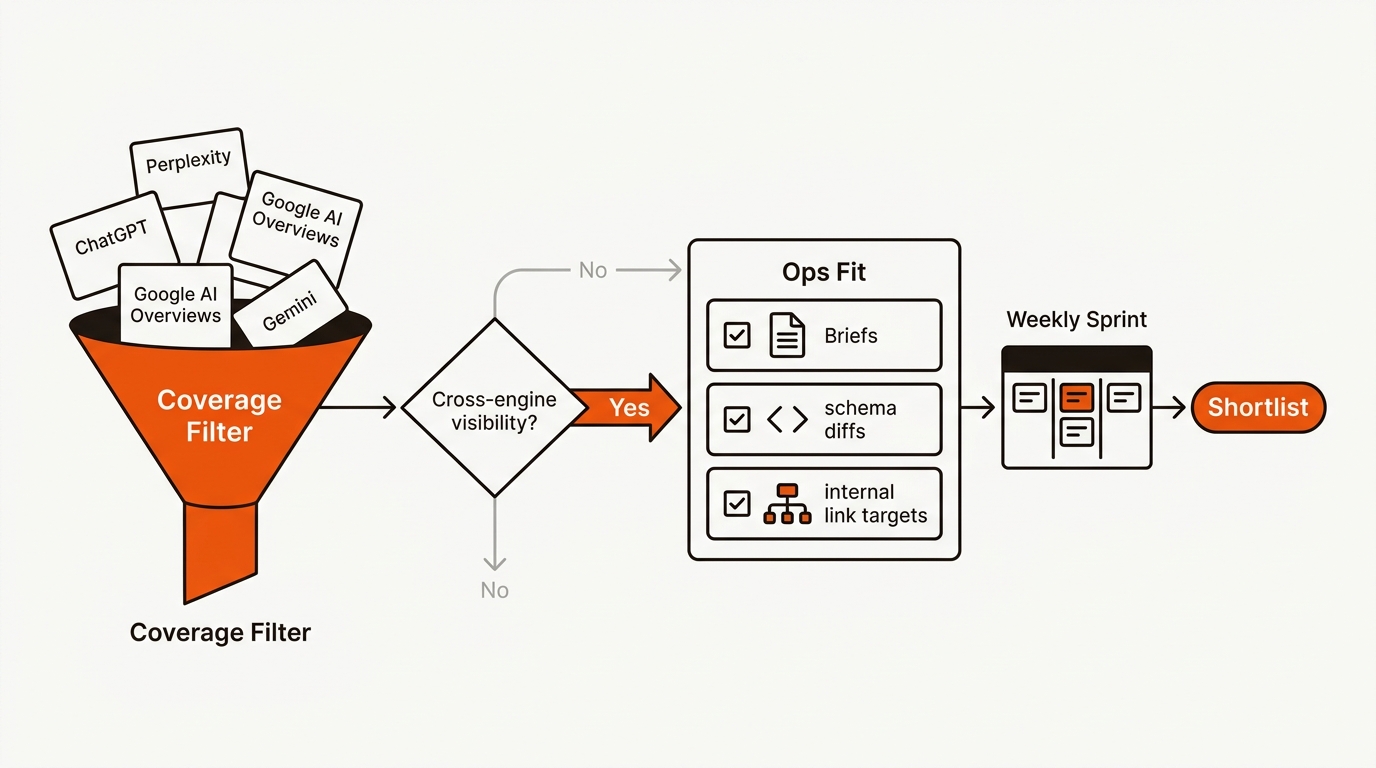
The operator filter is simple: confirm coverage first, then confirm ops fit. If a vendor cannot show your entity in panels across at least two engines within a trial, nothing else matters. If reporting cannot export into briefs and schema you can ship, you will not move visibility.
Tool/Platform
Primary Category
Multi-LLM Coverage
Ops Automation
Reporting Depth
Best For
Profound
AI visibility analytics
ChatGPT, Perplexity, Google
Low
High
Data-heavy teams, enterprises
Ahrefs Brand Radar
Monitoring + research
Google, Bing, AIO
Medium
Medium
SEO-led teams needing crossover
Semrush AI Visibility
Monitoring + optimization
Google AIO, Gemini
Medium
Medium
All-purpose marketing teams
MarketMuse
Content optimization
Indirect
Medium
Medium
Content quality and briefs
Surfer AI Tracker
Monitoring + on-page
Indirect
Medium
Low-Med
Fast-moving content ops
Yext Scout
Entity/knowledge graphs
Chat assistants
Medium
High
Local and entity-heavy catalogs
Scrunch/LLM trackers
Monitoring niche engines
Varies
Low
Low
Early signal hunting
Coverage is step one. Ops fit is step two. The tools that win let you send tasks straight into your publishing pipeline, produce schema patches, and surface internal link targets tied to intents.
Make selection decisions with DART: Discovery, Authority, Routing, Throughput. Discovery measures visibility across engines and your panel-share for tracked intents. Authority tracks entity consistency, citations, and source credibility uplift across your site and third-party mentions. Routing turns gaps into briefs, schema, and link tasks mapped to specific intents and owners. Throughput quantifies how many fixes you can ship weekly without adding headcount.
DART enforces balance. Over-invest in Discovery and you risk analysis without action. Over-index on Routing without Authority and you publish artifacts that do not earn citations. Failure modes show up as reporting without tasks, or tasks that never reach weekly velocity. Use DART to decide what to buy, how to pilot, and when to scale.
Track panels, ship fixes, recheck share, and quantify brand lift.
A sprint like this needs a source for query demand, a tool for panel capture, and a workflow that turns gaps into briefs. Keep the cadence fixed: ship briefs on a regular rhythm, batch schema patches, and update internal links in one pass.
If your stack cannot show weekly panel-share gains and route fixes automatically, you are paying for dashboards. Use a shortlist of the top aeo tools 2026 filtered by coverage and throughput, then operationalize DART to deliver evidence every week.
Tool roundups rarely pressure-test ops. TechnologyAdvice (https://technologyadvice.com/blog/sales/best-aeo-tools/), Ahrefs on AI Overviews (https://ahrefs.com/blog/ai-overviews/), and Semrush on AI Overviews (https://www.semrush.com/blog/ai-overviews/) explain mechanics but stop before weekly routing and throughput math. Our angle: evaluate tools on multi-LLM coverage and the ability to turn findings into shipped fixes every week so your entity gains citations.
Two checks beat hour-long demos: coverage delta and ops velocity. First, run a 7-day trial and measure current versus week-1 citation count across your 25 highest-revenue intents. Second, confirm the tool exports task-ready briefs, schema diffs, and internal link targets your team can ship in under 5 hours per week. If either check fails, visibility will not move.
A practical pilot: pick 25 intents touching high-intent pages. Track panels daily in ChatGPT and Perplexity, then tag changes in Google AIO or Gemini weekly. Require exports that slot into your CMS or Git workflow. If you cannot publish at least 10 content or schema artifacts in the first two weeks, the pipeline will stall.
The main tradeoff is speed versus depth. Publishing 20 thin artifacts loses to 8 thorough ones that close entity gaps, add FAQs, and fix internal links to canonical pages. Above 200 pages, manual workflows break because indexing lag and coordination overhead compound. Solve that early with automation or you will cap out on throughput.
• External check: Multi-LLM tracking must include ChatGPT and Perplexity at minimum; Google AIO coverage is variable but directionally required next.
Stay focused on execution workflows and measurement. If a guide does not show weekly panel deltas and shipped artifacts, archive it. Keep your attention on tools and workflows that convert visibility gaps into published output you can verify in panels and GSC.
We will add deeper dives on entity-first briefing, schema patching, and internal link systems at publish. The throughline will stay the same: coverage, routing, throughput, proof.
Mergeflo can help you run this loop: it checks whether ChatGPT, Gemini and Claude mention your brand for your buyer questions (weekly on paid plans, one check on the free plan), and tracks your Google positions.
Choose for coverage and throughput, then ship weekly fixes. The top aeo tools 2026 only matter if they increase panel share and help your team ship more entity-consistent content every week. Start with a 30-intent pilot, measure citation deltas, and standardize your Routing and Throughput with DART.
Treat AEO as a production system. Maintain panels like you maintain conversions: track, diagnose, fix, and recheck. Operators who do this build defensible visibility across answer engines and convert that attention into pipeline.
Keep reading: answer engine optimization platform and AEO for startups.
Top AEO tools 2026 covers the structural work of the article above: the page inventory, the workflow that keeps it shipping, and the measurement loop that confirms it's working. The sections preceding this FAQ describe each part in detail.
There is no fixed timeline. Google does not promise when, or whether, a page will rank. Watch Search Console impressions for the questions the page targets each week, because impressions move before clicks. A page with no impressions after a few months usually needs a sharper angle or more internal links.
Cost depends on who does the work: your own team's time, a freelancer, an agency or a software tool. Mergeflo has a free plan, and paid plans are listed on the pricing page.
Mergeflo researches topics, writes briefs and drafts in your brand voice, adds FAQ schema and suggests internal links. You choose the topics and approve each article, and it publishes to Webflow only when you press Publish. For pages losing reach, Mergeflo flags them, and when you press Refresh it writes a refresh brief for you to review.
