
Short answer: Examples of bottom of the funnel content include customer case studies with quantified results, product demos (live or recorded), pricing and plans, ROI/TCO calculators, vendor comparison pages, independent reviews (G2/Capterra), security/compliance pages, and implementation guides. These assets remove final objections and drive trial, demo, or buy-now actions.
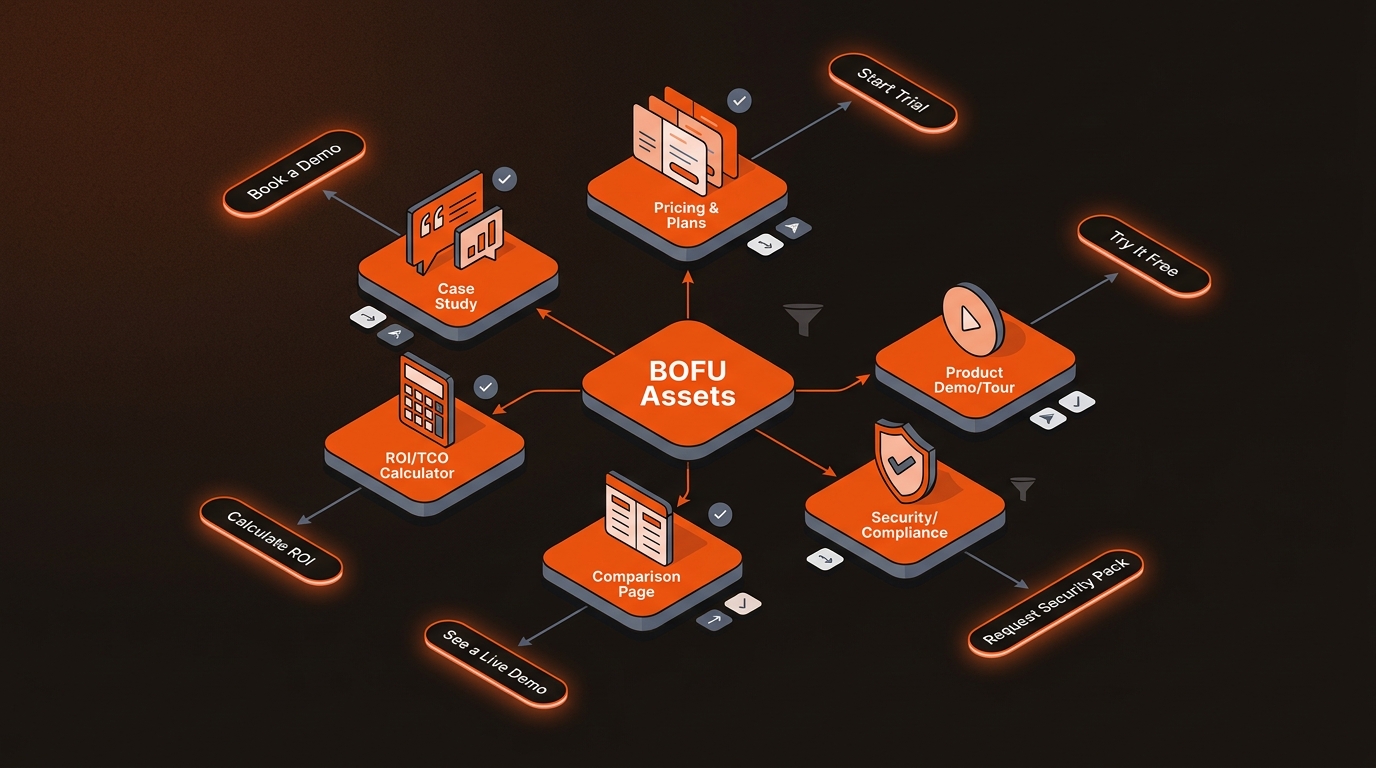
Buyers read 5+ assets before talking to sales, and 84% want pricing and proof upfront. Starve them and they churn to a competitor.
Align assets to roles. Economic buyers want ROI and TCO. Procurement wants terms and SLAs. Technical buyers want architecture, data flow, and security docs. Users want workflow fit via a demo. Put these one click from the primary CTA. Avoid burying them three clicks deep.
Scenario: a 3-person growth team with a $2k/month content budget replaced generic MOFU posts with six BOFU assets mapped to objections. Within two sprints, sales stopped sending ad hoc PDFs. Pricing and comparison pages became the top demo sources in GA4. That shift came from access and clarity.
TrustRadius B2B Buying Disconnect and G2 Software Buyer Behavior show late-stage buyers self-educate on pricing, comparisons, and proof before contacting sales.
Choose BOFU assets by the objection they must clear; then test placement for demo/trial lift.
Use this table to match objections, proof, and measurement. Publish, route, and instrument with GA4 events, HubSpot/Salesforce campaign touches, and scroll/click maps (Clarity, Hotjar). If an asset does not move demo/trial rate or win rate in 30 days, rewrite or reposition it. Bottom of the funnel content must earn its slot.
BOFU Asset Selection By Objection
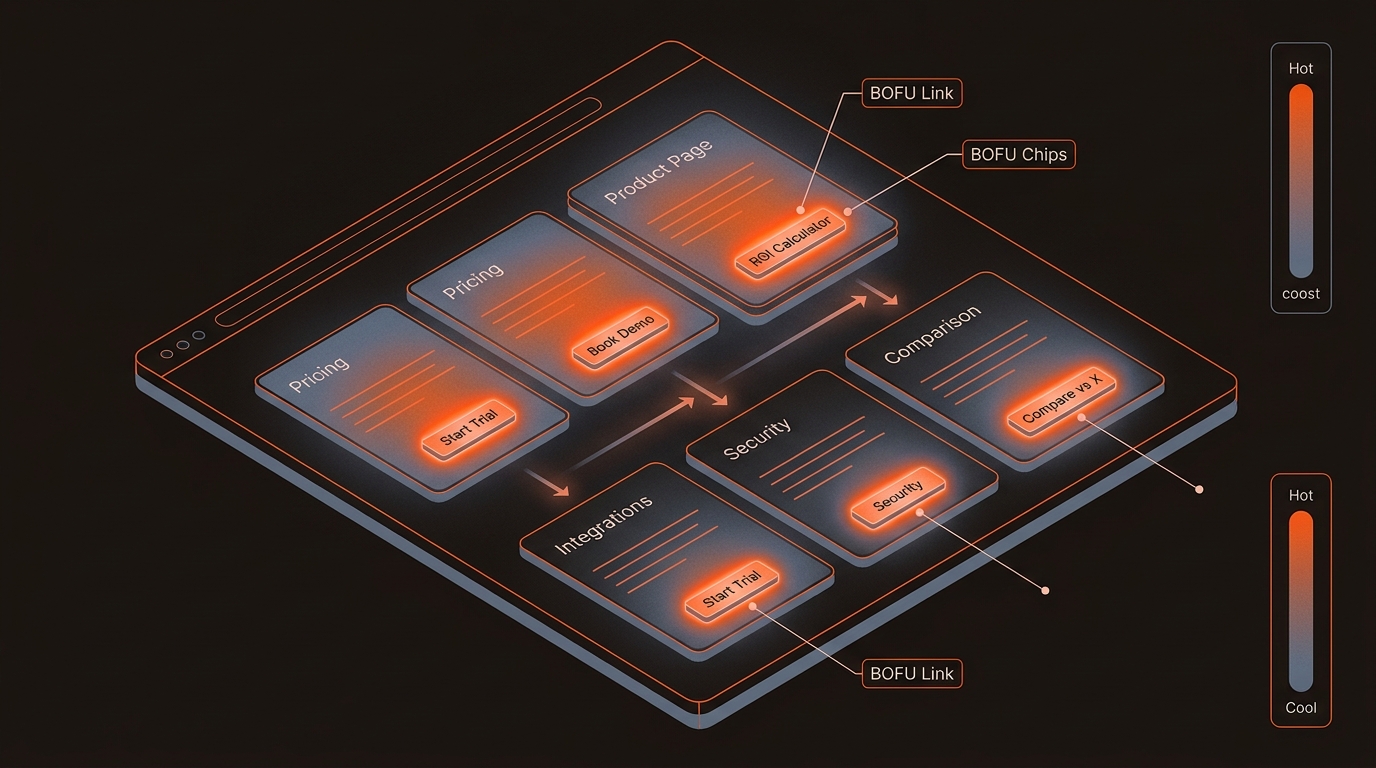
Place BOFU assets on product pages, pricing, and nav. Add footer links for Pricing, Security, and Comparisons. For high-intent blog posts, insert in-line modules: 30-second demo clip, ROI teaser, and a case study from the same ICP. Use GA4 path exploration to confirm these modules shorten the path to conversion.
For deeper context, see What Are The Best SEO Strategies For SAAS Companies.
BOFU must be discoverable in Google and citable in AI to matter at decision time.
Mergeflo is an AI search visibility platform for startups. Our autonomous SEO + AEO content engine takes you from research to published, AI-citable pages in your CMS, with schema, internal links, and ongoing refresh. We prioritize bottom of the funnel content for high-intent queries and on-site routing to demo/trial. We also maintain comparison pages and ROI calculators alongside your broader strategy. If you are planning SAAS growth content, align this with proven SEO strategies for SAAS companies so BOFU ranks for bottom-intent keywords and supports sales.
Build order, gating, placement, and measurement decide whether BOFU converts or sits idle.
Pull 10 recent lost opportunities and tag the blocking reason (price, integration, security, ROI). Build one asset per tag and route it to product pages and sales sequences. For a lean team, start with Pricing, a competitor comparison, and one ICP-matched case study; these usually impact demo/trial rate fastest.
Gate only when there is a clear value exchange that advances the deal, like exporting an ROI model or requesting a security pack. Do not gate pricing, comparison pages, or basic implementation guides. The tradeoff: gating can capture emails, but it often reduces discovery and citation in AI systems and Google.
One click from the primary CTA. Keep persistent header links for Demo and Pricing, and footer links for Pricing, Security, and Comparisons. On product pages, add in-line modules for a 3-5 minute demo, an ROI teaser with calculator entry, and a case study tile. Confirm navigability with GA4 pathing and Clarity click maps.
Track demo/trial request rate from each asset, opportunity creation with asset touch, win rate uplift when consumed, and sales cycle reduction. In GA4 and your CRM, use UTMs and content touchpoints; in GSC, monitor query coverage for comparison/pricing terms that map to purchase intent. Set 30-day baselines and review weekly.
