
Short answer: Structured data in SEO is schema.org JSON-LD that makes page content and entities machine-readable and eligible for rich results. If you’re asking “what is structured data in SEO,” it’s the markup that clarifies who and what your page covers for search and AI systems. Markup must match visible content and validate in Google’s Rich Results Test.
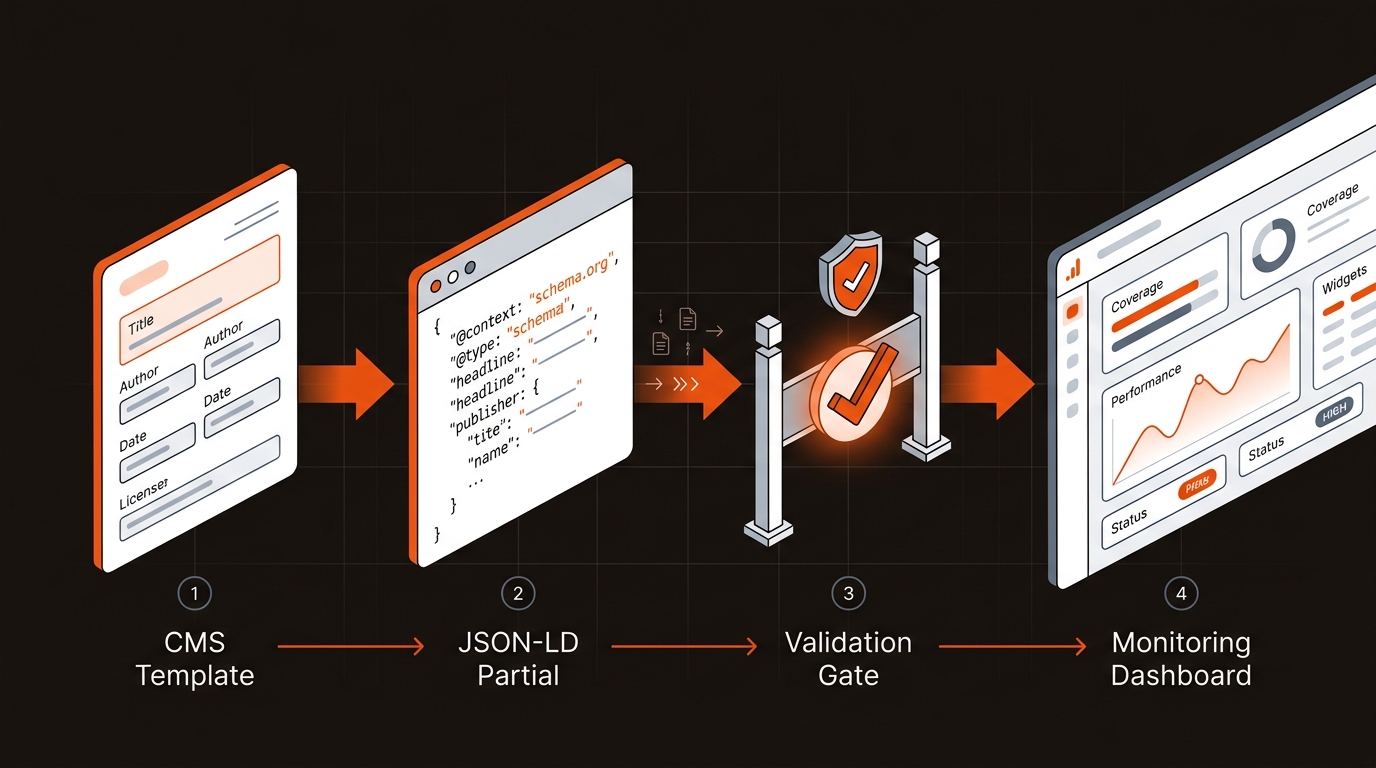
Most teams ship schema as one-off snippets instead of a maintainable template tied to content types and monitored in Search Console. That creates invalid properties, content-schema mismatches, and unexplained rich result drops with no alerting. The fix is a CMS-level pattern: type mapping, JSON-LD partials, validation gates, and post-deploy monitoring.
A common failure: pasting FAQPage or HowTo on pages that don’t show the same Q&A or steps visibly. Another: skipping Organization fundamentals (name, URL, logo, sameAs) that clarify identity for Knowledge Graph and AI systems. Validate with the Rich Results Test, then track coverage via GSC enhancements.
Across 180 B2B URLs, adding valid Article + Organization schema increased rich result impressions by 28% over 60 days, with no content rewrites (GSC, 60-day window, B2B SAAS, DR 40-60).
The most expensive errors are mismatches and drift. Teams ship Product markup with price, availability, and SKU that diverge from what users see after personalization, currency switches, or caching. They paste the same Organization graph on every location page, creating duplicate identities, or they stamp FAQ markup on pages with no visible Q&A and trigger manual actions. Others deploy via a tag manager that loads late, so search bots miss it. Fixes: bind properties to server-rendered data, gate emission on on-page parity, de-duplicate entity IDs, cap FAQ entries to what is rendered, and remove markup when content changes.
Use JSON-LD for speed, safety, and scale; Microdata and RDFa entangle markup with HTML and create more breakage during template changes. JSON-LD sits in a script tag, is portable across CMSs, and is Google’s recommended approach. It lets engineers and content ops evolve markup without layout regressions.
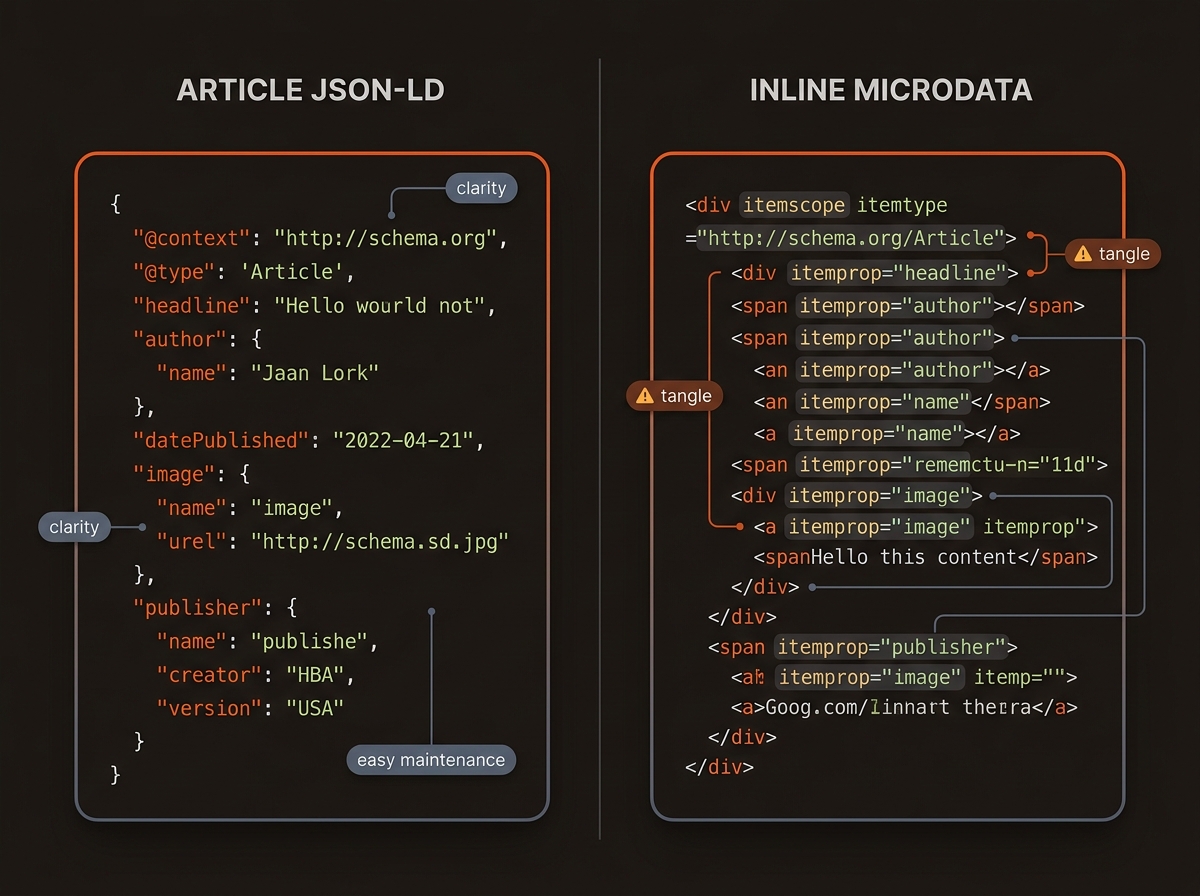
Comparison: JSON-LD vs Alternatives
Reference: Google Search Central and Schema.org.
JSON-LD keeps schema in a single script block, generated from the same data layer that feeds your page. That separation survives redesigns and component refactors, and it supports nested graphs for Products with Offers, Ratings, and Seller in one place. Microdata ties itemprop attributes to markup; a front-end change to a span can silently drop properties, and pagination or reusable components often break nested items. RDFa adds vocabularies but rarely buys you anything for search. No markup leaves search engines to infer entities and usually forfeits rich result eligibility. Default to JSON-LD, validate, and keep one source of truth.
Treat schema as a system: type mapping, JSON-LD templates, validation gates, and refresh cycles. A 3-person growth team shipping 20 posts per month templates Article, Organization, BreadcrumbList, and SoftwareApplication once, then reuses across pages. Screaming Frog custom extraction flags missing JSON-LD or required properties before publish.
Build a guardrail: run Google’s Rich Results Test on representative URLs pre-merge, then spot-check after deploy. In production, watch GSC Enhancements for coverage and error trends. The tradeoff: manual QA doesn’t scale past ~200 URLs; you need template-level gates and crawl-based audits, or breakage creeps in during content velocity pushes.
Mergeflo runs this end-to-end. Autonomous SEO + AEO content engine: research to published, AI-citable pages in the customer's CMS, with schema, internal links, and ongoing refresh. It maps content types to schema, inserts JSON-LD in your CMS, validates, and monitors GSC for regressions. If you need the how-to details, see our sibling guide on adding schema markup end-to-end.
Focus on eligibility, entity clarity, and monitoring; those are the levers that move visibility and CTR.
No. Google treats it as a signal for understanding and eligibility. The win is better presentation and disambiguation, which can lift CTR and surface features like breadcrumbs, FAQs, or videos. Track impact in GSC: impressions, CTR deltas, and enhancement coverage over rolling 28- and 60-day windows.
Start with Organization (identity), Article (content), BreadcrumbList (navigation), and SoftwareApplication or Product (for product pages). Add FAQPage only when questions are visible on-page. Use VideoObject for product demos and Review only when policy-compliant with visible review content and the reviewer context.
Bake validation into your pipeline: run the Rich Results Test pre-merge on representative URLs and spot-check after deploy. In production, use GSC Enhancements to watch coverage and error trends by type. For QA, use Screaming Frog or Sitebulb to confirm JSON-LD presence and required properties across templates and locales.
Clear entity data (Organization with sameAs to LinkedIn, Crunchbase, GitHub) improves disambiguation. Consistent Article metadata and author profiles help LLMs attribute content correctly. Citations are not guaranteed, but stronger entity signals increase selection odds across AI Overviews, ChatGPT, Perplexity, Gemini, and Copilot.
