
Short answer: There is no single lowest-competition niche. The lowest-competition angle is a micro-niche inside a broader market where page-one results show weak domains, fragmented intent, and stale content. Find geographic, intent, and format gaps with data, then ship a compact cluster aligned to how users search and how engines rank.
For the keyword-level version of this method, see our main guide on how to find profitable keywords with low competition.
There is no absolute lowest-competition niche. You pick a pocket where defensive moats are weak and buyer intent still exists. Compare a niche product query with a crowded software query: the first usually shows weaker domains, fewer referring domains behind rank 3, and lower CPC, while the second shows strong domains, many referring domains, high CPC, and aggregators.
Stop hunting universal low-competition niches and start measuring low-competition signals. Lists age fast; SERP weakness signals repeat across markets. You need a measurement stack.
Most teams ignore supply-side tells. Scan for low-authority winners, thin or outdated pages, scattered intents, and missing formats. If DR 20-40 pages rank among DR 70+, and no fresh content landed in 12-18 months, a focused cluster can break in. Mergeflo can take on part of this audit: it finds search gaps and buyer questions, and drafts briefs and articles in your brand voice for review.
Ahrefs found that 96.55% of the pages in its index get zero traffic from Google. The gap is rarely demand; it is misaligned content and weak cluster coverage. Ahrefs
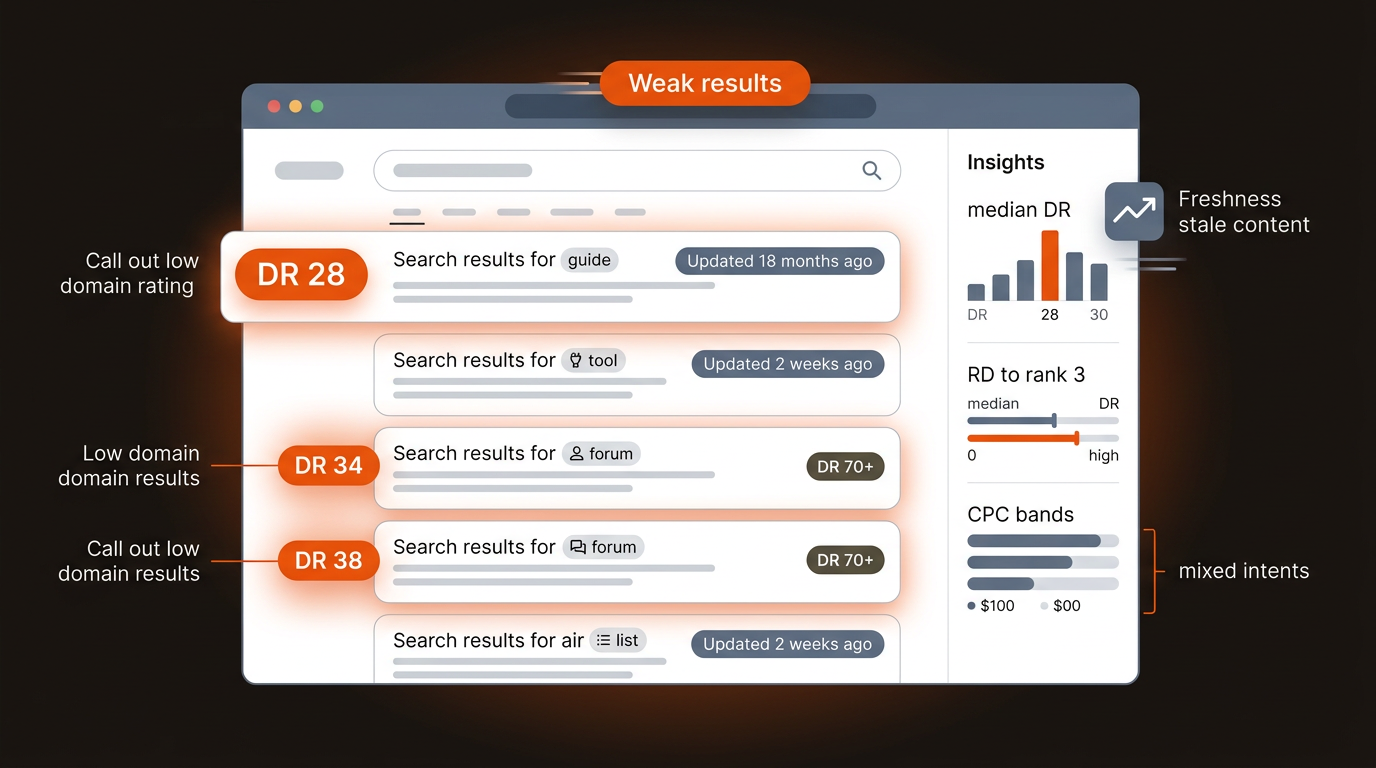
Copying low-competition lists burns cycles. A list can look easy because volume is low and keyword difficulty scores are thin, even when page one is stacked with big retailers, shopping blocks, and heavy ads. The fix is a 60-minute scan per idea: pull top 20 results, log unique hosts, count ads and shopping units, check rank 3 referring domains, and read two buyer threads in forums before you commit.
Low competition is a set of measurable thresholds. Use these operator signals to decide if a micro-niche is winnable this quarter.
Signals That Indicate a Low-Competition Micro-Niche
How to operationalize this today. Use Ahrefs or SEMrush for DR/KD and link velocity, and read the SERP manually for freshness and intent classes. Then validate with Google Search Console after shipping 5-8 pages to confirm impressions and exact-match queries. References: Ahrefs KD, Google helpful content.
Operational tradeoff. Manual auditing breaks as the list grows. At that scale, indexing lag and human variance create noisy reads of freshness and authority. Either narrow scope (6-12 pages per sprint) or use automation to keep thresholds consistent.
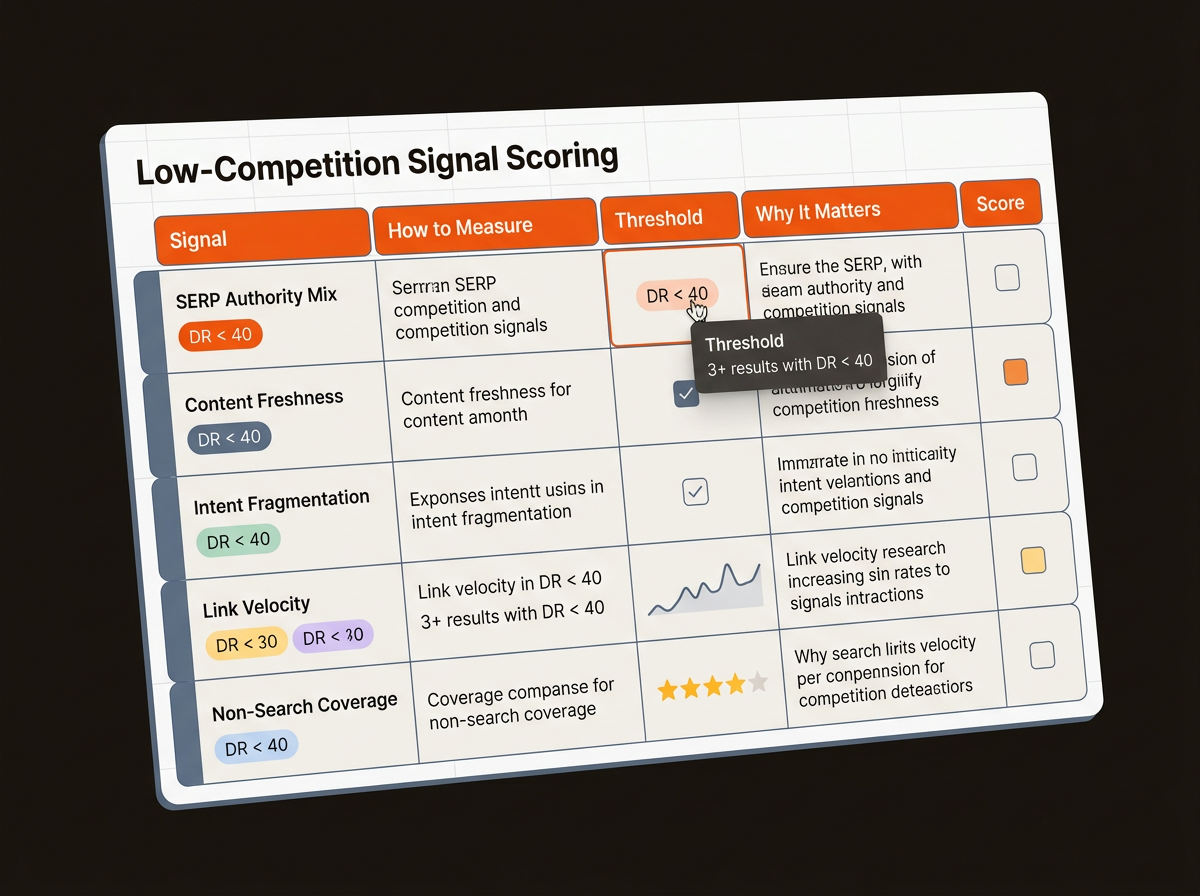
Use a fast checklist. These cutoffs are our starting points, not industry standards. Host diversity: 7 or more unique domains in the top 10 is promising. Freshness gap: if top 5 winners are older than 12 months and still ranking, content velocity is low. Referring domain threshold: if rank 3 holds with under 30 referring domains, you can breach. Ad and shopping load: two or fewer ad units or no shopping pack reduces paid pressure. Long-tail slope: if 60 percent of volume sits in 4 to 6 word variants, you can angle multiple entries. Question density: three or more Q&A results or forum threads signals informational wins. Align intent with your model and confirm a monetization path.
Fixed niche lists go stale, so use patterns to generate candidates and run the SERP checks above on each one. These task-level intents tend to have weak incumbents because vendor documentation stays generic.
Spread the first batch across a few of these patterns, give each page a primary query plus a short FAQ, and compare which pattern earns impressions first. Going too broad underpowers every page, and going too deep in one micro-vertical can stall discovery.
The forum threads you read during the audit double as a language source. Mirror their phrasing in headings and FAQ questions so each page matches how buyers describe the problem. Decide the stop rules before you ship: write down which Search Console result after indexing means the cluster is parked, so a weak test ends on schedule and does not drag on for quarters.
You need a system that finds these gaps and turns them into drafts you approve. Manual checks do not scale beyond a few niches; shipping speed wins.
Mergeflo is an AI search visibility platform for startups. It tracks Google positions and, on paid plans, checks whether ChatGPT, Gemini and Claude mention you.
Here is how the workflow above runs inside Mergeflo:
• Gap discovery runs on your seed terms and intent-based variants, surfacing search gaps and buyer questions.
• Mergeflo drafts briefs and articles in your brand voice for the micro-cluster you choose, and you review each draft.
• Approved articles publish to Webflow, and Mergeflo flags pages losing impressions and writes a refresh brief when you press Refresh.
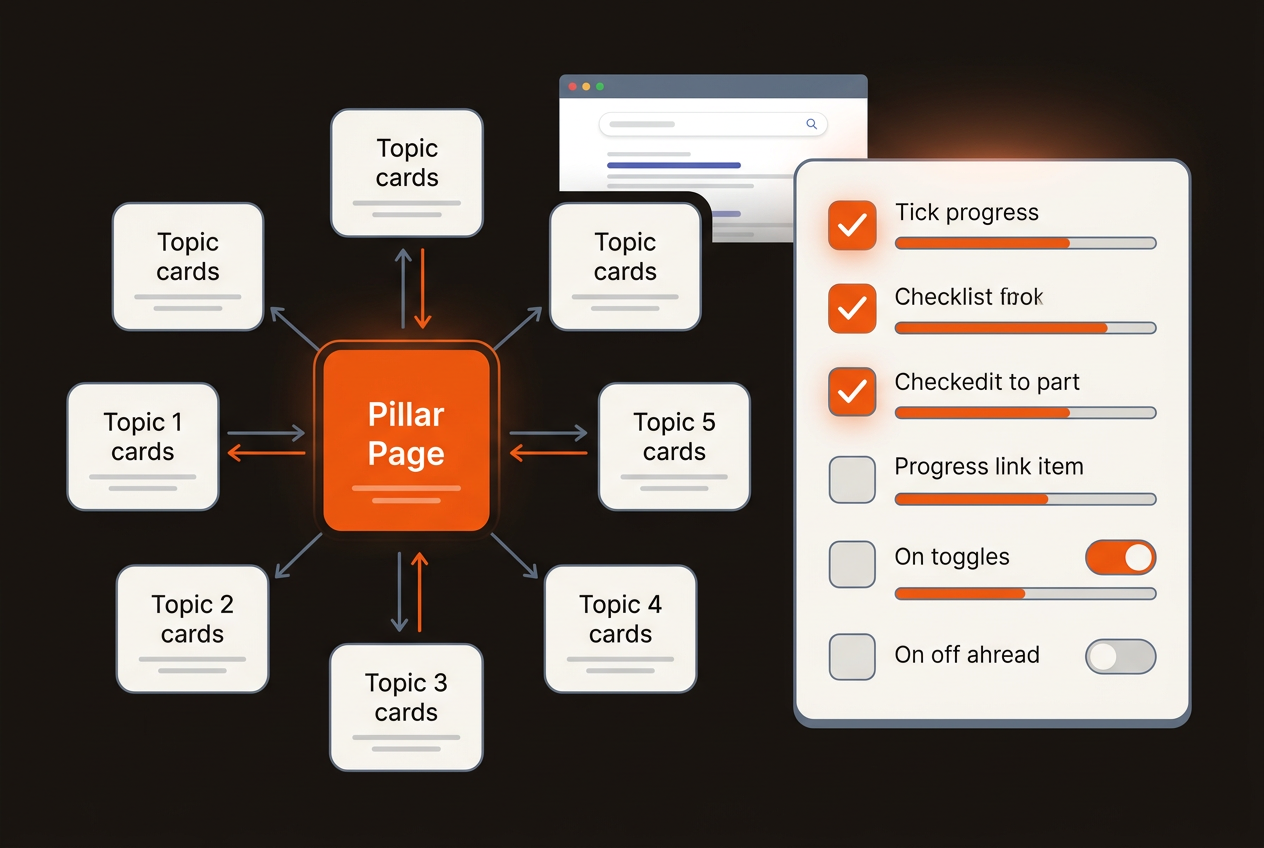
Turn signals into a repeatable pipeline. Seed 100 keywords and three competitors. Harvest the top 20 SERPs, host counts, ad load, and referring domains for every variant, then assign a score with weights you choose, for example 40 percent on RD threshold, 20 percent on host diversity, 15 percent on freshness, 15 percent on long-tail slope, 10 percent on ad pressure. Cluster by parent topic, pick 30 with score above your cut, and schedule two posts per day for three weeks. Ship, then measure time to first impression and p50 clicks by topic. If RD threshold rises above 50 or host diversity collapses, pivot clusters immediately.
Aim for a cluster of 6-12 pages covering a tightly scoped job-to-be-done, with roughly 2,000-8,000 combined monthly searches as a starting point and clear SERP weakness signals. If you cannot outline 6 pages without overlap, it is too narrow. If you need 20+, the niche is likely too broad to win fast.
Trust the SERP. If DR 80+ dominates with fresh, complete guides, treat it as high competition. You need either sub-intents they ignored, format gaps (calculator, checklist), or a GEO/vertical slice to create a separate ranking lane.
There is no fixed timeline. Shipping the full cluster with internal links gives it the best chance, and Search Console impressions will show movement before clicks do. Single-page tests drag timelines. Publish the set in one sprint to help discovery and topical authority consolidate.
Check if AI Overviews show for your terms and which sources they cite. If AI cites forums or outdated posts, that is a signal you can earn citations with updated, structured content. Plan People Also Ask coverage and add schema to increase inclusion odds in AI answers.
Ship it when community demand is active and the intent is clear. Reported volume is often low for fragmented or emerging queries. If Search Console shows early impressions and long-tail variants after launch, expand sideways into adjacent modifiers while your authority builds.
Warning signs include tiny volume across most target queries, AI Overviews that never trigger, and page one dominated by high-authority vendor documentation. Slow indexing across several pages points to a crawl or site quality problem to fix before scaling. In health, finance, and legal topics, established authorities dominate, so plan for more depth, such as first-party data and expert quotes, and a longer validation window.
