AI chat answers now decide which pages to cite, so your content must be built to be quoted and clearly attributed. If chatgpt SEO ranking is the goal, publish pages that state verifiable facts, map entities cleanly, and sit inside focused clusters. Chat answers reward tight claims, topical depth, and page signals that make attribution obvious.
AI traffic already sits well above 6 percent of Google traffic and is growing (ChatBeat).

This guide is for builders running lean growth. Startup founders, growth marketers, and technical co-founders who want AI-citable content without agency overhead or complex handoffs. If you own the CMS, brief, and publish cycle, you can run this weekly routine and measure where answers cite you.
Ship only AI-citable content; no manual code or CMS integration Templates needed. Keep the system light: briefs that lock scope, pages that open with direct answers, and schema that binds claims to entities. Your stack can be simple: Webflow or WordPress, a schema helper, Google Search Console, and a crawl checker.
AI chat can introduce your brand before a click. When answers cite your page, you earn visibility and trust even if users never search again. Founders care because runway depends on compounding awareness, and shipping citable pages scales faster than PR or outbound. The next section names the gap most guides leave open.
Most guides stop at on-page tweaks and skip how answers decide what to cite. Agency blogs list checklists and overlook the artifacts models scan: fact blocks with sources, schema that ties people, products, and organizations, and a cadence that builds cluster depth. This article gives you a repeatable workflow to ship citation-ready pages each week.
Models quote pages that resolve a question with verifiable facts and clear attribution anchors. That favors claim-first structures, cited evidence, and entity-rich markup. It also favors sites with depth: interlinked pages that cover the same theme from adjacent angles.
You can scan practical notes from a B2B perspective in this short tactics overview. Link your internal process to brief quality too: a focused AI SEO brief for brand voice and ranking cuts rewrites and keeps claims crisp and citable.
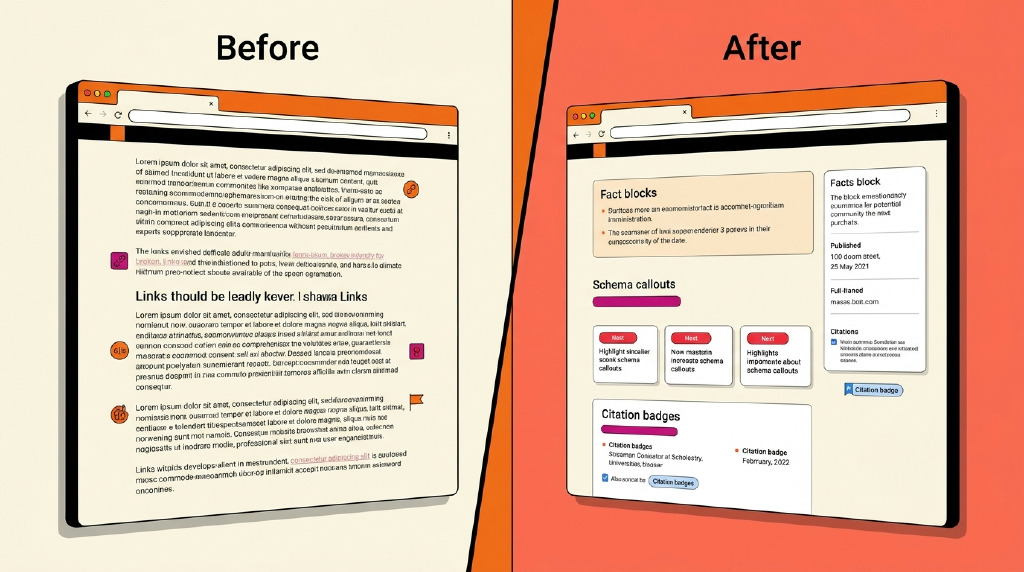
You still need crawlable, indexable pages, and AI answers add citation readiness on top. Treat chat surfaces as an extra distribution layer that rewards clarity, compact answers, and structured evidence.
| Dimension | Traditional SEO Focus | AI Answer Optimization Focus | What To Change |
|---|---|---|---|
| Query Match | Exact-match intent coverage | Conversational question resolution | Add Q&A subheads mirroring user phrasing |
| Evidence | External links optional | Verifiable, attributed claims | Cite nearby authoritative sources for key statements |
| Structure | Long-form sections | Short fact blocks and summaries | Open with a tight summary and a few bullets |
| Markup | Basic on-page tags | Entity-rich schema | Add Article, FAQ, and Organization schema |
| Topical Depth | Category breadth | Cluster depth and interlinking | Build a focused cluster per theme |
| Audit Loop | Traffic-first | Citation-first, then traffic | Track where answers cite you |
For another angle on practical steps, scan this compact implementation guide.
This guide's framework, the Citation Chain Framework, turns each topic into linked, citable artifacts. It maps one user question to a brief, a page that opens with a fact block, schema that binds entities, and a few supporting subpages that expand depth. Apply it by shipping one chain per week until a cluster holds. The tradeoff: narrower page scopes and more editorial discipline. Failure modes include fuzzy claims, missing schema, weak interlinking, and pages that try to do too much.
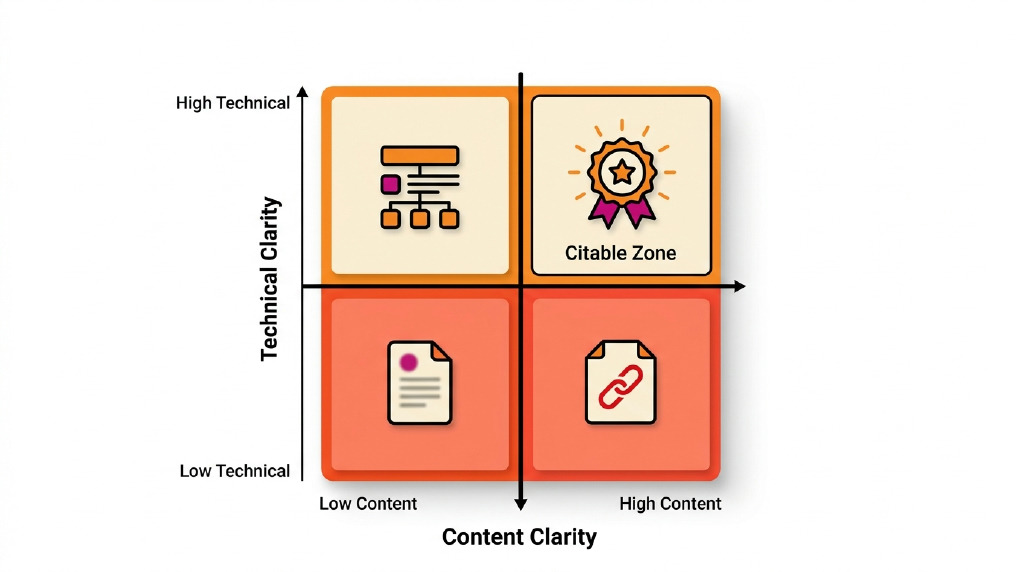
Citations follow clarity in both content and code. Make claims easy to extract, verify, and attribute back to you.
Open with the answer, then build out sections that match sub-questions a buyer actually asks in chat, using plain phrasing over jargon. Place brief fact blocks near key claims and anchor them to reputable sources right where the statement appears; this helps models bind text spans to citations, as seen in this guide to ranking inside chat answers.
Schema tells models who and what your page is about. Use Article, FAQ, and Organization schema to connect your brand, product, and claims. When your content teaches a process, add HowTo; when it mirrors a clear Q&A, consider QAPage. Keep internal links tight: reinforce clusters around answer engine optimization terms, generative engine concepts, and topical authority explainers with descriptive anchors.
If a page is not indexed, it will not get cited. Clear "crawled but not indexed" and "discovered currently not indexed" states in Google Search Console before you expect citations. Fix thin pages, add internal links from relevant siblings, and ensure slugs and headings use the same language people type or say, including long-tail phrasing when it supports the page's scope.
For shaping effort, route prioritization through the 80 20 rule in SEO. Spend your limited time on chains that sit closest to product value and buyer questions.
Do the math on output and plan your weekly runway. Say you publish 8 posts a month at 2 hours each, so a month takes 8 x 2 = 16 hours. Say each post gets a 20 minute technical pass for schema and links, so 8 posts take 8 x 0.33 = 2.64 hours. Say you add 2 supporting FAQs per post at 10 minutes each, so 16 FAQs take 16 x 0.17 = 2.72 hours. Say you run a weekly crawl check at 30 minutes, so a month takes 4 x 0.5 = 2 hours. Add the steps: 16 + 2.64 + 2.72 + 2 = 23.36 hours.
Cadence wins: brief, draft, structure, ship, probe, and iterate every week. Keep a running list of buyer questions tied to intent, and assign one Citation Chain per week until topical authority forms. Treat fact blocks, schema, and internal links as non-negotiable artifacts in the checklist.
Example: a lean team with one marketer and one founder uses Docs for briefs, a style guide to keep answers concise, a schema helper to paste JSON-LD, and Search Console to confirm indexing; they publish on Webflow with approvals, and review citations by asking ChatGPT, Claude, and Gemini the top three buyer questions each Friday.
Operational tradeoff: speed against depth. If you push many thin posts, indexing lag compounds and chat answers skip you in favor of clearer sources. If you slow down for stronger chains, you publish fewer pages but increase your odds of appearing as a cited source in the surfaces that matter for chatgpt SEO ranking.
Mergeflo is an AI search visibility platform for startups seeking to rank on Google and earn AI citations. It helps teams plan briefs, ship citable pages, add schema, and check where AI mentions come from.
External references worth scanning:
Pick one buyer question and build a Citation Chain for it. Draft a brief, write the answer-first page, add two fact blocks with on-page sources, implement Article and FAQ schema, publish, and interlink to existing siblings. Then test citations directly by asking the question in major chat models. This is how you earn visibility where discovery is shifting for chatgpt SEO ranking.
AI answers need extractable, attributed facts and entity clarity, while traditional SEO often optimizes for long-form topical coverage and links. Keep both in play: open with concise answers, cite authoritative sources near key claims, and add schema so models can tie entities back to your page. Treat clusters as your core asset for chatgpt SEO ranking.
FAQ schema helps structure questions and answers in a format chat models parse cleanly, which supports citation readiness. Add it when the page truly answers discrete questions a buyer asks, and mirror the phrasing people use in the interface. Pair it with internal links to related pages so depth signals support the citation.
Start with question-led intent inside your market, where your product has authority. Look for recurring buyer questions in sales calls and support tickets, then group them into small clusters you can complete in a few weeks. Prioritize chains where you already have strong content or subject-matter expertise to keep claims precise.
Fix crawl and index status before chasing citations. Address thin or duplicative content, add internal links from relevant siblings, and tighten the page's scope to answer a single question cleanly. Use Google Search Console to validate changes, then re-ask target questions in chat interfaces to check for movement.
