
Short answer: To bring organic traffic to your website, ship intent-based clusters fast: publish 20-40 tightly scoped pages, wire them with internal links and schema, and target low-KD, high-intent queries first. Use Ahrefs and GSC for selection, Screaming Frog for crawl health, and optimize for AI Overviews citations with crisp FAQs and clear entities.
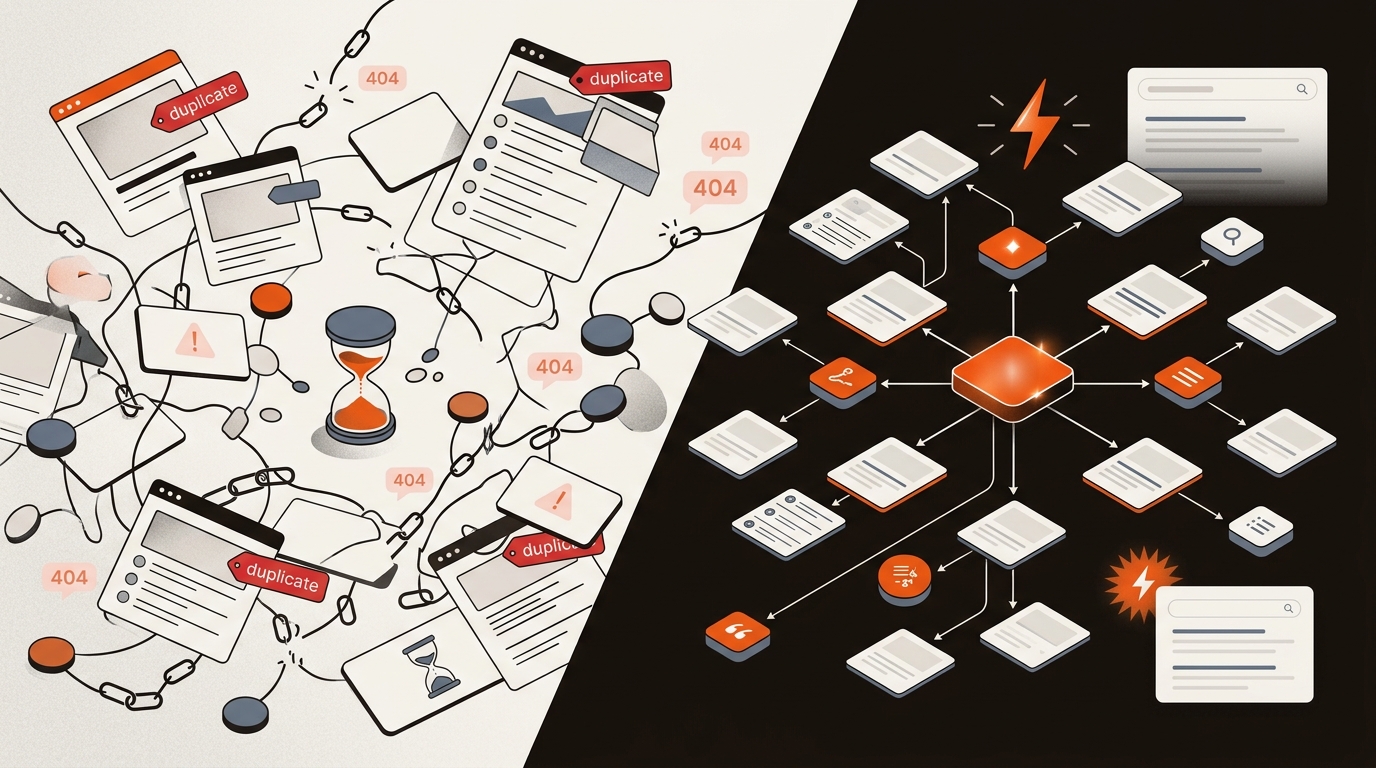
Bottom-of-funnel modifiers like "vs", "pricing", and "best for [ICP]" tend to attract readers who are closer to a buying decision than generic how-to queries.
Ship one cluster at a time, from money pages outwards, with a fixed weekly cadence. This is how to bring organic traffic to your website in weeks.
• Pick a parent job-to-be-done. In Ahrefs, group 30-60 keywords into 4-6 subtopics: money page, comparisons, alternatives, how-tos, and FAQs. Target KD <= 20 for your domain DR.
• Draft briefs. Define title, H2s, entities, FAQs, and internal link targets before generation. One article = one clear intent.
• Publish in batches of 10-15 URLs so Google can see the cluster. Interlink using exact anchors to money pages. Validate crawl with Screaming Frog.
• Add schema on day one: Article, FAQPage, Product where relevant. This supports GEO and increases AI Overview extractability.
• Measure in GSC weekly: index status, non-brand clicks, and queries by intent. Kill or merge pages that don’t get impressions by day 45.
This playbook also works to increase organic traffic in AI results. AI engines cite concise, structured answers with clear entities, consistent terminology, and FAQ blocks that map to user questions.
For deeper context, see What Are Your Top 3 Link Building Strategies.
Run a 30-minute audit: export 16 months of non-brand queries from Search Console, group by intent, and pick 10 problem and 10 buying terms for one ICP. Build a cluster: 1 pillar at 1,800 to 2,200 words, plus 4 support articles at 900 to 1,100 words each. Roles and time: research 3 hours, writer 6, editor 2, designer 2 visuals, dev 0.5 hour. On-page rules: title under 60 characters, H1 matches the primary query, first 100 words define the term, include a numbered workflow, 2 diagrams, 3 to 5 FAQ items, 3 internal links in and 5 out. Ship weekly, check impressions and query spread at weeks 2, 4, and 8.
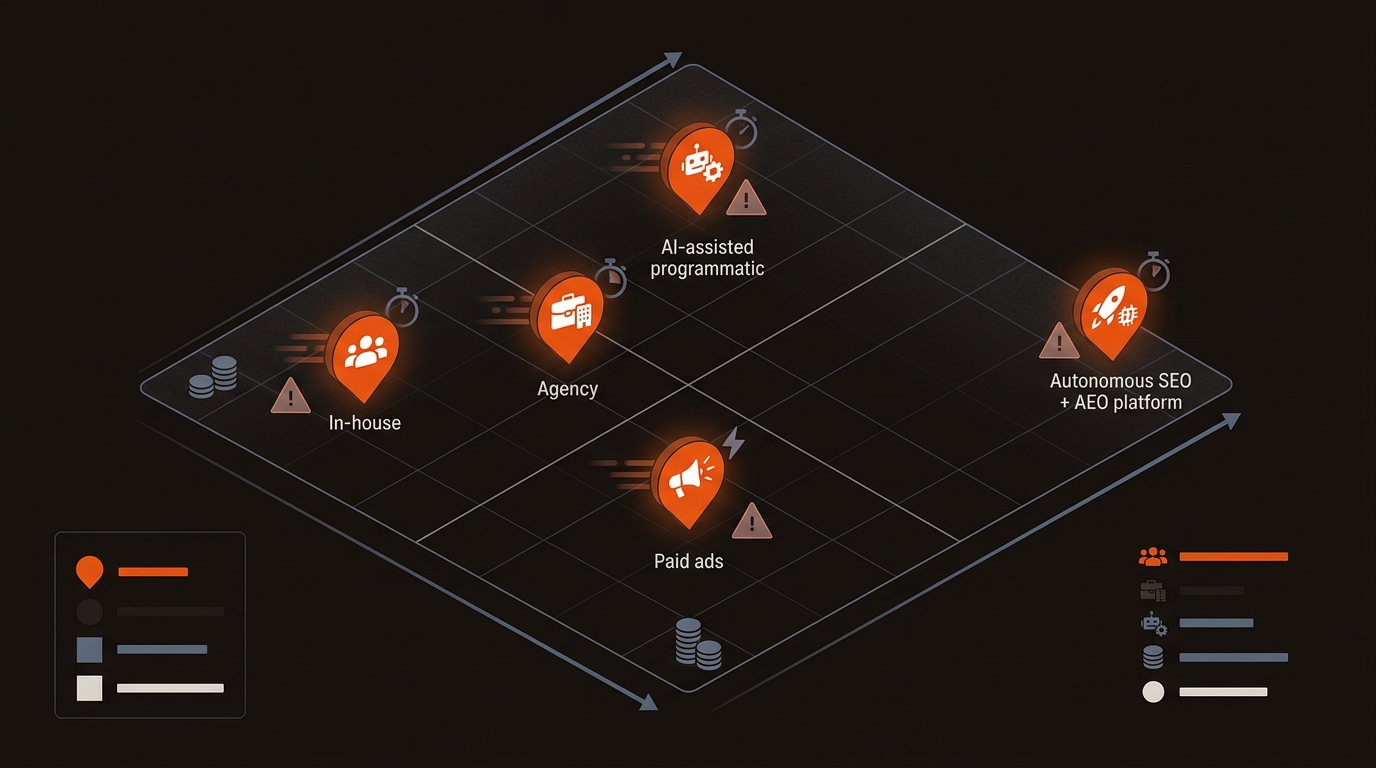
Choose approaches that fit your team’s constraints, speed to impact, and ability to scale. Mix two concurrently: one compounding engine and one spike tactic.
caption
| Approach | Speed To Impact | Resources Needed | Ranking Upside | Operational Risk | |---|---|---|---|---| | Intent-Based Topic Clusters | 4-8 weeks for first clicks | 1 strategist + 1 writer; Ahrefs + GSC | High compounding across 30-80 URLs | Requires strict internal linking and schema hygiene | | Programmatic SEO (Templates + Data) | 2-6 weeks if templates ready | Data source + dev/No-Code + CMS | Very high at scale (100-1,000 pages) | Thin content risk; indexing stalls >200 pages without links | | Product-Led Content (Use Cases, Comparisons) | 2-4 weeks | PMM + writer; customer language | Highest conversion; solid AI citations | Harder to outsource; needs product access | | Digital PR/Thought Capital | 6-12 weeks | Founder time + PR ops | Authority + links boost all clusters | Expensive per link; story fatigue | | Technical Cleanup (Crawl/Index/Site Speed) | 1-3 weeks | SEO + dev hours; Screaming Frog | Immediate lift to existing pages | One-off benefit; needs upkeep after changes |Pick plays by impact, maintenance, and conversion quality. Example profiles: Glossary hubs scale fast and yield broad top-funnel traffic. Comparison pages require careful claims review. Calculators take engineering time to build and some upkeep, and can earn links. Programmatic pages can ship 500 at once but risk thin content, crawl limits, and QA drag. Case studies convert highest but scale slowly.
AI engines cite pages that answer cleanly, structure clearly, and show topic authority. Build one page to answer, many pages to prove authority.
Focus on scannable sections, entity consistency (product names, ICP labels), and FAQ blocks that mirror high-volume questions. Use schema and tight internal links so AI models can summarize confidently and credit your domain across AI Overviews, ChatGPT, and Perplexity.
Mergeflo turns the above into a weekly plan, drafts articles for your review, and publishes the ones you approve to Webflow. The autonomous SEO + AEO content engine finds gaps, drafts articles with FAQ schema and suggested internal links, and publishes the ones you approve to Webflow. On paid plans it also checks whether ChatGPT, Gemini and Claude cite your brand.
There is no fixed timeline. A new cluster needs time to be crawled and indexed before it earns impressions, and clicks follow after that. Speed depends on competition, batch size, internal links, and whether the site already has a crawlable sitemap and clean schema.
You can win low-KD clusters without net-new links if internal links are strong and intent is tight. For tougher terms or large programmatic sets, a few relevant links to your hub pages help Google find and trust them. Use a backlink tool such as Ahrefs to find hubs with few links before you scale.
Publish at a pace you can keep up without cutting quality. There is no proven ideal batch size, and a steady weekly flow is easier to sustain than sporadic drops. If quality dips, slow down; thin pages drag the whole cluster.
Answer the question in 2-3 sentences up top, add a concise checklist or steps, and include an FAQ with 3-5 Q&As. Use FAQPage schema and consistent entities. Keep paragraphs short. Short, direct answers are easier for AI features to quote than long intros. Track citations and refine phrasing that AI actually quotes.
