
Modern SEO moves when a governed workflow ships work every week; feature checklists alone do not move a pipeline. SEO automation tools promise speed, but most teams stall on integration, review, and handoff. Design the pipeline first, then pick the tools that snap into it. Build a line that runs crawl, triage, brief, draft, review, publish, and monitor.
You will map automation to the work you already do: crawl, triage, brief, optimize, publish, and monitor. Keep human sign-offs where judgment lives and automate the boring parts. Treat each handoff like production. Only AI-citable content; no manual code or CMS integration templates needed.

AI SEO agents vs SEO automation
Founder-led teams, lean marketing squads, and technical co-founders need a dependable cadence without hiring an agency. If you want an operating plan you can run inside your CMS and analytics stack, this is for you. The result is a workflow you can explain, audit, and improve without pausing publishing.
You will connect tools you already use: a crawler, Google Search Console, your CMS, and a writing stack. Add governance and a small set of checks. Keep the pipeline visible so anyone on the team can step in and move work forward.
Start where repetition hides time: crawling, indexation checks, and on-page optimization prompts. Wire a crawler to flag broken links, orphan pages, and "crawled but not indexed" states, then push issues into your tracker. Connect Search Console to your brief template so queries and URLs prefill before writing.
Use an optimizer to suggest headings, semantically related terms, and internal links before editorial review. This trims manual checks and focuses editors on angle and clarity. You can borrow task ideas from common automation playbooks without copying their tooling choices.
Automate outputs that do not require judgment: lists of candidate links, missing alt attributes, pages with thin internal links, or titles over your line length. Keep judgmental calls manual: intent, product position, and what stays out of scope. Put these into your brief so writers do not guess.
Automation without governance creates mess; add explicit human sign-offs at risky steps. Drafts should only start from a brief. Schema changes should only go live after a review. Publishing should only happen behind a gate that re-validates indexability, schema, and internal links.
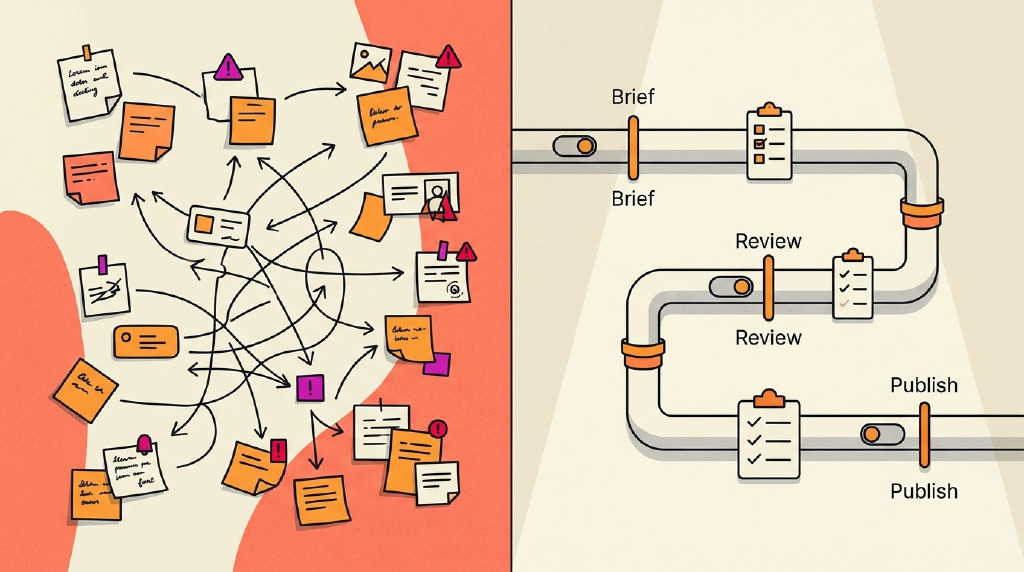
Use a visual builder or an orchestration layer that supports handoffs between tools, data stores, and your CMS. A good model chains fetch, transform, and approve, as shown in workflow-based automation. The goal is predictable movement.
Define owners for each gate. Editors own angle and accuracy. Engineers own templates, redirects, and schema integrity. Marketers own internal link placement and the final URL path. Keep the gate simple: a checklist, the key diffs, and a one-click approve or send-back.
Automate discovery and clustering; keep intent judgment and angle selection human. Use automation to explore how to find profitable keywords with low competition and how to find low competition long tail keywords, then select terms that match what is the funnel for SAAS. Assign funnel stage so the piece earns the right CTA and measurement.
Push chosen terms into a brief that enforces what is structured data in SEO and how to add schema markup to HTML. Include target questions, internal links to prioritize, outbound expert cites, and a short outline. Make "out-of-scope" explicit to block scope creep.
Treat the pipeline like production: small, governed changes beat big monthly pushes.
Best AI SEO tools for startups can inform categories to evaluate. Design first; buy second.
Unpublished drafts and misaligned posts drain runway because they do not compound. SEO automation tools reduce toil on crawl checks, query pulls, and optimizer passes so you can protect a weekly rhythm. A governed pipeline also catches "crawled but not indexed" and "discovered currently not indexed" issues before they spread. Next, you will add gates and guardrails.
Most guides list features and skip who approves what and when automation should stop. Agency blogs describe tools and ignore the reality of a tiny team that needs weekly routines and safe defaults. This article lays out a minimum viable pipeline, the governance points, and the exact artifacts needed to keep it shippable.
This guide's framework, the Gate-and-Guardrail Framework, defines where automation runs and where humans decide. Gates are required approvals before risky actions like publishing, redirects, or schema changes. Guardrails are constraints such as allowed templates, internal link ranges, canonical rules, and source-of-truth fields in your CMS.
Apply it by scripting data pulls, clustering, and draft scaffolds under guardrails, then pausing at gates for editor or engineer review. The tradeoff is clear: more gates slow throughput while fewer guardrails invite drift and rework. Failure modes include stale guardrails, empty gates with no assigned owner, and silent errors from vendor API changes.
Review gates weekly and re-test guardrails anytime your CMS or schema evolves. Keep the checklist short and unskippable. The framework works because it removes ambiguity while keeping judgment with people.
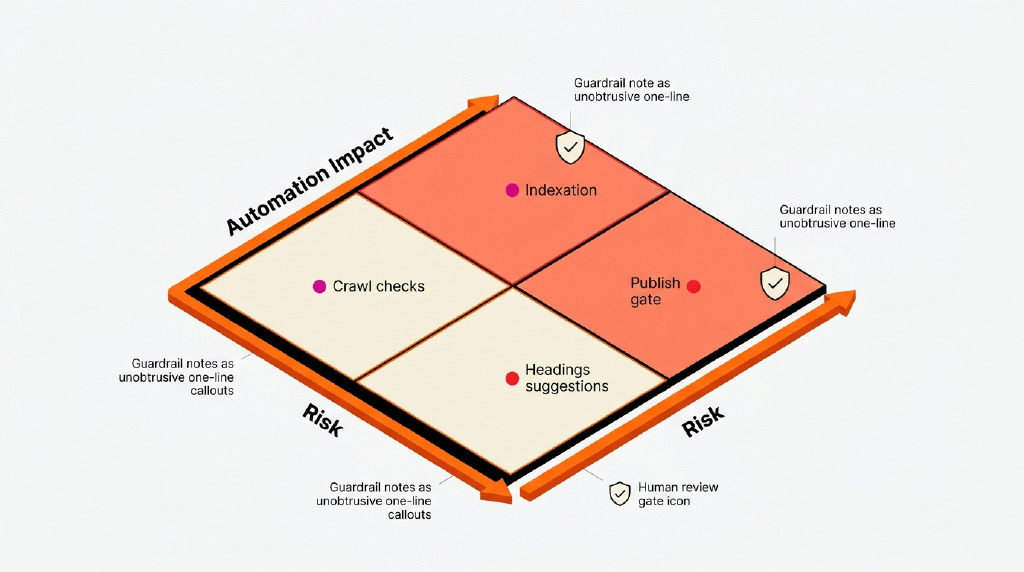
Automate detection; human-fix the cause. Queue fixes for how to fix crawl errors in Google Search Console and how to fix discovered currently not indexed based on crawler outputs. Automate the triage: label by cause, assign an owner, and link the evidence. Keep changes gated: redirects, templates, and robots rules need eyes.
Generate structured data blocks aligned to how to create topical authority, then run a validator before the review gate. For indexation triage, track why is my Google Search Console page not indexed alongside "crawled but not indexed" flags. Route thin content to a new brief and cannibalizing posts to an internal link update.
Example: a founder and a growth lead run Webflow, a crawler, and Search Console. The crawler posts issues to a board; Search Console data auto-fills briefs; a draft assistant proposes headings and links; an editor gate approves; Webflow publishes. This small loop runs weekly without heroics and expands only after it's stable.
Practical AI agents for SEO illustrate how multi-step chains can run safely with checkpoints. Use checkpoints; skip fully autonomous changes on live templates.
| SEO Task | Tool Category | Governance Needed | Common Failure Mode |
|---|---|---|---|
| Site Crawl and Audits | Crawler or site auditor | Guardrail: scope; Gate: ticket creation | Flood of low-value issues |
| Query Mining | Analytics connector + keyword explorer | Guardrail: filters; Gate: term selection | Chasing irrelevant intent |
| Brief Generation | Template engine + LLM writer | Guardrail: schema and links; Gate: editor sign-off | Off-angle drafts |
| On-Page Optimization | Optimizer + internal link suggester | Guardrail: link range; Gate: editor | Over-optimized headings |
| Schema Injection | CMS schema manager | Guardrail: types allowed; Gate: engineer | Invalid markup |
| Publish and Monitor | CMS + analytics checks | Guardrail: checklist; Gate: approver | Indexation gaps unnoticed |
See the pipeline's time math so you ship consistently. Say you publish 8 posts a month at 2 hours to brief each, so briefing takes 8 x 2 = 16 hours. Suppose each draft takes 3 hours with an optimizer assisting, so drafting takes 8 x 3 = 24 hours. Say your editor reviews at 1 hour per post, so reviews take 8 x 1 = 8 hours. Suppose your technical checks and schema take 0.5 hours per post, so checks take 8 x 0.5 = 4 hours. Add the steps: 16 + 24 + 8 + 4 = 52 hours. Say you automate query pulls and brief scaffolds to cut briefing to 1 hour each, so the new briefing time is 8 x 1 = 8 hours. Add the updated steps: 8 + 24 + 8 + 4 = 44 hours.
Install guardrails first, then turn on automations. Define acceptable schema types, internal link ranges, and title formats inside your CMS. Require an approval gate for publish and for any sitewide change such as templates, redirects, and robots rules. Keep the checklist short enough that people use it every time.
Set monitors for why does most content get no traffic from Google by watching intent mismatch in queries and thin-link clusters. Add a rule for anchor text variety and context fit, not just counts. Document how often should a startup publish blog posts so cadence anchors the stack and prevents batch-and-blast.
The operational tradeoff is speed against depth. Many thin articles lose to fewer, thorough pages that answer intent and earn internal links. Your guardrails should bias for depth where it matters and push short formats only for clear long-tail questions.
AI SEO agents vs SEO automation
Best AI SEO tools for startups 2026
Platforms vs tools for startups
Mergeflo is an AI search visibility platform for startups seeking to rank on Google and earn AI citations. Mergeflo helps teams automate briefs, structure, publishing, and citation tracking inside a governed workflow.
Set a crawler to flag patterns and pair it with Search Console exports, then route items to a triage board. Automate the checks, cannibalization needs internal link updates, and blocked resources need engineering. Use a publish gate to re-validate indexability, schema, and internal links before anything goes live.
Start with a weekly crawl, a brief template, and an optimizer pass before review. Connect analytics to auto-fill query data into briefs so writers stop copying and pasting. Only after these three run smoothly should you automate schema generation or publishing. Keep human gates for risky steps such as templates, redirects, and robots rules.
It can prepare content to be cited by enforcing structure, source clarity, and internal linking. Add monitors to check which surfaces mention you and which queries surface your brand. The stack should track answer engine optimization signals and push briefs toward citable, concise sections with clear headings and a sources block.
Set a cadence you can keep without skipping review gates. Many teams ship on a weekly rhythm when briefs, drafts, and checks are templated, but quality guardrails come first. The goal is consistent movement through crawl, brief, draft, review, publish, and monitor.
