
Short answer: The 10 key keywords related to digital marketing are: affiliate marketing, social media marketing, marketing strategy, email marketing, search engine optimization (SEO), content marketing, pay-per-click (PPC) advertising, online advertising, digital advertising, and digital marketing strategy. Use these 10 key keywords related to digital marketing as head terms to seed intent-aligned clusters that rank and convert.
Treat the ten as a working set that feeds pipeline. For example, take 'marketing automation' and assume volume 18k, keyword difficulty 62, CPC 14. That signals high research intent and cost, so plan a comparison guide, a build vs buy checklist, and a simple ROI calculator. 'Customer acquisition cost' with, say, 7k volume and KD 48 converts well with a formula page plus a downloadable worksheet. 'Content calendar template' at, say, 22k volume and KD 41 can fuel freemium signup via an ungated template and a gated bundle. For each term, tag intent, map funnel stage, and assign one measurable conversion.
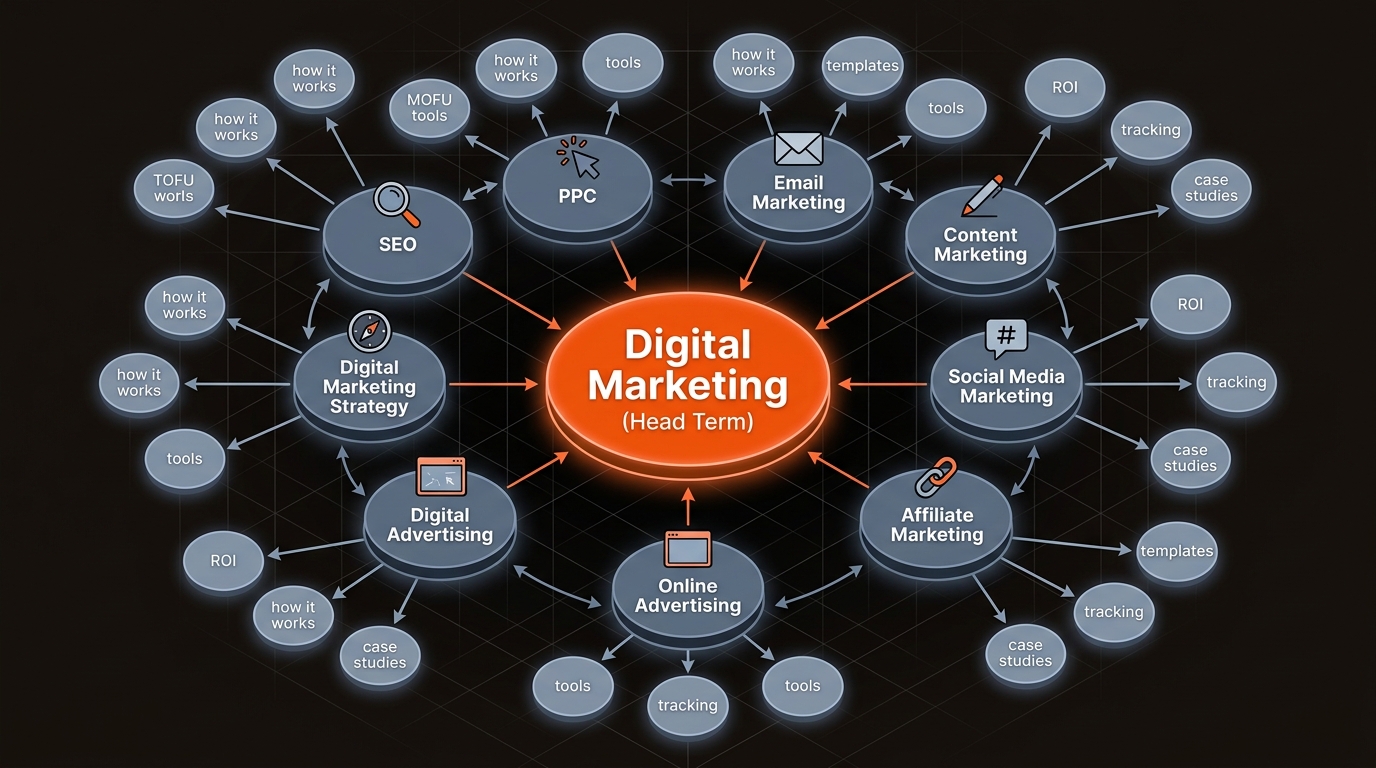
Head terms only drive rankings when each becomes a tightly themed cluster with intent-mapped pages and internal links. Teams publish one-offs for SEO or email marketing and stall because they ignore subtopics, schema, and link architecture. Map each head term to 6-12 support pages that satisfy TOFU/MOFU/BOFU intent, and ship them in weeks.
Affiliate marketing shows ~135,000 global monthly searches (WordStream sample), but teams miss when they chase raw volume without matching search intent or difficulty.
A typical 3-person growth team with a $2k/mo content budget and DR 25 will not move a high-KD head term with 2 posts. Use Ahrefs or SEMrush to confirm KD and SERP features, then scope clusters accordingly. Track by cluster in GSC using page-group tags and compare CTR and position weekly. The tradeoff: depth vs. speed. Thin clusters index faster but rarely crack page one.
External sources: WordStream, Ahrefs on Keyword Difficulty
Head terms look big but burn cash when isolated. Assume a 10,000 dollar test on 'digital marketing' at 12 dollar CPC and 1 percent landing page conversion. You buy about 833 clicks and 8 leads, so cost per lead is about 1,250 dollars. Now cluster around a mid intent hub like 'B2B content strategy' with ten long tails at 4 dollar CPC and 2.5 percent conversion. The same budget yields about 2,500 clicks and 62 leads, roughly 161 dollars per lead. Clusters also compound organic wins through internal links and broader query coverage.
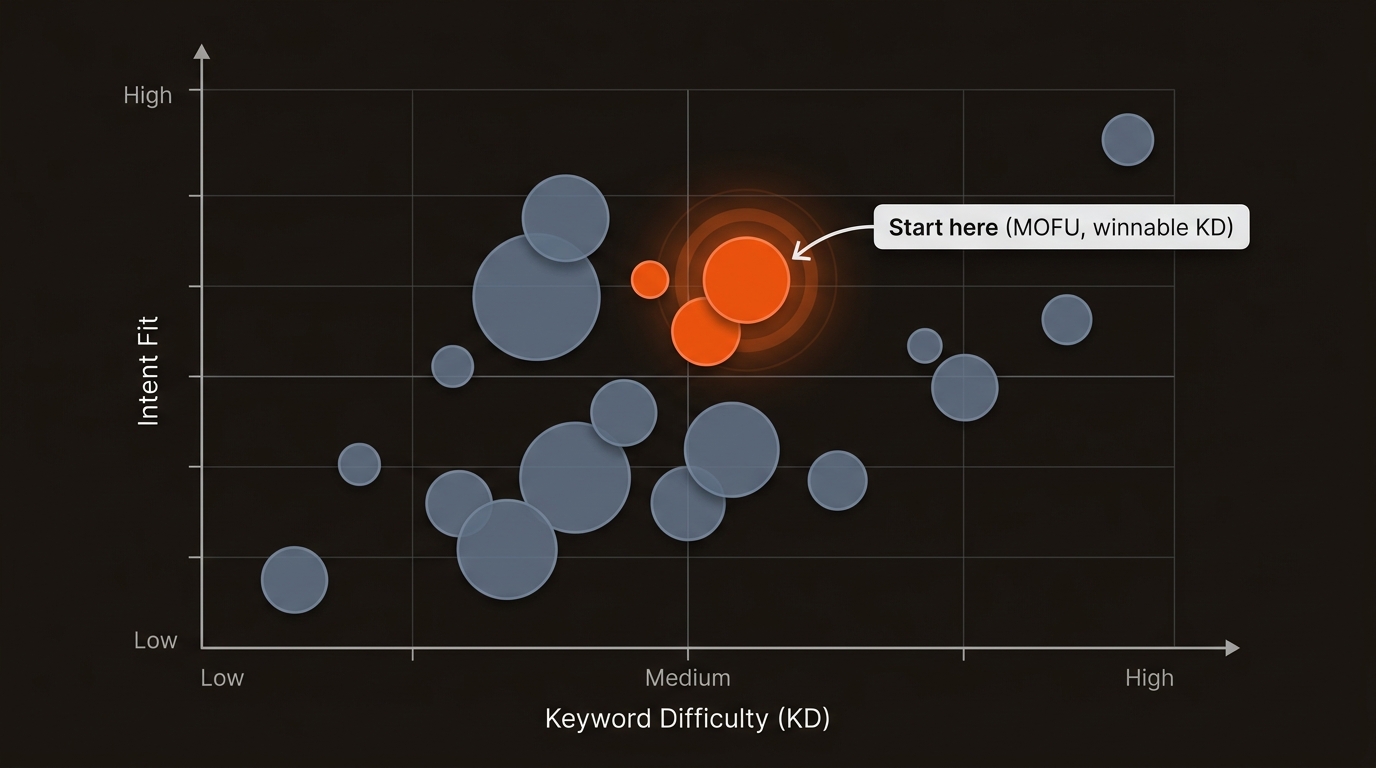
Prioritize the head term where dominant intent matches your product and KD is winnable inside 90 days. For a lean B2B SAAS, start by owning MOFU queries (workflows, templates, comparisons) that capture trials, then ladder internal links up to the head term with FAQ/HowTo schema on support pages.
caption
For a Series A SAAS with DR 28 publishing 12 posts/month, we’ve seen faster traction by starting with email marketing and PPC advertising clusters, then pointing internal links to the digital marketing strategy hub. Add FAQ schema on support pages, interlink with descriptive anchors, and monitor page-group impressions/CTR in GSC weekly to cut cannibalization early.
For deeper context, see Can I Use Chatgpt For Keyword Research.
Prioritize with a simple weighted score so you are not chasing volume. Use six factors on a 0 to 5 scale: ICP fit 30 percent, commercial intent 25 percent, competitive gap 15 percent, internal authority 10 percent, SERP favorability 10 percent, content effort inverse 10 percent. Example: 'marketing automation platforms' scores 4.5, 4, 2, 3, 3, 2.5 for a 3.5 composite. 'content calendar template' scores 3, 3.5, 4, 4, 4, 4 for a 3.6 composite. 'customer acquisition cost' scores 4, 4.5, 3, 3.5, 3.5, 3 for a 3.8 composite. Start with CAC, then template, then platforms.
You win by producing clusters that rank on Google and get cited in AI answers, then maintaining them automatically. Mergeflo’s Autonomous SEO + AEO content engine does research to published, AI-citable pages in your CMS, with schema, internal links, and ongoing refresh. It measures and fixes visibility across Google and AI Overviews using startup-priced plans. If you want to pressure-test prompts and sourcing, see our take in How Do I Find Competitor Keywords.
Turn the chosen keyword into a shippable, AI-citable cluster in two weeks. Ship one cornerstone that defines the entity, includes a numbered TLDR with 5 to 7 claims, and a plain language glossary. Add three supporting explainers and two practical assets like a template and a calculator. Use schema.org Article, FAQ, and HowTo where appropriate. Give every claim an anchor ID and a table that states inputs and outputs. Cross link top down and laterally. Keep stable slugs and dates. Publish a sources section that cites your own data and primary standards so AI can attribute confidently.
Ship fast by aligning intent, KD, and internal links.
Pick the term where your product fits the dominant intent and KD is <= your domain’s ceiling. In Ahrefs, compare KD and top-10 DR to your DR; if you’re 15+ DR points lower than the median, start with a medium-KD term like email marketing or online advertising and build topical authority first.
Plan 6-12 support pages: definitions, comparisons, workflows, templates, and FAQs. Ship 3 per week for a month, then add internal links and schema. This cadence gives Google a coherent cluster to crawl and rank and gives you enough data in GSC to prune overlaps by week 6.
In GSC, tag pages by cluster, then track impressions, CTR, and average position by page-group. Add Ahrefs Top pages and a rank tracker by folder. Aim for week-4 impressions, week-6 clicks, and first page entries by weeks 8-10 when KD and DR are scoped correctly.
Indexing lag and cannibalization creep at >100 pages. Solve with tight URL taxonomy, one head term per folder, and descriptive internal anchors. Expect more maintenance budget: refresh decaying URLs quarterly with new stats, FAQs, and links to newly published support pieces to sustain rankings and AI citations.
