
Short answer: The best tools for answer engine optimization pair AI citation tracking with execution. Use Ahrefs and Semrush to monitor brand inclusion in AI answers and question volatility, add a diagnostic like HubSpot's AEO Grader or Scrunch, and use Mergeflo to draft articles with FAQ schema and suggested internal links for your review. Speed and coverage win.
Buying tools without a measurement-to-publishing loop leaves you invisible in AI answers. Most teams track positions. They audit schema once, then stop. And they never connect question demand to a publishing pipeline in their CMS.
A small growth team needs two things: validation that the brand shows up in AI Overviews and LLM answers, and a way to ship AEO-ready pages weekly. Without both, you chase volatility and stall with posts that do not rank or get cited.
Operational tradeoff: pure trackers help you pick questions, but output stalls if briefs do not become pages inside your CMS within the same sprint. Tie diagnostics to publishing or lose the window when answers reshuffle.

Misses show up when teams lack a maintained question inventory and an offline test set. Without 50 to 100 high value intents and 5 to 10 gold answers per intent, you cannot grade coverage, grounding, or freshness. Logs live in silos: GSC, site search, chat, support. No one joins them, so obvious gaps like 'refund timing' or 'change seating' stay invisible. Markup is inconsistent: product attributes exist in copy but not in JSON-LD, or entity IDs vary across pages, which breaks consolidation. Content updates land, but no SLA exists for structured data or sitemap pings, so answer engines keep serving stale snippets.
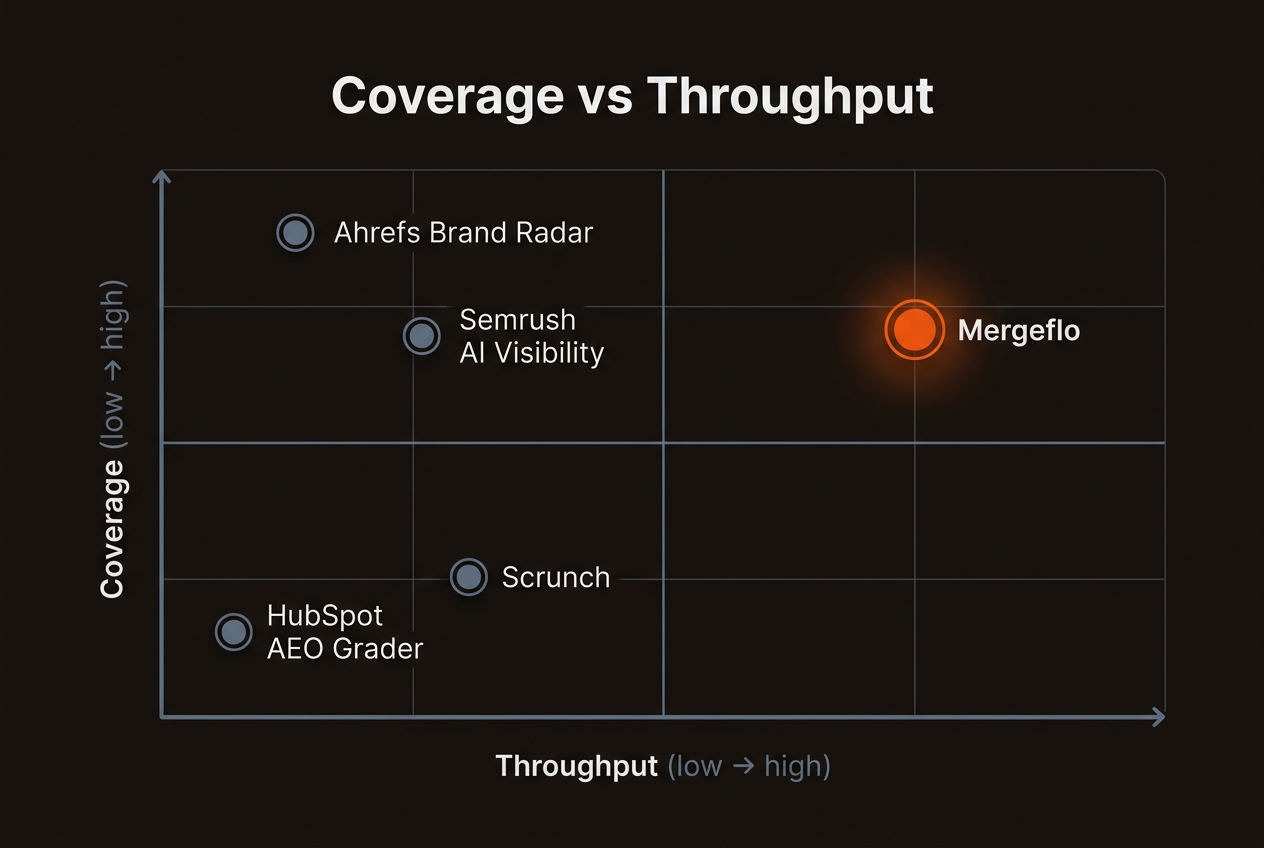
Evaluate tools by coverage (citations, questions, geos), diagnostics (answer-readiness), and throughput (pages shipped). For what are the best tools for answer engine optimization, you need one view of brand citations across AI engines, a fast diagnostic, and an execution engine that publishes fixes into your site.
Use suites like Ahrefs and Semrush to discover volatile questions and confirm inclusion. AEO-native entrants surface answer-readiness gaps. An execution engine converts those signals into AI-citable pages with schema and internal links that can win citations.
Comparison: AEO Tool Coverage vs Execution Throughput
Discovery: combine GSC queries, People Also Ask via a scraper or SerpAPI, internal site search, and support macros. Structuring: crawl with Screaming Frog, fix headings, add FAQ and HowTo schema, validate in Rich Results Test and the Schema.org validator. Grounding: maintain a canonical data layer in a CMS or knowledge store, and add a vector index for internal retrieval. Generation: pick an LLM with citations and a function calling path. Evaluation: run a nightly 100 question set to score answerability, factuality, and latency. Monitoring: push runs to BigQuery or Snowflake. Tradeoffs include API quotas, token cost, and lock in. Prefer JSON-LD and OpenAPI, and keep pgvector as an escape hatch.
Turn insights into a weekly plan of drafts you review and publish to Webflow. Mergeflo is an AI search visibility platform for startups. It tracks Google search and, on paid plans, AI answers from ChatGPT, Gemini and Claude. It has a free plan, and paid plans are listed on the pricing page.
Use suites for monitoring and questions. Mergeflo then finds your own gaps and buyer questions and drafts articles for your review. Its autonomous SEO + AEO content engine finds gaps, drafts articles with FAQ schema and suggested internal links, and publishes the ones you approve to Webflow. It closes the loop that pure trackers cannot. For more on choosing tools, see our guide to AEO tool coverage, throughput, and wins.
Prove impact with a bounded test, demand daily coverage, and wire audits to publishing.
Run a 6-week test on 25 target questions. Track brand or URL inclusion in AI answers weekly, and watch GSC for AI Overview clicks where present. Publish 2-3 AEO-ready pages per week. Success is higher citation frequency plus incremental non-branded clicks tied to the new pages.
At minimum: US plus your top buyer GEO, desktop and mobile, and the ability to re-check questions daily. Ask for corpus size, refresh cadence, and how brand or URL inclusion is detected vs paraphrases. Validate with a 20-question side-by-side sample before committing budget.
Diagnostics flag answer gaps like missing FAQ blocks, thin definitions, or absent schema. Execution means shipping a page that fixes those gaps with internal links and structured data. Connect audits to a CMS-ready pipeline so briefs become pages in one sprint.
Week 1: wire tracking and run diagnostics. Weeks 2-3: ship 4-6 AEO-ready pages. Citations come on each engine's schedule, so track them weekly instead of expecting a date. Stabilize the brief-to-publish pipeline, then scale and refresh winners to hold citations.
