
Short answer: The top 3 website performance metrics to monitor are Largest Contentful Paint (LCP), Interaction to Next Paint (INP), and Cumulative Layout Shift (CLS). Track p75 by device and template with field data. Target LCP ≤ 2.5 s, INP ≤ 200 ms, and CLS ≤ 0.10, using CrUX/GSC for truth and synthetic tests for diagnosis.
Teams fail when they treat Lighthouse as the KPI instead of field p75 by device and template. Lab runs guide debugging; they do not reflect real-user distributions where Google evaluates Core Web Vitals.
A common miss on INP appears after hydration. Heavy client-side JS, analytics beacons, and chat widgets create long tasks that delay the next paint. On CLS, un-sized images, late-loading fonts, and dynamic ad slots push content mid-read. Fixes require template-level budgets, RUM, and release gates wired to thresholds.
INP evaluates the latency of all interactions in a visit, not just the first. It replaced FID in 2024 as the responsiveness KPI.
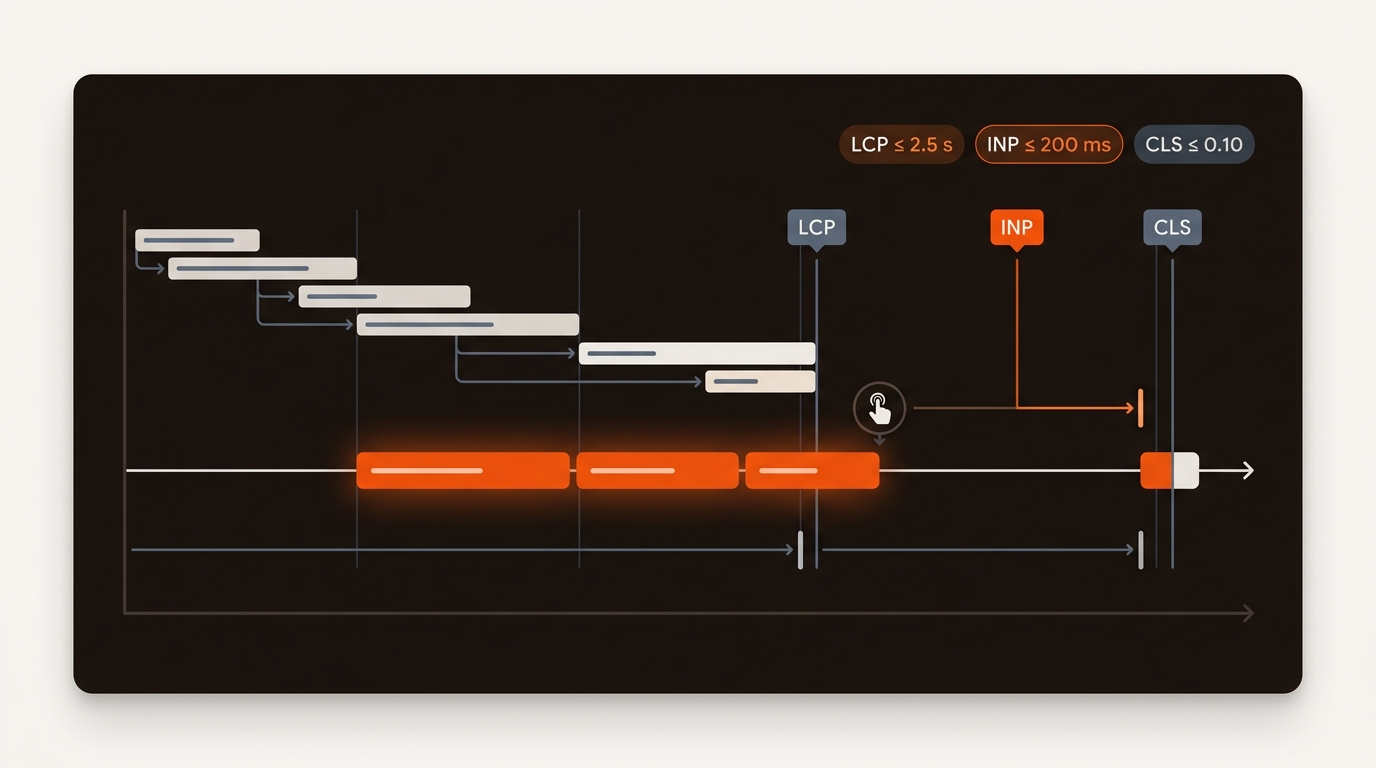
For a 3-person growth team shipping 15 pages/month, the tradeoff is speed vs stability. Adding a new widget may help demos, but a +150 ms INP regression on Pricing can drop conversions and rankings for competitive terms within a month.
External references: Core Web Vitals overview, Chrome UX Report (CrUX)
Use LCP/INP/CLS as your p75 KPIs; use TTFB/TBT as diagnostics to find causes. This keeps you focused on user-perceived speed while tracing root causes in server and JS.
caption
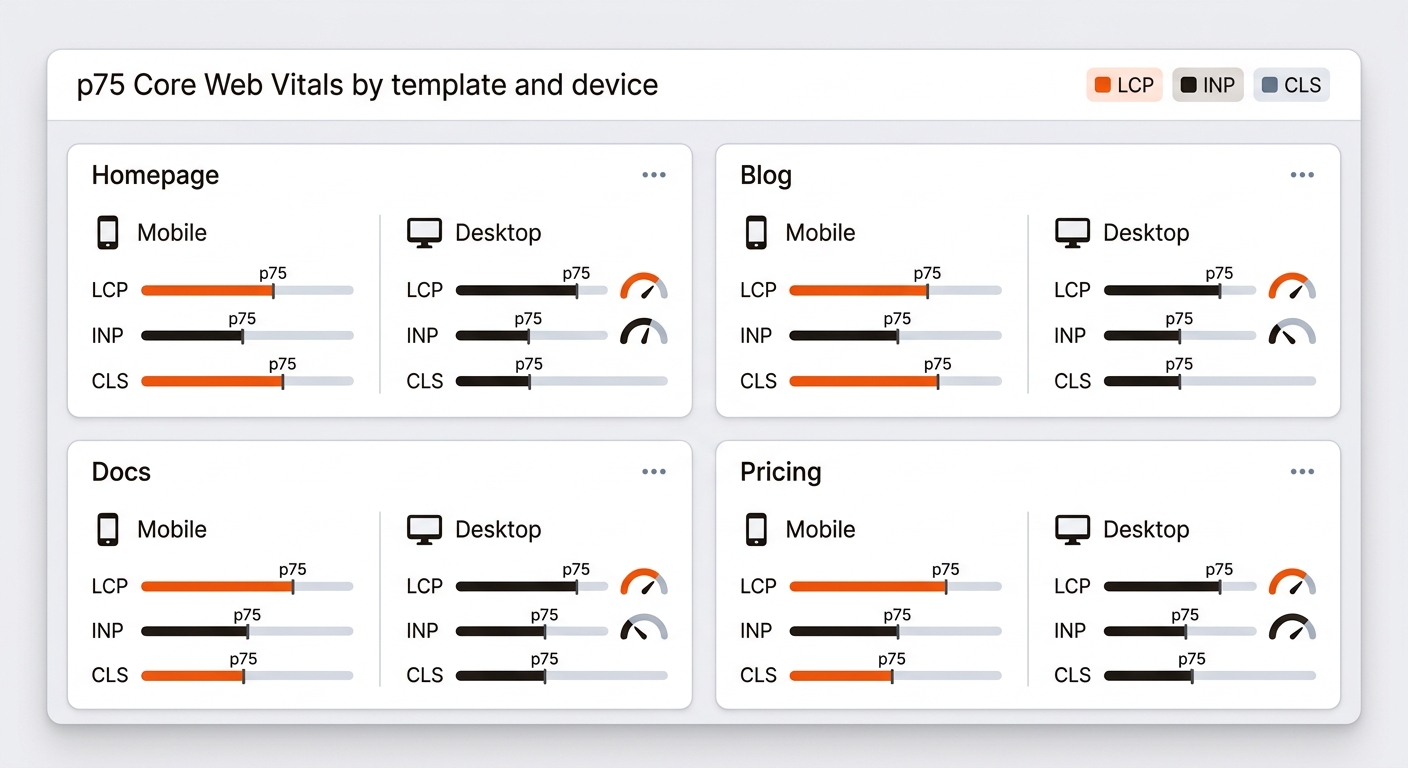
Operator note: Monitor the top 3 website performance metrics to monitor by template. Homepage and Pricing usually carry the most revenue risk; Blog and Docs drive long-tail rankings and internal link equity. Segmenting avoids chasing noise from one-off pages.
For deeper context, see What Are The Three Core Web Vitals.
Tie Web Vitals to templates and CI gates so regressions never reach production. Group pages into Homepage, Pricing, Blog Post, and Docs. Set device-specific budgets: LCP ≤ 2.5 s (mobile), INP ≤ 200 ms (mobile), CLS ≤ 0.10 (mobile/desktop). Use a RUM SDK (e.g., Sentry, SpeedCurve) to capture real-user distributions.
Add a CI check: fail builds that increase TBT by >50 ms or add >75 KB JS on marketing templates. Add release dashboards for template rollups and p75 deltas week-over-week. Validate field impact monthly in GSC’s Core Web Vitals and CrUX. When p75 slips, route fixes: image sizing and preload for LCP, long-task splitting and script deferral for INP, slot reservations and font metrics override for CLS.
Mergeflo’s Autonomous SEO + AEO content engine ships AI-citable pages with schema, internal links, and ongoing refresh. It measures and fixes visibility across Google and AI engines, then routes work to the highest-ROI templates. If you need a primer on the KPIs themselves, read our sibling post: How To Pass Core Web Vitals Assessment.
Mergeflo connects Web Vitals to rankings and AI citations inside one workflow. Our autonomous engine researches, drafts, and publishes AI-citable pages in your CMS with schema and internal links, monitors p75 LCP/INP/CLS by template, and pushes code-ready fixes. You get Google and AI visibility at startup pricing without hiring an agency.
Field data is the KPI; wire budgets, gates, and weekly reviews so you can act Monday.
Track real-user p75 for LCP/INP/CLS as your KPI, segmented by device and template. Use lab (Lighthouse/WebPageTest) to reproduce and isolate regressions. Pair CrUX or RUM for truth with synthetic tests for diagnosis. Both matter, but only field data maps to how Google evaluates and how users feel speed.
Weekly for template rollups, daily for alerts on regressions >10% at p75. Add a release gate in CI: fail builds that increase TBT by >50 ms or add >75 KB JS. Review CrUX monthly to validate field impact and seasonality, then refresh fixes if p75 slips.
Core Web Vitals influence visibility as part of page experience signals and can act as a tiebreaker among similar pages. They also improve crawl efficiency, reduce bounce, and raise conversion. Treat them as necessary hygiene for competitive queries and durable traffic.
Compress and properly size hero images; preload the LCP resource; self-host fonts with metrics override to curb CLS; defer analytics/trackers; and split app bundles from marketing pages. For INP, break long tasks >50 ms and reduce hydration with partial or islands rendering.
